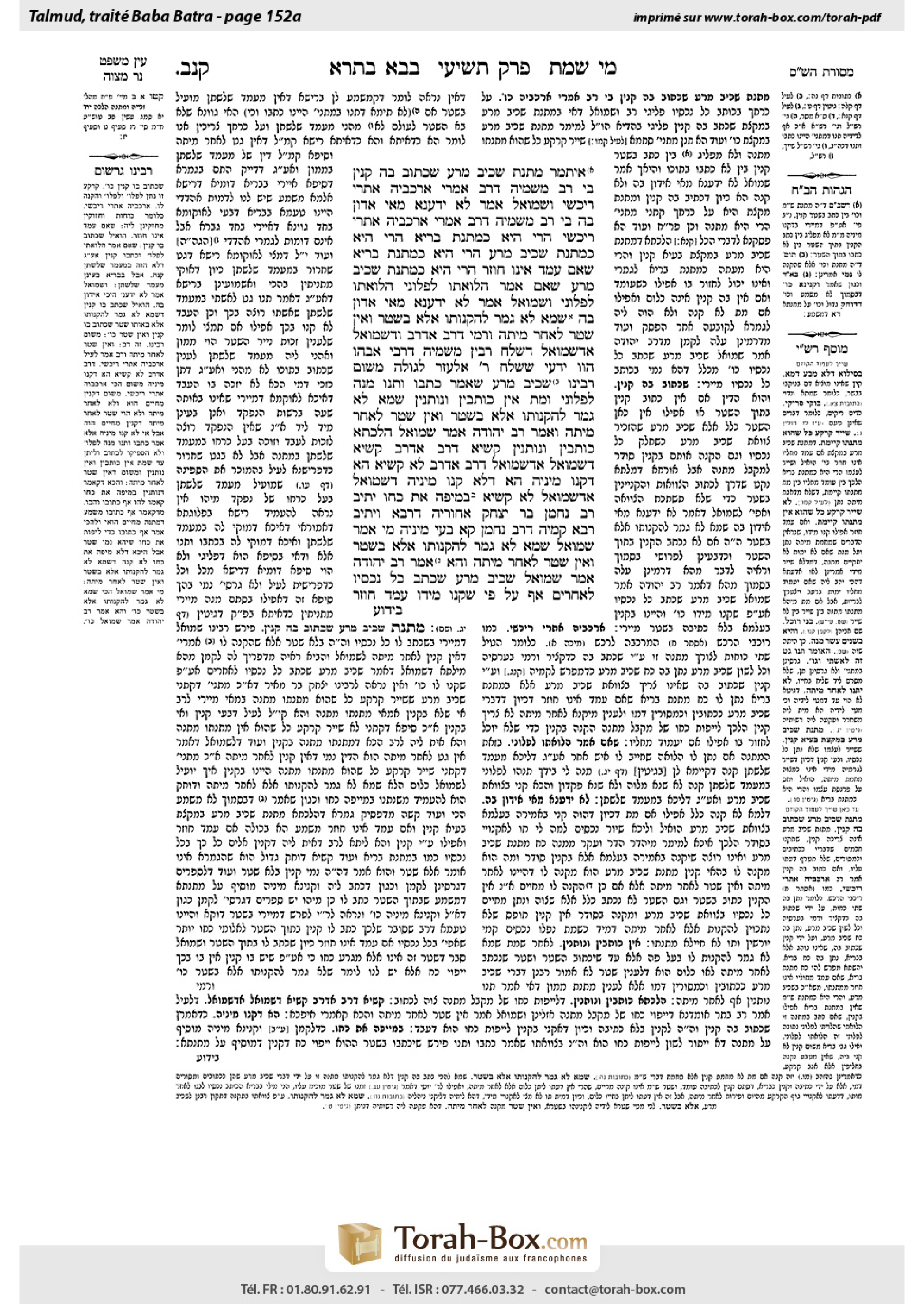
Bava Batra 152a: Talmud study for Daf Yomi
Study the Talmud for Daf Yomi with scanned pages, Hebrew text, English translations from Sefaria and AI-generated French translations.
Passage selection and English or AI-generated French translation are available where the scan has annotations. Daf Study is independent of Torah-Box and Sefaria.
Browse Bava Batra · בבא בתרא · All tractatesBava Batra 152a text and translations
This page of Bava Batra includes the Aramaic text, an English translation and an AI-generated French translation, alongside the scan above.
בבא בתרא קנ״ב א · Aramaic and Hebrew text
אִיתְּמַר: מַתְּנַת שְׁכִיב מְרַע שֶׁכָּתוּב בָּהּ קִנְיָן – בֵּי רַב מִשְּׁמֵיהּ דְּרַב אָמְרִי: אַרְכְּבֵיהּ אַתְּרֵי רִיכְשֵׁי. וּשְׁמוּאֵל אָמַר: לָא יָדַעְנָא מַאי אֵדוּן בַּהּ.
בֵּי רַב מִשְּׁמֵיהּ דְּרַב אָמְרִי: אַרְכְּבֵיהּ אַתְּרֵי רִיכְשֵׁי – הֲרֵי הִיא כְּמַתְּנַת בָּרִיא, הֲרֵי הִיא כְּמַתְּנַת שְׁכִיב מְרַע; הֲרֵי הִיא כְּמַתְּנַת בָּרִיא – שֶׁאִם עָמַד אֵינוֹ חוֹזֵר, הֲרֵי הִיא כְּמַתְּנַת שְׁכִיב מְרַע – שֶׁאִם אָמַר הַלְוָאָתוֹ לִפְלוֹנִי, הַלְוָאָתוֹ לִפְלוֹנִי.
וּשְׁמוּאֵל אָמַר: לָא יָדַעְנָא מַאי אֵדוּן בַּהּ – שֶׁמָּא לֹא גָּמַר לְהַקְנוֹתוֹ אֶלָּא בִּשְׁטָר, וְאֵין שְׁטָר לְאַחַר מִיתָה.
וּרְמִי דְּרַב אַדְּרַב, וְדִשְׁמוּאֵל אַדִּשְׁמוּאֵל – דִּשְׁלַח רָבִין מִשְּׁמֵיהּ דְּרַבִּי אֲבָהוּ: הֱווֹ יָדְעִי שֶׁשָּׁלַח רַבִּי אֶלְעָזָר לַגּוֹלָה מִשּׁוּם רַבֵּינוּ, שְׁכִיב מְרַע שֶׁאָמַר: ״כִּתְבוּ וּתְנוּ מָנֶה לִפְלוֹנִי״, וּמֵת – אֵין כּוֹתְבִין וְנוֹתְנִין; שֶׁמָּא לֹא גָּמַר לְהַקְנוֹתוֹ אֶלָּא בִּשְׁטָר, וְאֵין שְׁטָר לְאַחַר מִיתָה. וְאָמַר רַב יְהוּדָה אָמַר שְׁמוּאֵל, הִלְכְתָא: כּוֹתְבִין וְנוֹתְנִין.
קַשְׁיָא דְּרַב אַדְּרַב, קַשְׁיָא דִּשְׁמוּאֵל אַדִּשְׁמוּאֵל!
דְּרַב אַדְּרַב לָא קַשְׁיָא – הָא דִּקְנוֹ מִינֵּיהּ, הָא דְּלָא קְנוֹ מִינֵּיהּ. דִּשְׁמוּאֵל אַדִּשְׁמוּאֵל לָא קַשְׁיָא – בִּמְיַפֶּה אֶת כֹּחוֹ.
יָתֵיב רַב נַחְמָן בַּר יִצְחָק אֲחוֹרֵיהּ דְּרָבָא, וְיָתֵיב רָבָא קַמֵּיהּ דְּרַב נַחְמָן קָא בָּעֵי מִינֵּיהּ – מִי אָמַר שְׁמוּאֵל: שֶׁמָּא לֹא גָּמַר לְהַקְנוֹתוֹ אֶלָּא בִּשְׁטָר, וְאֵין שְׁטָר לְאַחַר מִיתָה? וְהָא אָמַר רַב יְהוּדָה אָמַר שְׁמוּאֵל: שְׁכִיב מְרַע שֶׁכָּתַב כׇּל נְכָסָיו לַאֲחֵרִים, אַף עַל פִּי שֶׁקָּנוּ מִיָּדוֹ – עָמַד, חוֹזֵר;
Bava Batra 152a · English translation
§ It was stated that the amora’im disagreed with regard to a deed pertaining to the gift of a person on his deathbed in which it is written that an act of acquisition was also performed. In the study hall of Rav they say in the name of Rav: The person on his deathbed caused the recipient to mount two steeds, i.e., he strengthened the validity of his gift in two different ways. And Shmuel said: I do not know what I should rule with regard to this gift, as it may not be a valid gift.
The Gemara explains: In the study hall of Rav they say in the name of Rav that he caused him to mount two steeds. On the one hand, it is like the gift of a healthy person, but on the other hand, it is like the gift of a person on his deathbed. It is like the gift of a healthy person, as, if he recovers he cannot retract the gift, because an act of acquisition was performed. It is like the gift of a person on his deathbed, as, if he said that the loan owed to him should be given to so-and-so, the loan owed to him is acquired by so-and-so, whereas a healthy person cannot transfer his right to collect a debt except in the presence of all three parties.
And Shmuel said: I do not know what I should rule with regard to this gift. Perhaps the fact that an act of acquisition was performed indicates that he resolved to transfer it to him only with a deed. The gift of a person on his deathbed takes effect only after he dies, and a deed is not effective if it is delivered after the death of the owner.
The Gemara raises a contradiction between this statement of Rav and another statement of Rav, and between this statement of Shmuel and another statement of Shmuel. This is as Ravin sent in the name of Rabbi Abbahu: You should know that Rabbi Elazar sent a ruling to the Diaspora, i.e., Babylonia, in the name of our teacher, Rav: With regard to a person on his deathbed who says: Write a deed and give with it one hundred dinars to so-and-so, and he died before the deed was written, it is not written and given to that person. The reason for this is that perhaps he resolved to transfer the gift to him only with the deed, and a deed is not effective if it is delivered after the death of the owner. And Rav Yehuda says that Shmuel says: The halakha is that the deed is written and given to the recipient.
The Gemara concludes: The first statement of Rav is difficult, as it is apparently contradicted by the other statement of Rav, and the first statement of Shmuel is difficult, as it is apparently contradicted by the other statement of Shmuel.
The Gemara replies: The apparent contradiction between the first statement of Rav and the other statement of Rav is not difficult. This statement, that the gift is valid, is referring to a case where the gift was acquired from the person on his deathbed by means of an act of acquisition. That other statement is referring to a case where the gift was not acquired from him by means of an act of acquisition, but only by verbal instruction, and therefore the deed is not written after his death. The apparent contradiction between the first statement of Shmuel and the other statement of Shmuel is not difficult, as Shmuel’s statement that the deed is written after his death is referring to a case where the giver was clearly enhancing the legal power of the recipient by providing him with a deed, and he was not making the gift contingent upon the delivery of a deed.
Rav Naḥman bar Yitzḥak was sitting behind Rava, and Rava was sitting before Rav Naḥman, and Rava asked Rav Naḥman: Did Shmuel actually say that perhaps the fact that an act of acquisition was performed indicates that the person on his deathbed resolved to transfer ownership of the gift only with the deed, and therefore the gift is invalid, as a deed is not effective if it is delivered after the death of the owner? But doesn’t Rav Yehuda say that Shmuel says: With regard to a person on his deathbed who wrote a deed granting all of his property to others, even though they performed an act of acquisition, if he recovers he can retract his gift?
Bava Batra 152a · Traduction française (IA)
§ Il a été dit que les amora’im étaient en désaccord concernant un acte relatif à un don d'une personne sur son lit de mort, dans lequel il est écrit qu'un acte d'acquisition a également été accompli. Dans la salle de étude de Rav, ils disent en nom de Rav : La personne sur son lit de mort a fait monter deux chevaux à l'acquéreur, c'est-à-dire qu'il a renforcé la validité de son don de deux manières différentes. Et Shmuel a dit : Je ne sais pas ce que je devrais décider concernant ce don, car il peut ne pas être un don valide.
La Guemara explique : Dans la salle de étude de Rav, ils disent en nom de Rav qu'il a fait monter deux chevaux à l'homme. D'un côté, cela ressemble à un don d'une personne en bonne santé, mais de l'autre côté, cela ressemble à un don d'une personne sur son lit de mort. Cela ressemble à un don d'une personne en bonne santé, car s'il se rétablit, il ne peut pas révoquer le don, car un acte d'acquisition a été accompli. Cela ressemble à un don d'une personne sur son lit de mort, car s'il dit que la dette qui lui est due devrait être donnée à tel ou tel, la dette qui lui est due est acquise par tel ou tel, alors qu'une personne en bonne santé ne peut transférer son droit de récupérer une dette qu'en présence des trois parties.
Et Shmuel a dit : Je ne sais pas ce que je devrais décider concernant ce don. Peut-être que le fait d'avoir accompli un acte d'acquisition indique qu'il a résolu de transférer la propriété uniquement par un acte écrit. Le don d'une personne sur son lit de mort prend effet seulement après sa mort, et un acte n'est pas efficace s'il est livré après la mort du propriétaire.
La Guemara soulève une contradiction entre cette déclaration de Rav et une autre déclaration de Rav, et entre cette déclaration de Shmuel et une autre déclaration de Shmuel. C’est ainsi que Rabin envoya en nom de Rabbi Abbahu : Vous devez savoir que Rabbi Elazar envoya un avis aux pays de l’Exil, c’est-à-dire en Babylonie, en nom de notre maître, Rav : Concernant une personne sur son lit de mort qui dit : Écris un acte et donne avec lui cent dinars à tel ou tel, et il est mort avant que l’acte ne soit écrit, il n’est pas écrit et donné à cette personne. La raison de cela est que peut-être il a résolu de transférer le don uniquement par l’acte, et un acte n’est pas efficace s’il est livré après la mort du propriétaire. Et Rav Yehuda dit que Shmuel dit : La halakha est que l’acte est écrit et donné au destinataire.
La Guemara conclut : La première déclaration de Rav est difficile, car elle semble être contredite par l’autre déclaration de Rav, et la première déclaration de Shmuel est difficile, car elle semble être contredite par l’autre déclaration de Shmuel.
La Guemara répond : La contradiction apparente entre la première déclaration de Rav et l’autre déclaration de Rav n’est pas difficile. Cette déclaration, selon laquelle le don est valide, se réfère à un cas où le don a été acquis par la personne sur son lit de mort par l’intermédiaire d’un acte d’acquisition. Cette autre déclaration se réfère à un cas où le don n’a pas été acquis par lui par l’intermédiaire d’un acte d’acquisition, mais uniquement par une instruction verbale, et par conséquent l’acte n’est pas écrit après sa mort. La contradiction apparente entre la première déclaration de Shmuel et l’autre déclaration de Shmuel n’est pas difficile, car la déclaration de Shmuel selon laquelle l’acte est écrit après sa mort se réfère à un cas où le donneur renforçait clairement le pouvoir juridique du destinataire en lui donnant un acte, et il ne faisait pas du don dépendre de la livraison de l’acte.
Rav Naḥman bar Yitzḥak était assis derrière Rava, et Rava était assis devant Rav Naḥman, et Rava demanda à Rav Naḥman : Shmuel a-t-il vraiment dit que peut-être le fait d’avoir accompli un acte d’acquisition indique que la personne sur son lit de mort a résolu de transférer la propriété du don uniquement par l’acte, et par conséquent le don est invalide, car un acte n’est pas efficace s’il est livré après la mort du propriétaire ? Mais ne dit pas Rav Yehuda que Shmuel dit : Concernant une personne sur son lit de mort qui a écrit un acte lui donnant toute sa propriété à d’autres, même s’ils ont accompli un acte d’acquisition, s’il se rétablit, il peut révoquer son don ?
Traduction française générée par IA à partir de l’édition anglaise de Sefaria. Vérifie toujours un passage avec le texte source.
Text from Sefaria: William Davidson Edition - Vocalized Aramaic (CC BY NC); William Davidson Edition - English (CC BY NC).