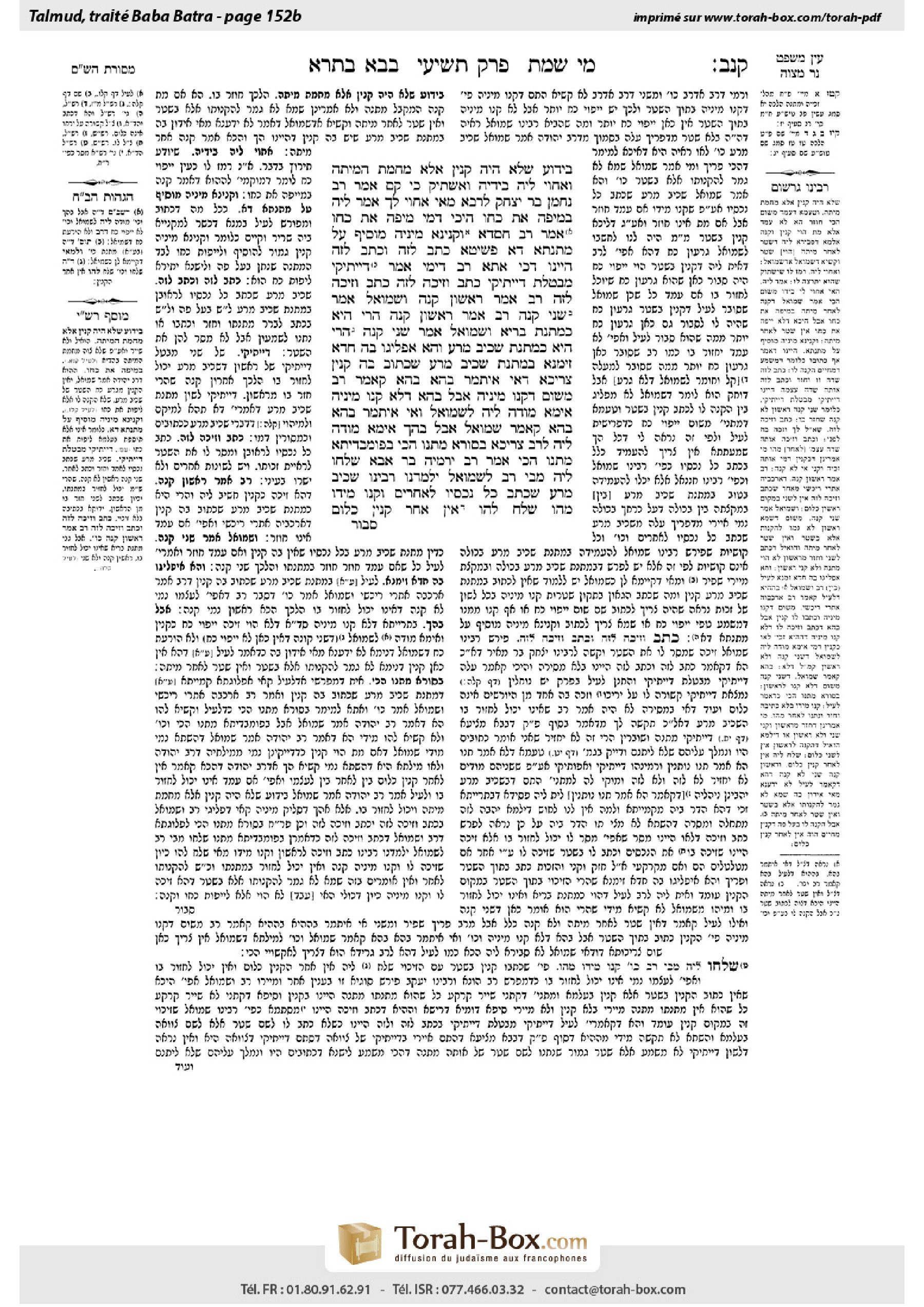
Bava Batra 152b: Talmud study for Daf Yomi
Study the Talmud for Daf Yomi with scanned pages, Hebrew text, English translations from Sefaria and AI-generated French translations.
Passage selection and English or AI-generated French translation are available where the scan has annotations. Daf Study is independent of Torah-Box and Sefaria.
Browse Bava Batra · בבא בתרא · All tractatesBava Batra 152b text and translations
This page of Bava Batra includes the Aramaic text, an English translation and an AI-generated French translation, alongside the scan above.
בבא בתרא קנ״ב ב · Aramaic and Hebrew text
בְּיָדוּעַ שֶׁלֹּא הָיָה קִנְיָן אֶלָּא מֵחֲמַת הַמִּיתָה. וְאַחְוִי לֵיהּ בִּידֵיהּ, וְאִשְׁתִּיק.
כִּי קָם, אָמַר רַב נַחְמָן בַּר יִצְחָק לְרָבָא: מַאי אַחְוִי לָךְ? אֲמַר לֵיהּ: בִּמְיַפֶּה אֶת כֹּחוֹ.
הֵיכִי דָּמֵי מְיַפֶּה אֶת כֹּחוֹ? אָמַר רַב חִסְדָּא: ״וּקְנֵינָא מִינֵּיהּ מוֹסִיף עַל מַתַּנְתָּא דָּא״.
פְּשִׁיטָא – כָּתַב לָזֶה וְכָתַב לָזֶה, הַיְינוּ דְּכִי אֲתָא רַב דִּימִי אָמַר: דְּיָיתֵיקֵי מְבַטֶּלֶת דְּיָיתֵיקֵי. כָּתַב וְזִיכָּה לָזֶה, כָּתַב וְזִיכָּה לָזֶה – רַב אָמַר: רִאשׁוֹן קָנָה, וּשְׁמוּאֵל אָמַר: שֵׁנִי קָנָה.
רַב אָמַר: רִאשׁוֹן קָנָה – הֲרֵי הִיא כְּמַתְּנַת בָּרִיא. וּשְׁמוּאֵל אָמַר: שֵׁנִי קָנָה – הֲרֵי הִיא כְּמַתְּנַת שְׁכִיב מְרַע.
וְהָא אִפְּלִיגוּ בַּהּ חֲדָא זִימְנָא – בְּמַתְּנַת שְׁכִיב מְרַע שֶׁכָּתוּב בָּהּ קִנְיָן!
צְרִיכָא; דְּאִי אִיתְּמַר בְּהָא – בְּהָא קָאָמַר רַב, מִשּׁוּם דִּקְנוֹ מִינֵּיהּ; אֲבָל בְּהָא, דְּלָא קְנוֹ מִינֵּיהּ – אֵימָא מוֹדֶה לֵיהּ לִשְׁמוּאֵל. וְאִי אִיתְּמַר בְּהָא – בְּהָא קָאָמַר שְׁמוּאֵל; אֲבָל בְּהָךְ – אֵימָא מוֹדֶה לֵיהּ לְרַב; צְרִיכָא.
בְּסוּרָא – מַתְנוּ הָכִי; בְּפוּמְבְּדִיתָא – מַתְנוּ הָכִי, אָמַר רַב יִרְמְיָה בַּר אַבָּא: שְׁלַחוּ לֵיהּ מִבֵּי רַב לִשְׁמוּאֵל, יְלַמְּדֵנוּ רַבֵּינוּ: שְׁכִיב מְרַע שֶׁכָּתַב כׇּל נְכָסָיו לַאֲחֵרִים, וְקָנוּ מִיָּדוֹ, מַהוּ? שְׁלַח לְהוּ: אֵין אַחַר קִנְיָן כְּלוּם.
Bava Batra 152b · English translation
The reason for Shmuel’s ruling is that it is known that an act of acquisition was performed only due to his expectation of imminent death. This ruling indicates that if the giver does not recover, the recipient acquires the gift, and the performance of an act of acquisition does not indicate that the giver intended to transfer the property only after his death. Rav Naḥman indicated the answer to Rava with a gesture of his hand, and Rava was silent.
When Rav Naḥman arose from his place, Rav Naḥman bar Yitzḥak said to Rava: What did he indicate to you with that gesture? Rava said to him: He indicated that the statement of Rav Yehuda is referring to a case where the giver was clearly enhancing the legal power of the recipient by requiring an act of acquisition to be performed in addition to bestowing the gift.
The Gemara asks: What is considered an act of acquisition that enhances the legal power of the recipient? Rav Ḥisda said: An act of acquisition is clearly intended only to reinforce the legal power of the recipient when, for example, the following phrase is written in the deed: And we, the witnesses, acquired it from him by means of an act of acquisition in addition to this gift. This indicates that the act of acquisition was not performed in order to effect the actual acquisition.
§ It is obvious that if a person on his deathbed wrote a deed of transfer granting his property to this individual, and he then wrote a deed granting the same property to that individual, i.e., a second recipient, this is the case discussed by Rav Dimi. As when Rav Dimi came from Eretz Yisrael to Babylonia he said: A later will [dayetikei] nullifies an earlier will. The amora’im disagree with regard to a case where one wrote a deed of transfer and also conferred possession of the property on this individual, and then he wrote a deed of transfer and conferred possession of the same property on that second individual. Rav says: The first recipient acquires the gift, and Shmuel says: The second recipient acquires the gift.
The Gemara explains: Rav says that the first recipient acquires the gift. Since an additional act of conferring possession of the property was performed, the gift is considered like the gift of a healthy person, which cannot be retracted. Shmuel says that the second recipient acquires the gift because it is considered like the gift of a person on his deathbed, which can be retracted.
The Gemara asks: But didn’t Rav and Shmuel already disagree about this matter once? With regard to a deed pertaining to the gift of a person on his deathbed in which it is written that an act of acquisition was also performed, Rav maintained that the gift cannot be retracted, whereas Shmuel maintained that the acquisition was not effective. Why is it necessary to record another disagreement with regard to the same principle?
The Gemara replies: It is necessary to cite both cases. This is because if it were stated only with regard to that case, where an act of acquisition was recorded in the deed, one might say that only in that case Rav says that the gift cannot be retracted, because an act of acquisition was performed. But in this case, where an act of acquisition was not performed, one might say that he concedes to Shmuel. And if it was stated only with regard to this case, where he conferred possession of the property on the recipient through a deed alone, one might say that only in this case Shmuel says that he can retract the gift. But in the other case, where an act of acquisition was recorded in the deed, one might say that Shmuel concedes to Rav that he cannot retract it. Therefore, it is necessary to cite both cases.
In Sura they taught the statements of Rav and Shmuel that way, as stated above. In Pumbedita they taught their statements like this: Rav Yirmeya bar Abba says: After the death of Rav, the following question was sent from the study hall of Rav to Shmuel: Let our teacher teach us: With regard to a person on his deathbed who wrote a deed of transfer granting all of his property to others, and they performed an act of acquisition, what is the halakha? Shmuel sent to them in reply: After an act of acquisition is performed, nothing can effect a retraction of the gift.
Bava Batra 152b · Traduction française (IA)
La raison du jugement de Shmuel est qu'il est connu qu'un acte d'acquisition a été accompli uniquement en raison de son attente d'une mort prochaine. Ce jugement indique que si le donneur ne récupère pas, le receveur acquiert le don, et l'accomplissement d'un acte d'acquisition ne signifie pas que le donneur avait l'intention de transférer la propriété uniquement après sa mort. Rav Naḥman a indiqué la réponse à Rava avec un geste de la main, et Rava a gardé le silence.
Quand Rav Naḥman est sorti de sa place, Rav Naḥman bar Yitzḥak a dit à Rava : Qu'est-ce qu'il t'a indiqué avec ce geste ? Rava a répondu à lui : Il a indiqué que la déclaration de Rav Yehuda s'applique à un cas où le donneur renforçait clairement le pouvoir juridique du receveur en exigeant un acte d'acquisition en plus de faire don de la propriété.
La Guemara pose la question : Qu'est-ce qui constitue un acte d'acquisition qui renforce le pouvoir juridique du receveur ? Rav Ḥisda a dit : Un acte d'acquisition est clairement destiné uniquement à renforcer le pouvoir juridique du receveur lorsque, par exemple, la phrase suivante est écrite dans le document : Et nous, les témoins, avons acquis cela de lui par l'intermédiaire d'un acte d'acquisition en plus de ce don. Cela indique que l'acte d'acquisition n'a pas été accompli pour effectuer l'acquisition réelle.
§ Il est évident que si une personne, sur son lit de mort, a écrit un document de transfert lui donnant sa propriété à cette personne, et qu'il a ensuite écrit un autre document lui donnant la même propriété à cette autre personne, c'est le cas discuté par Rav Dimi. Comme lorsque Rav Dimi est venu d'Eretz Yisrael vers Babylone, il a dit : Un testament ultérieur [dayetikei] annule un testament antérieur. Les amoraïm s'opposent sur le cas où l'on a écrit un document de transfert et conféré la possession de la propriété à cette personne, et ensuite l'on a écrit un autre document de transfert et conféré la possession de la même propriété à cette autre personne. Rav dit : Le premier receveur acquiert le don, et Shmuel dit : Le second receveur acquiert le don.
La Guemara explique : Rav dit que le premier receveur acquiert le don. Puisqu'un acte supplémentaire de conférence de possession de la propriété a été accompli, le don est considéré comme celui d'une personne saine, qui ne peut être révoqué. Shmuel dit que le second receveur acquiert le don, car il est considéré comme celui d'une personne sur son lit de mort, qui peut être révoqué.
La Guemara pose la question : Mais n'ont-ils pas déjà disputé sur ce sujet auparavant ? Concernant un document relatif au don d'une personne sur son lit de mort, dans lequel il est écrit qu'un acte d'acquisition a également été accompli, Rav affirmait que le don ne peut être révoqué, tandis que Shmuel affirmait que l'acquisition n'était pas efficace. Pourquoi est-il nécessaire de consigner une autre dispute sur le même principe ?
La Guemara répond : Il est nécessaire de citer les deux cas. Cela est nécessaire car, si on avait seulement mentionné ce cas, où un acte d'acquisition a été inscrit dans le document, on pourrait dire que c'est uniquement dans ce cas que Rav dit que le don ne peut être révoqué, car un acte d'acquisition a été accompli. Mais dans ce cas, où un acte d'acquisition n'a pas été accompli, on pourrait dire qu'il concède à Shmuel. Et si on avait seulement mentionné ce cas, où la possession de la propriété a été conférée au receveur par un seul document, on pourrait dire que c'est uniquement dans ce cas que Shmuel dit qu'il peut révoquer le don. Mais dans l'autre cas, où un acte d'acquisition a été inscrit dans le document, on pourrait dire que Shmuel concède à Rav que le don ne peut pas être révoqué. Par conséquent, il est nécessaire de citer les deux cas.
À Sura, ils ont enseigné les déclarations de Rav et de Shmuel ainsi, comme mentionné ci-dessus. À Pumbedita, ils les ont enseignées ainsi : Rav Yirmeya bar Abba dit : Après la mort de Rav, la question suivante a été envoyée de la salle d'étude de Rav à Shmuel : Faisons-nous apprendre par notre maître : Concernant une personne sur son lit de mort qui a écrit un document de transfert lui donnant toute sa propriété à d'autres, et qu'ils ont accompli un acte d'acquisition, quelle est la halakha ? Shmuel a répondu à leur envoi : Après qu'un acte d'acquisition ait été accompli, rien ne peut révoquer le don.
Traduction française générée par IA à partir de l’édition anglaise de Sefaria. Vérifie toujours un passage avec le texte source.
Text from Sefaria: William Davidson Edition - Vocalized Aramaic (CC BY NC); William Davidson Edition - English (CC BY NC).