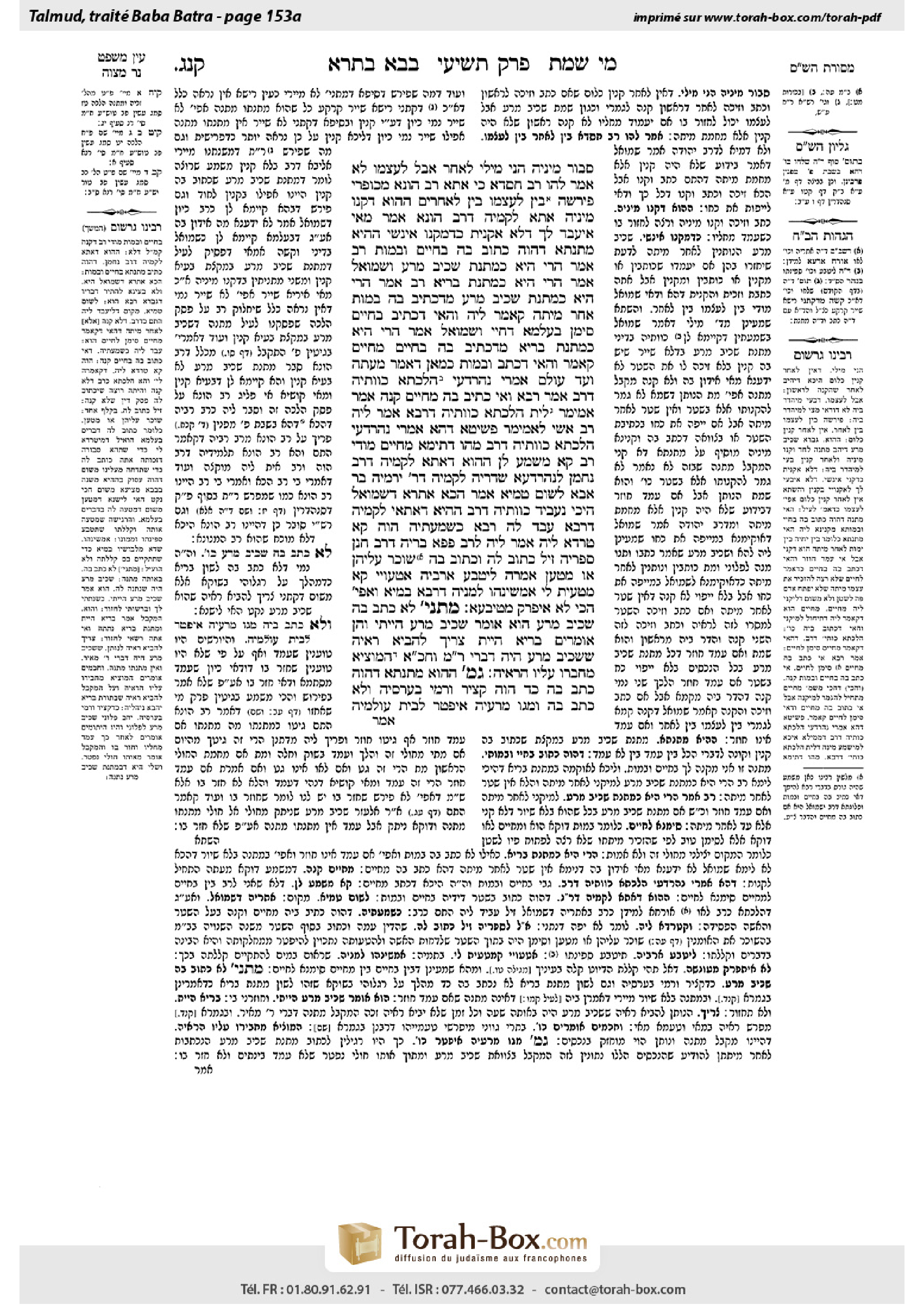
Bava Batra 153a: Talmud study for Daf Yomi
Study the Talmud for Daf Yomi with scanned pages, Hebrew text, English translations from Sefaria and AI-generated French translations.
Passage selection and English or AI-generated French translation are available where the scan has annotations. Daf Study is independent of Torah-Box and Sefaria.
Browse Bava Batra · בבא בתרא · All tractatesBava Batra 153a text and translations
This page of Bava Batra includes the Aramaic text, an English translation and an AI-generated French translation, alongside the scan above.
בבא בתרא קנ״ג א · Aramaic and Hebrew text
סְבוּר מִינֵּיהּ, הָנֵי מִילֵּי לְאַחֵר, אֲבָל לְעַצְמוֹ – לֹא; אֲמַר לְהוּ רַב חִסְדָּא: כִּי אֲתָא רַב הוּנָא מִכּוּפְרִי, פָּירְשַׁהּ: בֵּין לְעַצְמוֹ בֵּין לַאֲחֵרִים.
הָהוּא דִּקְנוֹ מִינֵּיהּ, אֲתָא לְקַמֵּיהּ דְּרַב הוּנָא, אָמַר: מַאי אֶיעְבֵּיד לָךְ, דְּלָא אַקְנֵית כִּדְמַקְנוּ אִינָשֵׁי.
הָהִיא מַתַּנְתָּא דַּהֲוָה כָּתוּב בָּהּ ״בַּחַיִּים וּבַמָּוֶת״ – רַב אָמַר: הֲרֵי הִיא כְּמַתְּנַת שְׁכִיב מְרַע. וּשְׁמוּאֵל אָמַר: הֲרֵי הִיא כְּמַתְּנַת בָּרִיא.
רַב אָמַר הֲרֵי הִיא כְּמַתְּנַת שְׁכִיב מְרַע – מִדִּכְתִיב בָּהּ ״בַּמָּוֶת״, אַחַר מִיתָה קָאָמַר לֵיהּ; וְהַאי דִּכְתִיב ״בַּחַיִּים״ – סִימָן בְּעָלְמָא, דְּחָיֵי.
וּשְׁמוּאֵל אָמַר הֲרֵי הִיא כְּמַתְּנַת בָּרִיא – מִדִּכְתִיב בָּהּ ״בַּחַיִּים״, מֵחַיִּים קָאָמַר; וְהַאי דִּכְתַב ״וּבַמָּוֶת״ – כְּמַאן דְּאָמַר ״מֵעַתָּה וְעַד עוֹלָם״. אָמְרִי נְהַרְדָּעֵי: הִלְכְתָא כְּווֹתֵיהּ דְּרַב.
אָמַר רָבָא: וְאִי כְּתִיב בַּהּ ״מֵחַיִּים״ – קְנָה.
אָמַר אַמֵּימָר: לֵית הִלְכְתָא כְּווֹתֵיהּ דְּרָבָא. אֲמַר לֵיהּ רַב אָשֵׁי לְאַמֵּימָר: פְּשִׁיטָא, דְּהָא אָמְרִי נְהַרְדָּעֵי: הִלְכְתָא כְּווֹתֵיהּ דְּרַב! מַהוּ דְּתֵימָא ״מֵחַיִּים״ – מוֹדֵי רַב; קָא מַשְׁמַע לַן.
הָהוּא דַּאֲתָא לְקַמֵּיהּ דְּרַב נַחְמָן לִנְהַרְדְּעָא. שַׁדְּרֵיהּ לְקַמֵּיהּ דְּרַבִּי יִרְמְיָה בַּר אַבָּא לְשׁוּם טַמְיָא, אָמַר: הָכָא אַתְרָא דִשְׁמוּאֵל – הֵיכִי נַעֲבֵיד כְּווֹתֵיהּ דְּרַב!
הָהִיא דַּאֲתַאי לְקַמֵּיהּ דְּרָבָא, עֲבַד לַהּ רָבָא כִּשְׁמַעְתֵּיהּ. הֲוָה קָא טָרְדָא לֵיהּ.
אֲמַר לֵיהּ לְרַב פָּפָּא בְּרֵיהּ דְּרַב חָנָן – סָפְרֵיהּ: זִיל כְּתוֹב לַהּ, וּכְתוֹב בָּהּ: ״שׂוֹכֵר עֲלֵיהֶן אוֹ מַטְעָן״. אָמְרָה: לִיטְבַּע אַרְבֵּיהּ! אַטְעוֹיֵי קָא מַטְעֵית לִי! אַמְשִׁינְהוּ לְמָנֵיהּ דְּרָבָא בְּמַיָּא, וַאֲפִילּוּ הָכִי לָא אִיפְּרַק מִטִּיבְעָא.
מַתְנִי׳ לֹא כָּתַב בָּהּ שְׁכִיב מְרַע, הוּא אוֹמֵר ״שְׁכִיב מְרַע הָיִיתִי״, וְהֵן אוֹמְרִים ״בָּרִיא הָיִיתָ״ – צָרִיךְ לְהָבִיא רְאָיָה שֶׁשְּׁכִיב מְרַע הָיָה, דִּבְרֵי רַבִּי מֵאִיר. וַחֲכָמִים אוֹמְרִים: הַמּוֹצִיא מֵחֲבֵרוֹ – עָלָיו הָרְאָיָה.
גְּמָ׳ הָהוּא מַתַּנְתָּא דַּהֲוָה כְּתִב בַּהּ: ״כַּד הֲוָה קְצִיר וּרְמֵי בְּעַרְסֵיהּ״; וְלָא כְּתַב בָּהּ: ״וּמִגּוֹ מַרְעֵיהּ אִיפְּטַר לְבֵית עוֹלָמֵיהּ״.
Bava Batra 153a · English translation
Rav’s disciples understood from this that this statement applies only when the person on his deathbed wishes to retract his gift and transfer it to another. But if he recovers and wishes to retract the gift and retain it for himself, Shmuel’s statement does not apply. Rav Ḥisda said to them: When Rav Huna came from Kufrei, he explained that Shmuel’s statement applies both to retaining the property for himself and to transferring it to others.
The Gemara relates: There was a certain person on his deathbed who wrote a deed of transfer granting his property to another, and it was acquired from him by means of an act of acquisition. He subsequently recovered and wanted to retract the gift, and he came before Rav Huna. Rav Huna said to him: What can I do for you? You cannot retract the gift, as you did not transfer the gift in the manner that people on their deathbed transfer ownership of gifts, and you enhanced the legal power of the recipient by performing an act of acquisition.
§ The Gemara relates: There was a deed pertaining to a certain gift of a person on his deathbed, in which it was written that the gift is given both in life and in death. In such a case, Rav says: It is like the gift of a person on his deathbed, and if he recovers he can retract it. And Shmuel says: It is like the gift of a healthy person, and he cannot retract it.
The Gemara explains: Rav says: It is like the gift of a person on his deathbed. This can be inferred from the fact that it is written in the deed that the gift is given in death. This means that the giver is saying to him that the gift should take effect after his death, and that which is written in the deed, that the gift is given in life, is merely an auspicious omen, expressing hope that the giver will live.
And Shmuel says: It is like the gift of a healthy person. This can be inferred from the fact that it is written in the deed that the gift is given in life. This means that the giver is saying that the gift takes effect during his life, i.e., immediately. And that which he wrote, that the gift is given in death, is like one who says: From now and for evermore, i.e., that the gift is not retractable. The Sages of Neharde’a say: The halakha is in accordance with the opinion of Rav.
Rava said: And if it was written in the deed that the gift is given during life and in death, the recipient acquires the gift and it cannot be retracted, as this term indicates that the gift takes effect while the giver still lives.
Ameimar said: The halakha is not in accordance with the opinion of Rava. Rav Ashi said to Ameimar: Isn’t that obvious, as the Sages of Neharde’a say that the halakha is in accordance with the opinion of Rav? Ameimar replied: Lest you say that with regard to the term: During life, Rav concedes that the giver intends for the gift to take effect immediately, Ameimar teaches us that since the giver also mentioned death, he intended the gift as the gift of a person on his deathbed and he can retract it.
The Gemara relates: There was a certain person who wrote in the deed that the gift is given in life and in death. When he recovered he wanted to retract the gift. He came before Rav Naḥman in Neharde’a. Rav Naḥman sent him to appear before Rabbi Yirmeya bar Abba in Shum Tamya. Rav Naḥman said in explanation of his actions: Here, Neharde’a, is the place of Shmuel. Consequently, Shmuel’s rulings should be followed, and therefore how can we act in accordance with the opinion of Rav?
The Gemara relates: There was a certain woman who wrote in the deed that the gift is given during life and in death. She came before Rava. Rava acted with regard to her case in accordance with his halakhic ruling, and he ruled that she cannot retract the gift. She did not accept the ruling, and she constantly troubled him, saying that he had not judged her case properly.
Rava said to Rav Pappa, his scribe, son of Rav Ḥanan: Go, write for her a ruling in her favor, and write in the ruling the phrase: He may hire replacements at their expense, or deceive them to get them to return to work. This is a phrase from the mishna (Bava Metzia 75b) that discusses the ruling in the case of one who hired laborers to perform a task that cannot be delayed, and they quit. Rava intended this phrase to indicate to the court that the ruling was merely a ruse in order to persuade the woman to leave. The woman understood the ruse. She said: May his ship sink; you are deceiving me. Rava had his clothes immersed in water so that the curse should be fulfilled in this alternative manner, but even so he was not saved from the sinking of his ship.
MISHNA: If one did not write in the deed that he was on his deathbed, and he then recovered and wished to retract the gift, and he says: I was on my deathbed, and since I recovered, I can retract the gift, but the recipients say: You were healthy, and the gift cannot be retracted, the giver must bring proof that he was on his deathbed in order to retract the gift. This is the statement of Rabbi Meir. And the Rabbis say: The burden of proof rests upon the claimant, and since the property is in the possession of the giver, the recipients must bring proof that they have the right to receive it.
GEMARA: There was a deed pertaining to a certain gift of a person on his deathbed, in which it was written that the gift was bestowed when the giver was sick and lying in his bed, but the continuation of the standard formula: And from his sickness he departed to his eternal home, was not written in it. The giver’s heirs claimed that although he was ill when he wrote the deed, he later recovered, and his gift is not valid.
Bava Batra 153a · Traduction française (IA)
Les disciples de Rava comprirent de cela que cette déclaration s'applique uniquement lorsque la personne sur son lit de mort souhaite révoquer son don et le transférer à un autre. Mais si elle recouvre la santé et souhaite révoquer le don et le conserver pour elle-même, la déclaration de Shmuel ne s'applique pas. Rav Ḥisda dit à eux : Quand Rav Huna est revenu de Kufrei, il expliqua que la déclaration de Shmuel s'applique à la fois à la conservation de la propriété pour soi-même et au transfert à d'autres.
La Guemara rapporte : Il y avait un certain homme sur son lit de mort qui écrivit un acte de donation lui transférant sa propriété à un autre, et cette propriété fut acquise par l'acte d'acquisition. Il recouvra ensuite la santé et voulut révoquer le don, et il vint devant Rav Huna. Rav Huna dit à lui : Que puis-je faire pour vous ? Vous ne pouvez pas révoquer le don, car vous n'avez pas transféré le don de la manière dont les personnes sur leur lit de mort transfèrent la propriété des dons, et vous avez renforcé le pouvoir juridique du destinataire en accomplissant un acte d'acquisition.
§ La Guemara rapporte : Il y avait un acte concernant un certain don d'une personne sur son lit de mort, dans lequel il était écrit que le don est donné à la fois pendant la vie et après la mort. Dans ce cas, Rav dit : C'est comme le don d'une personne sur son lit de mort, et s'il recouvre la santé, il peut révoquer le don. Et Shmuel dit : C'est comme le don d'une personne en bonne santé, et il ne peut pas révoquer le don.
La Guemara explique : Rav dit : C'est comme le don d'une personne sur son lit de mort. Cela peut être inféré du fait qu'il est écrit dans l'acte que le don est donné après la mort. Cela signifie que le donneur dit au destinataire que le don doit prendre effet après sa mort, et ce qui est écrit dans l'acte, que le don est donné pendant la vie, est simplement un présage favorable, exprimant l'espoir que le donneur vivra.
Et Shmuel dit : C'est comme le don d'une personne en bonne santé. Cela peut être inféré du fait qu'il est écrit dans l'acte que le don est donné pendant la vie. Cela signifie que le donneur dit que le don prend effet pendant sa vie, c'est-à-dire immédiatement. Et ce qu'il a écrit, que le don est donné après la mort, est comme celui qui dit : De maintenant et pour toujours, c'est-à-dire que le don n'est pas révocable. Les Sages de Neharde’a disent : La halakha suit l'opinion de Rav.
Rava dit : Et si cela était écrit dans l'acte que le don est donné pendant la vie et après la mort, le destinataire acquiert le don et il ne peut pas être révoqué, car ce terme indique que le don prend effet pendant que le donneur est encore vivant.
Ameimar dit : La halakha ne suit pas l'opinion de Rava. Rav Ashi dit à Ameimar : N'est-ce pas évident, car les Sages de Neharde’a disent que la halakha suit l'opinion de Rav ? Ameimar répondit : Afin que vous ne disiez pas que, concernant le terme : pendant la vie, Rav reconnaît que le donneur entend que le don prenne effet immédiatement, Ameimar enseigne que puisque le donneur a également mentionné la mort, il entendait le don comme celui d'une personne sur son lit de mort et il peut le révoquer.
La Guemara rapporte : Il y avait un certain homme qui écrivit dans l'acte que le don est donné pendant la vie et après la mort. Lorsqu'il recouvra la santé, il voulut révoquer le don. Il vint devant Rav Naḥman à Neharde’a. Rav Naḥman envoya le faire apparaître devant Rabbi Yirmeya bar Abba à Shum Tamya. Rav Naḥman expliqua ses actions en disant : Ici, Neharde’a, est le lieu de Shmuel. Par conséquent, les décisions de Shmuel devraient être suivies, et donc comment pouvons-nous agir selon l'opinion de Rav ?
La Guemara rapporte : Il y avait une certaine femme qui écrivit dans l'acte que le don est donné pendant la vie et après la mort. Elle vint devant Rava. Rava agit à son égard selon son jugement halakhique, et il décida qu'elle ne pouvait pas révoquer le don. Elle n'accepta pas le jugement et la tourmenta constamment, disant qu'il n'avait pas jugé correctement son cas.
Rava dit à Rav Pappa, son scribe, fils de Rav Ḥanan : Allez, écrivez pour elle un jugement en sa faveur, et écrivez dans le jugement la phrase : Il peut embaucher des remplaçants à leurs frais, ou les tromper pour les faire revenir au travail. Cette phrase provient de la Michna (Bava Metzia 75b) qui discute du jugement dans le cas d'une personne qui a embauché des ouvriers pour accomplir une tâche qui ne peut pas être différée, et ils ont quitté. Rava avait l'intention que cette phrase indique au tribunal que le jugement était simplement un subterfuge afin de convaincre la femme de partir. La femme comprit le subterfuge. Elle dit : Que son bateau coule ; vous me trompez. Rava fit immerger ses vêtements dans l'eau afin que la malédiction soit accomplie de cette autre manière, mais même ainsi, il ne fut pas sauvé de la coulée de son bateau.
MICHNA : Si l'on n'a pas écrit dans l'acte qu'il était sur son lit de mort, et s'il recouvre la santé et souhaite révoquer le don, et s'il dit : J'étais sur mon lit de mort, et puisque j'ai recouvré la santé, je peux révoquer le don, mais les destinataires disent : Vous étiez en bonne santé, et le don ne peut pas être révoqué, le donneur doit apporter la preuve qu'il était sur son lit de mort afin de révoquer le don. C'est l'opinion de Rabbi Meir. Et les Rabbins disent : La charge de la preuve incombe au plaignant, et puisque la propriété est en possession du donneur, les destinataires doivent apporter la preuve qu'ils ont le droit de la recevoir.
GUEMARA : Il y avait un acte concernant un certain don d'une personne sur son lit de mort, dans lequel il était écrit que le don avait été fait lorsque le donneur était malade et couché dans son lit, mais la continuation de la formule standard : Et de sa maladie il est parti vers son demeure éternelle, n'était pas écrite dans cet acte. Les héritiers du donneur affirmèrent que bien qu'il fût malade lorsqu'il avait écrit l'acte, il s'était ensuite rétabli, et son don n'est pas valide.
Traduction française générée par IA à partir de l’édition anglaise de Sefaria. Vérifie toujours un passage avec le texte source.
Text from Sefaria: William Davidson Edition - Vocalized Aramaic (CC BY NC); William Davidson Edition - English (CC BY NC).