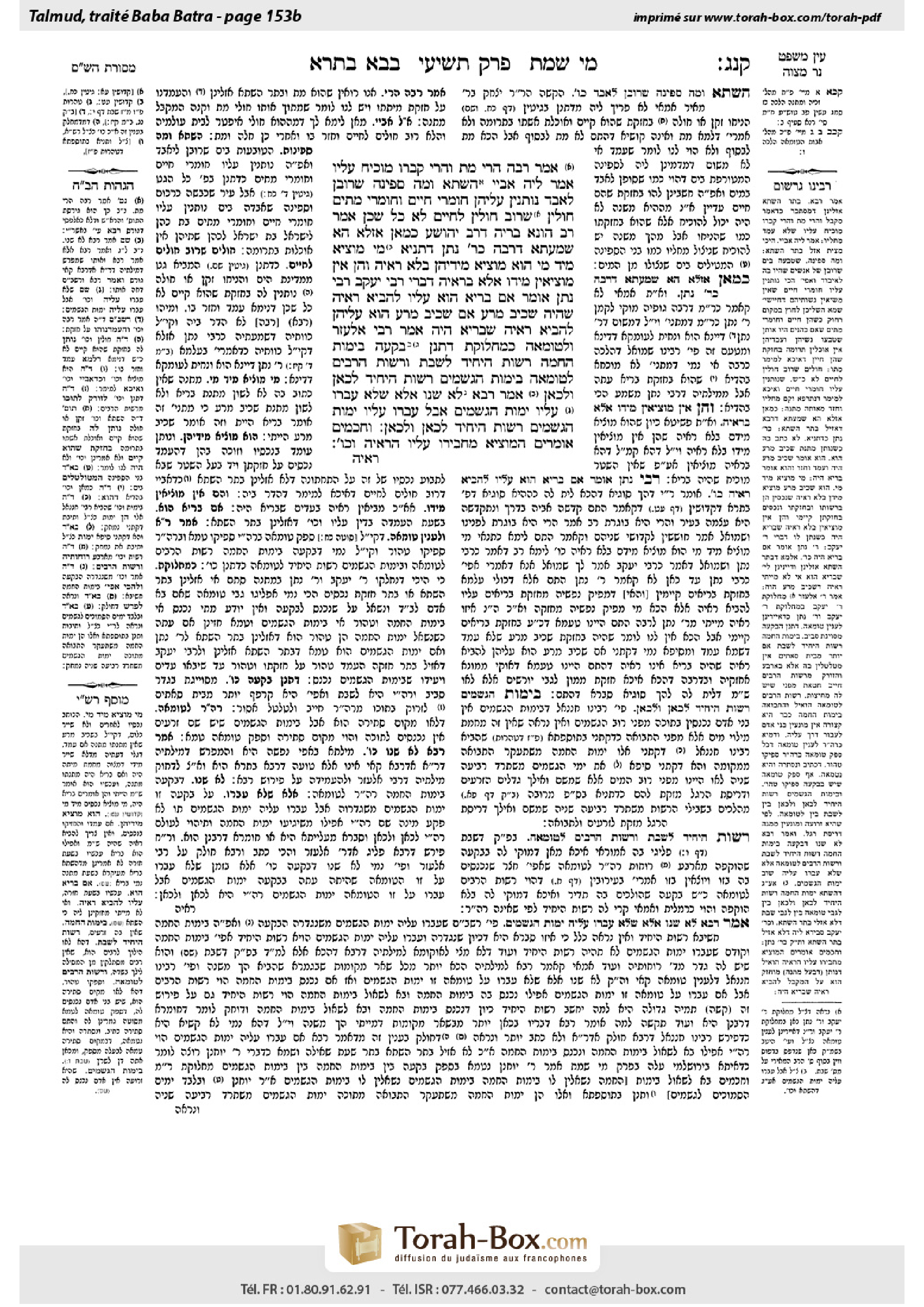
Bava Batra 153b: Talmud study for Daf Yomi
Study the Talmud for Daf Yomi with scanned pages, Hebrew text, English translations from Sefaria and AI-generated French translations.
Passage selection and English or AI-generated French translation are available where the scan has annotations. Daf Study is independent of Torah-Box and Sefaria.
Browse Bava Batra · בבא בתרא · All tractatesBava Batra 153b text and translations
This page of Bava Batra includes the Aramaic text, an English translation and an AI-generated French translation, alongside the scan above.
בבא בתרא קנ״ג ב · Aramaic and Hebrew text
אֲמַר רַבָּה: הֲרֵי מֵת, וַהֲרֵי קִבְרוֹ מוֹכִיחַ עָלָיו. אֲמַר לֵיהּ אַבָּיֵי: הַשְׁתָּא, וּמָה סְפִינָה – שֶׁרוּבָּן לֵאָבֵד, נוֹתְנִין עֲלֵיהֶן חוּמְרֵי חַיִּים וְחוּמְרֵי מֵתִים; חוֹלִין – שֶׁרוֹב חוֹלִין לְחַיִּים, לֹא כׇּל שֶׁכֵּן?!
אָמַר רַב הוּנָא בְּרֵיהּ דְּרַב יְהוֹשֻׁעַ: כְּמַאן אָזְלָא הָא שְׁמַעְתָּא דְּרַבָּה – כְּרַבִּי נָתָן. דְּתַנְיָא: מִי מוֹצִיא מִיַּד מִי? הוּא מוֹצִיא מִידֵיהֶן בְּלֹא רְאָיָה, וְהֵן אֵין מוֹצִיאִין מִיָּדוֹ אֶלָּא בִּרְאָיָה; דִּבְרֵי רַבִּי יַעֲקֹב.
רַבִּי נָתָן אוֹמֵר: אִם בָּרִיא הוּא – עָלָיו לְהָבִיא רְאָיָה שֶׁהָיָה שְׁכִיב מְרַע. אִם שְׁכִיב מְרַע הוּא – עֲלֵיהֶן לְהָבִיא רְאָיָה שֶׁבָּרִיא הָיָה.
אָמַר רַבִּי אֶלְעָזָר: וּלְטוּמְאָה – כַּמַּחְלוֹקֶת. דִּתְנַן: בִּקְעָה בִּימוֹת הַחַמָּה – רְשׁוּת הַיָּחִיד לַשַּׁבָּת, וּרְשׁוּת הָרַבִּים לַטּוּמְאָה.
בִּימוֹת הַגְּשָׁמִים – רְשׁוּת הַיָּחִיד לְכָאן וּלְכָאן.
אָמַר רָבָא: לֹא שָׁנוּ אֶלָּא שֶׁלֹּא עָבְרוּ עָלָיו יְמוֹת הַגְּשָׁמִים, אֲבָל עָבְרוּ עָלָיו יְמוֹת הַגְּשָׁמִים – רְשׁוּת הַיָּחִיד לְכָאן וּלְכָאן.
וַחֲכָמִים אוֹמְרִים: הַמּוֹצִיא מֵחֲבֵירוֹ עָלָיו הָרְאָיָה וְכוּ׳.
Bava Batra 153b · English translation
Rabba said: He is dead, and his grave proves that he died. It may therefore be assumed that he did not recover from his sickness, and his gift remains valid. Abaye said to him: And now, if in the case of a ship that sank, where the fate of most of the passengers of sunken ships is to perish, the stringencies of the living and the stringencies of the dead are applied to them due to the uncertainty as to whether they are alive or dead, in the case of sick people, where the fate of most sick people is to return to life, all the more so is it not clear that one should assume that he recovered from the illness and his gift is invalid?
Rav Huna, son of Rav Yehoshua, said: In accordance with whose opinion is that halakha of Rabba? It is in accordance with the opinion of Rabbi Natan, as it is taught in a baraita: With regard to a case where one who gave his property to others claims that since he was on his deathbed at the time he can retract the gifts, and the recipients claim that he was healthy and cannot retract it, who removes the property from whose possession? The giver can remove it from the recipients’ possession without proof, as the property was previously established to be in his possession, but the recipients can remove it from the giver’s possession only with proof. This is the statement of Rabbi Ya’akov.
Rabbi Natan says: The presumption is that the current situation reflects the situation at the time the gift was bestowed. Therefore, if he is currently healthy, the obligation is upon him to bring proof that he was on his deathbed when he gave his property to others. If he is currently on his deathbed, the obligation is upon the recipients to bring proof that he was healthy then.
Rabbi Elazar says: And with regard to a case of uncertain ritual impurity, the halakha depends on the same dispute. This is as we learned in a mishna (Teharot 6:7): The halakha is that a case where it is uncertain if something or someone became impure in the public domain, the item or person is deemed pure. With regard to an expanse of fields, in the summer, when many people pass through the fields, it is considered the private domain with regard to the halakhot of Shabbat, but it is considered the public domain with regard to the halakhot of ritual impurity, and if one is uncertain as to whether he was rendered impure there, he is deemed pure.
In the rainy season, when not many people pass through the fields, an expanse of fields is considered the private domain both with regard to this, Shabbat, and with regard to that, ritual impurity. Therefore, if one is uncertain whether he was rendered impure there, he is deemed impure. If one does not know whether the day he entered the expanse of fields was considered part of the summer or the rainy season, and he is uncertain whether he was rendered impure there, Rabbi Ya’akov maintains that he retains the status of purity that he held before entering the fields. According to Rabbi Natan, it is presumed that he entered the fields during the same season in which he came to ask whether he was rendered impure.
Rava disagrees with Rabbi Elazar and says: They taught the ruling of the mishna only with regard to a case where the rainy season has not yet passed over the fields after the possibility arose that the fields contained impurity. But if the rainy season has already passed over the fields, it is considered the private domain both with regard to this, Shabbat, and with regard to that, ritual impurity. Even though the one who passed through the fields came to ask about his status in the summer, when the fields should be considered the public domain, he is nevertheless deemed impure even according to Rabbi Natan, and there is no parallel dispute with regard to uncertain ritual impurity.
§ The mishna teaches: And the Rabbis say: The burden of proof rests upon the claimant, and since the property is in the possession of the giver, the recipients must bring proof that they have the right to receive it.
Bava Batra 153b · Traduction française (IA)
Rabba a dit : Il est mort, et son tombeau démontre qu'il est mort. On peut donc supposer qu'il n'a pas guéri de sa maladie, et son don reste valide. Abaye a répondu à lui : Et maintenant, dans le cas d'un navire coulé, où la destinée de la plupart des passagers de navires coulés est de périr, les exigences des vivants et celles des morts s'appliquent à eux en raison de l'incertitude quant à leur état de vie ou de mort, dans le cas des malades, où la destinée de la plupart des malades est de revenir à la vie, tout autant que cela est clair qu'on devrait supposer qu'il a guéri de sa maladie et son don est invalide ?
Rav Huna, fils de Rav Yéhoshua, a dit : Selon quel avis est-ce que la halakha de Rabba ? C'est selon l'avis de Rabbi Natan, comme il est enseigné dans une baraïta : En ce qui concerne un cas où une personne qui a donné ses biens à d'autres affirme qu'il était sur son lit de mort à l'époque et peut donc révoquer ses dons, et les bénéficiaires affirment qu'il était en bonne santé et ne peut pas révoquer, à qui appartient la propriété ? Le donneur peut la retirer des bénéficiaires sans preuve, car la propriété était précédemment établie comme étant en son possession, mais les bénéficiaires peuvent la retirer du donneur uniquement avec une preuve. C'est la déclaration de Rabbi Yaakov.
Rabbi Natan dit : La présomption est que la situation actuelle reflète la situation au moment où le don a été fait. Ainsi, si il est actuellement en bonne santé, la charge de la preuve incombe à lui pour prouver qu'il était sur son lit de mort lorsqu'il a donné ses biens à d'autres. Si il est actuellement sur son lit de mort, la charge de la preuve incombe aux bénéficiaires pour prouver qu'il était en bonne santé à l'époque.
Rabbi Eléazar dit : Et en ce qui concerne un cas d'incertitude quant à l'impureté rituelle, la halakha dépend du même débat. C'est comme nous avons appris dans une mitsva (Téharot 6:7) : La halakha est que dans un cas où il est incertain si quelque chose ou quelqu'un est devenu impur dans le domaine public, l'objet ou la personne est considéré comme pur. En ce qui concerne un vaste champ, en été, où beaucoup de personnes passent par les champs, il est considéré comme un domaine privé en ce qui concerne les halakhot de la Shabbat, mais comme un domaine public en ce qui concerne les halakhot de l'impureté rituelle, et si l'on est incertain quant à savoir s'il est devenu impur là, on le considère comme pur.
En saison de pluie, où peu de personnes passent par les champs, un vaste champ est considéré comme un domaine privé à la fois en ce qui concerne la Shabbat et en ce qui concerne l'impureté rituelle. Ainsi, si l'on est incertain quant à savoir s'il est devenu impur là, on le considère comme impur. Si l'on ne sait pas si la journée où l'on est entré dans le vaste champ était considérée comme faisant partie de l'été ou de la saison de pluie, et qu'on est incertain quant à savoir s'il est devenu impur là, Rabbi Yaakov maintient qu'il conserve le statut de pureté qu'il avait avant d'entrer dans les champs. Selon Rabbi Natan, on suppose qu'il est entré dans les champs pendant la même saison où il est venu demander s'il était devenu impur.
Rava conteste Rabbi Eléazar et dit : Ils ont enseigné la décision de la mitsna uniquement dans le cas où la saison de pluie n'a pas encore passé sur les champs après que la possibilité d'impureté y ait surgi. Mais si la saison de pluie a déjà passé sur les champs, il est considéré comme un domaine privé à la fois en ce qui concerne la Shabbat et en ce qui concerne l'impureté rituelle. Même si la personne qui est passée par les champs est venue demander son statut en été, lorsque les champs devraient être considérés comme un domaine public, il est néanmoins considéré comme impur même selon Rabbi Natan, et il n'y a pas de débat parallèle concernant l'incertitude quant à l'impureté rituelle.
§ La mitsna enseigne : Et les Rabbins disent : La charge de la preuve incombe à celui qui fait la demande, et puisque la propriété est en possession du donneur, les bénéficiaires doivent apporter la preuve qu'ils ont le droit de la recevoir.
Traduction française générée par IA à partir de l’édition anglaise de Sefaria. Vérifie toujours un passage avec le texte source.
Text from Sefaria: William Davidson Edition - Vocalized Aramaic (CC BY NC); William Davidson Edition - English (CC BY NC).