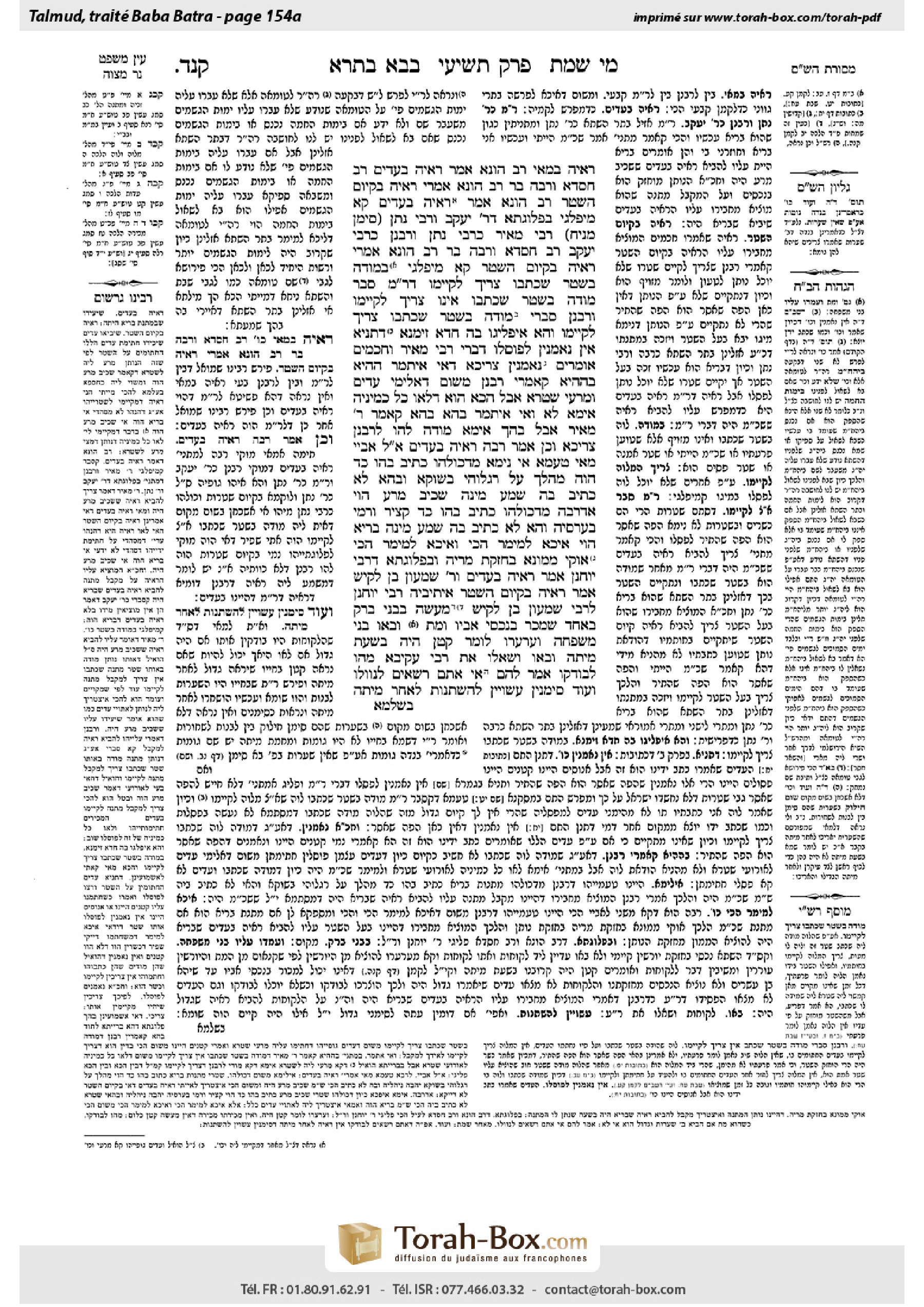
Bava Batra 154a: Talmud study for Daf Yomi
Study the Talmud for Daf Yomi with scanned pages, Hebrew text, English translations from Sefaria and AI-generated French translations.
Passage selection and English or AI-generated French translation are available where the scan has annotations. Daf Study is independent of Torah-Box and Sefaria.
Browse Bava Batra · בבא בתרא · All tractatesBava Batra 154a text and translations
This page of Bava Batra includes the Aramaic text, an English translation and an AI-generated French translation, alongside the scan above.
בבא בתרא קנ״ד א · Aramaic and Hebrew text
רְאָיָה – בְּמַאי? רַב הוּנָא אָמַר: רְאָיָה בְּעֵדִים. רַב חִסְדָּא וְרַבָּה בַּר רַב הוּנָא אָמְרִי: רְאָיָה בְּקִיּוּם הַשְּׁטָר.
רַב הוּנָא אָמַר רְאָיָה בְּעֵדִים – קָא מִיפַּלְגִי בִּפְלוּגְתָּא דְּרַבִּי יַעֲקֹב וְרַבִּי נָתָן;
(סִימָן: מַנִּיחַ.) רַבִּי מֵאִיר – כְּרַבִּי נָתָן, וְרַבָּנַן – כְּרַבִּי יַעֲקֹב.
רַב חִסְדָּא וְרַבָּה בַּר רַב הוּנָא אָמְרִי רְאָיָה בְּקִיּוּם הַשְּׁטָר – קָא מִיפַּלְגִי בְּמוֹדֶה בִּשְׁטָר שֶׁכְּתָבוֹ צָרִיךְ לְקַיְּימוֹ; דְּרַבִּי מֵאִיר סָבַר: מוֹדֶה בִּשְׁטָר שֶׁכְּתָבוֹ – אֵינוֹ צָרִיךְ לְקַיְּימוֹ. וְרַבָּנַן סָבְרִי: מוֹדֶה בִּשְׁטָר שֶׁכְּתָבוֹ – צָרִיךְ לְקַיְּימוֹ.
וְהָא אִיפְּלִיגוּ בַהּ חֲדָא זִימְנָא! דְּתַנְיָא: אֵין נֶאֱמָנִין לְפוֹסְלוֹ, דִּבְרֵי רַבִּי מֵאִיר. וַחֲכָמִים אוֹמְרִים: נֶאֱמָנִין!
צְרִיכָא, דְּאִי אִיתְּמַר הָהִיא – בְּהַהִיא קָאָמְרִי רַבָּנַן, מִשּׁוּם דְּאַלִּימֵי עֵדִים וּמַרְעִי שְׁטָרָא; אֲבָל הָכָא – הוּא דְּלָאו כָּל כְּמִינֵּיהּ, אֵימָא לָא;
וְאִי אִיתְּמַר בְּהָא, בְּהָא קָאָמַר רַבִּי מֵאִיר; אֲבָל בְּהָךְ, אֵימָא מוֹדֶה לְהוּ לְרַבָּנַן; צְרִיכָא.
וְכֵן אָמַר רַבָּה: רְאָיָה בְּעֵדִים. אֲמַר לֵיהּ אַבָּיֵי: מַאי טַעְמָא? אִי נֵימָא מִדְּכוּלְּהוּ כְּתִיב בְּהוּ: ״כַּד הֲוָה מְהַלֵּךְ עַל רַגְלוֹהִי בְּשׁוּקָא״, וּבְהָא לָא כְּתִיב בָּהּ – שְׁמַע מִינַּהּ שְׁכִיב מְרַע הָוֵי; אַדְּרַבָּה! מִדְּכוּלְּהוּ כְּתִיב בְּהוּ: ״כַּד קְצִיר וּרְמֵי בְּעַרְסֵיהּ״, וְהָא לָא כְּתִיב בָּהּ, שְׁמַע מִינַּהּ בָּרִיא הָוֵי!
אִיכָּא לְמֵימַר הָכִי וְאִיכָּא לְמֵימַר הָכִי, אוֹקִי מָמוֹנָא בְּחֶזְקַת מָרֵיהּ.
וּבִפְלוּגְתָּא; דְּרַבִּי יוֹחָנָן אָמַר: רְאָיָה בְּעֵדִים, וְרַבִּי שִׁמְעוֹן בֶּן לָקִישׁ אָמַר: רְאָיָה בְּקִיּוּם הַשְּׁטָר.
אֵיתִיבֵיהּ רַבִּי יוֹחָנָן לְרַבִּי שִׁמְעוֹן בֶּן לָקִישׁ: מַעֲשֶׂה בִּבְנֵי בְרַק בְּאֶחָד שֶׁמָּכַר בְּנִכְסֵי אָבִיו, וּמֵת, וּבָאוּ בְּנֵי מִשְׁפָּחָה וְעִרְעֲרוּ לוֹמַר: קָטָן הָיָה בִּשְׁעַת מִיתָה, וּבָאוּ וְשָׁאֲלוּ אֶת רַבִּי עֲקִיבָא: מַהוּ לְבוֹדְקוֹ? אָמַר לָהֶם: אִי אַתֶּם רַשָּׁאִים לְנַוְּולוֹ. וְעוֹד, סִימָנִין עֲשׂוּיִין לְהִשְׁתַּנּוֹת לְאַחַר מִיתָה.
Bava Batra 154a · English translation
The Gemara asks: With regard to the proof that the recipients must bring, in what manner is it brought? Rav Huna says: The proof is presented by bringing witnesses who testify that the giver was healthy. Rav Ḥisda and Rabba bar Rav Huna say: The proof is presented by the ratification of the deed, i.e., the recipients are required only to ascertain that the signatures of the witnesses on the deed are authentic in order to prove that it is not forged.
The Gemara explains: Rav Huna says that the proof is presented by bringing witnesses. He maintains that Rabbi Meir and the Rabbis disagree with regard to the issue that is the subject of the dispute of Rabbi Ya’akov and Rabbi Natan in the baraita (153b).
The Gemara notes a mnemonic device that indicates which tannaitic opinions are correlated: Manniaḥ, which represents the letters mem, nun, yod, ḥet, stands for Meir, Natan, Ya’akov, and the Rabbis [ḥakhamim]. This indicates that Rabbi Meir, who says that the giver must bring proof that he was on his deathbed, holds in accordance with the opinion of Rabbi Natan, who maintains that one presumes that the current situation reflects the situation at the time the gift was bestowed. And the Rabbis, who say that the recipients must bring proof that the giver was healthy, hold in accordance with the opinion of Rabbi Ya’akov.
Rav Ḥisda and Rabba bar Rav Huna say that the proof is presented by the ratification of the deed. The Gemara explains: Rav Ḥisda and Rabba bar Rav Huna maintain that Rabbi Meir and the Rabbis disagree with regard to whether when there is a debtor who admits that he wrote a promissory note, the creditor must ratify it in court in order to collect payment. The same ruling would apply to a case where the person on his deathbed admits that he wrote the deed granting the gift. They explain that Rabbi Meir holds that when there is a debtor who admits that he wrote a promissory note, the creditor need not ratify it in court in order to collect payment, and in this case the giver cannot invalidate the deed by claiming that he was on his deathbed. But the Rabbis hold that even when there is a debtor who admits that he wrote a promissory note, the creditor must ratify it in court in order to collect payment.
The Gemara asks: But didn’t they already disagree with regard to this matter once? As it is taught in a baraita: With regard to witnesses who ratified their signatures but claimed that at the time they signed the document they were not fit to bear witness, their testimony is not deemed credible to invalidate the document; this is the statement of Rabbi Meir. And the Rabbis say: Their testimony is deemed credible.
The Gemara answers: It is necessary to state both cases, because if only that case with regard to witnesses who disqualified their testimony was stated, one might think that the Sages say that their testimony is accepted only in that case, due to the fact that the testimony of witnesses is powerful and they can impair the validity of the document, but here, with regard to him, the giver, who admitted that he wrote the deed but it is not in his power to impair the validity of the deed, I would say that his claim is not accepted.
And if only this case, with regard to a debtor who admits that he wrote a promissory note, was stated, one might think that Rabbi Meir says that the giver cannot invalidate the deed only with regard to this case, but with regard to that case, where the witnesses ratified their signatures, I would say that Rabbi Meir concedes to the Rabbis that witnesses can invalidate the deed. Therefore, it is necessary to state the dispute in both cases.
And Rabba also says: With regard to the proof that the recipients must present, it is presented by bringing witnesses who testify that the giver was healthy. Abaye said to him: What is the reason for this? If we say that due to the fact that in all deeds of gift the following formulation is written: When he was walking on his feet in the marketplace, which indicates that the gift was the gift of a healthy person, and in this deed this was not written, therefore one may conclude from the deed that the giver was on his deathbed, that is not correct. On the contrary, one could say that due to the fact that in all deeds concerning the gifts of a person on his deathbed the following is written: When he was sick and lying in his bed, and in this deed this was not written, therefore one may conclude from the deed that the giver was healthy.
Rabba replied: Since one can say this and one can say that, nothing can be concluded from the formulation of the deed. Therefore, due to the uncertainty, establish the property in the possession of its last known owner.
And this dispute with regard to the statement of the Rabbis is also the subject of a dispute between other amora’im, as Rabbi Yoḥanan says: The proof is presented by bringing witnesses, and Rabbi Shimon ben Lakish says: The proof is presented by the ratification of the deed.
Rabbi Yoḥanan raised an objection to Rabbi Shimon ben Lakish from a baraita: There was an incident in Bnei Brak involving one who sold some of his father’s property that he had inherited, and he died, and the members of his family came and contested the sale, saying: He was a minor at the time of his death, and therefore the sale was not valid. And they came and asked Rabbi Akiva: What is the halakha? Is it permitted to exhume the corpse in order to examine it and ascertain whether or not the heir was a minor at the time of his death? Rabbi Akiva said to them: It is not permitted for you to disgrace him for the sake of a monetary claim. And furthermore, signs indicating puberty are likely to change after death, and therefore nothing can be proved by exhuming the body.
Bava Batra 154a · Traduction française (IA)
La Guemara pose la question : En ce qui concerne la preuve que les bénéficiaires doivent apporter, dans quel sens est-elle présentée ? Rav Huna dit : La preuve est présentée en apportant des témoins qui témoignent que le donneur était en bonne santé. Rav Ḥisda et Rabba bar Rav Huna disent : La preuve est présentée par la ratification du document, c'est-à-dire les bénéficiaires sont tenus uniquement de vérifier que les signatures des témoins sur le document sont authentiques afin de prouver qu'il ne s'agit pas d'une contrefaçon.
La Guemara explique : Rav Huna affirme que la preuve est présentée en apportant des témoins. Il maintient que Rabbi Meir et les Rabbins sont en désaccord concernant la question qui est au centre du débat entre Rabbi Ya’akov et Rabbi Natan dans la baraïta (153b).
La Guemara note un dispositif mnémotechnique qui indique quels opinions tannaitiques sont corrélés : Manniaḥ, qui représente les lettres mem, nun, yod, ḥet, correspond à Meir, Natan, Ya’akov et les Rabbins [ḥakhamim]. Cela indique que Rabbi Meir, qui affirme que le donneur doit apporter la preuve qu'il était sur son lit de mort, suit l'opinion de Rabbi Natan, qui maintient que l'on suppose que la situation actuelle reflète celle au moment de la donation. Et les Rabbins, qui affirment que les bénéficiaires doivent apporter la preuve que le donneur était en bonne santé, suivent l'opinion de Rabbi Ya’akov.
Rav Ḥisda et Rabba bar Rav Huna disent que la preuve est présentée par la ratification du document. La Guemara explique : Rav Ḥisda et Rabba bar Rav Huna maintiennent que Rabbi Meir et les Rabbins sont en désaccord concernant la question de savoir si, lorsqu'il y a un débiteur qui admet avoir écrit une promesse de paiement, le créancier doit ratifier ce document en cour afin de récupérer le paiement. La même décision s'appliquerait à un cas où la personne sur son lit de mort admet avoir écrit le document de donation. Ils expliquent que Rabbi Meir affirme que lorsqu'il y a un débiteur qui admet avoir écrit une promesse de paiement, le créancier n'a pas besoin de ratifier ce document en cour afin de récupérer le paiement, et dans ce cas, le donneur ne peut pas invalider le document en affirmant qu'il était sur son lit de mort. Les Rabbins, en revanche, affirment que même lorsqu'il y a un débiteur qui admet avoir écrit une promesse de paiement, le créancier doit ratifier ce document en cour afin de récupérer le paiement.
La Guemara pose la question : Mais n'ont-ils pas déjà eu un désaccord concernant cette question auparavant ? Comme il est enseigné dans une baraïta : En ce qui concerne des témoins qui ont ratifié leurs signatures mais affirment qu'ils n'étaient pas aptes à témoigner lorsqu'ils ont signé le document, leur témoignage n'est pas considéré comme crédible pour invalider le document ; c'est l'opinion de Rabbi Meir. Et les Rabbins disent : Leur témoignage est considéré comme crédible.
La Guemara répond : Il est nécessaire d'énoncer les deux cas, car si seul le cas des témoins qui ont disqualifié leur témoignage était évoqué, on pourrait penser que les Sages disent que leur témoignage est accepté uniquement dans ce cas, en raison du fait que le témoignage des témoins est puissant et qu'ils peuvent altérer la validité du document, mais ici, concernant lui, le donneur, qui admet avoir écrit le document mais ne peut pas altérer la validité du document, je dirais que son argument n'est pas accepté.
Et si seul ce cas, concernant un débiteur qui admet avoir écrit une promesse de paiement, était évoqué, on pourrait penser que Rabbi Meir affirme que le donneur ne peut invalider le document qu'en ce cas précis. Mais concernant ce cas, où les témoins ont ratifié leurs signatures, je dirais que Rabbi Meir reconnaît que les témoins peuvent invalider le document. Par conséquent, il est nécessaire d'énoncer le débat dans les deux cas.
Et Rabba dit aussi : En ce qui concerne la preuve que les bénéficiaires doivent présenter, elle est présentée en apportant des témoins qui témoignent que le donneur était en bonne santé. Abaye dit à lui : Quel est le motif de cela ? Si nous disons que, en raison du fait que dans tous les documents de donation, la formulation suivante est écrite : Lorsqu'il marchait sur ses pieds dans le marché, ce qui indique que la donation a été faite par une personne en bonne santé, et dans ce document cette formulation n'est pas écrite, donc on peut conclure à partir du document que le donneur était sur son lit de mort, cela n'est pas correct. Au contraire, on pourrait dire que, en raison du fait que dans tous les documents concernant les donations d'une personne sur son lit de mort, la formulation suivante est écrite : Lorsqu'il était malade et allongé dans son lit, et dans ce document cette formulation n'est pas écrite, donc on peut conclure à partir du document que le donneur était en bonne santé.
Rabba répondit : Puisque l'on peut dire cela et l'on peut dire cela, rien ne peut être conclu à partir de la formulation du document. Par conséquent, en raison de l'incertitude, il faut établir la propriété dans la possession de son dernier propriétaire connu.
Et ce débat concernant l'opinion des Rabbins est également l'objet d'un débat entre d'autres amoraïm, comme Rabbi Yoḥanan dit : La preuve est présentée en apportant des témoins, et Rabbi Shimon ben Lakish dit : La preuve est présentée par la ratification du fait.
Rabbi Yoḥanan a soulevé une objection contre Rabbi Shimon ben Lakish à partir d'une baraïta : Il y avait un incident à Bnei Brak concernant une personne qui avait vendu une partie de la propriété de son père qu'il avait héritée, et il était mort, et les membres de sa famille sont venus contester la vente, disant : Il était mineur au moment de sa mort, et donc la vente n'était pas valide. Et ils sont venus demander à Rabbi Akiva : Quel est le halakha ? Est-il permis d'exhumer le corps afin d'examiner s'il était mineur au moment de sa mort ? Rabbi Akiva a dit à eux : Il n'est pas permis de déshonorer le défunt à cause d'une revendication monétaire. Et de plus, les signes d'adultère sont susceptibles de changer après la mort, et donc rien ne peut être prouvé en exhumant le corps.
Traduction française générée par IA à partir de l’édition anglaise de Sefaria. Vérifie toujours un passage avec le texte source.
Text from Sefaria: William Davidson Edition - Vocalized Aramaic (CC BY NC); William Davidson Edition - English (CC BY NC).