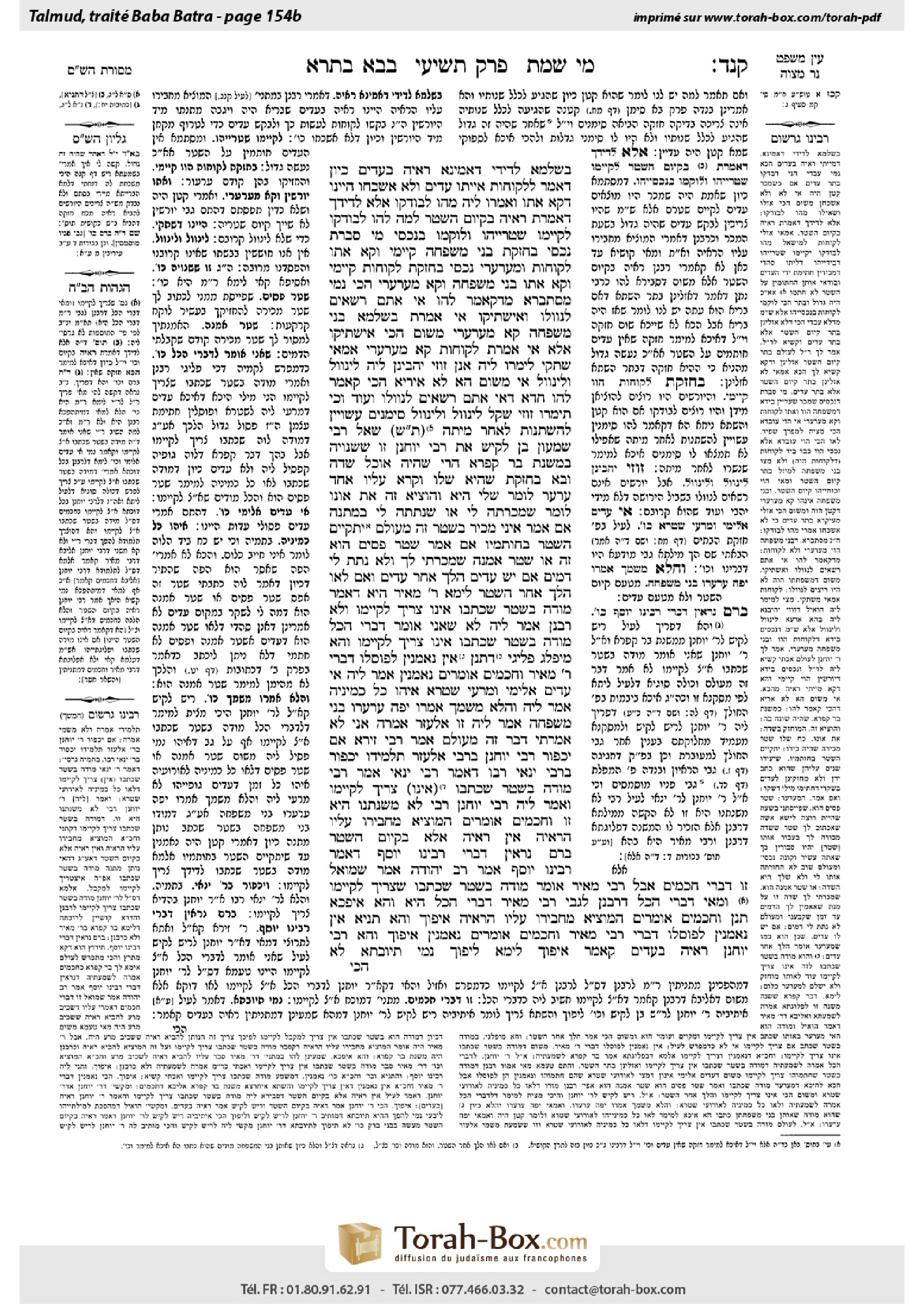
Bava Batra 154b: Talmud study for Daf Yomi
Study the Talmud for Daf Yomi with scanned pages, Hebrew text, English translations from Sefaria and AI-generated French translations.
Passage selection and English or AI-generated French translation are available where the scan has annotations. Daf Study is independent of Torah-Box and Sefaria.
Browse Bava Batra · בבא בתרא · All tractatesBava Batra 154b text and translations
This page of Bava Batra includes the Aramaic text, an English translation and an AI-generated French translation, alongside the scan above.
בבא בתרא קנ״ד ב · Aramaic and Hebrew text
בִּשְׁלָמָא לְדִידִי – דְּאָמֵינָא רְאָיָה בְּעֵדִים; כֵּיוָן דְּאָמַר לְלָקוֹחוֹת: ״אַיְיתוֹ עֵדִים״, וְלָא אַשְׁכַּחוּ, הַיְינוּ דְּקָא אֲתוֹ וַאֲמַרוּ לֵיהּ: מַהוּ לְבוֹדְקוֹ. אֶלָּא לְדִידָךְ דְּאָמְרַתְּ: רְאָיָה בְּקִיּוּם הַשְּׁטָר, לְמָה לְהוּ לְבוֹדְקוֹ? לְקַיְּימוּ שְׁטָרַיְיהוּ, וְלוֹקְמוּ בְּנִכְסֵי!
מִי סָבְרַתְּ נִכְסֵי בְּחֶזְקַת בְּנֵי מִשְׁפָּחָה קָיְימִי – וְקָא אָתוּ לָקוֹחוֹת וּמְעַרְעֲרִי? נִכְסֵי בְּחֶזְקַת לָקוֹחוֹת קָיְימִי – וְקָא אָתוּ בְּנֵי מִשְׁפָּחָה וְקָא מְעַרְעֲרִי!
הָכִי נָמֵי מִסְתַּבְּרָא, מִדְּקָאָמַר לְהוּ: אִי אַתֶּם רַשָּׁאִים לְנַוְּולוֹ, וְאִישְׁתִּיקוּ. אִי אָמְרַתְּ בִּשְׁלָמָא בְּנֵי מִשְׁפָּחָה קָא מְעַרְעֲרִי, מִשּׁוּם הָכִי אִישְׁתִּיקוּ. אֶלָּא אִי אָמְרַתְּ לָקוֹחוֹת קָא מְעַרְעֲרִי, אַמַּאי שָׁתְקִי? לֵימְרוּ לֵיהּ: אֲנַן זוּזֵי יָהֲבִינַן לֵיהּ, לִינַּוַול וְלִינַּוַּול!
אִי מִשּׁוּם הָא – לָא אִירְיָא; הָכִי קָאָמַר לְהוּ: חֲדָא, דְּאִי אַתֶּם רַשָּׁאִים לְנַוְּולוֹ. וְעוֹד, וְכִי תֵּימְרוּ זוּזֵי שְׁקַל – לִינַּוַול וְלִינַּוַּול; סִימָנִים עֲשׂוּיִין לְהִשְׁתַּנּוֹת לְאַחַר מִיתָה.
תָּא שְׁמַע: שָׁאַל רַבִּי שִׁמְעוֹן בֶּן לָקִישׁ אֶת רַבִּי יוֹחָנָן, זוֹ שֶׁשְּׁנוּיָה בְּמִשְׁנַת בַּר קַפָּרָא: הֲרֵי שֶׁהָיָה אוֹכֵל שָׂדֶה וּבָא – בְּחֶזְקַת שֶׁהִיא שֶׁלּוֹ, וְקָרָא עָלָיו אֶחָד עַרְעָר לוֹמַר: ״שֶׁלִּי הִיא״, וְהוֹצִיא זֶה אֶת אוֹנוֹ לוֹמַר: ״שֶׁמְּכַרְתָּהּ לִי״ אוֹ ״שֶׁנְּתַתָּהּ לִי בְּמַתָּנָה״, אִם אָמַר: ״אֵינִי מַכִּיר בִּשְׁטָר זֶה מֵעוֹלָם״ – יִתְקַיֵּים הַשְּׁטָר בְּחוֹתְמָיו.
אִם אָמַר: ״שְׁטַר פַּסִּים הוּא זֶה״ אוֹ ״שְׁטַר אֲמָנָה״; ״שֶׁמָּכַרְתִּי לָךְ, וְלֹא נָתַתָּ לִי דָּמִים״ – אִם יֵשׁ עֵדִים, הַלֵּךְ אַחַר עֵדִים; וְאִם לָאו – הַלֵּךְ אַחַר הַשְּׁטָר.
לֵימָא רַבִּי מֵאִיר הִיא, דְּאָמַר: מוֹדֶה בִּשְׁטָר שֶׁכְּתָבוֹ – אֵינוֹ צָרִיךְ לְקַיְּימוֹ; וְלָא רַבָּנַן?
אֲמַר לֵיהּ: לָא; שֶׁאֲנִי אוֹמֵר: דִּבְרֵי הַכֹּל – מוֹדֶה בִּשְׁטָר שֶׁכְּתָבוֹ, אֵינוֹ צָרִיךְ לְקַיְּימוֹ. וְהָא מִיפְלָג פְּלִיגִי! דִּתְנַן: אֵין נֶאֱמָנִין לְפוֹסְלוֹ, דִּבְרֵי רַבִּי מֵאִיר. וַחֲכָמִים אוֹמְרִים: נֶאֱמָנִין!
אֲמַר לֵיהּ: אִי עֵדִים אַלִּימֵי וּמַרְעִי שְׁטָרָא, אִיהוּ כָּל כְּמִינֵּיהּ?! אֲמַר לֵיהּ, וַהֲלֹא מִשִּׁמְךָ אָמְרוּ: יָפֶה עִרְעֲרוּ בְּנֵי מִשְׁפָּחָה! אֲמַר לֵיהּ: זוֹ – אֶלְעָזָר אֲמָרָהּ; אֲנִי לֹא אָמַרְתִּי דָּבָר זֶה מֵעוֹלָם.
אָמַר רַבִּי זֵירָא: אִם יִכְפּוֹר רַבִּי יוֹחָנָן בְּרַבִּי אֶלְעָזָר תַּלְמִידוֹ, יִכְפּוֹר בְּרַבִּי יַנַּאי רַבּוֹ? דְּאָמַר רַבִּי יַנַּאי אָמַר רַבִּי: מוֹדֶה בִּשְׁטָר שֶׁכְּתָבוֹ – אֵינוֹ צָרִיךְ לְקַיְּימוֹ. וַאֲמַר לֵיהּ רַבִּי יוֹחָנָן: רַבִּי, לֹא מִשְׁנָתֵנוּ הִיא זוֹ? וַחֲכָמִים אוֹמְרִים: הַמּוֹצִיא מֵחֲבֵירוֹ – עָלָיו הָרְאָיָה. אֵין רְאָיָה אֶלָּא בְּקִיּוּם הַשְּׁטָר!
בְּרַם, נִרְאִין דִּבְרֵי רַבֵּינוּ יוֹסֵף – דְּאָמַר רַבֵּינוּ יוֹסֵף אָמַר רַב יְהוּדָה אָמַר שְׁמוּאֵל: זוֹ דִּבְרֵי חֲכָמִים, אֲבָל רַבִּי מֵאִיר אוֹמֵר: מוֹדֶה בִּשְׁטָר שֶׁכְּתָבוֹ, שֶׁצָּרִיךְ לְקַיְּימוֹ. וּמַאי דִּבְרֵי הַכֹּל? דְּרַבָּנַן לְגַבֵּי רַבִּי מֵאִיר – דִּבְרֵי הַכֹּל הִיא.
וְהָא אִיפְּכָא תְּנַן, וַחֲכָמִים אוֹמְרִים: הַמּוֹצִיא מֵחֲבֵירוֹ – עָלָיו הָרְאָיָה! אֵיפוֹךְ. וְהָא תַּנְיָא: אֵין נֶאֱמָנִין לְפוֹסְלוֹ, דִּבְרֵי רַבִּי מֵאִיר. וַחֲכָמִים אוֹמְרִים: נֶאֱמָנִין! אֵיפוֹךְ.
וְהָא רַבִּי יוֹחָנָן ״רְאָיָה בְּעֵדִים״ קָאָמַר! אֵיפוֹךְ. לֵימָא לֵיפוֹךְ נָמֵי תְּיוּבְתָּא? לָא,
Bava Batra 154b · English translation
Rabbi Yoḥanan explains: Granted, according to my explanation of the mishna, that I say that the proof must be presented by bringing witnesses, I can explain the baraita. Since Rabbi Akiva said to the buyers: Bring witnesses, and they did not find witnesses, this is the reason that they came and said to him: What is the halakha? Is it permitted to examine him? But according to you, that you say that the proof is presented by ratification of the deed, why do they need to examine him? Let them ratify their deed and they shall be established as owners of the property.
Rabbi Shimon ben Lakish replies: Do you maintain that the property stood in the possession of the members of his family and the buyers came and contested their possession of the property? Rather, the property stood in the possession of the buyers, and the members of his family came and contested the sale. Since they claimed that the deed was invalid, they could not prove their claim by ratifying the deed, but only by bringing witnesses or examining the body.
This, too, stands to reason, as Rabbi Akiva said to the claimants: You are not permitted to disgrace him, and they were silent. Granted, if you say that the members of his family were contesting the sale, due to that reason they were silent, as they accepted that they should not disgrace their relative. But if you say that the buyers were contesting the claim of the relatives, why were they silent? They should have said to Rabbi Akiva: We gave him money, and if our right to the property cannot be proven without disgracing him, let him be disgraced.
The Gemara rejects this argument: If it is due to that reason, i.e., this claim they could have said, there is no conclusive argument. This is what Rabbi Akiva said to them: One reason to prohibit exhuming the body is that you are not permitted to disgrace him. And furthermore, if you should say: He took the money; let him be disgraced, in any event nothing can be proved by exhuming the body, as signs indicating puberty are likely to change after death.
The Gemara suggests: Come and hear a proof: Rabbi Shimon ben Lakish asked Rabbi Yoḥanan about that which is taught in the Mishna of bar Kappara: There was one who was continually enjoying the profits from a field, and it was the presumption that it was his, and someone contested his claim, saying: It is mine. And that person, who was profiting from the field, produced a deed, in order to say: It is mine, as you sold this field to me, or: It is mine, as you gave me this field as a gift. If the one who protested his claim said: I do not recognize that deed as one that I have ever written, the deed must be ratified through its signatures.
If the one who protested his claim said: This is a document of appeasement [shtar passim], a document written only so that the holder should appear wealthy, or a document of trust, which means that I sold the field to you and provided you with the deed, trusting you to provide payment, and since you did not give me the money the sale is void, then if there are witnesses, follow the testimony of the witnesses, and if not, follow the deed.
Rabbi Shimon ben Lakish concludes: According to your explanation, the Rabbis maintain that even if the deed is ratified the claimant cannot take possession of the property without bringing witnesses. If so, shall we say that this baraita is in accordance with the opinion of Rabbi Meir, who says that when there is a debtor who admits that he wrote a promissory note, the creditor is not required to ratify it in court in order to collect payment, and it is not in accordance with the opinion of the Rabbis?
Rabbi Yoḥanan said to Rabbi Shimon ben Lakish: No, it is not so. As I say that everyone agrees that in the case of a debtor who admits that he wrote a promissory note, the creditor is not required to ratify it in court in order to collect payment. Rabbi Shimon ben Lakish asked: But don’t they disagree, as we learned in a baraita: With regard to witnesses who ratified their signatures but claimed that they were not fit to bear witness when they signed the deed, their testimony is not deemed credible to invalidate the document; this is the statement of Rabbi Meir. And the Rabbis say: Their testimony is deemed credible.
Rabbi Yoḥanan said to Rabbi Shimon ben Lakish: Even if the testimony of witnesses is powerful and they impair the validity of the deed, which they admit to have written, with regard to him, the giver, is it in his power to impair the validity of a deed that he admits to have written? Rabbi Shimon ben Lakish said to Rabbi Yoḥanan: But wasn’t it stated in your name with regard to the aforementioned incident in Bnei Brak: The members of his family contested the claim correctly, even though they admitted that the deed was authentic? This means that the claimant is required to ratify the deed. Rabbi Yoḥanan said to Rabbi Shimon ben Lakish: That statement was stated in my name by Rabbi Elazar, my disciple, but I never said that statement.
Rabbi Zeira says: If Rabbi Yoḥanan denies the statement of Rabbi Elazar, his disciple, will Rabbi Yoḥanan also deny that which he said to Rabbi Yannai, his teacher? This is as Rabbi Yannai says that Rabbi Yehuda HaNasi says: When there is a debtor who admits that he wrote a promissory note, the creditor is not required to ratify it in court in order to collect the payment. And Rabbi Yoḥanan said to Rabbi Yannai: My teacher, is this not the case discussed in our mishna, which states to the contrary: And the Rabbis say: The burden of proof rests upon the claimant? Rabbi Yoḥanan concludes: The proof mentioned in this mishna is nothing other than ratification of the deed. This indicates that Rabbi Yoḥanan maintains that according to the opinion of the Rabbis, the recipient is required to ratify the deed. If so, why does he state that everyone agrees that the recipient is not required to ratify the deed?
Rabbi Zeira explains: Indeed, the statement of our teacher, Rav Yosef, appears to be correct, as our teacher Rav Yosef says that Rav Yehuda says that Shmuel says: The opinions here should be reversed. This, the baraita taught by bar Kappara, according to which the deed does not require ratification, is the statement of the Rabbis. But Rabbi Meir says that when there is a debtor who admits that he wrote a promissory note, the creditor is not required to ratify it in court in order to collect payment. And what is the meaning of Rabbi Yoḥanan’s statement that everyone agrees that in this case, the recipient is not required to ratify the deed? Rabbi Yoḥanan means that this is the statement of the Rabbis, and a statement of the Rabbis that is disputed only by Rabbi Meir is tantamount to a statement accepted by all.
The Gemara asks: But didn’t we learn the opposite in the mishna: And the Rabbis say that the burden of proof rests upon the claimant? This means that the recipient is required to ratify the deed. The Gemara replies: Reverse the opinions in the mishna. The Gemara asks: But isn’t it taught in a baraita: With regard to witnesses who ratified their signatures but claimed that they were not fit to bear witness, their testimony is not deemed credible to invalidate the document; this is the statement of Rabbi Meir. And the Rabbis say: Their testimony is deemed credible. This indicates that according to the Rabbis the document requires ratification. The Gemara answers: Here too, reverse the opinions.
The Gemara asks: But doesn’t Rabbi Yoḥanan say with regard to the proof that the recipient is required to bring, that the proof is presented by bringing witnesses who testify that the giver was healthy, and not by ratifying the deed? The Gemara answers: Reverse the opinions of Rabbi Yoḥanan and Rabbi Shimon ben Lakish. Rabbi Yoḥanan maintains that the recipient is required to prove his claim only by ratifying the deed, whereas Rabbi Shimon ben Lakish maintains that the recipient is required to bring witnesses. The Gemara asks: Shall we say that we should also reverse the objection that Rabbi Yoḥanan raised to Rabbi Shimon ben Lakish previously, and say that Rabbi Shimon ben Lakish raised the objection to Rabbi Yoḥanan? The Gemara answers: No, that is unnecessary.
Bava Batra 154b · Traduction française (IA)
Rabbi Yoḥanan explique : Cela est vrai, selon mon explication de la mitsna, que je dis que la preuve doit être présentée par l'apport de témoins, je peux expliquer la baraïta. Puisque Rabbi Akiva a dit aux acheteurs : Apportez des témoins, et qu'ils n'ont pas trouvé de témoins, c'est la raison pour laquelle ils sont venus et ont dit à lui : Quelle est la halakha ? Est-ce permis d'examiner lui ? Mais selon vous, que vous dites que la preuve est présentée par l'approbation du document, pourquoi ont-ils besoin d'examiner lui ? Laissez-les approuver leur acte et ils seront établis comme propriétaires du bien.
Rabbi Shimon ben Lakish répond : Maintenez-vous que la propriété était en possession des membres de sa famille et les acheteurs sont venus contester leur possession du bien ? Plutôt, la propriété était en possession des acheteurs, et les membres de sa famille sont venus contester la vente. Puisqu'ils ont affirmé que le document était invalide, ils ne pouvaient pas prouver leur revendication par l'approbation du document, mais seulement par l'apport de témoins ou l'examen du corps.
Cela aussi est logique, car Rabbi Akiva a dit aux réclamants : Vous n'êtes pas autorisés à déshonorer lui, et ils étaient muets. Cela est vrai, si vous dites que les membres de sa famille contestaient la vente, à cette raison ils étaient muets, car ils acceptaient qu'ils ne devaient pas déshonorer leur parent. Mais si vous dites que les acheteurs contestaient la revendication des parents, pourquoi étaient-ils muets ? Ils devraient avoir dit à Rabbi Akiva : Nous avons donné de l'argent, et si notre droit sur le bien ne peut être prouvé sans déshonorer lui, laissez-le être déshonoré.
La Guemara rejette cet argument : Si c'est à cause de cela, c'est-à-dire cette revendication qu'ils auraient pu émettre, il n'y a pas d'argument concluant. C'est ce que Rabbi Akiva a dit à eux : Une raison pour interdire l'exhumation du corps est que vous n'êtes pas autorisés à déshonorer la personne. Et de plus, si vous dites : Il a pris l'argent ; laissez-le être déshonoré, en tout cas rien ne peut être prouvé par l'exhumation du corps, car les signes d'adolescence sont susceptibles de changer après la mort.
La Guemara suggère : Venez écouter une preuve : Rabbi Shimon ben Lakish a demandé à Rabbi Yoḥanan à propos de ce qui est enseigné dans la Michna de bar Kappara : Il y avait un homme qui profitait continuellement des revenus d'un champ, et c'était la présomption qu'il était son propriétaire, et quelqu'un a contesté sa revendication, disant : C'est à moi. Et cet homme, qui profitait du champ, a produit un document, afin de dire : C'est à moi, soit que vous m'ayez vendu ce champ, soit que vous m'ayez donné ce champ en cadeau. Si celui qui contestait sa revendication a dit : Je ne reconnais pas ce document comme celui que j'ai jamais écrit, le document doit être approuvé par ses signatures.
Si celui qui contestait sa revendication a dit : C'est un document de conciliation [shtar passim], un document écrit uniquement afin que le détenteur apparaisse riche, ou un document de confiance, ce qui signifie que j'ai vendu le champ à vous et vous ai donné le document, en confiant que vous me paierez, et puisque vous n'avez pas donné l'argent, la vente est nulle, alors si des témoins existent, suivez leur témoignage, et si non, suivez le document.
Rabbi Shimon ben Lakish conclut : Selon votre explication, les Rabbins affirment que même si le document est approuvé, le réclamant ne peut pas prendre possession du bien sans présenter des témoins. Si c'est ainsi, devons-nous dire que cette baraïta est conforme à l'opinion de Rabbi Meir, qui affirme que lorsqu'il y a un débiteur qui admet avoir écrit une note de remboursement, le créancier n'est pas tenu d'approuver le document en cour pour récupérer le paiement, et ce n'est pas conforme à l'opinion des Rabbins ?
Rabbi Yoḥanan a dit à Rabbi Shimon ben Lakish : Non, ce n'est pas ainsi. Car je dis que tout le monde convient que dans le cas d'un débiteur qui admet avoir écrit une note de remboursement, le créancier n'est pas tenu d'approuver le document en cour pour récupérer le paiement. Rabbi Shimon ben Lakish a demandé : Mais ne s'agit-il pas de désaccord, comme nous l'avons appris dans une baraïta : Concernant des témoins qui ont approuvé leurs signatures mais qui affirment qu'ils n'étaient pas dignes de témoigner lorsqu'ils ont signé le document, leur témoignage n'est pas considéré comme crédible pour invalider le document ; c'est l'opinion de Rabbi Meir. Et les Rabbins disent : Leur témoignage est considéré comme crédible.
Rabbi Yoḥanan a dit à Rabbi Shimon ben Lakish : Même si le témoignage des témoins est puissant et qu'ils altèrent la validité du document, qu'ils admettent avoir écrit, concernant lui, le donneur, est-ce qu'il est en son pouvoir d'altérer la validité d'un document qu'il admet avoir écrit ? Rabbi Shimon ben Lakish a dit à Rabbi Yoḥanan : Mais n'était-il pas dit en votre nom concernant l'incident mentionné à Bnei Brak : Les membres de sa famille ont contesté la revendication correctement, même s'ils admettaient que le document était authentique ? Cela signifie que le réclamant est tenu d'approuver le document. Rabbi Yoḥanan a dit à Rabbi Shimon ben Lakish : Cette déclaration a été faite en mon nom par Rabbi Elazar, mon disciple, mais je n'ai jamais dit cette déclaration.
Rabbi Zeira dit : Si Rabbi Yoḥanan nie la déclaration de Rabbi Elazar, son disciple, niera-t-il pas aussi celle qu'il a faite à Rabbi Yannai, son maître ? C'est ce que Rabbi Yannai dit que Rabbi Yehuda HaNasi a dit : Lorsqu'il y a un débiteur qui admet avoir écrit une note de remboursement, le créancier n'est pas tenu d'approuver le document en cour pour récupérer le paiement. Et Rabbi Yoḥanan a dit à Rabbi Yannai : Mon maître, n'est-ce pas le cas discuté dans notre mitsna, qui affirme le contraire : Et les Rabbins disent : La charge de la preuve incombe au réclamant ? Rabbi Yoḥanan conclut : La preuve mentionnée dans cette mitsna n'est autre que l'approbation du document. Cela indique que Rabbi Yoḥanan maintient que selon l'opinion des Rabbins, le récepteur est tenu d'approuver le document. Si c'est ainsi, pourquoi a-t-il dit que tout le monde convient que le récepteur n'est pas tenu d'approuver le document ?
Rabbi Zeira explique : En effet, la déclaration de notre maître, Rav Yosef, semble être correcte, car notre maître Rav Yosef dit que Rav Yehuda dit que Shmuel dit : Les opinions ici doivent être inversées. Cela, la baraïta enseignée par bar Kappara, selon laquelle l'acte ne nécessite pas de ratification, est la déclaration des Rabbins. Mais Rabbi Meïr dit que lorsqu'il y a un débiteur qui admet avoir écrit une note de promesse, le créancier n'est pas tenu de ratifier cela devant le tribunal afin de récupérer le paiement. Et quelle est la signification de la déclaration de Rabbi Yoḥanan selon laquelle tout le monde s'accorde sur le fait que dans ce cas, le destinataire n'est pas tenu de ratifier l'acte ? Rabbi Yoḥanan veut dire que cela est la déclaration des Rabbins, et une déclaration des Rabbins qui est contestée uniquement par Rabbi Meïr est équivalente à une déclaration acceptée par tous.
Le Guemara demande : Mais n'avons-nous pas appris l'opposé dans la mishna : Et les Rabbins disent que la charge de la preuve incombe au demandeur ? Cela signifie que le destinataire est tenu de ratifier l'acte. Le Guemara répond : Inversez les opinions dans la mishna. Le Guemara demande : Mais n'est-il pas enseigné dans une baraïta : Concernant des témoins qui ont ratifié leurs signatures mais affirment ne pas être dignes de témoigner, leur témoignage n'est pas considéré comme crédible pour invalider le document ; c'est la déclaration de Rabbi Meïr. Et les Rabbins disent : Leur témoignage est considéré comme crédible. Cela indique que selon les Rabbins, le document nécessite une ratification. Le Guemara répond : Ici aussi, inversez les opinions.
Le Guemara demande : Mais n'est-ce pas ce que Rabbi Yoḥanan dit concernant la preuve que le destinataire est tenu de présenter, que la preuve est présentée en apportant des témoins qui témoignent que le donneur était en bonne santé, et non en ratifiant l'acte ? Le Guemara répond : Inversez les opinions de Rabbi Yoḥanan et de Rabbi Shimon ben Lakish. Rabbi Yoḥanan maintient que le destinataire est tenu de prouver sa revendication uniquement en ratifiant l'acte, tandis que Rabbi Shimon ben Lakish maintient que le destinataire est tenu d'apporter des témoins. Le Guemara demande : Devons-nous dire que nous devons aussi inverser l'objection que Rabbi Yoḥanan a soulevée contre Rabbi Shimon ben Lakish précédemment, et dire que Rabbi Shimon ben Lakish a soulevé l'objection contre Rabbi Yoḥanan ? Le Guemara répond : Non, cela n'est pas nécessaire.
Traduction française générée par IA à partir de l’édition anglaise de Sefaria. Vérifie toujours un passage avec le texte source.
Text from Sefaria: William Davidson Edition - Vocalized Aramaic (CC BY NC); William Davidson Edition - English (CC BY NC).