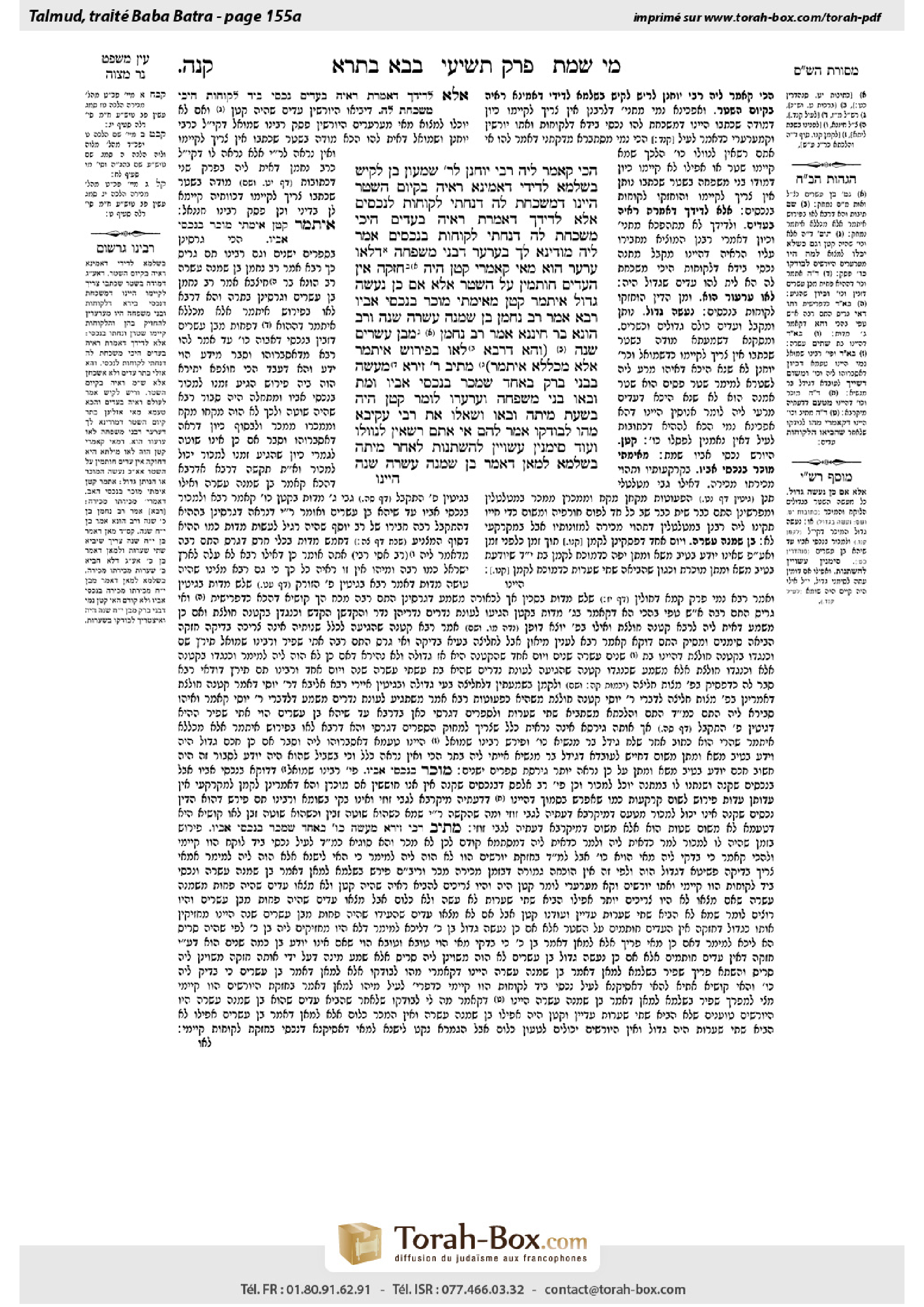
Bava Batra 155a: Talmud study for Daf Yomi
Study the Talmud for Daf Yomi with scanned pages, Hebrew text, English translations from Sefaria and AI-generated French translations.
Passage selection and English or AI-generated French translation are available where the scan has annotations. Daf Study is independent of Torah-Box and Sefaria.
Browse Bava Batra · בבא בתרא · All tractatesBava Batra 155a text and translations
This page of Bava Batra includes the Aramaic text, an English translation and an AI-generated French translation, alongside the scan above.
בבא בתרא קנ״ה א · Aramaic and Hebrew text
הָכִי קָאָמַר לֵיהּ רַבִּי יוֹחָנָן לְרַבִּי שִׁמְעוֹן בֶּן לָקִישׁ: בִּשְׁלָמָא לְדִידִי, דְּאָמֵינָא: רְאָיָה בְּקִיּוּם הַשְּׁטָר – הַיְינוּ דְּמַשְׁכַּחַתְּ לַהּ דְּנָחֲתִי לָקוֹחוֹת לִנְכָסִים. אֶלָּא לְדִידָךְ דְּאָמְרַתְּ רְאָיָה בְּעֵדִים, הֵיכִי מַשְׁכַּחַתְּ לַהּ דְּנָחֲתִי לָקוֹחוֹת בִּנְכָסִים?
אֲמַר לֵיהּ: מוֹדֵינָא לָךְ בְּעַרְעָר דִּבְנֵי מִשְׁפָּחָה, דְּלָאו עַרְעָר הוּא. מַאי קָאָמְרִי? קָטָן הָיָה; חֲזָקָה אֵין הָעֵדִים חוֹתְמִין עַל הַשְּׁטָר, אֶלָּא אִם כֵּן נַעֲשָׂה גָּדוֹל.
אִיתְּמַר: קָטָן, מֵאֵימָתַי מוֹכֵר בְּנִכְסֵי אָבִיו? רָבָא אָמַר רַב נַחְמָן: בֶּן שְׁמֹנֶה עֶשְׂרֵה שָׁנָה, וְרַב הוּנָא בַּר חִינָּנָא אָמַר רַב נַחְמָן: מִבֶּן עֶשְׂרִים שָׁנָה. וְהָא דְּרָבָא – לָאו בְּפֵירוּשׁ אִיתְּמַר, אֶלָּא מִכְּלָלָא אִיתְּמַר.
מֵתִיב רַבִּי זֵירָא: מַעֲשֶׂה בִּבְנֵי בְרַק בְּאֶחָד שֶׁמָּכַר בְּנִכְסֵי אָבִיו, וּמֵת; וּבָאוּ בְּנֵי מִשְׁפָּחָה, וְעִרְעֲרוּ לוֹמַר: קָטָן הָיָה בִּשְׁעַת מִיתָה. וּבָאוּ וְשָׁאֲלוּ אֶת רַבִּי עֲקִיבָא: מַהוּ לְבוֹדְקוֹ? אָמַר לָהֶם: אִי אַתֶּם רַשָּׁאִין לְנַוְּולוֹ. וְעוֹד, סִימָנִין עֲשׂוּיִין לְהִשְׁתַּנּוֹת לְאַחַר מִיתָה. בִּשְׁלָמָא לְמַאן דְּאָמַר בֶּן שְׁמֹנֶה עֶשְׂרֵה שָׁנָה,
Bava Batra 155a · English translation
This is what Rabbi Yoḥanan said to Rabbi Shimon ben Lakish: Granted, according to my explanation of the mishna, that I say that presenting proof through the ratification of the deed is sufficient in order to enable the recipient to claim the gift, this is the reason that with regard to the incident in Bnei Brak you find the possibility that the buyers take possession of the property by ratifying the deed. It is therefore possible that the buyers held the property, and the relatives were claiming it from them. But according to you, that you say that the proof must be presented by bringing witnesses, how can you find circumstances in which the buyers take possession of the property, since they have no proof?
Rabbi Shimon ben Lakish said to Rabbi Yoḥanan: I concede to you with regard to a case where the members of the deceased’s family contested the legality of the buyers’ claim that their contesting the legality of that claim is not taken into consideration, since they are contesting the deed held by the buyers. It is therefore possible for the buyers to take possession of the property, as in this case what do the relatives say? They say that the seller was a minor. But there is a presumption that witnesses do not sign the document unless the seller has become an adult. In the mishna, by contrast, there is no presumption that counters the giver’s claim that he was on his deathbed. The recipient is therefore required to bring proof that the giver was healthy.
§ It was stated that there was a dispute with regard to the following matter: From when, i.e., from what age, can a minor sell his deceased father’s property? Rava says that Rav Naḥman says: From the time he is eighteen years old, and Rav Huna bar Ḥinnana says that Rav Naḥman says: From the time he is twenty years old. The Gemara notes: And this statement of Rava was not stated explicitly; rather, it was stated by inference.
Rabbi Zeira raises an objection from the aforementioned baraita: There was an incident in Bnei Brak involving one who sold some of his father’s property, which he had inherited, and he died, and the members of his family came and contested the sale, saying: He was a minor at the time of his death, and therefore the sale was not valid. And they came and asked Rabbi Akiva: What is the halakha? Is it permitted to exhume the corpse in order to examine it and ascertain whether or not the heir was a minor at the time of his death? Rabbi Akiva said to them: It is not permitted for you to disgrace him for the sake of a monetary claim. And furthermore, signs indicating puberty are likely to change after death, and therefore nothing can be proved by exhuming the body. Rabbi Zeira explains the objection: Granted, according to the one who says that the heir can sell the property once he is eighteen years old,
Bava Batra 155a · Traduction française (IA)
C’est ce que le maître Yochanan a dit au maître Simon ben Lakish : C’est vrai, selon mon explication de la mitsna, que je dis que la preuve par la ratification de l’acte suffit pour permettre au destinataire de revendiquer le don, c’est la raison pour laquelle, concernant l’incident à Béne-Berak, vous trouvez la possibilité que les acheteurs prennent possession de la propriété par la ratification de l’acte. Il est donc possible que les acheteurs aient possédé la propriété, et les parents réclamaient celle-ci. Mais selon vous, qui dites que la preuve doit être apportée par témoins, comment pouvez-vous trouver des circonstances où les acheteurs prennent possession de la propriété, puisqu’ils n’ont pas de preuve ?
Le maître Simon ben Lakish a répondu au maître Yochanan : Je vous concède concernant un cas où les membres de la famille du défunt contestent la légitimité de la revendication des acheteurs, leur contestation ne sera pas prise en compte, puisqu’ils contestent l’acte détenue par les acheteurs. Il est donc possible que les acheteurs prennent possession de la propriété, comme dans ce cas, que disent les parents ? Ils disent que le vendeur était mineur. Mais il y a une présomption que les témoins ne signent pas l’acte à moins que le vendeur ne soit devenu majeur. Dans la mitsna, par contre, il n’y a pas de présomption qui contredit la revendication du donneur selon lequel il était sur son lit de mort. Le destinataire est donc tenu de fournir une preuve selon laquelle le donneur était en bonne santé.
§ On a évoqué un débat concernant la question suivante : À partir de quel âge un mineur peut-il vendre la propriété de son père décédé ? Rava dit que Rav Naḥman dit : À partir de l’âge de dix-huit ans, et Rav Huna bar Ḥinnana dit que Rav Naḥman dit : À partir de l’âge de vingt ans. La Guemara note : Et cette déclaration de Rava n’a pas été formulée explicitement ; elle a été évoquée par déduction.
Le maître Zéira émet une objection à partir de la baraïta mentionnée précédemment : Il y avait un incident à Béne-Berak concernant une personne qui avait vendu une partie de la propriété de son père, qu’il avait héritée, et il est décédé, et les membres de sa famille sont venus contester la vente, disant : Il était mineur au moment de sa mort, donc la vente n’était pas valide. Et ils sont venus demander à Rabbi Akiva : Quelle est la halakha ? Est-il permis d’exhumer le corps afin d’examiner s’il s’agissait d’un mineur au moment de sa mort ? Rabbi Akiva a dit à eux : Il n’est pas permis de déshonorer le défunt à cause d’une revendication monétaire. De plus, les signes de la puberté peuvent changer après la mort, donc rien ne peut être prouvé en exhumant le corps. Le maître Zéira explique l’objection : C’est vrai, selon celui qui dit que l’héritier peut vendre la propriété à l’âge de dix-huit ans,
Traduction française générée par IA à partir de l’édition anglaise de Sefaria. Vérifie toujours un passage avec le texte source.
Text from Sefaria: William Davidson Edition - Vocalized Aramaic (CC BY NC); William Davidson Edition - English (CC BY NC).