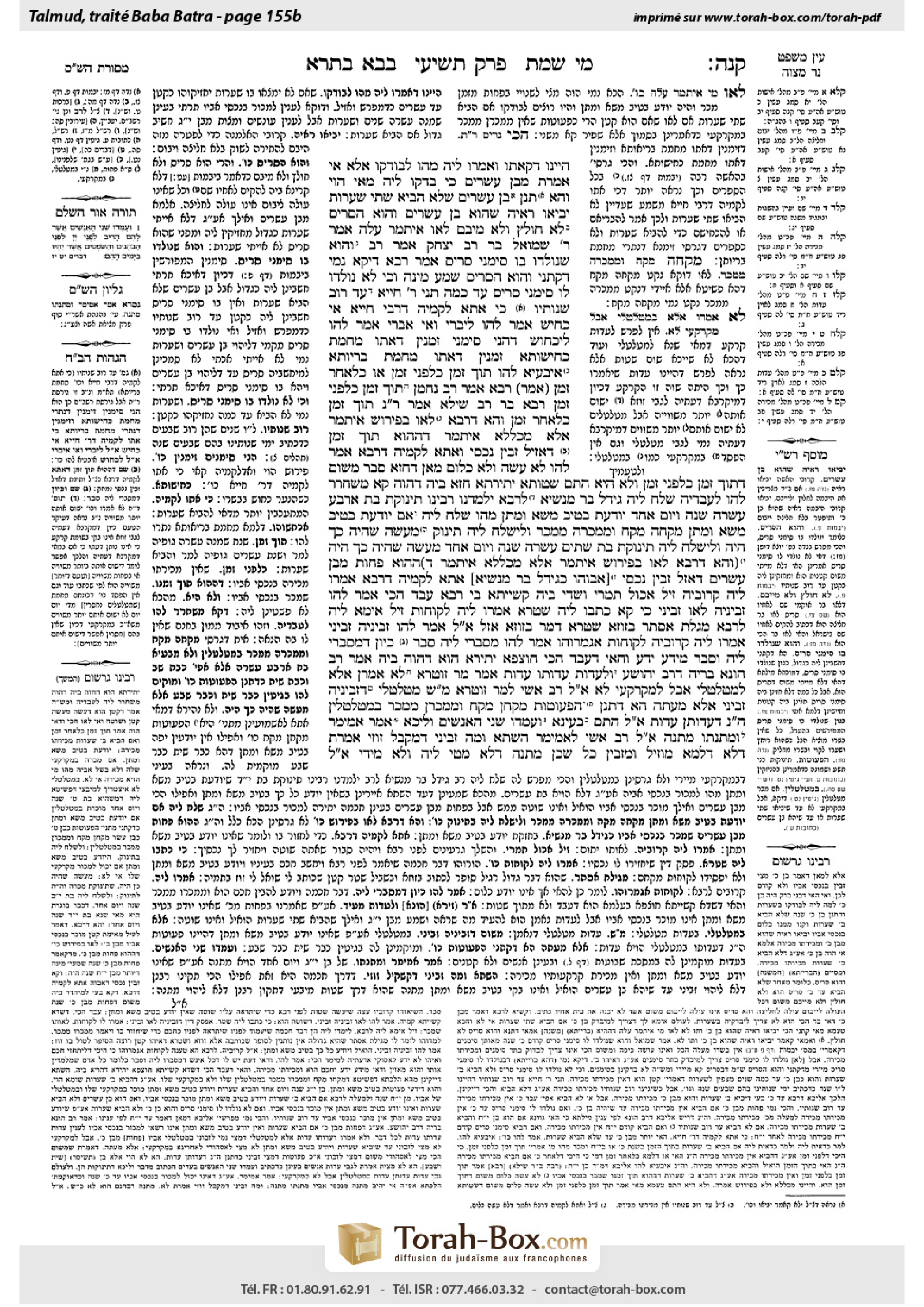
Bava Batra 155b: Talmud study for Daf Yomi
Study the Talmud for Daf Yomi with scanned pages, Hebrew text, English translations from Sefaria and AI-generated French translations.
Passage selection and English or AI-generated French translation are available where the scan has annotations. Daf Study is independent of Torah-Box and Sefaria.
Browse Bava Batra · בבא בתרא · All tractatesBava Batra 155b text and translations
This page of Bava Batra includes the Aramaic text, an English translation and an AI-generated French translation, alongside the scan above.
בבא בתרא קנ״ה ב · Aramaic and Hebrew text
הַיְינוּ דְּקָאָתוּ וְאָמְרוּ לֵיהּ: מַהוּ לְבוֹדְקוֹ. אֶלָּא אִי אָמְרַתְּ מִבֶּן עֶשְׂרִים, כִּי בָּדְקוּ לֵיהּ מַאי הָוֵי? וְהָא תְּנַן: בֶּן עֶשְׂרִים שֶׁלֹּא הֵבִיא שְׁתֵּי שְׂעָרוֹת – יָבִיאוּ רְאָיָה שֶׁהוּא בֶּן עֶשְׂרִים; וְהוּא הַסָּרִיס, לֹא חוֹלֵץ וְלֹא מְיַבֵּם!
לָאו אִיתְּמַר עֲלַהּ, אָמַר רַבִּי שְׁמוּאֵל בַּר רַב יִצְחָק אָמַר רַב: וְהוּא שֶׁנּוֹלְדוּ בּוֹ סִימָנֵי סָרִיס? אָמַר רָבָא: דַּיְקָא נָמֵי, דְּקָתָנֵי: וְהוּא הַסָּרִיס; שְׁמַע מִינַּהּ.
וְכִי לָא נוֹלְדוּ לוֹ סִימָנֵי סָרִיס, עַד כַּמָּה? תָּנֵי רַבִּי חִיָּיא: עַד רוֹב שְׁנוֹתָיו. כִּי אֲתָא לְקַמֵּיהּ דְּרַבִּי חִיָּיא, אִי כָּחֵישׁ אֲמַר לְהוּ: לִיבְרֵי; וְאִי אִבְּרִי אֲמַר לְהוּ: לִיכְחוֹשׁ. דְּהָנֵי סִימָנֵי – זִמְנִין דְּאָתוּ מֵחֲמַת כְּחִישׁוּתָא, זִמְנִין דְּאָתוּ מֵחֲמַת בְּרִיּוּתָא.
אִיבַּעְיָא לְהוּ: תּוֹךְ זְמַן – כְּלִפְנֵי זְמַן, אוֹ כִּלְאַחַר זְמַן? (אָמַר) רָבָא אָמַר רַב נַחְמָן: תּוֹךְ זְמַן כְּלִפְנֵי זְמַן. רָבָא בַּר רַב שֵׁילָא אָמַר רַב נַחְמָן: תּוֹךְ זְמַן כִּלְאַחַר זְמַן.
וְהָא דְּרָבָא, לָאו בְּפֵירוּשׁ אִיתְּמַר, אֶלָּא מִכְּלָלָא אִיתְּמַר – דְּהָהוּא תּוֹךְ זְמַן דְּאָזֵיל זַבֵּין נִכְסֵי, וַאֲתָא לְקַמֵּיהּ דְּרָבָא, אֲמַר לְהוּ: לֹא עָשָׂה וְלֹא כְלוּם. מַאן דַּחֲזָא סָבַר, מִשּׁוּם דְּתוֹךְ זְמַן כְּלִפְנֵי זְמַן; וְלָא הִיא, הָתָם שְׁטוּתָא יַתִּירְתָא חֲזָא בֵּיהּ – דַּהֲוָה קָא מְשַׁחְרַר לְהוּ לְעַבְדֵיהּ.
שְׁלַח לֵיהּ גִּידֵּל בַּר מְנַשְּׁיָא לְרָבָא, יְלַמְּדֵנוּ רַבֵּינוּ: תִּינוֹקֶת בַּת אַרְבַּע עֶשְׂרֵה שָׁנָה וְיוֹם אֶחָד, יוֹדַעַת בְּטִיב מַשָּׂא וּמַתָּן; מַהוּ? שְׁלַח לֵיהּ: אִם יוֹדַעַת בְּטִיב מַשָּׂא וּמַתָּן – מִקָּחָהּ מִקָּח וּמִמְכָּרָהּ מִמְכָּר.
וְלִישְׁלַח לֵיהּ תִּינוֹק! מַעֲשֶׂה שֶׁהָיָה כָּךְ הָיָה. וְלִישְׁלַח לֵיהּ תִּינוֹקֶת בַּת שְׁתֵּים עֶשְׂרֵה שָׁנָה וְיוֹם אֶחָד! מַעֲשֶׂה שֶׁהָיָה כָּךְ הָיָה.
וְהָא דְּרָבָא, לָאו בְּפֵירוּשׁ אִיתְּמַר, אֶלָּא מִכְּלָלָא אִיתְּמַר – דְּהָהוּא פָּחוּת מִבֶּן עֶשְׂרִים דַּאֲזַל זַבֵּין נִכְסֵי אֲבוּהוּ, כְּגִידֵּל בַּר מְנַשְּׁיָא. אֲתָא לְקַמֵּיהּ דְּרָבָא, אֲמַרוּ לֵיהּ קְרוֹבֵיהּ: זִיל אֱכוֹל תַּמְרֵי, וּשְׁדִי (בֵּיהּ) קַשְׁיָיתָא בֵּי רָבָא. עֲבַד הָכִי, אֲמַר לְהוּ: זְבִינֵיהּ לָאו זְבִינֵי.
כִּי קָא כָּתְבוּ לֵיהּ שְׁטָרָא, אֲמַרוּ לֵיהּ לָקוֹחוֹת: זִיל אֵימָא לֵיהּ לְרָבָא, מְגִלַּת אֶסְתֵּר – בְּזוּזָא; שְׁטָרָא דְמָר בְּזוּזָא?! אֲזַל אֲמַר לֵיהּ. אֲמַר לְהוּ: זְבִינֵיהּ זְבִינֵי. אֲמַרוּ לֵיהּ קְרוֹבֵיהּ: לָקוֹחוֹת אַגְמְרוּהוּ! אֲמַר לְהוּ: מַסְבְּרִי לֵיהּ – סָבַר. כֵּיוָן דְּמַסְבְּרִי לֵיהּ, וְסָבַר – מִידָּע יָדַע, וְהַאי דַּעֲבַד הָכִי – חוּצְפָּא יַתִּירָא הוּא דַּהֲוָה בֵּיהּ.
אָמַר רַב הוּנָא בְּרֵיהּ דְּרַב יְהוֹשֻׁעַ: וּלְעֵדוּת – עֵדוּתוֹ עֵדוּת. אָמַר מָר זוּטְרָא: לָא אֲמַרַן אֶלָּא לְמִטַּלְטְלֵי, אֲבָל לִמְקַרְקְעֵי – לָא.
אֲמַר לֵיהּ רַב אָשֵׁי לְמָר זוּטְרָא: מַאי שְׁנָא מִטַּלְטְלִי – דִּזְבִינֵיהּ זְבִינֵי; אֶלָּא מֵעַתָּה, הָא דִּתְנַן: הַפָּעוֹטוֹת – מִקָּחָן מִקָּח וּמִמְכָּרָן מִמְכָּר בְּמִטַּלְטְלִין, הָכִי נָמֵי דְּעֵדוּתָן עֵדוּת?! אָמַר לֵיהּ: הָתָם, בָּעֵינָא ״וְעָמְדוּ שְׁנֵי הָאֲנָשִׁים״, וְלֵיכָּא.
אָמַר אַמֵּימָר: וּמַתְּנָתוֹ מַתָּנָה. אֲמַר לֵיהּ רַב אָשֵׁי לְאַמֵּימָר: הַשְׁתָּא, וּמָה זְבִינֵי – דִּמְקַבֵּל זוּזֵי, אָמְרַתְּ דְּלָא – דִּלְמָא מוֹזֵיל וּמְזַבֵּין; כׇּל שֶׁכֵּן מַתָּנָה – דְּלָא מָטֵי לֵיהּ וְלָא מִידֵּי! אֲמַר לֵיהּ:
Bava Batra 155b · English translation
this is the reason that they came and said to Rabbi Akiva: What is the halakha? Is it permitted to examine the corpse? But if you say that he can sell the property from the time he is twenty years old, even if they examine him, what of it? But didn’t we learn in a mishna (Nidda 47b): With regard to a twenty-year-old man who did not develop two pubic hairs, proof must be brought that he is twenty years old, and then he is no longer considered a minor. And he is the sexually underdeveloped man, who is excluded from the mitzva of levirate marriage. Therefore, if his married brother dies childless, he neither performs ḥalitza nor enters into levirate marriage with his widow. Since a twenty-year-old is considered an adult even if he has not developed signs of puberty, there is no reason to examine the body.
The Gemara replies: Wasn’t it stated with regard to that mishna: Rabbi Shmuel bar Rav Yitzḥak says that Rav says: And is this the halakha only where he developed the signs of a sexually underdeveloped man? Otherwise, a twenty-year-old who has not developed two pubic hairs is still considered a minor. The examination of the deceased could therefore be effective to see if he has other signs of being sexually underdeveloped. Rava said: The language of the mishna is also precise, as it teaches: And he is the sexually underdeveloped man. The usage of the definitive article indicates that the mishna is referring to one who is clearly a sexually underdeveloped man. The Gemara affirms: One can conclude from the mishna that the mishna is speaking of one who developed the signs of a sexually underdeveloped man.
The Gemara asks: And if he did not develop the signs of a sexually underdeveloped man, until when is he considered a minor if he does not develop two pubic hairs? Rabbi Ḥiyya teaches in a baraita: He is considered a minor until most of his years have elapsed, i.e., until he is thirty-five years old. When the case of one who had not developed pubic hair would come before Rabbi Ḥiyya, he would offer the following advice: If the person was thin, he would say to those appearing in court: Cause him to become fat, and if he was fat, he would say to them: Cause him to become thin. This is because these signs indicating puberty sometimes develop due to excessive thinness, and sometimes they develop due to corpulence.
§ A dilemma was raised before the Sages: During the time, i.e., the year, when a minor comes of age with regard to selling his deceased father’s property, i.e., during his eighteenth or twentieth year, is this year considered as before the time that he comes of age or is it considered as after the time? Does one come of age at the beginning or end of that year? Rava says that Rav Naḥman says: During that time is considered as before the time, and he does not come of age until the year has elapsed. Rava bar Rav Sheila says that Rav Naḥman says: During that time is considered as after the time, and he is considered as having come of age during that year.
The Gemara notes: And this statement of Rava was not stated explicitly; rather, it was stated by inference. As there was a certain person who was during the time, i.e., the year, when one comes of age who went and sold his father’s property, and the case came before Rava. Rava said to the litigants: He did not do anything, and the sale is not valid. One who observed Rava’s ruling assumed that he ruled in this manner because he maintained that during the time when he comes of age is considered as before the time. But that is not so. The reason for Rava’s ruling was that there, Rava observed excessive mental incompetence in the behavior of that individual, as he was emancipating his slaves. Since Rava saw that he was mentally incompetent, he invalidated the sale.
§ Giddel bar Menashya sent an inquiry to Rava: Let our teacher instruct us: With regard to a girl who is fourteen years and one day old who understands the nature of business negotiations, what is the halakha? Can she sell property that she inherited from her father? Rava sent a reply to Giddel bar Menashya: If she understands the nature of business negotiations her purchase is a valid purchase and her sale is a valid sale.
The Gemara asks: But Giddel could have sent this question to Rava with regard to a boy. Why did he not do so? The Gemara answers: The incident that took place, took place in this way. The Gemara asks: But he could have sent this question to Rava with regard to a girl who is twelve years and one day old, at which age a girl reaches her majority. Why did he not do so? The Gemara answers: The incident that took place, took place in this way.
The Gemara notes: And this statement of Rava was not stated explicitly; rather, it was stated by inference, as it was inferred from the following incident. There was a certain person who was under twenty years old and understood business negotiations who went and sold his father’s property, in accordance with the ruling that Rava sent to Giddel bar Menashya, and the case came before Rava. The seller’s relatives said to the one who sold the property: Go eat dates and throw the pits into Rava’s house, in order to prove to Rava that their relative was not mentally competent. He did so. Rava said to them: His sale is not a valid sale.
When they were writing for him a writ containing the decision, the buyers said to the seller, in order to prove that he was mentally competent: Go and say to Rava: The scroll of Esther, which is a large scroll, is bought for a dinar. Why then does the short writ containing Master’s ruling also cost a dinar, which was the scribe’s fee? The seller went and said this to Rava. Rava said to them: His sale is a valid sale. The boy’s relatives said to Rava: The buyers taught him to say that. Rava said to them: Even so, when they explain the matter to him he understands. Since, when they explain a matter to him he understands, he knows what he is doing. And the reason that he acted in this manner, throwing the pits into Rava’s house, was because of excessive impudence that was in him, not mental incompetence.
§ Rav Huna, son of Rav Yehoshua, says: And with regard to the testimony of one who is not old enough to sell property that he inherits from his father, his testimony is valid testimony. Mar Zutra said: We said that his testimony is valid only with regard to movable property, but not with regard to land.
Rav Ashi said to Mar Zutra: In what way is movable property different from land? It is different because with regard to movable property his sale is a valid sale. But if that is so, consider that which we learned in a mishna (Gittin 59a): A purchase made by young children is a valid purchase, and a sale made by them is a valid sale. These halakhot apply to transactions involving movable property. Is it possible that also in the case of young children their testimony is valid testimony? Isn’t it an established halakha that minors are disqualified from bearing witness? Mar Zutra said to Rav Ashi: There, with regard to testimony, I require the witnesses to be men, as the verse states: “Then the two men shall stand” (Deuteronomy 19:17), which is interpreted as referring to witnesses, and this requirement is not fulfilled in the case of young children.
§ Ameimar says: With regard to one who is not old enough to sell property that he inherits from his father, if he gave a gift from the property, his gift is a valid gift. Rav Ashi said to Ameimar: Now, if with regard to a sale, in which he receives money, you say that the Sages instituted an ordinance that he is not authorized to sell, lest he reduce the price of the property and deplete his father’s estate, all the more so in the case of a gift he is not authorized to give a gift, as nothing at all comes into his possession in exchange. Ameimar said to Rav Ashi:
Bava Batra 155b · Traduction française (IA)
C’est la raison pour laquelle ils sont venus dire à Rabbi Akiva : Quel est le halakha ? Est-il permis d’examiner le corps ? Mais si vous dites qu’il peut vendre la propriété à partir de l’âge de vingt ans, même s’ils l’examinent, qu’y a-t-il de particulier ? Mais n’avons-nous pas appris dans une mitsva (Nidda 47b) : Concernant un homme de vingt ans qui n’a pas développé deux poils pubiens, il faut apporter la preuve qu’il a vingt ans, et alors il n’est plus considéré comme mineur. Et c’est l’homme sexuellement sous-développé, exclu de la mitsva du mariage levirique. Ainsi, si son frère marié meurt sans enfants, il ne pratique pas la halitza ni ne se marie leviriquement avec sa veuve. Puisque l’homme de vingt ans est considéré comme majeur même s’il n’a pas développé les signes de la puberté, il n’y a pas de raison d’examiner le corps.
Le Guemara répond : N’a-t-il pas été dit concernant cette mitsva : Rabbi Shmuel bar Rav Yitzḥak dit que Rav dit : Et est-ce la halakha uniquement dans le cas où il a développé les signes de l’homme sexuellement sous-développé ? Sinon, un homme de vingt ans qui n’a pas développé deux poils pubiens est encore considéré comme mineur. L’examen du défunt pourrait donc être efficace pour vérifier s’il présente d’autres signes de sous-développement sexuel. Rava a dit : La formulation de la mitsva est aussi précise, car elle enseigne : Et c’est l’homme sexuellement sous-développé. L’usage de l’article défini indique que la mitsva fait référence à un homme clairement sexuellement sous-développé. Le Guemara affirme : On peut conclure de la mitsva que la mitsva parle d’un homme qui a développé les signes de l’homme sexuellement sous-développé.
Le Guemara pose la question : Et s'il n'a pas développé les signes d'un homme sexuellement sous-développé, jusqu'à quel âge est-il considéré comme mineur s'il n'a pas développé deux poils pubiens ? Rabbi Ḥiyya enseigne dans une baraïta : Il est considéré comme mineur jusqu'à ce que la plupart de ses années aient passé, c'est-à-dire jusqu'à l'âge de trente-cinq ans. Lorsque le cas d'une personne qui n'avait pas développé de poils pubiens est venu devant Rabbi Ḥiyya, il donnait le conseil suivant : Si la personne était maigre, il disait à ceux qui étaient présents en cour : Faites-le grossir, et si elle était corpulente, il disait : Faites-le maigrir. C'est parce que ces signes de puberté se développent parfois à cause de la maigreur excessive, et parfois à cause de la corpulence.
§ Un dilemme a été soulevé devant les Sages : Pendant la période, c'est-à-dire l'année, où un mineur atteint l'âge de vendre la propriété de son père décédé, c'est-à-dire pendant son dix-huitième ou vingtième année, cette année est-elle considérée comme avant ou après le moment où il atteint l'âge ? Le passage à l'âge a-t-il lieu au début ou à la fin de cette année ? Rava dit que Rav Naḥman dit : Pendant cette période est considérée comme avant le moment, et il ne devient majeur qu'après que l'année ait pris fin. Rava bar Rav Sheila dit que Rav Naḥman dit : Pendant cette période est considérée comme après le moment, et il est considéré comme majeur pendant cette année.
Le Guemara note : Et cette déclaration de Rava n’a pas été formulée explicitement ; elle a été déduite par l’intermédiaire d’une inférence. Car il y avait un certain homme qui était pendant la période, c’est-à-dire l’année, où l’on atteint l’âge, qui est allé vendre la propriété de son père, et le cas est venu devant Rava. Rava a dit aux parties : Il n’a pas fait de chose, et la vente n’est pas valide. Celui qui a observé la décision de Rava a supposé qu’il avait rendu ce jugement parce qu’il maintenait que la période pendant laquelle l’on atteint l’âge est considérée comme avant le moment. Mais ce n’est pas le cas. La raison de la décision de Rava était que, là, Rava a observé une insuffisance mentale excessive dans le comportement de cette personne, car il libérait ses esclaves. Puisque Rava a vu qu’il était mentalement incompétent, il a invalidé la vente.
§ Giddel bar Menashya a envoyé une question à Rava : Faites-nous instruire par notre maître : Concernant une fille de quatorze ans et un jour qui comprend la nature des négociations commerciales, quelle est la halakha ? Peut-elle vendre une propriété qu’elle a héritée de son père ? Rava a envoyé une réponse à Giddel bar Menashya : Si elle comprend la nature des négociations commerciales, sa vente est une vente valide et sa vente est une vente valide.
Le Guemara pose la question : Mais Giddel aurait pu envoyer cette question à Rava concernant un garçon. Pourquoi n’a-t-il pas fait ainsi ? Le Guemara répond : L’incident qui s’est produit s’est produit ainsi. Le Guemara pose la question : Mais il aurait pu envoyer cette question à Rava concernant une fille de douze ans et un jour, à l’âge où une fille atteint la majorité. Pourquoi n’a-t-il pas fait ainsi ? Le Guemara répond : L’incident qui s’est produit s’est produit ainsi.
Le Guemara note que cette déclaration de Rava n’a pas été formulée explicitement, mais a été déduite par l’intermédiaire d’une inférence, car elle a été inférée à partir de l’incident suivant. Il y avait un certain homme, âgé de moins de vingt ans, mais qui comprenait les négociations commerciales, qui est allé vendre la propriété de son père conformément à la décision que Rava avait envoyée à Giddel bar Menashya, et le cas est venu devant Rava. Les parents du vendeur ont dit au vendeur : Va manger des dattes et jette les noyaux dans la maison de Rava, afin de prouver à Rava que leur parent n’était pas mentalement compétent. Il l’a fait. Rava a dit à eux : Sa vente n’est pas une vente valide.
Lorsqu’ils écrivaient pour lui un document contenant la décision, les acheteurs ont dit au vendeur, afin de prouver qu’il était mentalement compétent : Va et dis à Rava : Le rouleau d’Esther, qui est un rouleau grand, est acheté pour un dinar. Pourquoi alors le petit document contenant la décision du maître coûte aussi un dinar, qui était la rétribution du scribe ? Le vendeur est allé dire cela à Rava. Rava a dit à eux : Sa vente est une vente valide. Les parents du garçon ont dit à Rava : Les acheteurs lui ont appris à dire cela. Rava a dit à eux : Même ainsi, quand ils expliquent la chose à lui, il comprend. Puisque, quand ils expliquent une chose à lui, il comprend, il sait ce qu’il fait. Et la raison pour laquelle il a agi ainsi, jetant les noyaux dans la maison de Rava, était à cause de l’audace excessive qu’il avait, pas une insuffisance mentale.
§ Rav Huna, fils de Rav Yéhoshua, dit : Et concernant le témoignage d'une personne qui n'est pas encore majeure pour vendre une propriété qu'elle hérite de son père, son témoignage est considéré comme valide. Mar Zutra dit : Nous avions dit que son témoignage est valide uniquement concernant les biens mobiliers, mais pas concernant la terre.
Rav Ashi dit à Mar Zutra : De quelle manière les biens mobiliers diffèrent-ils des terres ? Ils diffèrent car concernant les biens mobiliers, sa vente est une vente valide. Mais si c'est ainsi, considérez ce que nous avons appris dans une mitsva (Gittin 59a) : Un achat effectué par des enfants est un achat valide, et une vente effectuée par eux est une vente valide. Ces halakhot s'appliquent aux transactions concernant les biens mobiliers. Est-il possible que dans le cas des enfants aussi leur témoignage soit valide ? N'est-ce pas une halakha établie que les mineurs sont exclus du témoignage ? Mar Zutra dit à Rav Ashi : Là, concernant le témoignage, je exige que les témoins soient des hommes, comme le dit la Paracha : « Puis deux hommes se dresseront » (Deutéronome 19:17), ce qui est interprété comme faisant référence aux témoins, et cette exigence n'est pas remplie dans le cas des enfants.
§ Ameimar dit : Concernant celui qui n'est pas encore majeure pour vendre une propriété qu'il hérite de son père, si il fait un don à partir de la propriété, son don est un don valide. Rav Ashi dit à Ameimar : Maintenant, si concernant une vente, dans laquelle il reçoit de l'argent, vous dites que les Sages ont institué un ordonnance selon laquelle il n'est pas autorisé à vendre, de peur qu'il réduise le prix de la propriété et qu'il épuise l'immobilier de son père, encore plus dans le cas d'un don, il n'est pas autorisé à faire un don, car rien ne lui vient en échange. Ameimar dit à Rav Ashi :
Traduction française générée par IA à partir de l’édition anglaise de Sefaria. Vérifie toujours un passage avec le texte source.
Text from Sefaria: William Davidson Edition - Vocalized Aramaic (CC BY NC); William Davidson Edition - English (CC BY NC).