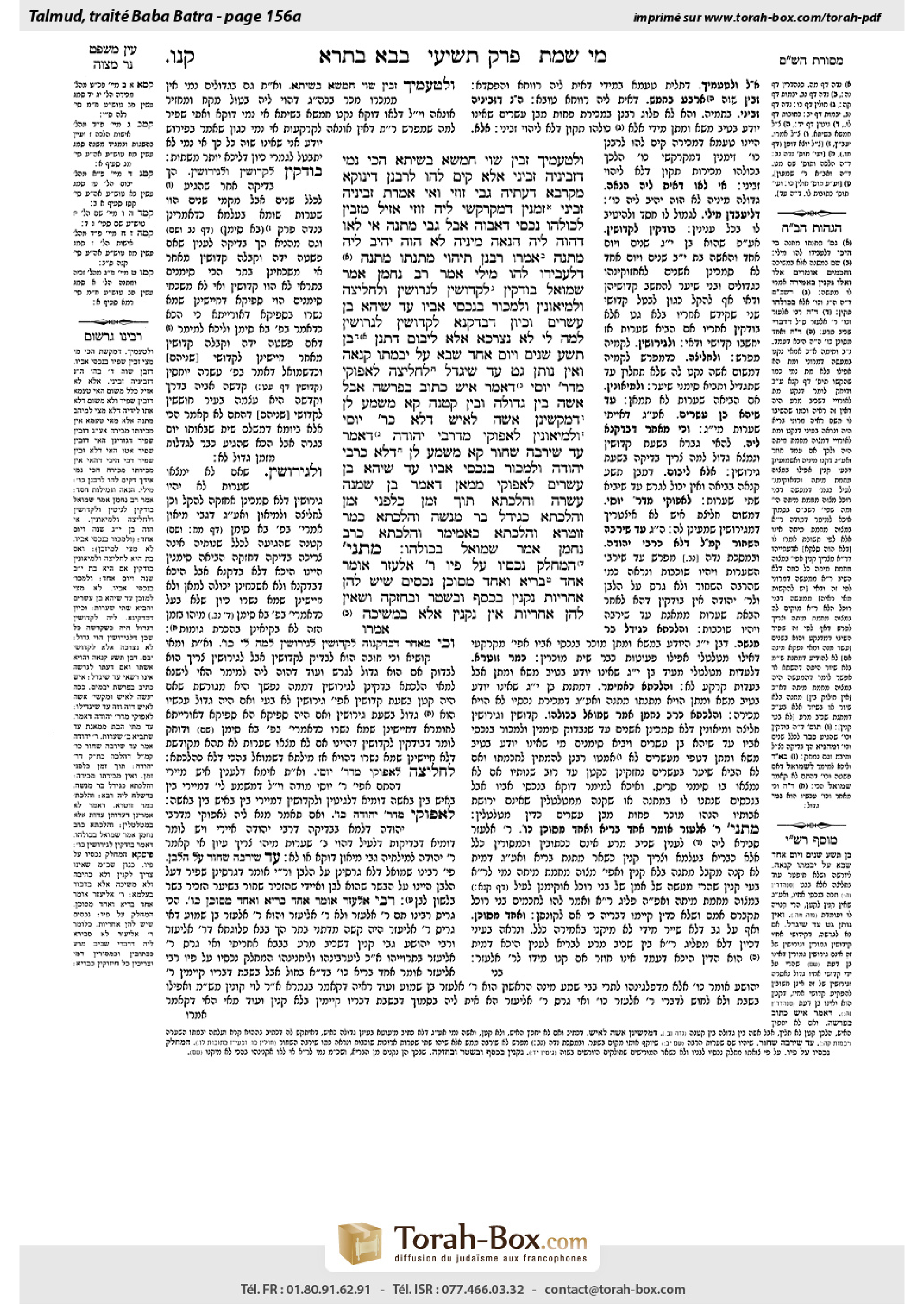
Bava Batra 156a: Talmud study for Daf Yomi
Study the Talmud for Daf Yomi with scanned pages, Hebrew text, English translations from Sefaria and AI-generated French translations.
Passage selection and English or AI-generated French translation are available where the scan has annotations. Daf Study is independent of Torah-Box and Sefaria.
Browse Bava Batra · בבא בתרא · All tractatesBava Batra 156a text and translations
This page of Bava Batra includes the Aramaic text, an English translation and an AI-generated French translation, alongside the scan above.
בבא בתרא קנ״ו א · Aramaic and Hebrew text
וּלְטַעְמָיךְ, זַבֵּין שָׁוֵי חַמְשָׁא – בְּשִׁיתָּא, הָכִי נָמֵי דִּזְבִינֵיהּ זְבִינֵי?!
אֶלָּא קִים לְהוּ לְרַבָּנַן דְּיָנוֹקָא מְקָרְבָא דַּעְתֵּיהּ גַּבֵּי זוּזֵי; וְאִי אָמְרַתְּ זְבִינֵיהּ זְבִינֵי, זִמְנִין דִּמְקַרְקְשִׁי לֵיהּ זוּזֵי, אָזֵיל מְזַבֵּין לְכוּלְּהוּ נִכְסֵי דַּאֲבוּהּ. אֲבָל גַּבֵּי מַתָּנָה, אִי לָאו דַּהֲוָה לֵיהּ הֲנָאָה מִינֵּיהּ – לָא הֲוָה יָהֵיב לֵיהּ מַתָּנָה; אֲמַרוּ רַבָּנַן: תֶּיהְוֵי מַתְּנָתוֹ מַתָּנָה, דְּלִעְבְּידוּ לְהוּ מִילֵּי.
אָמַר רַב נַחְמָן אָמַר שְׁמוּאֵל: בּוֹדְקִין לְקִדּוּשִׁין, לְגֵרוּשִׁין, וְלַחֲלִיצָה, וּלְמֵיאוּנִין. וְלִמְכּוֹר בְּנִכְסֵי אָבִיו – עַד שֶׁיְּהֵא בֶּן עֶשְׂרִים.
וְכֵיוָן דִּבְדַקְנָא לְקִדּוּשִׁין, לְגֵרוּשִׁין לְמָה לִי? לֹא נִצְרְכָא אֶלָּא לְיִבּוּם – דִּתְנַן: בֶּן תֵּשַׁע שָׁנִים וְיוֹם אֶחָד שֶׁבָּא עַל יְבִמְתּוֹ – קְנָאָהּ. וְאֵין נוֹתֵן גֵּט עַד שֶׁיִּגְדַּל.
לַחֲלִיצָה – לְאַפּוֹקֵי מִדְּרַבִּי יוֹסֵי, דְּאָמַר: ״אִישׁ״ כָּתוּב בַּפָּרָשָׁה, אֲבָל אִשָּׁה – בֵּין גְּדוֹלָה וּבֵין קְטַנָּה; קָא מַשְׁמַע לַן דְּמַקְּשִׁינַן אִשָּׁה לְאִישׁ, דְּלָא כְּרַבִּי יוֹסֵי.
וּלְמֵיאוּנִין – לְאַפּוֹקֵי מִדְּרַבִּי יְהוּדָה, דְּאָמַר: עַד שֶׁיִּרְבֶּה שָׁחוֹר; קָא מַשְׁמַע לַן דְּלָא כְּרַבִּי יְהוּדָה.
וְלִמְכּוֹר בְּנִכְסֵי אָבִיו עַד שֶׁיְּהֵא בֶּן עֶשְׂרִים – לְאַפּוֹקֵי מִמַּאן דְּאָמַר בֶּן שְׁמֹנֶה עֶשְׂרֵה.
וְהִלְכְתָא: תּוֹךְ זְמַן, כְּלִפְנֵי זְמַן. וְהִלְכְתָא כְּגִידֵּל בַּר מְנַשֶּׁה.
וְהִלְכְתָא כְּמָר זוּטְרָא. וְהִלְכְתָא כְּאַמֵּימָר. וְהִלְכְתָא כְּרַב נַחְמָן אָמַר שְׁמוּאֵל – בְּכוּלְּהוּ.
מַתְנִי׳ הַמְחַלֵּק נְכָסָיו עַל פִּיו, רַבִּי אֶלְעָזָר אוֹמֵר: אֶחָד בָּרִיא וְאֶחָד מְסוּכָּן; נְכָסִים שֶׁיֵּשׁ לָהֶן אַחְרָיוּת – נִקְנִין בְּכֶסֶף וּבִשְׁטָר וּבַחֲזָקָה, וְשֶׁאֵין לָהֶן אַחְרָיוּת – אֵין נִקְנִין אֶלָּא בִּמְשִׁיכָה.
Bava Batra 156a · English translation
And according to your reasoning, that the money he receives in exchange for the property is a reason one could consider his sale valid, if he sold property worth five dinars for six dinars, would his sale also be a valid sale?
Rather, the Sages maintain that a child’s inclination is to be attracted to money. And if you say that his sale is a valid sale, there may be times that there are potential buyers who rattle the dinars before him in order to tempt him to sell, and he will go and sell all of his father’s property. That is why the Sages ruled that all of his sales are not valid. But with regard to a gift, if he did not derive benefit from the recipient, he would not give him a gift. The Sages therefore said: Let the gift of an orphan be a valid gift, so that people will perform beneficial matters for the orphans, as the orphan can reciprocate by giving gifts.
§ Rav Naḥman says that Shmuel says: Children who have reached the age of majority, i.e., a boy who is thirteen years old and a girl who is twelve years old, are examined for signs indicating puberty if it is necessary to determine their adulthood for the purpose of betrothal, for the purpose of divorce, for the purpose of ḥalitza, and for the purpose of stating a girl’s refusal to remain married. But in order to sell from the property that one inherited from his father, the seller must be older, and one cannot sell this property until the seller is twenty years old.
The Gemara asks: But once I examined the boy for the purpose of betrothal, why do I need to examine him again for the purpose of divorce? The Gemara answers: This is necessary only with regard to the levirate marriage of a minor, as we learned in a mishna (Nidda 45a): A boy who is nine years and one day old who engaged in intercourse with his yevama, i.e., his brother’s widow, acquired her as his wife by means of engaging in the act of intercourse. Although a minor cannot betroth a woman under ordinary circumstances, in the case of levirate marriage the act of intercourse of a nine-year-old with his yevama effects acquisition. But he cannot give her a bill of divorce until he reaches his majority. It is therefore necessary to examine him at the time of the divorce.
The Gemara explains why it is necessary to mention examining a boy for the purpose of ḥalitza: This is mentioned to the exclusion of that which Rabbi Yosei says, as Rabbi Yosei says: “Man,” i.e., an adult man, is written in the Torah passage with regard to ḥalitza, as the verse states: “And if the man does not wish to take his brother’s wife” (Deuteronomy 25:7). But a woman, whether she is an adult or a minor, can be released by ḥalitza, as the verse does not indicate her age. To counter this, Rav Naḥman teaches us that a woman is juxtaposed to a man in this passage, indicating that the yevama must also have reached adulthood, and the halakha is not in accordance with the opinion of Rabbi Yosei.
The Gemara explains why it is necessary to mention examining a person for the purpose of stating her refusal. This is mentioned to the exclusion of that which Rabbi Yehuda says, as Rabbi Yehuda says that a girl whose mother or brother married her off while she was a minor can nullify her marriage by refusing to remain married, and she can state this refusal until she reaches complete maturity, i.e., when the area covered by black pubic hairs is greater than the skin of the genital area. Rav Naḥman therefore teaches us that the halakha is not in accordance with the opinion of Rabbi Yehuda, and once a girl has developed two pubic hairs she cannot state her refusal.
Rav Naḥman states: But in order to sell from the property that one inherited from his father, the seller must be older, and he cannot sell the property until he is twenty years old. This is mentioned to the exclusion of the opinion of the one who says that the seller can be eighteen years old.
The Gemara concludes: And the halakha is that with regard to the age when a minor can sell property inherited from his father, during the time, i.e., during his twentieth year, is considered as before the time when it is permitted, and he cannot sell until the end of his twentieth year. And the halakha is in accordance with the ruling that Rava sent to Giddel bar Menashe, that a child who has reached his majority and understands the nature of business negotiations can sell land.
The Gemara continues: And the halakha is in accordance with the statement of Mar Zutra, that one who is not fit to sell land is also not fit to bear witness with regard to land. And the halakha is in accordance with the statement of Ameimar, that an orphan under the age of twenty can bestow gifts from the property he inherited from his father. And the halakha is in accordance with the statement that Rav Naḥman says that Shmuel says with regard to all the matters that he mentioned.
MISHNA: With regard to one who divides his property between various recipients by means of verbal instruction, Rabbi Elazar says: Both in the case of one who is healthy and in the case of one who is dangerously ill, the halakha is as follows: Property that serves as a guarantee, i.e., land, is acquired by means of money, by a deed of transfer, or by taking possession of it. And that which does not serve as a guarantee, i.e., movable property, can be acquired only by pulling.
Bava Batra 156a · Traduction française (IA)
Et selon votre raisonnement, l'argent qu'il reçoit en échange de la propriété est une raison qui pourrait valider sa vente. Si un homme vend une propriété valant cinq dinars contre six dinars, sa vente serait-elle également valable ?
Plutôt, les Sages affirment que la tendance d'un enfant est d'être attiré par l'argent. Et si vous dites que sa vente est valable, il peut y avoir des moments où des acheteurs potentiels agitent les dinars devant lui afin de le séduire à vendre, et il ira vendre toute la propriété de son père. C'est pourquoi les Sages ont décidé que toutes ses ventes ne sont pas valables. Mais concernant un don, si l'enfant n'a pas tiré un bénéfice du destinataire, il ne lui donnerait pas un don. Les Sages ont donc dit : Faites que le don d'un orphelin soit un don valable, afin que les gens accomplissent des actions bénéfiques pour les orphelins, car l'orphelin peut réciproquement offrir des dons.
§ Rav Naḥman dit que Shmuel dit : Les enfants qui ont atteint l'âge de la majorité, c'est-à-dire un garçon de treize ans et une fille de douze ans, sont examinés pour des signes indiquant la puberté si cela est nécessaire pour déterminer leur majeurité dans le but du mariage, du divorce, de la ḥalitza et de l'indication d'une fille refusant de rester mariée. Mais pour vendre la propriété héritée de son père, le vendeur doit être plus âgé, et on ne peut vendre cette propriété que lorsque le vendeur a vingt ans.
La Guemara pose la question : Mais une fois que j'ai examiné le garçon pour le mariage, pourquoi ai-je besoin de l'examiner à nouveau pour le divorce ? La Guemara répond : Cela est nécessaire uniquement concernant le mariage leviratique d'un mineur, comme nous l'avons appris dans une mitsva (Nidda 45a) : Un garçon de neuf ans et un jour qui a eu des relations sexuelles avec sa yevama, c'est-à-dire la veuve de son frère, l'a acquis comme épouse par l'acte de relations sexuelles. Bien qu'un mineur ne puisse pas ordinairement épouser une femme, dans le cas du mariage leviratique, l'acte de relations sexuelles d'un garçon de neuf ans avec sa yevama constitue une acquisition. Mais il ne peut lui donner un certificat de divorce qu'une fois qu'il atteint sa majorité. C'est pourquoi il est nécessaire d'examiner lui à l'époque du divorce.
La Guemara explique pourquoi il est nécessaire de mentionner l'examen d'un garçon pour la ḥalitza : Cela est mentionné à l'exclusion de ce que dit Rabbi Yosei, comme Rabbi Yosei dit : « Homme », c'est-à-dire un homme adulte, est écrit dans la passation du Torah concernant la ḥalitza, comme le texte dit : « Et si l'homme ne veut pas prendre la femme de son frère » (Deutéronome 25:7). Mais une femme, qu'elle soit adulte ou mineure, peut être libérée par la ḥalitza, comme le texte ne précise pas son âge. Pour contrecarrer cela, Rav Naḥman nous enseigne que la femme est juxtaposée à l'homme dans ce passage, indiquant que la yevama doit également avoir atteint l'âge adulte, et la halakha ne suit pas l'opinion de Rabbi Yosei.
La Guemara explique pourquoi il est nécessaire de mentionner l'examen d'une personne afin d'indiquer son refus. Cela est mentionné à l'exclusion de ce que dit Rabbi Yehuda, car Rabbi Yehuda affirme qu'une fille dont la mère ou le frère l'a mariée alors qu'elle était mineure peut annuler son mariage en refusant de rester mariée, et elle peut déclarer ce refus jusqu'à ce qu'elle atteigne la maturité complète, c'est-à-dire lorsque la zone couverte par les poils noirs est plus grande que la peau du pénis. Rav Naḥman enseigne donc que la halakha ne suit pas l'opinion de Rabbi Yehuda, et une fois qu'une fille a développé deux poils pubiens, elle ne peut plus déclarer son refus.
Rav Naḥman affirme : Mais pour vendre la propriété héritée de son père, le vendeur doit être plus âgé, et il ne peut vendre la propriété qu'une fois qu'il a vingt ans. Cela est mentionné à l'exclusion de l'opinion de celui qui dit que le vendeur peut avoir dix-huit ans.
La Guemara conclut : Et la halakha est que concernant l'âge où un mineur peut vendre une propriété héritée de son père, pendant la période, c'est-à-dire pendant son vingtième année, est considérée comme avant la période où cela est permis, et il ne peut vendre qu'au terme de sa vingtième année. Et la halakha suit l'arrêté que Rava a envoyé à Giddel bar Menashe, que l'enfant qui a atteint sa majorité et comprend la nature des négociations commerciales peut vendre une terre.
La Guemara continue : Et la halakha suit l'affirmation de Mar Zutra, que celui qui n'est pas digne de vendre une terre n'est pas non plus digne de témoigner concernant la terre. Et la halakha suit l'affirmation d'Ameimar, qu'un orphelin sous l'âge de vingt ans peut faire don de biens de la propriété héritée de son père. Et la halakha suit l'affirmation que Rav Naḥman dit que Shmuel dit concernant toutes les questions qu'il a mentionnées.
MICHNA : Concernant celui qui divise sa propriété entre divers destinataires par un ordre verbal, Rabbi Elazar dit : Qu'il s'agisse d'une personne en bonne santé ou d'une personne gravement malade, la halakha est la suivante : La propriété servant de garantie, c'est-à-dire la terre, est acquise par l'argent, par un acte de transfert ou par la possession. Et ce qui ne sert pas de garantie, c'est-à-dire la propriété mobile, ne peut être acquis qu'en la tirant.
Traduction française générée par IA à partir de l’édition anglaise de Sefaria. Vérifie toujours un passage avec le texte source.
Text from Sefaria: William Davidson Edition - Vocalized Aramaic (CC BY NC); William Davidson Edition - English (CC BY NC).