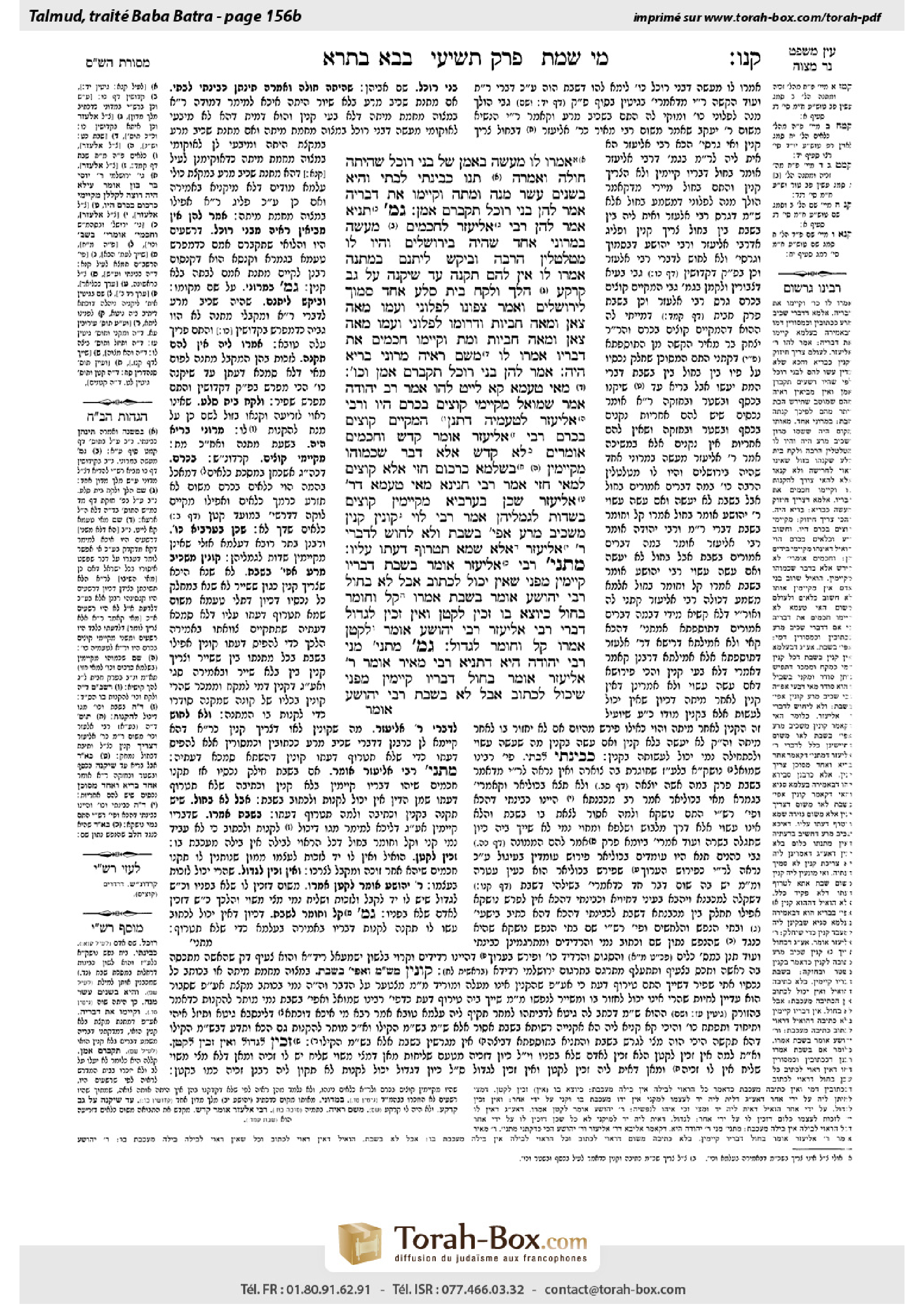
Bava Batra 156b: Talmud study for Daf Yomi
Study the Talmud for Daf Yomi with scanned pages, Hebrew text, English translations from Sefaria and AI-generated French translations.
Passage selection and English or AI-generated French translation are available where the scan has annotations. Daf Study is independent of Torah-Box and Sefaria.
Browse Bava Batra · בבא בתרא · All tractatesBava Batra 156b text and translations
This page of Bava Batra includes the Aramaic text, an English translation and an AI-generated French translation, alongside the scan above.
בבא בתרא קנ״ו ב · Aramaic and Hebrew text
אָמְרוּ לוֹ: מַעֲשֶׂה בְּאִמָּן שֶׁל בְּנֵי רוֹכֵל שֶׁהָיְתָה חוֹלָה, וְאָמְרָה: ״תְּנוּ כְּבִינְתִּי לְבִתִּי, וְהִיא בִּשְׁנֵים עָשָׂר מָנֶה״, וּמֵתָה, וְקִיְּימוּ אֶת דְּבָרֶיהָ! אָמַר לָהֶן: בְּנֵי רוֹכֵל – תִּקְבְּרֵם אִמָּן.
גְּמָ׳ תַּנְיָא, אָמַר לָהֶן רַבִּי אֱלִיעֶזֶר לַחֲכָמִים: מַעֲשֶׂה בְּמָרוֹנִי אֶחָד שֶׁהָיָה בִּירוּשָׁלַיִם, וְהָיוּ לוֹ מִטַּלְטְלִין הַרְבֵּה וּבִיקֵּשׁ לִיתְּנָם בְּמַתָּנָה. אָמְרוּ לוֹ: אֵין לָהֶם תַּקָּנָה עַד שֶׁיַּקְנֶה עַל גַּב קַרְקַע.
הָלַךְ וְלָקַח בֵּית סֶלַע אֶחָד סָמוּךְ לִירוּשָׁלַיִם, וְאָמַר: צְפוֹנוֹ לִפְלוֹנִי, וְעִמּוֹ מֵאָה צֹאן וּמֵאָה חָבִיּוֹת; וּדְרוֹמוֹ לִפְלוֹנִי, וְעִמּוֹ מֵאָה צֹאן וּמֵאָה חָבִיּוֹת. וָמֵת, וְקִיְּימוּ חֲכָמִים אֶת דְּבָרָיו. אָמְרוּ לוֹ: מִשָּׁם רְאָיָה?! מָרוֹנִי בָּרִיא הָיָה.
אָמַר לָהֶן: בְּנֵי רוֹכֵל תִּקְבְּרֵם אִמָּן וְכוּ׳. מַאי טַעְמָא קָא לָיֵיט לְהוּ? אָמַר רַב יְהוּדָה אָמַר שְׁמוּאֵל: מְקַיְּימֵי קוֹצִים בַּכֶּרֶם הָיוּ, וְרַבִּי אֱלִיעֶזֶר לְטַעְמֵיהּ – דִּתְנַן: הַמְקַיֵּים קוֹצִים בַּכֶּרֶם, רַבִּי אֱלִיעֶזֶר אוֹמֵר: קִדֵּשׁ; וַחֲכָמִים אוֹמְרִים: לֹא קִדֵּשׁ, אֶלָּא דָּבָר שֶׁכָּמוֹהוּ מְקַיְּימִין.
בִּשְׁלָמָא כַּרְכּוֹם, חֲזֵי; אֶלָּא קוֹצִים, לְמַאי חֲזֵי? אָמַר רַבִּי חֲנִינָא: מַאי טַעְמָא דְּרַבִּי אֱלִיעֶזֶר? שֶׁכֵּן בַּעֲרַבְיָא מְקַיְּימִין קוֹצִים בַּשָּׂדוֹת לִגְמַלֵּיהֶן.
אָמַר רַבִּי לֵוִי: קוֹנִין קִנְיָן מִשְּׁכִיב מְרַע, אֲפִילּוּ בְּשַׁבָּת. וְלֹא לָחוֹשׁ לְדִבְרֵי רַבִּי אֱלִיעֶזֶר, אֶלָּא שֶׁמָּא תִּטָּרֵף דַּעְתּוֹ עָלָיו.
מַתְנִי׳ רַבִּי אֱלִיעֶזֶר אוֹמֵר: בַּשַּׁבָּת – דְּבָרָיו קַיָּימִין, מִפְּנֵי שֶׁאֵין יָכוֹל לִכְתּוֹב; אֲבָל לֹא בַּחוֹל. רַבִּי יְהוֹשֻׁעַ אוֹמֵר: בַּשַּׁבָּת אָמְרוּ, קַל וָחוֹמֶר בַּחוֹל.
כַּיּוֹצֵא בּוֹ – זָכִין לַקָּטָן, וְאֵין זָכִין לַגָּדוֹל; דִּבְרֵי רַבִּי אֱלִיעֶזֶר. רַבִּי יְהוֹשֻׁעַ אוֹמֵר: לַקָּטָן אָמְרוּ, קַל וָחוֹמֶר לַגָּדוֹל.
גְּמָ׳ מַתְנִיתִין מַנִּי? רַבִּי יְהוּדָה הִיא – דְּתַנְיָא: רַבִּי מֵאִיר אוֹמֵר, רַבִּי אֱלִיעֶזֶר אוֹמֵר: בַּחוֹל – דְּבָרָיו קַיָּימִין, מִפְּנֵי שֶׁיָּכוֹל לִכְתּוֹב; אֲבָל לֹא בַּשַּׁבָּת.
רַבִּי יְהוֹשֻׁעַ
Bava Batra 156b · English translation
The Rabbis said to Rabbi Elazar: There was an incident involving the mother of the sons of Rokhel, who was sick, and who said: My brooch shall be given to my daughter, and it is valued at twelve hundred dinars. And this woman subsequently died, and the Sages upheld her statement. This indicates that a person on his deathbed can gift property without an act of acquisition. Rabbi Elazar said to them: That case was different; the sons of Rokhel should be buried by their mother, i.e., he cursed them. It is not possible to bring a proof from this incident, as these sons were wicked people. Consequently, when ruling in this matter the Sages did not act in accordance with the halakha, but allowed the mother of the sons of Rokhel to give this valuable piece of jewelry to their sister without an act of acquisition having been performed.
GEMARA: It is taught in a baraita: Rabbi Eliezer said to the Rabbis: There was an incident involving a certain man of Meron who was in Jerusalem, and he had a lot of movable property. And he desired to give the movable property as gifts to various individuals, but they could not be acquired by pulling. The Rabbis said to him: There is no remedy for transferring the property unless he transfers the movable property by means of transferring the ownership of land.
He went and acquired one plot of rocky land adjacent to Jerusalem, and he said: I give the north part of this area to so-and-so, and with it one hundred sheep and one hundred barrels. And I give the south part of the area to so-and-so, and with it one hundred sheep and one hundred barrels. And he died, and the Sages upheld his statement. This indicates that a person on his deathbed cannot transfer property without an act of acquisition. The Rabbis said to Rabbi Eliezer: Do you bring proof from there? The man of Meron was healthy at the time. This was not the gift of a person on his deathbed, and it could not be acquired by verbal instruction.
§ The mishna teaches: Rabbi Elazar said to them: That case was different; the sons of Rokhel should be buried by their mother. The Gemara asks: What is the reason that he was cursing them? Rav Yehuda says that Shmuel says: They were maintaining thorns in a vineyard and did not uproot them, and Rabbi Eliezer conforms to his line of reasoning, as we learned in a mishna (Kilayim 5:8): With regard to one who maintains thorns in a vineyard, Rabbi Eliezer says: He has proscribed the vineyard, rendering it forbidden due to the prohibition against diverse kinds. And the Rabbis say: Only growing a matter, i.e., a crop, the like of which people usually maintain, proscribes a vineyard and renders it forbidden.
The Gemara asks: Granted, if it were saffron that grew in the vineyard, it is useful for seasoning and other uses, and therefore it proscribes the vineyard. But with regard to thorns, for what are they useful? Rabbi Ḥanina said: What is the reasoning of Rabbi Eliezer? It is because in Arabia they maintain thorns in the fields for their camels. Rabbi Eliezer holds that since thorns are maintained in one place, they are considered useful everywhere.
Rabbi Levi says: An act of acquisition may be performed in order to effect acquisition of property from a person on his deathbed even on Shabbat, even though transactions are not performed on Shabbat. And this, that an act of acquisition must be performed, is not stated in order to take into consideration the statement of Rabbi Eliezer that the gifts of any person on his deathbed require an act of acquisition. Rather, the reason for this is that if a person on his deathbed requests the performance of an act of acquisition, his request is fulfilled, lest his anxiety upon seeing that his will is not being carried out cause him to lose control of his mind due to his grief, exacerbating his poor physical state.
MISHNA: Rabbi Eliezer says: On Shabbat, the verbal statement of a person on his deathbed stands, as he cannot write, and the Sages instituted that he can effect the transaction verbally lest the inability to do so exacerbate his condition. But a verbal instruction does not stand if stated on a weekday. Rabbi Yehoshua says: With regard to Shabbat, the Sages stated that his verbal instruction is sufficient, even though writing is prohibited. One can infer a fortiori that the same applies with regard to a weekday, when writing is permitted.
Similarly, one can acquire property on behalf of a minor, but one cannot acquire property on behalf of an adult, since he can perform the act of acquisition himself; this is the statement of Rabbi Eliezer. Rabbi Yehoshua says: The Sages stated this halakha with regard to a minor, and one may infer a fortiori that this also applies with regard to an adult, who is able to perform the act of acquisition himself.
GEMARA: The Gemara asks: Whose opinion is expressed in the mishna? The Gemara answers: This is the opinion of Rabbi Yehuda. This is as it is taught in a baraita: Rabbi Meir says that Rabbi Eliezer says: With regard to a person on his deathbed who distributes his property by verbal instruction, on a weekday, his statements stand, because he can write, but his statement does not stand on Shabbat, because he cannot write.
Rabbi Yehoshua
Bava Batra 156b · Traduction française (IA)
Les Sages dirent à Rabbi Elazar : Il y avait un cas concernant la mère des fils de Rokhel, qui était malade et qui dit : Mon broche sera donnée à ma fille, et elle vaut mille deux cents dinars. Et cette femme mourut ensuite, et les Sages firent valoir son déclaration. Cela montre qu'une personne sur son lit de mort peut donner un bien sans acte d'acquisition. Rabbi Elazar dit à ceux-ci : Ce cas était différent ; les fils de Rokhel devaient être enterrés par leur mère, c'est-à-dire qu'il les maudissait. Il n'est pas possible d'apporter une preuve à partir de ce cas, car ces fils étaient des gens mauvais. Ainsi, lorsqu'ils ont rendu un jugement dans cette affaire, les Sages n'ont pas agi conformément à la halakha, mais ont permis à la mère des fils de Rokhel de donner cette pièce précieuse à leur sœur sans que l'acte d'acquisition n'ait été accompli.
GUEMARA : Il est enseigné dans une baraïta : Rabbi Eliezer dit aux Sages : Il y avait un cas concernant un homme de Meron qui était à Jérusalem, et il possédait beaucoup de biens mobiliers. Et il voulait donner ces biens mobiliers en cadeaux à divers individus, mais ils ne pouvaient être acquis par simple déclaration. Les Sages dirent à lui : Il n'y a pas de remède pour transférer la propriété à moins qu'il ne transfère la propriété mobilière par le biais de la transmission de la propriété de la terre.
Il alla et acquit un terrain rocheux adjacent à Jérusalem, et il dit : Je donne la partie nord de cette zone à tel et tel, avec cent brebis et cent barriques. Et je donne la partie sud de cette zone à tel et tel, avec cent brebis et cent barriques. Et il mourut, et les Sages firent valoir son déclaration. Cela montre qu'une personne sur son lit de mort ne peut pas transférer une propriété sans acte d'acquisition. Les Sages dirent à Rabbi Eliezer : Est-ce que tu tires une preuve de là ? L'homme de Meron était en bonne santé à l'époque. Ce n'était pas un don d'une personne sur son lit de mort, et il ne pouvait être acquis par simple déclaration.
§ La mitsna enseigne : Rabbi Elazar dit à eux : Ce cas était différent ; les fils de Rokhel devaient être enterrés par leur mère. La Guemara demande : Quelle est la raison qu'il les maudissait ? Rav Yehuda dit que Shmuel dit : Ils maintenaient des épines dans un domaine de vigne et n'avaient pas arraché ces épines, et Rabbi Eliezer suit cette ligne de raisonnement, comme nous l'avons appris dans une mitsna (Kilayim 5:8) : Concernant celui qui maintient des épines dans un domaine de vigne, Rabbi Eliezer dit : Il a interdit le domaine de vigne, le rendant interdit en raison de l'interdiction des espèces diverses. Et les Sages disent : Seulement la culture d'une chose, c'est-à-dire un produit, dont les gens habituellement maintiennent, interdit un domaine de vigne et le rend interdit.
La Guemara pose la question : D'accord, si c'était du safran qui poussait dans le domaine de vigne, il est utile pour la cuisson et d'autres usages, et donc il interdit le domaine de vigne. Mais concernant les épine, à quoi sont-ils utiles ? Rabbi Ḥanina dit : Quel est le raisonnement de Rabbi Eliezer ? C'est parce qu'en Arabie, ils maintiennent des épine dans les champs pour leurs chameaux. Rabbi Eliezer considère que puisque les épine sont maintenues dans un lieu, elles sont considérées utiles partout.
Rabbi Levi dit : Un acte d'acquisition peut être accompli afin d'acquérir une propriété d'une personne sur son lit de mort même le sabbat, même si les transactions ne sont pas accomplies le sabbat. Et cela, que l'acte d'acquisition doit être accompli, n'est pas dit pour prendre en compte l'opinion de Rabbi Eliezer selon laquelle les dons d'une personne sur son lit de mort nécessitent un acte d'acquisition. La raison de cela est que si une personne sur son lit de mort demande l'accomplissement d'un acte d'acquisition, sa demande est exécutée, afin que son anxiété en voyant que son testament n'est pas exécuté ne cause pas qu'il perde la raison en raison de sa tristesse, aggravant ainsi son état physique.
MICHNA : Rabbi Eliezer dit : Le samedi, la déclaration verbale d'une personne sur son lit de mort est valable, car il ne peut pas écrire, et les Sages ont institué qu'il puisse effectuer la transaction verbalement afin que l'impossibilité de le faire ne n'aggrave pas son état. Mais une instruction verbale ne vaut pas si elle est déclarée un jour de semaine. Rabbi Yehoshua dit : Concernant le samedi, les Sages ont dit que sa déclaration verbale est suffisante, même si l'écriture est interdite. On peut en déduire par conséquent que cela s'applique également à un jour de semaine, lorsque l'écriture est permise.
De même, on peut acquérir une propriété au nom d'un mineur, mais on ne peut pas acquérir une propriété au nom d'un adulte, car il peut lui-même accomplir l'acte d'acquisition ; c'est l'opinion de Rabbi Eliezer. Rabbi Yehoshua dit : Les Sages ont établi cette halakha concernant un mineur, et on peut en déduire par conséquent qu'elle s'applique également à un adulte, qui peut lui-même accomplir l'acte d'acquisition.
GUEMARA : La Guemara demande : Quelle opinion est exprimée dans la mitsna ? La Guemara répond : C'est l'opinion de Rabbi Yehuda. C'est comme il est enseigné dans une baraïta : Rabbi Meir dit que Rabbi Eliezer dit : Concernant une personne sur son lit de mort qui distribue ses biens par déclaration verbale, un jour de semaine, ses déclarations sont valables, car il peut écrire, mais sa déclaration ne vaut pas le samedi, car il ne peut pas écrire.
Rabbi Yéhoshua
Traduction française générée par IA à partir de l’édition anglaise de Sefaria. Vérifie toujours un passage avec le texte source.
Text from Sefaria: William Davidson Edition - Vocalized Aramaic (CC BY NC); William Davidson Edition - English (CC BY NC).