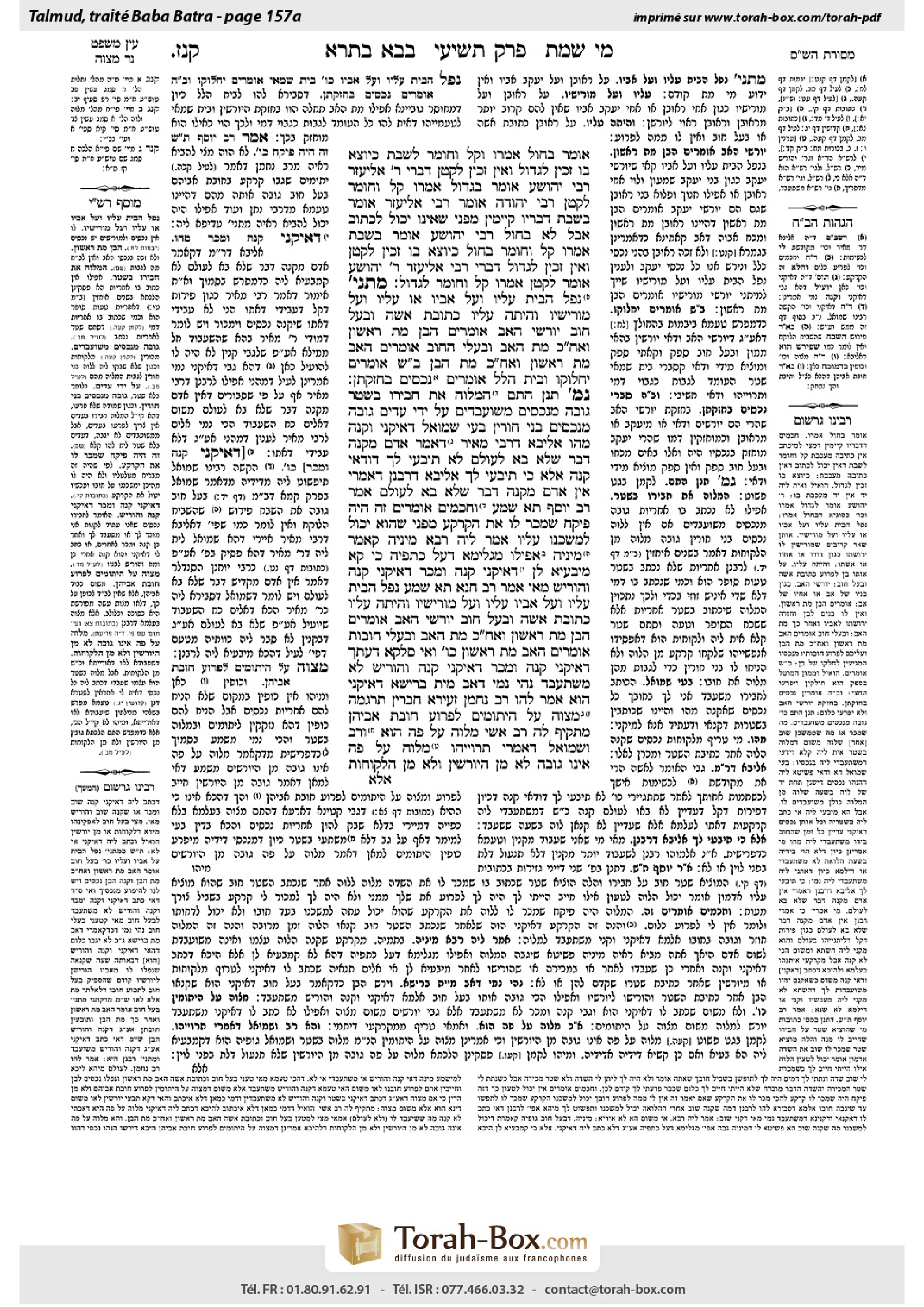
Bava Batra 157a: Talmud study for Daf Yomi
Study the Talmud for Daf Yomi with scanned pages, Hebrew text, English translations from Sefaria and AI-generated French translations.
Passage selection and English or AI-generated French translation are available where the scan has annotations. Daf Study is independent of Torah-Box and Sefaria.
Browse Bava Batra · בבא בתרא · All tractatesBava Batra 157a text and translations
This page of Bava Batra includes the Aramaic text, an English translation and an AI-generated French translation, alongside the scan above.
בבא בתרא קנ״ז א · Aramaic and Hebrew text
אוֹמֵר: בַּחוֹל אָמְרוּ, וְקַל וָחוֹמֶר לַשַּׁבָּת. כַּיּוֹצֵא בּוֹ – זָכִין לַגָּדוֹל, וְאֵין זָכִין לַקָּטָן; דִּבְרֵי רַבִּי אֱלִיעֶזֶר. רַבִּי יְהוֹשֻׁעַ אוֹמֵר: בְּגָדוֹל אָמְרוּ, קַל וָחוֹמֶר לַקָּטָן.
רַבִּי יְהוּדָה אוֹמֵר, רַבִּי אֱלִיעֶזֶר אוֹמֵר: בַּשַּׁבָּת – דְּבָרָיו קַיָּימִין, מִפְּנֵי שֶׁאֵינוֹ יָכוֹל לִכְתּוֹב; אֲבָל לֹא בַּחוֹל. רַבִּי יְהוֹשֻׁעַ אוֹמֵר: בַּשַּׁבָּת אָמְרוּ, קַל וָחוֹמֶר בַּחוֹל. כַּיּוֹצֵא בּוֹ – זָכִין לַקָּטָן וְאֵין זָכִין לַגָּדוֹל, דִּבְרֵי רַבִּי אֱלִיעֶזֶר. רַבִּי יְהוֹשֻׁעַ אוֹמֵר: לַקָּטָן אָמְרוּ, קַל וָחוֹמֶר לַגָּדוֹל.
מַתְנִי׳ נָפַל הַבַּיִת עָלָיו וְעַל אָבִיו, אוֹ עָלָיו וְעַל מוֹרִישָׁיו, וְהָיְתָה עָלָיו כְּתוּבַּת אִשָּׁה וּבַעַל חוֹב, יוֹרְשֵׁי הָאָב אוֹמְרִים: הַבֵּן מֵת רִאשׁוֹן, וְאַחַר כָּךְ מֵת הָאָב; וּבַעֲלֵי הַחוֹב אוֹמְרִים: הָאָב מֵת רִאשׁוֹן, וְאַחַר כָּךְ מֵת הַבֵּן.
בֵּית שַׁמַּאי אוֹמְרִים: יַחְלוֹקוּ, וּבֵית הִלֵּל אוֹמְרִים: נְכָסִים בְּחֶזְקָתָן.
גְּמָ׳ תְּנַן הָתָם: הַמַּלְוֶה אֶת חֲבֵירוֹ בִּשְׁטָר – גּוֹבֶה מִנְּכָסִים מְשׁוּעְבָּדִים. עַל יְדֵי עֵדִים – גּוֹבֶה מִנְּכָסִים בְּנֵי חוֹרִין.
בָּעֵי שְׁמוּאֵל: ״דְּאִיקְנֵי״, וְקָנָה; מַהוּ? אַלִּיבָּא דְּרַבִּי מֵאִיר, דְּאָמַר: אָדָם מַקְנֶה דָּבָר שֶׁלֹּא בָּא לָעוֹלָם – לָא תִּיבְּעֵי לָךְ, דְּוַדַּאי קָנָה. אֶלָּא כִּי תִּיבְּעֵי לָךְ – אַלִּיבָּא דְּרַבָּנַן, דְּאָמְרִי: אֵין אָדָם מַקְנֶה דָּבָר שֶׁלֹּא בָּא לָעוֹלָם.
אָמַר רַב יוֹסֵף: תָּא שְׁמַע, וַחֲכָמִים אוֹמְרִים: זֶה הָיָה פִּיקֵּחַ שֶׁמָּכַר לוֹ אֶת הַקַּרְקַע, מִפְּנֵי שֶׁהוּא יָכוֹל לְמַשְׁכְּנוֹ עָלָיו!
אֲמַר לֵיהּ רָבָא: מִינֵּיהּ קָאָמַר?! מִינֵּיהּ – אֲפִילּוּ מִגְּלִימָא דְּעַל כַּתְפֵּיהּ! כִּי קָא מִיבַּעְיָא לַן, ״דְּאִיקְנֵי״ – קָנָה וּמָכַר, ״דְּאִיקְנֵי״ – קָנָה וְהוֹרִישׁ, מַאי?
אָמַר רַב חָנָא, תָּא שְׁמַע: נָפַל הַבַּיִת עָלָיו וְעַל אָבִיו, עָלָיו וְעַל מוֹרִישָׁיו; וְהָיְתָה עָלָיו כְּתוּבַּת אִשָּׁה וּבַעַל חוֹב; יוֹרְשֵׁי הָאָב אוֹמְרִים: הַבֵּן מֵת רִאשׁוֹן וְאַחַר כָּךְ מֵת הָאָב, וּבַעֲלֵי חוֹבוֹת אוֹמְרִים: הָאָב מֵת רִאשׁוֹן כּוּ׳.
וְאִי סָלְקָא דַּעְתָּךְ ״דְּאִיקְנֵי״ – קָנָה וּמָכַר, ״דְּאִיקְנֵי״– קָנָה וְהוֹרִישׁ, לָא מִשְׁתַּעְבֵּד; נְהִי נָמֵי דְּאָב מָיֵת בְּרֵישָׁא, ״דְּאִיקְנֵי״ הוּא!
אֲמַר לְהוּ רַב נַחְמָן, זְעֵירָא חַבְרִין תַּרְגְּמַהּ: מִצְוָה עַל הַיְּתוֹמִים לִפְרוֹעַ חוֹבַת אֲבִיהֶן. מַתְקֵיף לַהּ רַב אָשֵׁי: מִלְוֶה עַל פֶּה הוּא, וְרַב וּשְׁמוּאֵל דְּאָמְרִי תַּרְוַיְיהוּ: מִלְוֶה עַל פֶּה – אֵינוֹ גּוֹבֶה לֹא מִן הַיּוֹרְשִׁין וְלֹא מִן הַלָּקוֹחוֹת!
Bava Batra 157a · English translation
says: With regard to weekdays the Sages stated that the verbal instruction of person on his deathbed is valid, even though it is permitted to write. And one may infer a fortiori that the same applies with regard to Shabbat, when writing is prohibited. Similarly, one can acquire property on behalf of an adult, as he is able to effect acquisition himself, but one cannot acquire property on behalf of a minor; this is the statement of Rabbi Eliezer. Rabbi Yehoshua says: The Sages stated this halakha with regard to an adult, even though he can effect acquisition himself. One may infer a fortiori that this also applies with regard to a minor, who cannot effect acquisition himself.
Rabbi Yehuda says that Rabbi Eliezer says: On Shabbat, the verbal statement of a person on his deathbed stands due to the fact that he cannot write. But a verbal instruction does not stand on a weekday. Rabbi Yehoshua says: With regard to Shabbat the Sages stated that his verbal instruction stands, even though writing is prohibited. One may infer a fortiori that the same applies with regard to a weekday, when writing is permitted. Similarly, one can acquire property on behalf of a minor, but one cannot acquire property on behalf of an adult, since he can effect the acquisition himself; this is the statement of Rabbi Eliezer. Rabbi Yehoshua says: The Sages stated this halakha with regard to a minor, and one may infer a fortiori that this also applies with regard to an adult.
MISHNA: A house collapsed on a son and upon his father, or upon a certain person and upon those from whom he stands to inherit, and it is unknown who died first. If the son bore the responsibility to pay the marriage contract of his wife and to pay a creditor, and the son had no money with which to pay them except that which he might inherit from his father, and the father’s heirs say: The son died first and afterward the father died, and therefore the son did not inherit property from his father, and the creditors say: The father died first and afterward the son died, resulting in the son’s inheriting his father’s property, enabling the creditors to collect payment from the property even after the son’s death, there is a dispute with regard to how to rule.
Since it cannot be determined who died first, Beit Shammai say: They divide the property between them so that the father’s heirs receive half of his property and the son’s creditors receive the other half. And Beit Hillel say: The property retains its previous ownership status. Since the last known owner of the property was the father, the property is given to the father’s heirs.
GEMARA: We learned in a mishna elsewhere (175a): One who lends money to another with a promissory note can collect the debt even from liened property that has been sold. If one lends money only with witnesses, he can collect the debt only from unsold property.
Shmuel raises a dilemma: If the borrower wrote in the promissory note: The property that I will acquire in the future shall be liened to this debt, and he subsequently acquired property, what is the halakha? Is the property liened or not? The Gemara clarifies the dilemma: According to the opinion of Rabbi Meir, who says: A person can transfer ownership of an entity that has not yet come into the world, you should not raise the dilemma, as the lender certainly acquires, i.e., places a lien, on the property. Rather, when should you raise the dilemma? Raise it according to the opinion of the Rabbis, who say: A person cannot transfer ownership of an entity that has not yet come into the world.
Rav Yosef said: Come and hear proof from a mishna (Ketubot 110a): If one produces a promissory note against another, and the borrower produced a bill of sale dated after the promissory note that states that the lender sold him a field of his, Admon says that the borrower can say: Were I really indebted to you, you should have collected the loan when you sold me the field. And the Rabbis say: This does not prove anything. It is possible that this lender was perspicacious, as he sold the borrower the land for a good reason, because now he can take the field as collateral from him in lieu of the outstanding loan. This mishna indicates that even property acquired by the borrower after the promissory note is written is liened.
Rava said to Rav Yosef: Do you speak of a case where the debt is collected from the debtor? With regard to collecting the debt from him, the debt is collected from any property currently in his possession, even from the cloak that is upon his shoulders. When the dilemma was raised to us, it was with regard to a case where the borrower wrote: The property that I will acquire shall be liened, and he subsequently acquired property and sold it to others. The dilemma also pertains to a case where the borrower wrote: The property that I will acquire shall be liened, and he subsequently acquired property and bequeathed it to his heirs. In these cases, what is the halakha? Can the lender repossess the property from the buyer or heir?
Rav Ḥana said: Come and hear a proof from the mishna: In a case where the house collapsed on a son and upon his father, or upon a certain person and upon those from whom he stands to inherit, and it is unknown who died first, the halakha depends on the circumstances. If the son bore the responsibility to pay the marriage contract of his wife and to pay a creditor, and the son had no money with which to pay them except that which he might inherit from his father, and the father’s heirs say: The son died first and afterward the father died, and therefore the son did not inherit property from his father, and the creditors say: The father died first and afterward the son died, there is a dispute with regard to how to rule. In this case, the creditors claim that the son inherited his father’s property, and therefore they have a lien upon the property.
The Gemara explains: And if it enters your mind to say that when the borrower writes: The property that I will acquire shall be liened, and he acquires property and sells it to others, it is not liened, and that when he writes: The property that I will acquire shall be liened, and he acquires property and bequeaths it to his heirs, it is not liened, then the mishna is difficult. Although the father indeed died first, this case is comparable to one where the borrower writes: The property that I will acquire shall be liened, as the son acquired the property after receiving the loan. This indicates that a lien can be placed upon property that one will acquire in the future.
Rav Naḥman said to the Sages: Rabbi Zeira, our colleague, interpreted the mishna as follows: In this case, the creditors do not claim the property because it is liened. Rather, they claim it because it is a mitzva incumbent upon the orphans to repay their father’s debt. Rav Ashi objects to this: If the promissory note does not place a lien on the property, this is considered a loan by oral agreement, and Rav and Shmuel both say: A loan by oral agreement cannot be collected, neither from the heirs nor from the buyers.
Bava Batra 157a · Traduction française (IA)
dit : Concernant les jours de semaine, les Sages ont déclaré que l'instruction verbale d'une personne sur son lit de mort est valable, même si l'on peut écrire. On peut en déduire a fortiori que cela s'applique également le sabbat, lorsque l'écriture est interdite. De même, on peut acquérir un bien au nom d'un adulte, car il est capable d'acquérir lui-même, mais on ne peut pas acquérir un bien au nom d'un mineur ; c'est la déclaration du Rabbi Eliezer. Le Rabbi Yéhoshua dit : Les Sages ont déclaré cette halakha concernant l'adulte, même s'il est capable d'acquérir lui-même. On peut en déduire a fortiori que cela s'applique également au mineur, qui n'est pas capable d'acquérir lui-même.
Le Rabbi Yéhuda dit que le Rabbi Eliezer dit : Le sabbat, l'instruction verbale d'une personne sur son lit de mort est valable en raison du fait qu'il ne peut pas écrire. Mais une instruction verbale ne vaut pas le jour de semaine. Le Rabbi Yéhoshua dit : Concernant le sabbat, les Sages ont déclaré que l'instruction verbale est valable, même si l'écriture est interdite. On peut en déduire a fortiori que cela s'applique également le jour de semaine, lorsque l'écriture est permise. De même, on peut acquérir un bien au nom d'un mineur, mais on ne peut pas acquérir un bien au nom d'un adulte, car il est capable d'acquérir lui-même ; c'est la déclaration du Rabbi Eliezer. Le Rabbi Yéhoshua dit : Les Sages ont déclaré cette halakha concernant le mineur, et on peut en déduire a fortiori que cela s'applique également à l'adulte.
MICHNA : Une maison s'est effondrée sur un fils et sur son père, ou sur une certaine personne et sur ceux d'entre eux d'où il peut hériter, et on ne sait pas qui est mort en premier. Si le fils avait la responsabilité de payer le contrat de mariage de sa femme et de payer un créancier, et que le fils n'avait pas d'argent pour les payer sauf celui qu'il pourrait hériter de son père, et que les héritiers du père disent : Le fils est mort en premier, puis le père, et donc le fils n'a pas hérité de la propriété de son père, et les créanciers disent : Le père est mort en premier, puis le fils, ce qui a permis au fils d'hériter de la propriété de son père, permettant aux créanciers de récupérer le paiement à partir de la propriété même après la mort du fils, il y a un débat sur la manière de décider.
Puisque cela ne peut être déterminé qui est mort en premier, Beit Shammai disent : Ils divisent la propriété entre eux de sorte que les héritiers du père reçoivent la moitié de sa propriété et les créanciers du fils reçoivent l'autre moitié. Et Beit Hillel disent : La propriété conserve son statut d'origine. Puisque le dernier propriétaire connu de la propriété était le père, la propriété est donnée aux héritiers du père.
GUEMARA : Nous avons appris dans une mishna ailleurs (175a) : Celui qui prête de l'argent à un autre avec un reçu peut récupérer le prêt même d'une propriété liée qui a été vendue. Si l'on prête de l'argent uniquement avec des témoins, on peut récupérer le prêt uniquement d'une propriété non vendue.
Shmuel soulève un dilemme : Si le prêteur a écrit dans le reçu : La propriété que je vais acquérir à l'avenir sera liée à ce prêt, et qu'il a ensuite acquis une propriété, que la halakha est-elle ? La propriété est-elle liée ou non ? La Guemara clarifie ce dilemme : Selon l'opinion du Rabbi Meir, qui dit : Une personne peut transférer la propriété d'une entité qui n'a pas encore été mise au monde, vous ne devriez pas soulever ce dilemme, car le prêteur acquiert certainement, c'est-à-dire place un joug, sur la propriété. Plutôt, quand devrait-on soulever ce dilemme ? Soulevez-le selon l'opinion des Rabbins, qui disent : Une personne ne peut pas transférer la propriété d'une entité qui n'a pas encore été mise au monde.
Rav Yosef a dit : Approchez-vous et trouvez une preuve dans une mishna (Ketubot 110a) : Si l'on produit un reçu contre un autre, et que le prêteur produit un acte de vente daté après le reçu qui stipule que le prêteur a vendu à l'emprunteur un champ de son, Admon dit que l'emprunteur peut dire : Si j'étais vraiment en dette de vous, vous devriez avoir récupéré le prêt lorsque vous m'avez vendu le champ. Et les Rabbins disent : Cela ne prouve rien. Il est possible que ce prêteur ait été perspicace, car il a vendu le champ à l'emprunteur pour une bonne raison, car maintenant il peut prendre le champ comme garantie à la place du prêt restant. Cette mishna indique que même une propriété acquise par l'emprunteur après que le reçu a été écrit est liée.
Rava a dit à Rav Yosef : Parlez-vous d'un cas où la dette est récupérée auprès du débiteur ? En ce qui concerne la récupération de la dette auprès de lui, la dette est récupérée sur toute propriété actuellement en son possession, même sur la cape qui est sur ses épaules. Lorsque ce dilemme a été soulevé à notre sujet, il était relatif à un cas où le prêteur a écrit : La propriété que je vais acquérir sera liée, et qu'il a ensuite acquis une propriété et l'a vendue à d'autres. Ce dilemme concerne également un cas où le prêteur a écrit : La propriété que je vais acquérir sera liée, et qu'il a ensuite acquis une propriété et l'a légué à ses héritiers. Dans ces cas, quelle est la halakha ? Le prêteur peut-il récupérer la propriété auprès du acheteur ou de l'héritier ?
Rav Ḥana a dit : Approchez-vous et écoutez une preuve tirée de la Michna : Dans un cas où une maison s'est effondrée sur un fils et sur son père, ou sur une certaine personne et sur ceux d'où il peut hériter, et on ne sait pas qui est mort en premier, la halakha dépend des circonstances. Si le fils avait la responsabilité de payer le contrat de mariage de sa femme et de payer un créancier, et que le fils n'avait pas d'argent pour les payer sauf celui qu'il pourrait hériter de son père, et que les héritiers du père disent : Le fils est mort en premier, puis le père, et donc le fils n'a pas hérité de la propriété de son père, et les créanciers disent : Le père est mort en premier, puis le fils, il y a un débat sur la manière de décider. Dans ce cas, les créanciers affirment que le fils a hérité de la propriété de son père, et donc ils ont un droit sur la propriété.
La Guemara explique : Et si cela entre dans votre pensée de dire que lorsque le prêteur écrit : La propriété que je vais acquérir sera liée, et qu'il acquiert une propriété et la vend à d'autres, elle n'est pas liée, et que lorsque il écrit : La propriété que je vais acquérir sera liée, et qu'il acquiert une propriété et la léguera à ses héritiers, elle n'est pas liée, alors la Misha est difficile. Bien que le père soit effectivement mort en premier, ce cas est comparable à celui où le prêteur écrit : La propriété que je vais acquérir sera liée, comme le fils a acquis la propriété après avoir reçu le prêt. Cela indique qu'un droit de gage peut être mis sur une propriété que l'on va acquérir à l'avenir.
Rav Naḥman dit aux Sages : Rabbi Zeira, notre collègue, a interprété la Misha comme suit : Dans ce cas, les créanciers ne réclament pas la propriété parce qu'elle est liée. Plutôt, ils la réclament parce que c'est une mitsva qui incombe aux orphelins de rembourser la dette de leur père. Rav Ashi s'oppose à cela : Si le titre de prêt ne met pas un droit de gage sur la propriété, cela est considéré comme un prêt par accord oral, et Rav et Shmuel disent tous les deux : Un prêt par accord oral ne peut pas être récupéré, ni auprès des héritiers ni auprès des acheteurs.
Traduction française générée par IA à partir de l’édition anglaise de Sefaria. Vérifie toujours un passage avec le texte source.
Text from Sefaria: William Davidson Edition - Vocalized Aramaic (CC BY NC); William Davidson Edition - English (CC BY NC).