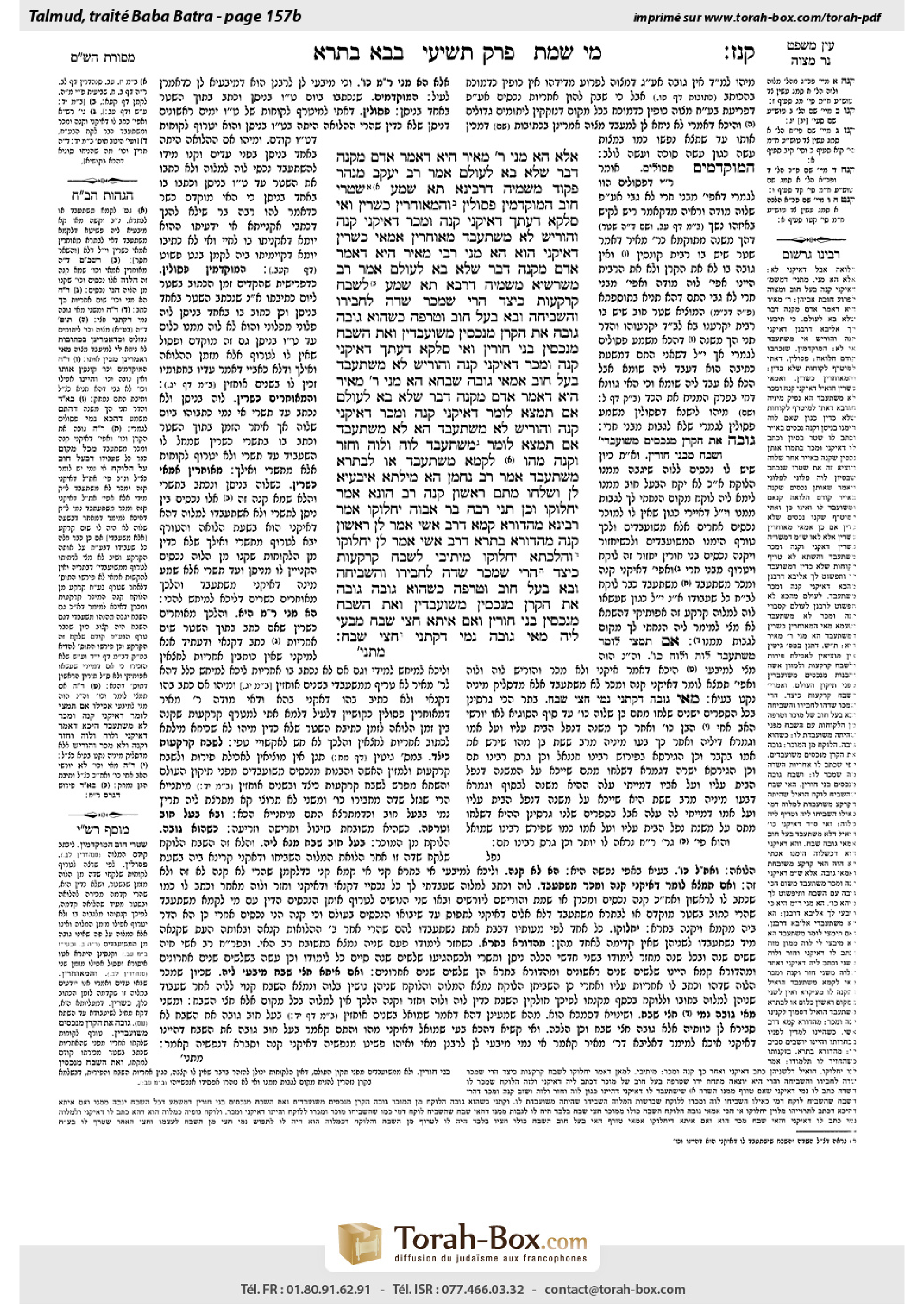
Bava Batra 157b: Talmud study for Daf Yomi
Study the Talmud for Daf Yomi with scanned pages, Hebrew text, English translations from Sefaria and AI-generated French translations.
Passage selection and English or AI-generated French translation are available where the scan has annotations. Daf Study is independent of Torah-Box and Sefaria.
Browse Bava Batra · בבא בתרא · All tractatesBava Batra 157b text and translations
This page of Bava Batra includes the Aramaic text, an English translation and an AI-generated French translation, alongside the scan above.
בבא בתרא קנ״ז ב · Aramaic and Hebrew text
אֶלָּא הָא מַנִּי – רַבִּי מֵאִיר הִיא, דְּאָמַר: אָדָם מַקְנֶה דָּבָר שֶׁלֹּא בָּא לָעוֹלָם.
אָמַר רַב יַעֲקֹב מִנְּהַר פְּקוֹד מִשְּׁמֵיהּ דְּרָבִינָא, תָּא שְׁמַע: שִׁטְרֵי חוֹב הַמּוּקְדָּמִין – פְּסוּלִין, וְהַמְאוּחָרִין – כְּשֵׁרִין.
וְאִי סָלְקָא דַּעְתָּךְ ״דְּאִיקְנֵי״ – קָנָה וּמָכַר, ״דְּאִיקְנֵי״ – קָנָה וְהוֹרִישׁ, לֹא מִשְׁתַּעְבֵּד; מְאוּחָרִין אַמַּאי כְּשֵׁרִין? ״דְּאִיקְנֵי״ הוּא!
הָא מַנִּי – רַבִּי מֵאִיר הִיא, דְּאָמַר: אָדָם מַקְנֶה דָּבָר שֶׁלֹּא בָּא לָעוֹלָם.
אָמַר רַב מְשַׁרְשְׁיָא מִשְּׁמֵיהּ דְּרָבָא, תָּא שְׁמַע: לְשֶׁבַח קַרְקָעוֹת כֵּיצַד? הֲרֵי שֶׁמָּכַר שָׂדֶה לַחֲבֵירוֹ, וְהִשְׁבִּיחָהּ, וּבָא בַּעַל חוֹב וּטְרָפָהּ, כְּשֶׁהוּא גּוֹבֶה – גּוֹבֶה אֶת הַקֶּרֶן מִנְּכָסִין מְשׁוּעְבָּדִין, וְאֶת הַשֶּׁבַח מִנְּכָסִין בְּנֵי חוֹרִין.
וְאִי סָלְקָא דַּעְתָּךְ ״דְּאִיקְנֵי״ – קָנָה וּמָכַר, ״דְּאִיקְנֵי״ – קָנָה וְהוֹרִישׁ, לֹא מִשְׁתַּעְבֵּד; בַּעַל חוֹב אַמַּאי גּוֹבֶה שְׁבָחָא?
הָא מַנִּי – רַבִּי מֵאִיר הִיא, דְּאָמַר: אָדָם מַקְנֶה דָּבָר שֶׁלֹּא בָּא לָעוֹלָם.
אִם תִּמְצָא לוֹמַר: ״דְּאִיקְנֵי״ – קָנָה וּמָכַר, ״דְּאִיקְנֵי״ – קָנָה וְהוֹרִישׁ, לֹא מִשְׁתַּעְבֵּד; הָא לֹא מִשְׁתַּעְבֵּד. אִם תִּמְצָא לוֹמַר: מִשְׁתַּעְבֵּד; לָוָה וְלָוָה, וְחָזַר וְקָנָה, מַהוּ? לְקַמָּא מִשְׁתַּעְבַּד, אוֹ לְבָתְרָא מִשְׁתַּעְבַּד?
אָמַר רַב נַחְמָן: הָא מִילְּתָא אִיבַּעְיָא לַן, וּשְׁלַחוּ מִתָּם: רִאשׁוֹן קָנָה. רַב הוּנָא אָמַר: יַחְלוֹקוּ. וְכֵן תָּנֵי רַבָּה בַּר אֲבוּהּ: יַחְלוֹקוּ. אָמַר רָבִינָא: מַהְדּוּרָא קַמָּא דְּרַב אָשֵׁי, אָמַר לַן: רִאשׁוֹן קָנָה. מַהְדּוּרָא בָּתְרָא דְּרַב אָשֵׁי, אָמַר לַן: יַחְלוֹקוּ. וְהִלְכְתָא: יַחְלוֹקוּ.
מֵיתִיבִי: לְשֶׁבַח קַרְקָעוֹת כֵּיצַד? הֲרֵי שֶׁמָּכַר שָׂדֶה לַחֲבֵירוֹ וְהִשְׁבִּיחָהּ, וּבָא בַּעַל חוֹב וּטְרָפָהּ, כְּשֶׁהוּא גּוֹבֶה – גּוֹבֶה אֶת הַקֶּרֶן מִנְּכָסִין מְשׁוּעְבָּדִין, וְאֶת הַשֶּׁבַח מִנְּכָסִין בְּנֵי חוֹרִין. וְאִם אִיתָא, חֲצִי שֶׁבַח מִבְּעֵי לֵיהּ!
מַאי ״גּוֹבֶה״ נָמֵי דְּקָתָנֵי – חֲצִי שֶׁבַח.
Bava Batra 157b · English translation
Rather, in accordance with whose opinion is this mishna? This mishna is in accordance with the opinion of Rabbi Meir, who says: A person can transfer ownership of an entity that has not yet come into the world. Similarly, Rabbi Meir maintains that one can place a lien on property that the borrower will subsequently acquire.
Rav Yaakov from Nehar Pekod says in the name of Ravina: Come and hear proof from a mishna (Shevi’it 10:5): Promissory notes that are antedated, i.e., that are dated prior to the date on which the loan actually was given, are invalid. This is because the promissory note places a lien on the borrower’s property. By dating the document earlier than the loan itself, the lender appears to have a lien on property that the borrower sold prior to taking out the loan, enabling the lender to fraudulently repossess it from the buyer. But promissory notes that are postdated are valid, as this does not enable the lender to defraud a buyer.
The Gemara explains: And if it enters your mind to say that property that the borrower acquires after receiving the loan is not liened even when he writes: The property that I will acquire shall be liened, and he acquires property and sells it to others, or when he writes: The property that I will acquire shall be liened, and he acquires property and bequeaths it to his heirs, why, then, are postdated promissory notes valid? They should be invalid, as in some instances they enable the creditor to fraudulently repossess property that is not liened, e.g., if the borrower acquires property after receiving the loan but before the date on the promissory note, and he sells it after that date. This case is comparable to one where the borrower writes: The property that I will acquire shall be liened.
The Gemara answers: In accordance with whose opinion is this mishna? This mishna is in accordance with the opinion of Rabbi Meir, who says: A person can transfer ownership of an entity that has not yet come into the world.
Rav Mesharshiyya says in the name of Rava: Come and hear proof from a baraita: With regard to collecting a debt in a case of enhancement of land, how does it happen that the debt cannot be collected from liened property that has been sold? This question arises in a case where a debtor sold a field to another and the buyer enhanced it, and a creditor came and repossessed it from the buyer. When the buyer collects the value of the land from the seller, he collects the principal even from liened property that was sold to others, but he collects the value of the enhancement only from unsold property.
And if it enters your mind to say that property that the borrower acquires after receiving the loan is not liened even when he writes: The property that I will acquire shall be liened, and he acquires property and sells it to others, or when he writes: The property that I will acquire shall be liened, and he acquires property and bequeaths it to his heirs, why does the creditor collect his debt by repossessing the enhancement from the buyer? Since the enhancement was not extant at the time of the loan, it is not liened.
The Gemara answers: In accordance with whose opinion is this mishna? This mishna is in accordance with the opinion of Rabbi Meir, who says: A person can transfer ownership of an entity that has not yet come into the world. The dilemma of Shmuel is raised according to the opinion of the Rabbis.
The Gemara comments: If you say that when the borrower writes: The property that I will acquire shall be liened, and he acquires property and sells it to others, it is not liened, and that when he writes: The property that I will acquire shall be liened, and he acquires property and bequeaths it to his heirs, it is not liened, then it is not liened and the following question will not arise. If you say that it is liened, what is the halakha with regard to one who borrowed money from one lender and then borrowed money from another lender, stating in both cases that the property that he will acquire shall be liened, and he then acquired land? Does the first lender have a lien upon the property or does the last lender have a lien upon the property?
Rav Naḥman said: This matter was raised before us, and the Sages sent a response from there, from Eretz Yisrael: The first lender acquires the property, since his lien came first. Rav Huna says: The lenders divide the property between them. And so teaches Rabba bar Avuh: The lenders divide the property between them. Ravina said: The first time Rav Ashi taught this matter he said to us: The first lender acquires the property. The last time Rav Ashi taught this matter he said to us: The lenders divide the property between them. And the halakha is that they divide the property between them.
The Gemara raises an objection from the aforementioned baraita: With regard to collecting a debt in a case of enhancement of land, how does it occur that the debt cannot be collected from liened property that has been sold? This question arises in a case where one sold a field to another, and the buyer enhanced it, and a creditor came and repossessed it from the buyer. When the buyer collects the value of the land from the seller, he collects the principal even from liened property that was sold to others, but he collects the value of the enhancement only from unsold property. And if it is so that in general, the property is divided between the creditors, then, since both the creditor and the buyer have a lien upon the enhancement of the property, the buyer should collect only half of the value of the enhancement.
The Gemara answers: What does the baraita mean, as well, when it teaches that the buyer collects the enhancement? The baraita means that he collects half of the value of the enhancement.
Bava Batra 157b · Traduction française (IA)
Plutôt, selon l'opinion de qui est cette mitsna ? Cette mitsna est selon l'opinion du Rabbi Meïr, qui dit : Une personne peut transférer la propriété d'un être qui n'a pas encore été créé. De même, le Rabbi Meïr affirme qu'on peut mettre un droit de gage sur une propriété que le prêteur va ultérieurement acquérir.
Rav Yaakov de Nehar Pekod dit en nom de Ravina : Venez écouter une preuve à partir d'une mitsna (Shevi’it 10:5) : Les billets de prêt antérieurs, c'est-à-dire datés avant la date à laquelle le prêt a effectivement été donné, sont invalides. Cela est dû au fait que le billet de prêt met un droit de gage sur la propriété du débiteur. En datant le document avant le prêt lui-même, le prêteur semble avoir un droit de gage sur une propriété que le débiteur a vendu avant d'avoir pris le prêt, permettant ainsi au prêteur de frauduleusement récupérer cette propriété auprès de l'acheteur. Les billets de prêt postérieurs sont valides, car cela ne permet pas au prêteur de frauder un acheteur.
La Guemara explique : Et si vous pensez que la propriété que le débiteur acquiert après avoir reçu le prêt n'est pas soumise à un droit de gage même s'il écrit : La propriété que je vais acquérir sera soumise à un droit de gage, et qu'il acquiert une propriété et la vend à d'autres, ou même s'il écrit : La propriété que je vais acquérir sera soumise à un droit de gage, et qu'il acquiert une propriété et la transmet à ses héritiers, pourquoi alors les billets de prêt postérieurs sont-ils valides ? Ils devraient être invalides, car dans certains cas ils permettent au créancier de frauduleusement récupérer une propriété non soumise à un droit de gage, par exemple si le débiteur acquiert une propriété après avoir reçu le prêt mais avant la date du billet de prêt, et qu'il la vend après cette date. Ce cas est comparable à celui où le débiteur écrit : La propriété que je vais acquérir sera soumise à un droit de gage.
La Guemara répond : Selon l'opinion de qui est cette Michna ? Cette Michna est selon l'opinion du Rabbi Meïr, qui dit : Une personne peut transférer la propriété d'un être qui n'a pas encore été créé.
Rav Mesharshiyya dit en nom de Rava : Venez écouter une preuve à partir d'une baraïta : En ce qui concerne la collecte d'une dette dans le cas d'amélioration d'une terre, comment se produit-il que la dette ne puisse être collectée à partir d'une propriété soumise à un droit de gage qui a été vendue ? Cette question se pose dans le cas où un débiteur vend un champ à un autre et que l'acheteur améliore la terre, et un créancier vient récupérer la propriété auprès de l'acheteur. Lorsque l'acheteur récupère la valeur de la terre auprès du vendeur, il récupère le principal même à partir d'une propriété soumise à un droit de gage qui a été vendue à d'autres, mais il récupère la valeur de l'amélioration uniquement à partir d'une propriété non vendue.
Et si vous pensez que la propriété que le débiteur acquiert après avoir reçu le prêt n'est pas soumise à un droit de gage même s'il écrit : La propriété que je vais acquérir sera soumise à un droit de gage, et qu'il acquiert une propriété et la vend à d'autres, ou même s'il écrit : La propriété que je vais acquérir sera soumise à un droit de gage, et qu'il acquiert une propriété et la transmet à ses héritiers, pourquoi le créancier récupère-t-il sa dette en récupérant l'amélioration auprès de l'acheteur ? Puisque l'amélioration n'existait pas au moment du prêt, elle n'est pas soumise à un droit de gage.
La Guemara répond : Selon l'opinion de qui est cette Michna ? Cette Michna est selon l'opinion du Rabbi Meïr, qui dit : Une personne peut transférer la propriété d'un être qui n'a pas encore été créé. Le dilemme de Shmuel est soulevé selon l'opinion des Rabbins.
La Guemara commente : Si vous dites que lorsque le débiteur écrit : La propriété que je vais acquérir sera soumise à un droit de gage, et qu'il acquiert une propriété et la vend à d'autres, elle n'est pas soumise à un droit de gage, et que lorsque qu'il écrit : La propriété que je vais acquérir sera soumise à un droit de gage, et qu'il acquiert une propriété et la transmet à ses héritiers, elle n'est pas soumise à un droit de gage, alors elle n'est pas soumise à un droit de gage et la question suivante ne se posera pas. Si vous dites qu'elle est soumise à un droit de gage, quelle est la halakha concernant celui qui a emprunté de l'argent à un prêteur et a ensuite emprunté de l'argent à un autre prêteur, en indiquant dans les deux cas que la propriété qu'il va acquérir sera soumise à un droit de gage, et qu'il a ensuite acquis une terre ? Le premier prêteur a-t-il un droit de gage sur la propriété ou le dernier prêteur ?
Rav Naḥman a dit : Cette question a été soulevée devant nous, et les Sages ont envoyé une réponse d'Israël : Le premier prêteur acquiert la propriété, car son droit de gage est venu en premier. Rav Huna dit : Les prêteurs partagent la propriété entre eux. Et ainsi enseigne Rabba bar Avuh : Les prêteurs partagent la propriété entre eux. Ravina a dit : La première fois que Rav Ashi a enseigné cette question, il nous a dit : Le premier prêteur acquiert la propriété. La dernière fois qu'il a enseigné cette question, il nous a dit : Les prêteurs partagent la propriété entre eux. Et la halakha est qu'ils partagent la propriété entre eux.
La Guemara soulève une objection tirée de la baraïta mentionnée précédemment : En ce qui concerne la collecte d'une dette dans le cas d'amélioration d'une terre, comment se produit-il que la dette ne puisse être collectée à partir d'une propriété soumise à un droit de gage qui a été vendue ? Cette question se pose dans le cas où l'on a vendu un champ à un autre, et l'acheteur a amélioré la terre, et un créancier est venu récupérer la propriété auprès de l'acheteur. Lorsque l'acheteur récupère la valeur de la terre auprès du vendeur, il récupère le principal même à partir d'une propriété soumise à un droit de gage qui a été vendue à d'autres, mais il récupère la valeur de l'amélioration uniquement à partir d'une propriété non vendue. Et si c'est ainsi que, en général, la propriété est partagée entre les créanciers, alors, puisque à la fois le créancier et l'acheteur ont un droit de gage sur l'amélioration de la propriété, l'acheteur devrait récupérer seulement la moitié de la valeur de l'amélioration.
La Guemara répond : Que signifie la baraïta, en outre, lorsqu'elle enseigne que l'acheteur récupère l'amélioration ? La baraïta signifie qu'il récupère la moitié de la valeur de l'amélioration.
Traduction française générée par IA à partir de l’édition anglaise de Sefaria. Vérifie toujours un passage avec le texte source.
Text from Sefaria: William Davidson Edition - Vocalized Aramaic (CC BY NC); William Davidson Edition - English (CC BY NC).