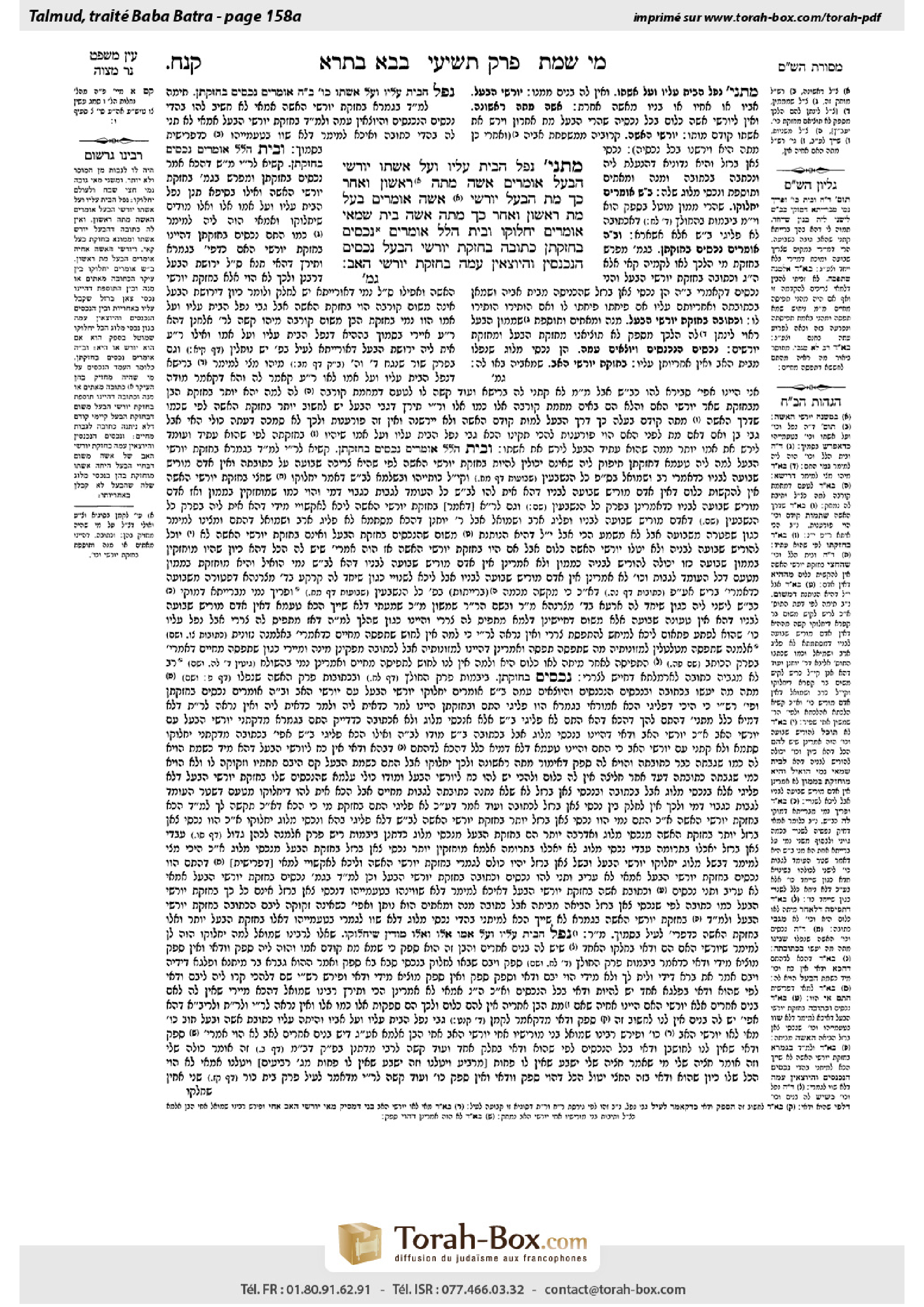
Bava Batra 158a: Talmud study for Daf Yomi
Study the Talmud for Daf Yomi with scanned pages, Hebrew text, English translations from Sefaria and AI-generated French translations.
Passage selection and English or AI-generated French translation are available where the scan has annotations. Daf Study is independent of Torah-Box and Sefaria.
Browse Bava Batra · בבא בתרא · All tractatesBava Batra 158a text and translations
This page of Bava Batra includes the Aramaic text, an English translation and an AI-generated French translation, alongside the scan above.
בבא בתרא קנ״ח א · Aramaic and Hebrew text
מַתְנִי׳ נָפַל הַבַּיִת עָלָיו וְעַל אִשְׁתּוֹ, יוֹרְשֵׁי הַבַּעַל אוֹמְרִים: אִשָּׁה מֵתָה רִאשׁוֹן, וְאַחַר כָּךְ מֵת הַבַּעַל; יוֹרְשֵׁי אִשָּׁה אוֹמְרִים: בַּעַל מֵת רִאשׁוֹן, וְאַחַר כָּךְ מֵתָה אִשָּׁה –
בֵּית שַׁמַּאי אוֹמְרִים: יַחְלוֹקוּ. וּבֵית הִלֵּל אוֹמְרִים: נְכָסִים – בְּחֶזְקָתָן, כְּתוּבָּה – בְּחֶזְקַת יוֹרְשֵׁי הַבַּעַל, נְכָסִים הַנִּכְנָסִין וְהַיּוֹצְאִין עִמָּהּ – בְּחֶזְקַת יוֹרְשֵׁי הָאָב.
Bava Batra 158a · English translation
MISHNA: If the house collapsed upon a husband and upon his wife, and it is unknown who died first, if the wife did not have any children from her husband, then the following claims arise: The husband’s heirs say: The wife died first and was inherited by her husband, and afterward the husband died, and therefore the husband’s heirs inherit both his and her property. The wife’s heirs say: The husband died first and afterward the wife died, and her heirs inherit the property that she brought with her to the marriage and the payment of her marriage contract.
Beit Shammai say: They divide the property under dispute between them. And Beit Hillel say: The guaranteed property that the wife brought with her to the marriage retains its previous ownership status. The sum of the marriage contract remains in the possession of the husband’s heirs, since the marriage contract is collected from the husband’s property. Property that is brought into and taken out of the marriage with her, i.e., usufruct property that remains in the wife’s possession during her marriage, remains in the possession of the heirs of the woman’s father.
Bava Batra 158a · Traduction française (IA)
MICHNA : Si la maison s'effondre sur un mari et sur sa femme, et si on ignore qui est mort en premier, et que la femme n'avait pas d'enfants avec son mari, alors les revendications suivantes émergent : Les héritiers du mari affirment : La femme est morte en premier et a été héritée par son mari, puis le mari est mort, et donc les héritiers du mari héritent des biens du mari et de ceux de la femme. Les héritiers de la femme affirment : Le mari est mort en premier, puis la femme, et donc les héritiers de la femme héritent des biens qu'elle avait apportés dans le mariage et du paiement de son contrat de mariage.
Beit Shammai disent : Ils divisent les biens en litige entre eux. Et Beit Hillel disent : Les biens garantis que la femme apportait dans le mariage conservent leur statut d'origine. La somme du contrat de mariage reste en possession des héritiers du mari, car le contrat de mariage est récolté à partir des biens du mari. Les biens apportés et retirés du mariage avec elle, c'est-à-dire les biens usufruitiers restant en possession de la femme pendant son mariage, restent en possession des héritiers du père de la femme.
Traduction française générée par IA à partir de l’édition anglaise de Sefaria. Vérifie toujours un passage avec le texte source.
Text from Sefaria: William Davidson Edition - Vocalized Aramaic (CC BY NC); William Davidson Edition - English (CC BY NC).