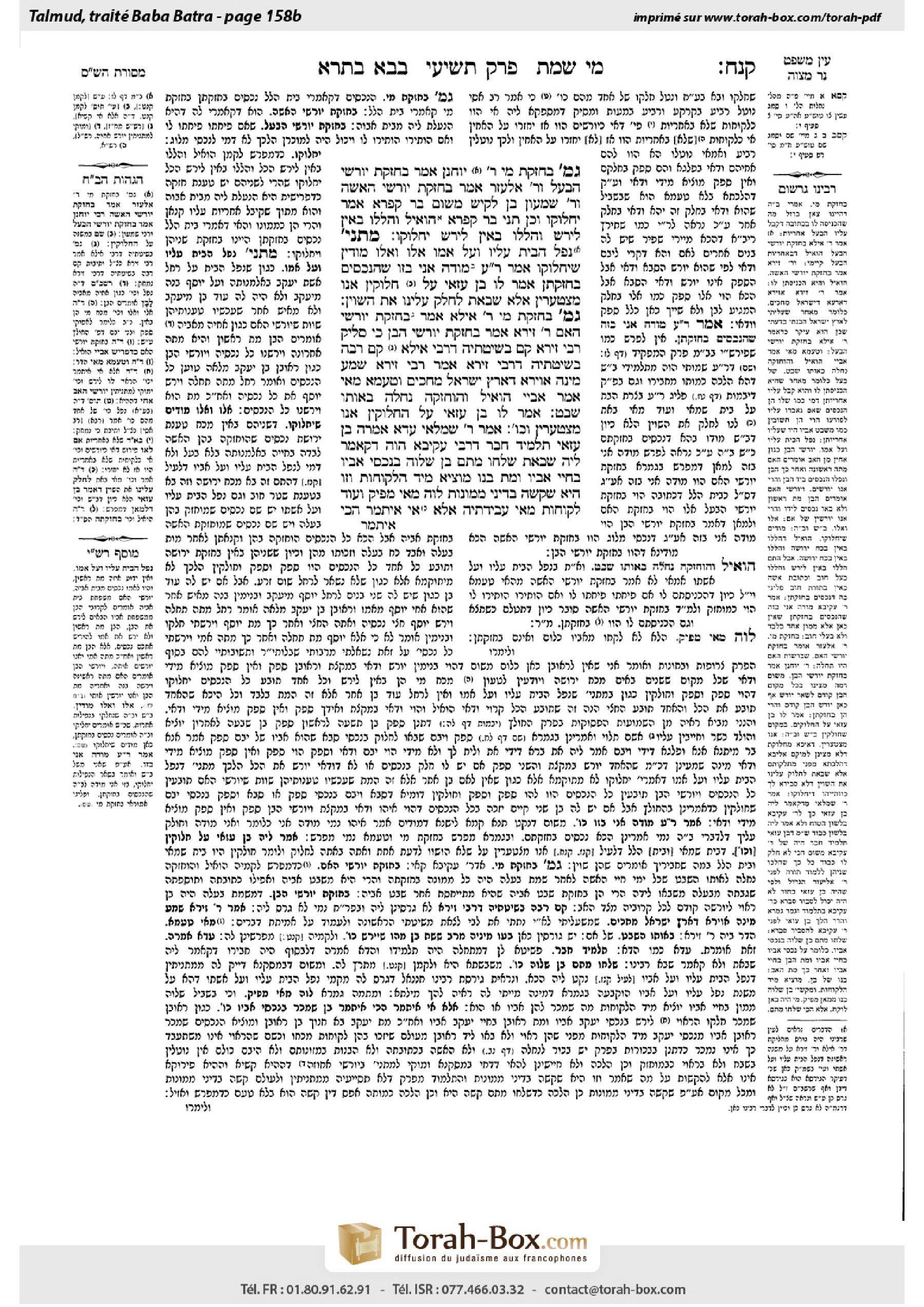
Bava Batra 158b: Talmud study for Daf Yomi
Study the Talmud for Daf Yomi with scanned pages, Hebrew text, English translations from Sefaria and AI-generated French translations.
Passage selection and English or AI-generated French translation are available where the scan has annotations. Daf Study is independent of Torah-Box and Sefaria.
Browse Bava Batra · בבא בתרא · All tractatesBava Batra 158b text and translations
This page of Bava Batra includes the Aramaic text, an English translation and an AI-generated French translation, alongside the scan above.
בבא בתרא קנ״ח ב · Aramaic and Hebrew text
גְּמָ׳ בְּחֶזְקַת מִי? רַבִּי יוֹחָנָן אָמַר: בְּחֶזְקַת יוֹרְשֵׁי הַבַּעַל, וְרַבִּי אֶלְעָזָר אָמַר: בְּחֶזְקַת יוֹרְשֵׁי הָאִשָּׁה,
וְרַבִּי שִׁמְעוֹן בֶּן לָקִישׁ מִשּׁוּם בַּר קַפָּרָא אָמַר: יַחְלוֹקוּ. וְכֵן תָּנֵי בַּר קַפָּרָא: הוֹאִיל וְהַלָּלוּ בָּאִין לִירַשׁ וְהַלָּלוּ בָּאִין לִירַשׁ, יַחְלוֹקוּ.
מַתְנִי׳ נָפַל הַבַּיִת עָלָיו וְעַל אִמּוֹ, אֵלּוּ וָאֵלּוּ מוֹדִין שֶׁיַּחְלוֹקוּ. אָמַר רַבִּי עֲקִיבָא: מוֹדֶה אֲנִי בָּזוֹ, שֶׁהַנְּכָסִים בְּחֶזְקָתָן. אָמַר לוֹ בֶּן עַזַּאי: עַל [הַ]חֲלוּקִין אָנוּ מִצְטַעֲרִין; אֶלָּא שֶׁבָּאתָ לְחַלֵּק עָלֵינוּ אֶת הַשָּׁוִין?!
גְּמָ׳ בְּחֶזְקַת מִי? רַבִּי אִילָא אָמַר: בְּחֶזְקַת יוֹרְשֵׁי הָאֵם. רַבִּי זֵירָא אָמַר: בְּחֶזְקַת יוֹרְשֵׁי הַבֵּן. כִּי סָלֵיק רַבִּי זֵירָא, קָם בְּשִׁיטְתֵיהּ דְּרַבִּי אִילָא. קָם רַבָּה בְּשִׁיטְתֵיהּ דְּרַבִּי זֵירָא. אָמַר רַבִּי זֵירָא, שְׁמַע מִינַּהּ – אַוֵּירָא דְּאֶרֶץ יִשְׂרָאֵל מַחְכִּים.
וְטַעְמָא מַאי? אָמַר אַבָּיֵי: הוֹאִיל וְהוּחְזְקָה נַחֲלָה בְּאוֹתוֹ שֵׁבֶט.
אָמַר לוֹ בֶּן עַזַּאי: עַל הַחֲלוּקִין אָנוּ מִצְטַעֲרִין וְכוּ׳. אָמַר רַבִּי שִׂמְלַאי, עֲדָא אָמְרָה – בֶּן עַזַּאי תַּלְמִיד חָבֵר דְּרַבִּי עֲקִיבָא הֲוָה, דְּקָאָמַר לֵיהּ ״שֶׁבָּאתָ״.
שְׁלַחוּ מִתָּם: בֵּן שֶׁלָּוָה בְּנִכְסֵי אָבִיו בְּחַיֵּי אָבִיו, וָמֵת – בְּנוֹ מוֹצִיא מִיַּד הַלָּקוֹחוֹת. וְזוֹ הִיא שֶׁקָּשָׁה בְּדִינֵי מָמוֹנוֹת. לָוָה – מַאי מַפֵּיק? וְעוֹד, לָקוֹחוֹת מַאי עֲבִידְתֵּיהּ? אֶלָּא אִי אִיתְּמַר, הָכִי
Bava Batra 158b · English translation
GEMARA: The mishna teaches that according to Beit Hillel, the guaranteed property that the wife brought with her to the marriage retains its previous ownership status. The Gemara asks: In whose possession does the guaranteed property remain? Rabbi Yoḥanan says: It remains in the possession of the husband’s heirs, since the husband is liable to compensate his wife for guaranteed property in the event of loss. And Rabbi Elazar says: It remains in the possession of the wife’s heirs, as the property came from her father’s house and belongs to her.
And Rabbi Shimon ben Lakish says in the name of bar Kappara: They divide the property between them. And likewise bar Kappara teaches in a baraita: Since these heirs come to inherit and those heirs come to inherit, and neither can prove his claim, they divide the property between them.
MISHNA: If the house collapsed on a son and upon his mother, and it is unknown who died first, the following claims arise: The mother’s paternal family claims that the son died first, and therefore they inherit from the mother, and the son’s heirs claim that the mother died first and her son inherited from her, and therefore they inherit from the son. In this case, both these Sages and those Sages, Beit Shammai and Beit Hillel, concede that they divide the property between them. Rabbi Akiva said: In this case I concede that the property retains its previous ownership status. Ben Azzai said to Rabbi Akiva: We are already troubled by those cases where Beit Shammai and Beit Hillel are in disagreement. But do you come to bring upon us a disagreement with regard to the case where they agree?
GEMARA: The mishna states that according to Rabbi Akiva, the property retains its previous ownership status. The Gemara asks: In whose possession does the property remain? Rabbi Ila says: It remains in the possession of the mother’s heirs. Rabbi Zeira, when he was still in Babylonia, said: It remains in the possession of the son’s heirs. When Rabbi Zeira ascended to Eretz Yisrael, he adopted the opinion of Rabbi Ila, whereas Rabba, in Babylonia, adopted the opinion stated by Rabbi Zeira. Rabbi Zeira said: Conclude from this incident that the air of Eretz Yisrael makes one wise, as when I ascended to Eretz Yisrael I accepted the opinion of Rabbi Ila, who was also from Eretz Yisrael, whereas Rabba, who remained in Babylonia, accepted my former opinion.
The Gemara asks: And what is the reason that the property remains in the possession of the mother’s heirs? Abaye says: Since the inheritance was initially in the possession of that tribe of the mother, it is not removed from their possession in order to transfer it to the son’s heirs, who are from a different tribe.
The mishna teaches: Ben Azzai said to Rabbi Akiva: We are already troubled by those cases where Beit Shammai and Beit Hillel are in disagreement. But do you come to bring upon us a disagreement with regard to the case where they agree? Rabbi Shamlai said: That is to say that ben Azzai was a disciple-colleague of Rabbi Akiva and not just a disciple, since he said to him: Do you come, in the second person, rather than using the more formal third person.
§ The Sages sent a ruling from there, Eretz Yisrael: With regard to a son who borrowed money based on the security of his father’s property during his father’s lifetime, and whose father subsequently died, his son repossesses the property from the buyers. And this is the most difficult halakha to understand with regard to monetary law. The Gemara clarifies the ruling: If the son borrowed, what does he repossess? He needs to repay a debt, not to collect payment. Moreover, what is the relevance of the buyers in this matter? There is no mention of them in the premise. Rather, if this matter was stated, it is in this manner
Bava Batra 158b · Traduction française (IA)
GUEMARA : La Michna enseigne que selon Beit Hillel, la propriété garantie que la femme apporte dans le mariage conserve son statut d'ancienne propriété. La Guemara pose la question : Dans quelle possession la propriété garantie demeure-t-elle ? Rabbi Yoḥanan dit : Elle demeure dans la possession des héritiers du mari, car le mari est tenu de compenser sa femme en cas de perte de la propriété garantie. Et Rabbi Elazar dit : Elle demeure dans la possession des héritiers de la femme, car la propriété provient de la maison de son père et lui appartient.
Et Rabbi Shimon ben Lakish dit au nom de bar Kappara : Ils partagent la propriété entre eux. Et de même, bar Kappara enseigne dans une baraïta : Puisque ces héritiers viennent hériter et ceux-ci viennent hériter, et aucun ne peut prouver son droit, ils partagent la propriété entre eux.
MICHNA : Si la maison s'est effondrée sur un fils et sur sa mère, et si on ignore qui est mort en premier, les revendications suivantes surgissent : La famille paternelle de la mère affirme que le fils est mort en premier, et donc ils héritent de la mère, et les héritiers du fils affirment que la mère est morte en premier et que son fils a hérité d'elle, et donc ils héritent du fils. Dans ce cas, tant ces Sages que ceux-ci, Beit Shammai et Beit Hillel, reconnaissent qu'ils partagent la propriété entre eux. Rabbi Akiva a dit : Dans ce cas, je reconnais que la propriété conserve son statut d'ancienne propriété. Ben Azzai a dit à Rabbi Akiva : Nous sommes déjà troublés par ces cas où Beit Shammai et Beit Hillel sont en désaccord. Mais est-ce que tu viens nous imposer un désaccord concernant le cas où ils sont d'accord ?
GUEMARA : La Michna indique que selon Rabbi Akiva, la propriété conserve son statut d'ancienne propriété. La Guemara pose la question : Dans quelle possession la propriété demeure-t-elle ? Rabbi Ila dit : Elle demeure dans la possession des héritiers de la mère. Rabbi Zeira, lorsqu'il était encore en Babylone, dit : Elle demeure dans la possession des héritiers du fils. Lorsque Rabbi Zeira est monté en Eretz Yisrael, il a adopté l'opinion de Rabbi Ila, tandis que Rabba, en Babylone, a adopté l'opinion exprimée par Rabbi Zeira. Rabbi Zeira a dit : Concluez de cet incident que l'air d'Eretz Yisrael rend sage, car lorsque j'ai monté en Eretz Yisrael, j'ai accepté l'opinion de Rabbi Ila, qui était également d'Eretz Yisrael, tandis que Rabba, resté en Babylone, a adopté mon ancienne opinion.
La Guemara pose la question : Et quelle est la raison pour laquelle la propriété demeure dans la possession des héritiers de la mère ? Abaye dit : Puisque l'héritage était initialement dans la possession de cette tribu de la mère, il n'est pas retiré de leur possession pour être transféré aux héritiers du fils, qui appartiennent à une autre tribu.
La Michna enseigne : Ben Azzai a dit à Rabbi Akiva : Nous sommes déjà troublés par ces cas où Beit Shammai et Beit Hillel sont en désaccord. Mais est-ce que tu viens nous imposer un désaccord concernant le cas où ils sont d'accord ? Rabbi Shamlai a dit : Cela signifie que Ben Azzai était un disciple et collègue de Rabbi Akiva et non seulement un disciple, car il a dit à lui : Tu viens, à la deuxième personne, plutôt que d'utiliser la troisième personne plus formelle.
§ Les Sages ont envoyé un avis depuis Eretz Yisrael : Concernant un fils qui a emprunté de l'argent en se fondant sur la garantie de la propriété de son père pendant la vie de ce dernier, et que son père est ensuite mort, son fils récupère la propriété auprès des acheteurs. Et c'est la halakha la plus difficile à comprendre concernant la loi monétaire. La Guemara clarifie cet avis : Si le fils a emprunté, de quoi récupère-t-il ? Il doit rembourser une dette, pas récupérer un paiement. De plus, quelle est l'importance des acheteurs dans cette affaire ? Ils ne sont pas mentionnés dans la prémisses. Plutôt, si cette affaire a été évoquée, c'est ainsi
Traduction française générée par IA à partir de l’édition anglaise de Sefaria. Vérifie toujours un passage avec le texte source.
Text from Sefaria: William Davidson Edition - Vocalized Aramaic (CC BY NC); William Davidson Edition - English (CC BY NC).