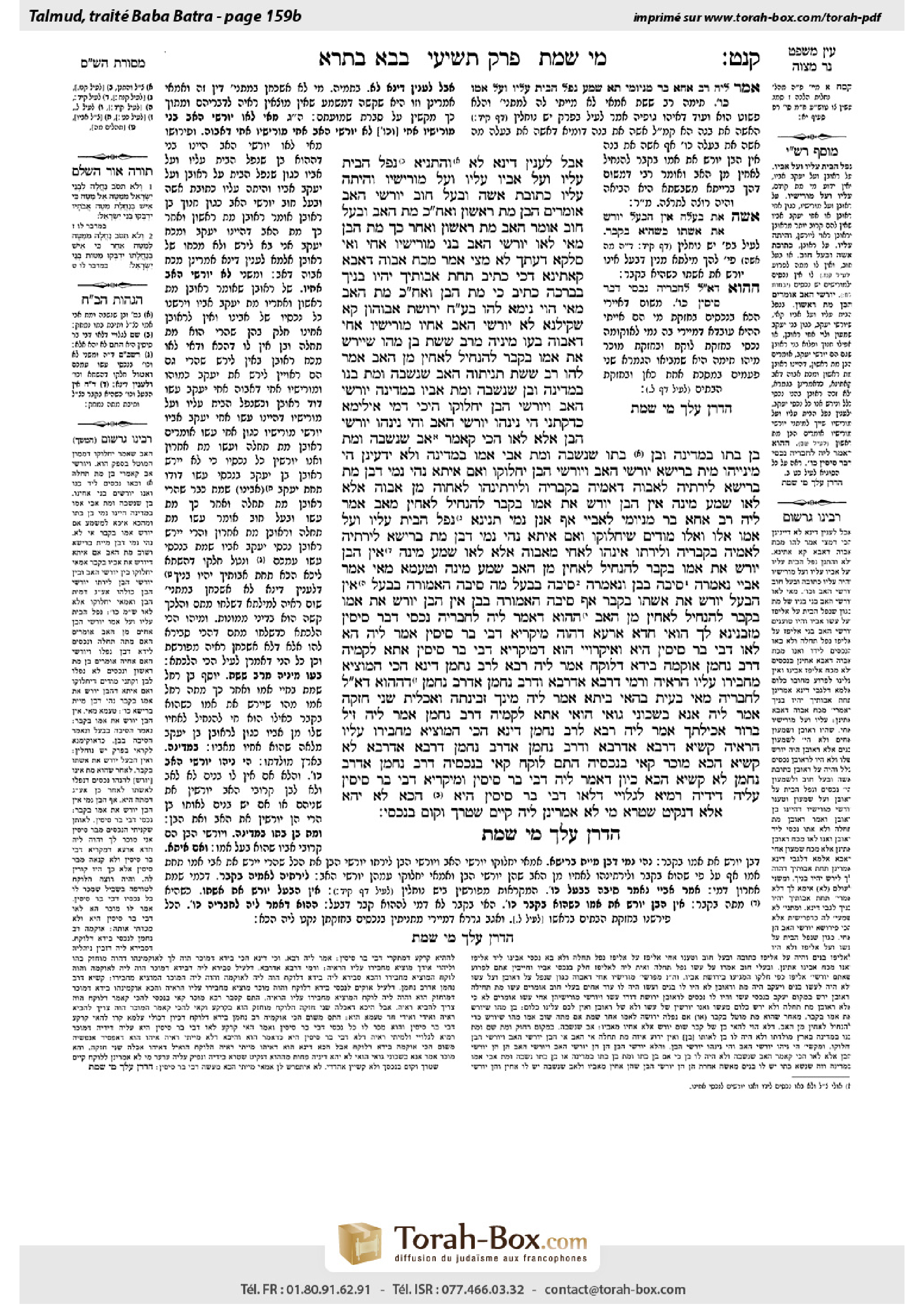
Bava Batra 159b: Talmud study for Daf Yomi
Study the Talmud for Daf Yomi with scanned pages, Hebrew text, English translations from Sefaria and AI-generated French translations.
Passage selection and English or AI-generated French translation are available where the scan has annotations. Daf Study is independent of Torah-Box and Sefaria.
Browse Bava Batra · בבא בתרא · All tractatesBava Batra 159b text and translations
This page of Bava Batra includes the Aramaic text, an English translation and an AI-generated French translation, alongside the scan above.
בבא בתרא קנ״ט ב · Aramaic and Hebrew text
אֲבָל לְעִנְיַן דִּינָא לָא?!
וְהָתַנְיָא: נָפַל הַבַּיִת עָלָיו וְעַל אָבִיו, עָלָיו וְעַל מוֹרִישָׁיו; וְהָיְתָה עָלָיו כְּתוּבַּת אִשָּׁה וּבַעַל חוֹב; יוֹרְשֵׁי הָאָב אוֹמְרִים: הַבֵּן מֵת רִאשׁוֹן, וְאַחַר כָּךְ מֵת הָאָב; וּבַעַל חוֹב אוֹמֵר: הָאָב מֵת רִאשׁוֹן, וְאַחַר כָּךְ מֵת הַבֵּן.
מַאי, לָאו ״יוֹרְשֵׁי הָאָב״ – בְּנֵי, ״מוֹרִישָׁיו״ – אַחֵי? וְאִי סָלְקָא דַּעְתָּךְ לָא מָצֵי אֲמַר ״מִכֹּחַ אֲבוּהּ דְּאַבָּא קָאָתֵינָא״, דְּכִי כְּתִיב: ״תַּחַת אֲבֹתֶיךָ יִהְיוּ בָנֶיךָ״ – בִּבְרָכָה כְּתִיב; כִּי מֵת הַבֵּן וְאַחַר כָּךְ מֵת הָאָב – מַאי הָוֵי? נֵימָא לְהוּ בַּעַל חוֹב: יְרוּשַּׁת אֲבוּהוֹן קָא שָׁקֵילְנָא!
לָא; ״יוֹרְשֵׁי הָאָב״ – אֶחָיו, ״מוֹרִישָׁיו״ – אַחֵי דַּאֲבוּהּ.
בְּעוֹ מִינֵּיהּ מֵרַב שֵׁשֶׁת: בֵּן, מַהוּ שֶׁיִּירַשׁ אֶת אִמּוֹ בַּקֶּבֶר – לְהַנְחִיל לָאַחִין מִן הָאָב? אֲמַר לְהוּ רַב שֵׁשֶׁת, תְּנֵיתוּהָ: הָאָב שֶׁנִּשְׁבָּה, וּמֵת בְּנוֹ בַּמְּדִינָה; וּבֵן שֶׁנִּשְׁבָּה, וּמֵת אָבִיו בַּמְּדִינָה – יוֹרְשֵׁי הָאָב וְיוֹרְשֵׁי הַבֵּן יַחְלוֹקוּ.
הֵיכִי דָמֵי? אִילֵּימָא כִּדְקָתָנֵי, הֵי נִינְהוּ יוֹרְשֵׁי הָאָב וְהֵי נִינְהוּ יוֹרְשֵׁי הַבֵּן? אֶלָּא לָאו הָכִי קָאָמַר: אָב שֶׁנִּשְׁבָּה וּמֵת בֶּן בִּתּוֹ בַּמְּדִינָה, וּבֶן בִּתּוֹ שֶׁנִּשְׁבָּה וּמֵת אֲבִי אִמּוֹ בַּמְּדִינָה, וְלָא יָדְעִינַן הֵי מִינַּיְיהוּ מִית בְּרֵישָׁא – יוֹרְשֵׁי הָאָב וְיוֹרְשֵׁי הַבֵּן יַחְלוֹקוּ.
וְאִם אִיתָא, נְהִי נָמֵי דְּבֵן מֵת בְּרֵישָׁא, לֵירְתֵיהּ לַאֲבוּהּ דְּאִמֵּיהּ בְּקִבְרֵיהּ, וְלֵירְתִינְהוּ לַאֲחוֹהַּ מִן אֲבוּהּ! אֶלָּא לָאו שְׁמַע מִינַּהּ – אֵין הַבֵּן יוֹרֵשׁ אֶת אִמּוֹ בַּקֶּבֶר, לְהַנְחִיל לָאַחִין מֵאָב?
אֲמַר לֵיהּ רַב אַחָא בַּר מִנְיוֹמֵי לְאַבָּיֵי, אַף אֲנַן נָמֵי תְּנֵינָא: נָפַל הַבַּיִת עָלָיו וְעַל אִמּוֹ – אֵלּוּ וָאֵלּוּ מוֹדִים שֶׁיַּחְלוֹקוּ. וְאִם אִיתָא, נְהִי נָמֵי דְּבֵן מֵת בְּרֵישָׁא, לֵירְתַיהּ לְאִמֵּיהּ בְּקִבְרֵיהּ, וְלֵירְתוּ אִינְהוּ לְאַחֵי מֵאֲבוּהּ! אֶלָּא לָאו שְׁמַע מִינַּהּ אֵין הַבֵּן יוֹרֵשׁ אֶת אִמּוֹ בַּקֶּבֶר לְהַנְחִיל לָאַחִין מִן הָאָב? שְׁמַע מִינַּהּ.
וְטַעְמָא מַאי? אָמַר אַבָּיֵי: נֶאֶמְרָה ״סִיבָּה״ בַּבֵּן, וְנֶאֶמְרָה ״סִיבָּה״ בַּבַּעַל; מָה ״סִיבָּה״ הָאֲמוּרָה בַּבַּעַל – אֵין הַבַּעַל יוֹרֵשׁ אֶת אִשְׁתּוֹ בַּקֶּבֶר, אַף ״סִיבָּה״ הָאֲמוּרָה בַּבֵּן – אֵין הַבֵּן יוֹרֵשׁ אֶת אִמּוֹ בַּקֶּבֶר, לְהַנְחִיל לָאַחִין מִן הָאָב.
הָהוּא דַּאֲמַר לֵיהּ לְחַבְרֵיהּ: נִכְסֵי דְּבַר סִיסִין מְזַבֵּנְינָא לָךְ. הֲוַאי חֲדָא אַרְעָא דַּהֲוָה מִיקַּרְיָא ״דְּבֵי בַּר סִיסִין״, אֲמַר לֵיהּ: הָא לָאו דְּבֵי בַּר סִיסִין הִיא, וְאִיקְּרוֹיֵי הוּא דְּמִיקַּרְיָא ״דְּבֵי בַּר סִיסִין״.
אֲתָא לְקַמֵּיהּ דְּרַב נַחְמָן, אוֹקְמַהּ בִּידָא דְּלוֹקֵחַ. אֲמַר לֵיהּ רָבָא לְרַב נַחְמָן: דִּינָא הָכִי?! הַמּוֹצִיא מֵחֲבֵירוֹ – עָלָיו הָרְאָיָה! וְרָמֵי דְּרָבָא אַדְּרָבָא, וּדְרַב נַחְמָן אַדְּרַב נַחְמָן –
דְּהָהוּא דַּאֲמַר לֵיהּ לְחַבְרֵיהּ: מַאי בָּעֵית בְּהַאי בֵּיתָא? אֲמַר לֵיהּ: מִינָּךְ זְבֵינְתַּהּ, וַאֲכַלִית שְׁנֵי חֲזָקָה. אֲמַר לֵיהּ: אֲנָא בְּשִׁכּוּנֵי גַּוָּאֵי הֲוַאי.
אֲתָא לְקַמֵּיהּ דְּרַב נַחְמָן, אֲמַר לֵיהּ: זִיל בְּרוֹר אֲכִילָתָךְ. אֲמַר לֵיהּ רָבָא לְרַב נַחְמָן: דִּינָא הָכִי?! הַמּוֹצִיא מֵחֲבֵירוֹ – עָלָיו הָרְאָיָה! קַשְׁיָא דְּרָבָא אַדְּרָבָא, וּדְרַב נַחְמָן אַדְּרַב נַחְמָן!
דְּרָבָא אַדְּרָבָא לָא קַשְׁיָא – הָכָא מוֹכֵר קָאֵי בְּנִכְסֵיהּ, הָתָם לוֹקֵחַ קָאֵי בְּנִכְסֵיהּ.
דְּרַב נַחְמָן אַדְּרַב נַחְמָן לָא קַשְׁיָא – הָכָא, כֵּיוָן דְּאָמַר לֵיהּ: דְּבֵי בַּר סִיסִין, וּמִיקַּרְיָא ״דְּבֵי בַּר סִיסִין״; עֲלֵיהּ דִּידֵיהּ רַמְיָא לְגַלּוֹיֵי דְּלָאו דְּבֵי בַּר סִיסִין הִיא. הָכָא, לֹא יְהֵא אֶלָּא דְּנָקֵיט שְׁטָרָא – מִי לָא אָמְרִינַן לֵיהּ: קַיֵּים שְׁטָרָךְ וְקוּם בְּנִכְסֵי?
הֲדַרַן עֲלָךְ מִי שֶׁמֵּת
Bava Batra 159b · English translation
but with regard to the halakha it does not indicate anything?
But isn’t it taught in the mishna (157a): A house collapsed on a son and upon his father, or upon a certain person and upon those from whom he stands to inherit, and it is unknown who died first. If the son bore the responsibility to pay the marriage contract of his wife and to pay a creditor, and the son had no money with which to pay them except that which he might inherit from his father, and the father’s heirs say: The son died first and afterward the father died, and therefore the son did not inherit property from his father, and the creditor says: The father died first and afterward the son died, there is a dispute as to the halakha. The son therefore inherited his father’s property, and his creditor has a lien upon the property, enabling him to collect payment from the property even after the son’s death.
What, is it not correct to explain that the father’s heirs are the son’s sons, and the term: Those from whom he stands to inherit, is referring to the deceased son’s brothers? And if it enters your mind to maintain that the grandson cannot say: I come to repossess the property on the basis of the right of my father’s father to the property, as when it is written in the verse in Psalms: “In the place of your fathers shall be your sons,” this is written as a blessing, then the mishna is difficult. According to this understanding, grandsons inherit from their grandfather only through their father. If so, even if the son died first and afterward the father died, what of it? Let the creditor say to the son’s sons: It is their father’s inheritance that I am taking, as the grandsons inherit from their grandfather only through their father.
The Gemara rejects this explanation: No, the father’s heirs are the deceased son’s brothers, who certainly inherit from their father directly, and the term: Those from whom he stands to inherit, is referring to the deceased son’s father’s brothers. Therefore, one cannot derive from the mishna that a grandson inherits from his grandfather directly.
§ The Sages raised a dilemma before Rav Sheshet: What is the halakha with regard to a son inheriting from his mother while he is in the grave, in order to bequeath that inheritance to his paternal brothers? If a son dies, and afterward his mother dies, does the deceased son inherit from his mother, and subsequently bequeath the inheritance to his paternal brothers, who are not related to the mother? Rav Sheshet said to them: You learned it in a baraita: Consider the case of a father who was taken captive and died in captivity, and his son died in the province, i.e., at home, and consider the case of a son who was taken captive and died, and his father died in the province. Since it is not known who died first, the father’s heirs and the son’s heirs divide the inheritance.
The Gemara asks: What are the circumstances of the case? If we say that the case is as the baraita teaches, the baraita is difficult. Who are the father’s heirs and who are the son’s heirs? The same individuals inherit from both of them. Rather, is it not so that this is what the baraita is saying: Consider the case of a father who was taken captive and died in captivity, and his daughter’s son died in the province, and consider the case of the son of his daughter who was taken captive and died, and the father of the captive’s mother died in the province, and we do not know which of them died first. If the father died first, his daughter’s son inherits from him, and the son’s paternal relatives subsequently inherit from the son. If the son died first, the father’s heirs inherit the father’s estate. Since it is unknown which of them died first, the father’s heirs and the son’s heirs divide the inheritance.
And if it is so that a son inherits from his mother while in the grave, although the son indeed died first, he should inherit from his mother’s father while in his grave and bequeath his inheritance to his paternal brothers, and the son’s heirs should receive the entire inheritance. Rather, isn’t it correct to conclude from the baraita that the son does not inherit from his mother while in the grave in order to bequeath that inheritance to his paternal brothers?
Rav Aḥa bar Minyumi said to Abaye: We learn this halakha in the mishna (158b) as well: If the house collapsed on a son and upon his mother, both these Sages and those Sages, Beit Shammai and Beit Hillel, concede that the son’s heirs and the mother’s heirs divide the property between them. And if it is so that a son inherits from his mother while in the grave, although the son indeed died first, he should inherit from his mother while in his grave and they should inherit from him, i.e., he should bequeath his inheritance to his paternal brothers. Rather, isn’t it correct to conclude from that mishna that the son does not inherit from his mother while in the grave in order to bequeath that inheritance to his paternal brothers? The Gemara affirms: Conclude from the mishna that this is so.
And what is the reason that a son does not inherit from his mother while in the grave? Abaye says: The term transfer, concerning the transfer of inheritance from one tribe to another, was stated with regard to the inheritance of a son (see Numbers 36:7), and the term transfer was stated with regard to the inheritance of a husband (see 111b–113a and Numbers 36:9). Just as in the case categorized as transfer that was stated with regard to the inheritance of a husband, the husband does not inherit from his wife while he is in the grave in order to bequeath that inheritance to his heirs, so too, in the case categorized as transfer that was stated with regard to the inheritance of a son, the son does not inherit from his mother while in the grave in order to bequeath that inheritance to his paternal brothers.
§ There was a certain person who said to another: I am selling to you all of the property that I own of bar Sisin. There was one parcel of land that was called the tract of the house of bar Sisin. The seller said to the buyer: This latter parcel of land is actually not the property of the house of bar Sisin, and it is merely called: Of the house of bar Sisin, and therefore it is not included in the sale.
The matter came before Rav Naḥman, and he placed the land in the possession of the buyer. Rava said to Rav Naḥman: Is this the halakha? The halakha is that the burden of proof rests upon the claimant, which in this case is the buyer. And the Gemara raises a contradiction between this statement of Rava and another statement of Rava, and between this statement of Rav Naḥman and another statement of Rav Naḥman.
The Gemara explains the contradictions. There was a certain man who said to another: What do you want, i.e., what are you doing, with this house of mine? He said to the claimant: I purchased it from you and I worked and profited from it for the years necessary for establishing the presumption of ownership. The claimant said to him: I was traveling among the settlements in a distant location, and I was unaware that you were residing in my house, which is why I did not lodge a protest.
The one residing in the house came before Rav Naḥman for a judgment. Rav Naḥman said to him: Go clarify your profiting, i.e., prove that you really resided there for three years, and then the case can be judged. Rava said to Rav Naḥman: Is this the correct judgment? The halakha is that the burden of proof rests upon the claimant. Therefore, the claimant should have to prove that the possessor did not reside in the house. The first statement of Rava is difficult, as it is contradicted by the second statement of Rava, and the first statement of Rav Naḥman is difficult, as it is contradicted by the second statement of Rav Naḥman. In the first case, Rav Naḥman ruled in favor of the buyer, and Rava ruled in favor of the seller, whereas in the second case their rulings were reversed.
The Gemara answers: The apparent contradiction between the first statement of Rava and the second statement of Rava is not difficult. Here, with regard to the property of bar Sisin, the seller stands in possession of his property, and the buyer claims the parcel of land from him. There, the buyer stands in possession of his property, since he dwells in the house, and the seller wishes to evict him.
The contradiction between one statement of Rav Naḥman and the other statement of Rav Naḥman is not difficult as well, because there, since the seller said to him: I am hereby selling you all of the property that I own of the house of bar Sisin, and this parcel of land is called: Of the house of bar Sisin, it is incumbent on him to reveal that it is not of the house of bar Sisin. But here, in the case where the claimant states that he had been in a distant location, it should not be considered as any case other than one where the possessor is holding a document as evidence that he purchased the house. Wouldn’t we then say to him: First ratify your document, and only then be established as the owner of the property? In this case as well, since his presumptive ownership is in place of a document, he needs to clarify the matter by means of witnesses.
Bava Batra 159b · Traduction française (IA)
mais concernant la halakha, elle ne précise rien ?
Mais n’est-il pas enseigné dans la mitsva (157a) : Une maison s’effondre sur un fils et sur son père, ou sur une certaine personne et sur ceux d’où il peut hériter, et on ignore qui est mort en premier. Si le fils avait la responsabilité de payer le contrat de mariage de sa femme et de rembourser un créancier, et que le fils n’avait pas d’argent pour les payer sauf celui qu’il pourrait hériter de son père, et que les héritiers du père disent : Le fils est mort en premier et ensuite le père, et donc le fils n’a pas hérité de la propriété de son père, et que le créancier dit : Le père est mort en premier et ensuite le fils, il y a un désaccord concernant la halakha. Le fils hérite donc de la propriété de son père, et le créancier a un droit sur la propriété, lui permettant de récupérer le paiement de la propriété même après la mort du fils.
Qu’est-ce que cela signifie ? N’est-ce pas correct d’expliquer que les héritiers du père sont les fils du fils, et que le terme : ceux d’où il peut hériter, fait référence aux frères du défunt fils ? Et si cela entre en votre tête de maintenir que le petit-fils ne peut pas dire : Je viens récupérer la propriété sur la base du droit de son grand-père à la propriété, comme lorsqu’il est écrit dans la verset de Psalms : « Dans le lieu de vos pères sera votre fils », cela est écrit comme une bénédiction, alors la mitsva est difficile. Selon cette compréhension, les petits-fils héritent de leur grand-père uniquement par l’intermédiaire de leur père. Si c’est ainsi, même si le fils est mort en premier et ensuite le père, qu’y a-t-il ? Que le créancier dise aux fils du fils : C’est l’héritage de leur père que je récupère, car les petits-fils héritent de leur grand-père uniquement par l’intermédiaire de leur père.
La Guemara rejette cette explication : Non, les héritiers du père sont les frères du défunt fils, qui héritent directement de leur père, et le terme : ceux d’où il peut hériter, fait référence aux frères du père du défunt fils. Ainsi, on ne peut pas déduire de la mitsna que les petits-fils héritent directement de leur grand-père.
§ Les Sages ont posé un dilemme devant Rav Sheshet : Quelle est la halakha concernant un fils qui hérite de sa mère alors qu’il est encore en vie, afin de léguer cette héritage à ses frères paternels ? Si un fils meurt, et ensuite sa mère meurt, le fils décédé hérite-t-il de sa mère, et ensuite léguer l’héritage à ses frères paternels, qui ne sont pas apparentés avec la mère ? Rav Sheshet a dit aux Sages : Vous l’avez appris dans une baraïta : Considérez le cas d’un père qui a été capturé et est mort en captivité, et son fils est mort dans la province, c’est-à-dire à la maison, et considérez le cas d’un fils qui a été capturé et est mort, et son père est mort dans la province. Puisque l’on ne sait pas qui est mort en premier, les héritiers du père et les héritiers du fils partagent l’héritage.
La Guemara demande : Quelles sont les circonstances du cas ? Si nous disons que le cas est comme celui que la baraïta enseigne, la baraïta est difficile. Qui sont les héritiers du père et qui sont les héritiers du fils ? Les mêmes individus héritent des deux. Plutôt, n’est-ce pas ainsi que la baraïta dit : Considérez le cas d’un père qui a été capturé et est mort en captivité, et le fils de sa fille est mort dans la province, et considérez le cas du fils de sa fille qui a été capturé et est mort, et le père de la mère du captif est mort dans la province, et on ne sait pas qui est mort en premier. Si le père est mort en premier, le fils de sa fille hérite de lui, et les parents paternels du fils héritent ensuite du fils. Si le fils est mort en premier, les héritiers du père héritent de l’héritage du père. Puisque l’on ne sait pas qui est mort en premier, les héritiers du père et les héritiers du fils partagent l’héritage.
Et si c’est ainsi que le fils hérite de sa mère alors qu’il est en terre, même si le fils est effectivement mort en premier, il devrait hériter de la propriété de son grand-père alors qu’il est en terre et léguer son héritage à ses frères paternels, et les héritiers du fils devraient recevoir l’ensemble de l’héritage. Plutôt, n’est-ce pas correct de conclure de la baraïta que le fils ne hérite pas de sa mère alors qu’il est en terre afin de léguer cette héritage à ses frères paternels ?
Rav Aḥa bar Minyumi a dit à Abaye : Nous apprenons cette halakha également dans la mitsva (158b) : Si la maison s’effondre sur un fils et sur sa mère, ces deux Sages et ces autres Sages, Beit Shammai et Beit Hillel, reconnaissent que les héritiers du fils et les héritiers de la mère partagent la propriété entre eux. Et si c’est ainsi que le fils hérite de sa mère alors qu’il est en terre, même si le fils est effectivement mort en premier, il devrait hériter de la propriété de sa mère alors qu’il est en terre et ils devraient hériter de lui, c’est-à-dire qu’il devrait léguer son héritage à ses frères paternels. Plutôt, n’est-ce pas correct de conclure de cette mitsva que le fils ne hérite pas de sa mère alors qu’il est en terre afin de léguer cette héritage à ses frères paternels ? La Guemara confirme : Concluez de la mitsva que c’est ainsi.
Et quelle est la raison pour laquelle un fils ne hérite pas de sa mère alors qu’il est en terre ? Abaye dit : Le terme de transfert, concernant le transfert d’héritage d’une tribu à une autre, a été énoncé concernant l’héritage d’un fils (voir Nombres 36:7), et le terme de transfert a été énoncé concernant l’héritage d’un mari (voir 111b–113a et Nombres 36:9). Tout comme dans le cas catégorisé comme transfert énoncé concernant l’héritage d’un mari, le mari ne hérite pas de sa femme alors qu’il est en terre afin de léguer cette héritage à ses héritiers, de même, dans le cas catégorisé comme transfert énoncé concernant l’héritage d’un fils, le fils ne hérite pas de sa mère alors qu’il est en terre afin de léguer cette héritage à ses frères paternels.
§ Il y avait un certain homme qui dit à un autre : Je vends à toi toute la propriété que j'possède de bar Sisin. Il y avait un lot de terre qui était appelé le tract de la maison de bar Sisin. Le vendeur dit à l'acheteur : Ce dernier lot de terre n'est pas en réalité la propriété de la maison de bar Sisin, et il est simplement appelé : De la maison de bar Sisin, et c'est pourquoi il n'est pas inclus dans la vente.
L'affaire est venue devant Rav Naḥman, et il a mis la terre en possession de l'acheteur. Rava a dit à Rav Naḥman : C'est cela la halakha ? La halakha est que la charge de la preuve repose sur le plaignant, qui dans ce cas est l'acheteur. Et la Guemara soulève une contradiction entre cette déclaration de Rava et une autre déclaration de Rava, et entre cette déclaration de Rav Naḥman et une autre déclaration de Rav Naḥman.
La Guemara explique les contradictions. Il y avait un certain homme qui dit à un autre : Que veux-tu, c'est-à-dire que fais-tu, avec cette maison à moi ? Il a dit au plaignant : J'ai acheté cette maison chez toi et j'ai travaillé et bénéficié d'elle pendant les années nécessaires pour établir la présomption d'ownership. Le plaignant a dit à lui : J'étais en voyage parmi les villages dans une localité éloignée, et je n'étais pas conscient que tu habitais dans ma maison, ce qui est pourquoi je n'ai pas porté plainte.
Celui qui habitait dans la maison est venu devant Rav Naḥman pour un jugement. Rav Naḥman a dit à lui : Va clarifier ton profit, c'est-à-dire prouve que tu as vraiment habité là pendant trois ans, et alors l'affaire pourra être jugée. Rava a dit à Rav Naḥman : C'est cela la bonne décision ? La halakha est que la charge de la preuve repose sur le plaignant. Donc le plaignant devrait avoir à prouver que le possesseur n'a pas habité dans la maison. La première déclaration de Rava est difficile, car elle est contredite par la deuxième déclaration de Rava, et la première déclaration de Rav Naḥman est difficile, car elle est contredite par la deuxième déclaration de Rav Naḥman. Dans le premier cas, Rav Naḥman a rendu un jugement en faveur de l'acheteur, et Rava a rendu un jugement en faveur du vendeur, tandis que dans le second cas leurs jugements étaient inversés.
La Guemara répond : La contradiction apparente entre la première déclaration de Rava et la deuxième déclaration de Rava n'est pas difficile. Ici, concernant la propriété de bar Sisin, le vendeur est en possession de sa propriété, et l'acheteur revendique le lot de terre contre lui. Là, l'acheteur est en possession de sa propriété, puisqu'il habite dans la maison, et le vendeur veut le faire expulser.
La contradiction entre une déclaration de Rav Naḥman et l'autre déclaration de Rav Naḥman n'est pas difficile non plus, car là, puisque le vendeur a dit à lui : Je vends à toi toute la propriété que j'possède de la maison de bar Sisin, et ce lot de terre est appelé : De la maison de bar Sisin, il est incumbent à lui de révéler qu'il n'est pas de la maison de bar Sisin. Mais ici, dans le cas où le plaignant affirme avoir été dans une localité éloignée, cela ne devrait pas être considéré comme un cas différent d'un cas où le possesseur tient un document comme preuve qu'il a acheté la maison. Ne dirions-nous pas alors à lui : D'abord validez votre document, et seulement alors soyez établi comme propriétaire de la propriété ? Dans ce cas également, puisque sa présomption d'ownership est en place d'un document, il a besoin de clarifier la question par l'intermédiaire de témoins.
Traduction française générée par IA à partir de l’édition anglaise de Sefaria. Vérifie toujours un passage avec le texte source.
Text from Sefaria: William Davidson Edition - Vocalized Aramaic (CC BY NC); William Davidson Edition - English (CC BY NC).