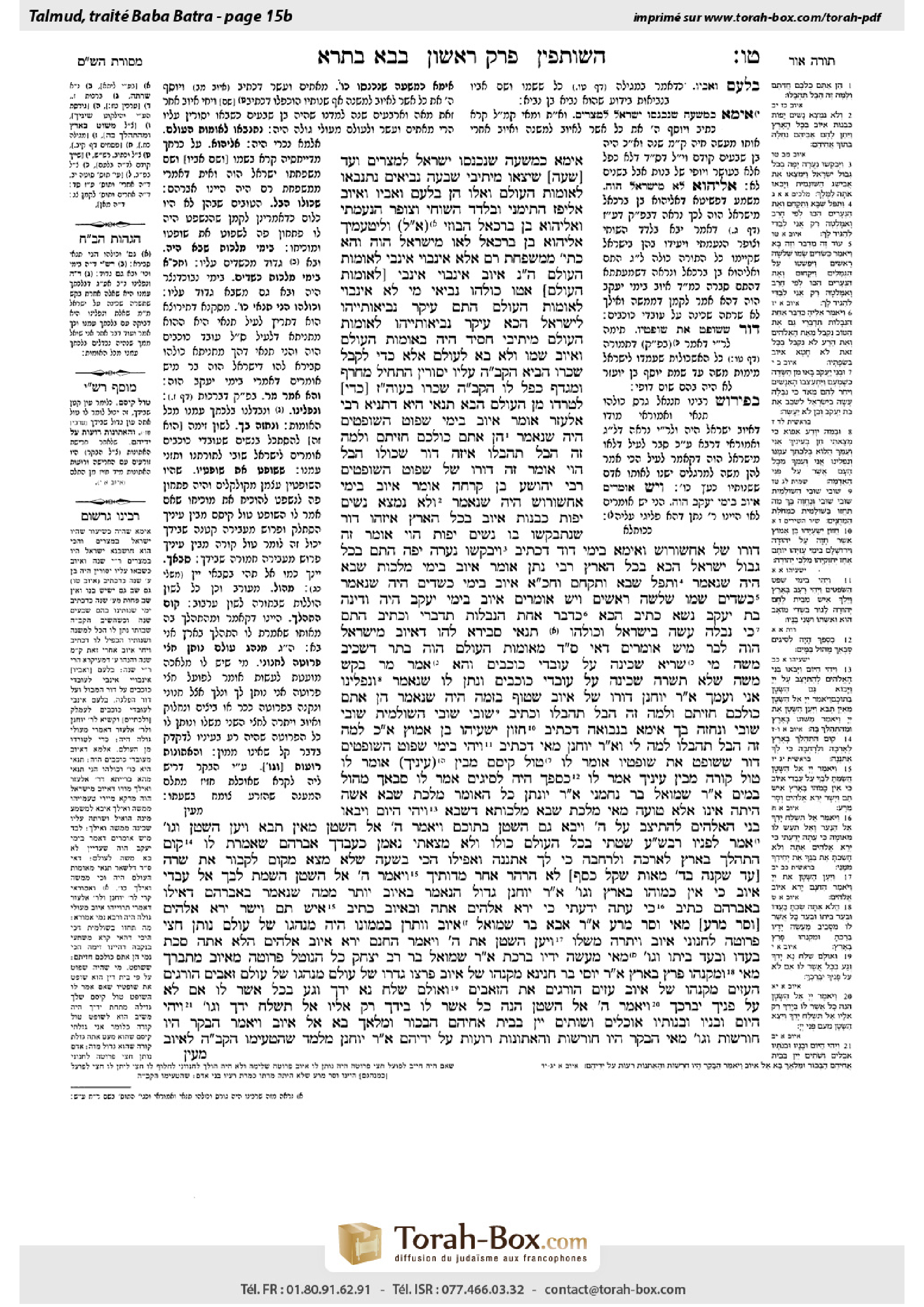
Bava Batra 15b: Talmud study for Daf Yomi
Study the Talmud for Daf Yomi with scanned pages, Hebrew text, English translations from Sefaria and AI-generated French translations.
Passage selection and English or AI-generated French translation are available where the scan has annotations. Daf Study is independent of Torah-Box and Sefaria.
Browse Bava Batra · בבא בתרא · All tractatesBava Batra 15b text and translations
This page of Bava Batra includes the Aramaic text, an English translation and an AI-generated French translation, alongside the scan above.
בבא בתרא י״ה ב · Aramaic and Hebrew text
אֵימָא: כְּמִשָּׁעָה שֶׁנִּכְנְסוּ יִשְׂרָאֵל לְמִצְרַיִם, וְעַד [שָׁעָה] שֶׁיָּצְאוּ.
מֵיתִיבִי: שִׁבְעָה נְבִיאִים נִתְנַבְּאוּ לְאוּמּוֹת הָעוֹלָם – וְאֵלּוּ הֵן: בִּלְעָם וְאָבִיו וְאִיּוֹב, אֱלִיפַז הַתֵּימָנִי וּבִלְדַּד הַשּׁוּחִי וְצוֹפַר הַנַּעֲמָתִי וֶאֱלִיהוּא בֶן בַּרַכְאֵל הַבּוּזִי! אֲמַר לֵיהּ: וְלִיטַעְמָיךְ, אֱלִיהוּא בֶן בַּרַכְאֵל – לָאו מִיִּשְׂרָאֵל הֲוָה? וְהָא כְּתִיב ״מִמִּשְׁפַּחַת רָם״!
אֶלָּא אִינַּבּוֹיֵ אִינַּבִּי לְאוּמּוֹת הָעוֹלָם; הָכִי נָמֵי אִיּוֹב – אִינַּבּוֹיֵ אִינַּבִּי [לְאוּמּוֹת הָעוֹלָם]. אַטּוּ כּוּלְּהוּ נְבִיאֵי מִי לָא אִינַּבּוֹ לְאוּמּוֹת הָעוֹלָם? הָתָם – עִיקַּר נְבִיאוּתַיְיהוּ לְיִשְׂרָאֵל, הָכָא – עִיקַּר נְבִיאוּתַיְיהוּ לְאוּמּוֹת הָעוֹלָם.
מֵיתִיבִי: חָסִיד הָיָה בְּאוּמּוֹת הָעוֹלָם – וְאִיּוֹב שְׁמוֹ, וְלֹא בָּא לָעוֹלָם אֶלָּא כְּדֵי לְקַבֵּל שְׂכָרוֹ. הֵבִיא הַקָּדוֹשׁ בָּרוּךְ הוּא עָלָיו יִסּוּרִין – הִתְחִיל מְחָרֵף וּמְגַדֵּף. כָּפַל לוֹ הַקָּדוֹשׁ בָּרוּךְ הוּא שְׂכָרוֹ בָּעוֹלָם הַזֶּה, [כְּדֵי] לְטׇרְדוֹ מִן הָעוֹלָם הַבָּא!
תַּנָּאֵי הִיא. דְּתַנְיָא, רַבִּי אֶלְעָזָר אוֹמֵר: אִיּוֹב בִּימֵי שְׁפוֹט הַשּׁוֹפְטִים הָיָה, שֶׁנֶּאֱמַר: ״הֵן אַתֶּם כֻּלְּכֶם חֲזִיתֶם, וְלָמָּה זֶּה הֶבֶל תֶּהְבָּלוּ״ – אֵיזֶה דּוֹר שֶׁכּוּלּוֹ הֶבֶל? הֱוֵי אוֹמֵר: זֶה דּוֹרוֹ שֶׁל שְׁפוֹט הַשּׁוֹפְטִים.
רַבִּי יְהוֹשֻׁעַ בֶּן קׇרְחָה אוֹמֵר: אִיּוֹב בִּימֵי אֲחַשְׁוֵרוֹשׁ הָיָה, שֶׁנֶּאֱמַר: ״וְלֹא נִמְצָא נָשִׁים יָפוֹת כִּבְנוֹת אִיּוֹב בְּכׇל הָאָרֶץ״ – אֵיזֶהוּ דּוֹר שֶׁנִּתְבַּקְּשׁוּ בּוֹ נָשִׁים יָפוֹת? הֱוֵי אוֹמֵר: זֶה דּוֹרוֹ שֶׁל אֲחַשְׁוֵרוֹשׁ. וְאֵימָא בִּימֵי דָּוִד, דִּכְתִיב: ״וַיְבַקְשׁוּ נַעֲרָה יָפָה״! הָתָם בְּכֹל גְּבוּל יִשְׂרָאֵל, הָכָא בְּכׇל הָאָרֶץ.
רַבִּי נָתָן אוֹמֵר: אִיּוֹב בִּימֵי מַלְכוּת שְׁבָא הָיָה, שֶׁנֶּאֱמַר: ״וַתִּפֹּל שְׁבָא וַתִּקָּחֵם״. וַחֲכָמִים אוֹמְרִים: אִיּוֹב בִּימֵי כַּשְׂדִּים הָיָה, שֶׁנֶּאֱמַר: ״כַּשְׂדִּים שָׂמוּ שְׁלֹשָׁה רָאשִׁים״. וְיֵשׁ אוֹמְרִים: אִיּוֹב בִּימֵי יַעֲקֹב הָיָה, וְדִינָה בַּת יַעֲקֹב נָשָׂא – כְּתִיב הָכָא: ״כְּדַבֵּר אַחַת הַנְּבָלוֹת תְּדַבֵּרִי״, וּכְתִיב הָתָם: ״כִּי נְבָלָה עָשָׂה בְיִשְׂרָאֵל״. וְכוּלְּהוּ תַּנָּאֵי סְבִירָא לְהוּ דְּאִיּוֹב מִיִּשְׂרָאֵל הֲוָה, לְבַר מִיֵּשׁ אוֹמְרִים;
דְּאִי סָלְקָא דַעְתָּךְ מֵאוּמּוֹת הָעוֹלָם הֲוָה, בָּתַר דִּשְׁכֵיב מֹשֶׁה – מִי שָׁרְיָא שְׁכִינָה עַל אוּמּוֹת הָעוֹלָם? וְהָא אָמַר מָר: בִּקֵּשׁ מֹשֶׁה שֶׁלֹּא תִּשְׁרֶה שְׁכִינָה עַל אוּמּוֹת הָעוֹלָם, וְנָתַן לוֹ – שֶׁנֶּאֱמַר: ״וְנִפְלִינוּ אֲנִי וְעַמְּךָ״.
אָמַר רַבִּי יוֹחָנָן: דּוֹרוֹ שֶׁל אִיּוֹב שָׁטוּף בְּזִמָּה הָיָה, שֶׁנֶּאֱמַר: ״הֵן אַתֶּם כּוּלְּכֶם חֲזִיתֶם, וְלָמָּה זֶּה הֶבֶל תֶּהְבָּלוּ״, וּכְתִיב: ״שׁוּבִי שׁוּבִי הַשּׁוּלַמִּית שׁוּבִי שׁוּבִי וְנֶחֱזֶה בָּךְ״. אֵימָא בִּנְבוּאָה, דִּכְתִיב: ״חֲזוֹן יְשַׁעְיָהוּ בֶן אָמוֹץ״! אִם כֵּן, ״לָמָּה זֶּה הֶבֶל תֶּהְבָּלוּ״ לְמָה לִי?
וְאָמַר רַבִּי יוֹחָנָן, מַאי דִּכְתִיב: ״וַיְהִי בִּימֵי שְׁפוֹט הַשּׁוֹפְטִים״? דּוֹר שֶׁשּׁוֹפֵט אֶת שׁוֹפְטָיו; אוֹמֵר לוֹ: ״טוֹל קֵיסָם מִבֵּין עֵינֶיךָ״ – אוֹמֵר לוֹ: ״טוֹל קוֹרָה מִבֵּין עֵינֶיךָ״. אֹמֵר לוֹ: ״כַּסְפְּךָ הָיָה לְסִיגִים״ – אֹמֵר לוֹ: ״סׇבְאֲךָ מָהוּל בְּמַיִם״.
אָמַר רַבִּי שְׁמוּאֵל בַּר נַחְמָנִי אָמַר רַבִּי יוֹנָתָן: כׇּל הָאוֹמֵר מַלְכַּת שְׁבָא אִשָּׁה הָיְתָה – אֵינוֹ אֶלָּא טוֹעֶה; מַאי ״מַלְכַּת שְׁבָא״? מַלְכוּתָא דִּשְׁבָא.
״וַיְהִי הַיּוֹם, וַיָּבֹאוּ בְּנֵי הָאֱלֹהִים לְהִתְיַצֵּב עַל ה׳, וַיָּבֹא גַּם הַשָּׂטָן בְּתוֹכָם. וַיֹּאמֶר ה׳ אֶל הַשָּׂטָן: מֵאַיִן תָּבֹא? וַיַּעַן הַשָּׂטָן וְגוֹ׳״ – אָמַר לְפָנָיו: רִבּוֹנוֹ שֶׁל עוֹלָם, שַׁטְתִּי בְּכׇל הָעוֹלָם כּוּלּוֹ, וְלֹא מָצָאתִי נֶאֱמָן כְּעַבְדְּךָ אַבְרָהָם – שֶׁאָמַרְתָּ לוֹ: ״קוּם הִתְהַלֵּךְ בָּאָרֶץ לְאׇרְכָּהּ וּלְרׇחְבָּהּ כִּי לְךָ אֶתְּנֶנָּה״, וַאֲפִילּוּ הָכִי, בְּשָׁעָה שֶׁלֹּא מָצָא מָקוֹם לִקְבּוֹר אֶת שָׂרָה [עַד שֶׁקָּנָה בְּאַרְבַּע מֵאוֹת שֶׁקֶל כֶּסֶף] – לֹא הִרְהֵר אַחַר מִדּוֹתֶיךָ.
״וַיֹּאמֶר ה׳ אֶל הַשָּׂטָן: הֲשַׂמְתָּ לִבְּךָ אֶל עַבְדִּי אִיּוֹב, כִּי אֵין כָּמוֹהוּ בָּאָרֶץ וְגוֹ׳״ – אָמַר רַבִּי יוֹחָנָן: גָּדוֹל הַנֶּאֱמָר בְּאִיּוֹב יוֹתֵר מִמַּה שֶּׁנֶּאֱמַר בְּאַבְרָהָם; דְּאִילּוּ בְּאַבְרָהָם כְּתִיב: ״כִּי עַתָּה יָדַעְתִּי כִּי יְרֵא אֱלֹהִים אַתָּה״, וּבְאִיּוֹב כְּתִיב: ״אִישׁ תָּם וְיָשָׁר יְרֵא אֱלֹהִים [וְסָר מֵרָע]״.
מַאי ״וְסָר מֵרָע״? אָמַר רַבִּי אַבָּא בַּר שְׁמוּאֵל: אִיּוֹב וַותְּרָן בְּמָמוֹנוֹ הָיָה – מִנְהָגוֹ שֶׁל עוֹלָם, נוֹתֵן חֲצִי פְּרוּטָה לַחֶנְוָנִי; אִיּוֹב – וִיתְּרָהּ מִשֶּׁלּוֹ.
״וַיַּעַן הַשָּׂטָן אֶת ה׳ וַיֹּאמַר: הַחִנָּם יָרֵא אִיּוֹב אֱלֹהִים?! הֲלֹא אַתָּה סַכְתָּ בַעֲדוֹ וּבְעַד בֵּיתוֹ וְגוֹ׳״ – מַאי ״מַעֲשֵׂה יָדָיו בֵּרַכְתָּ״? אָמַר רַבִּי שְׁמוּאֵל בַּר רַב יִצְחָק: כׇּל הַנּוֹטֵל פְּרוּטָה מֵאִיּוֹב, מִתְבָּרֵךְ.
מַאי ״וּמִקְנֵהוּ פָּרַץ בָּאָרֶץ״? אָמַר רַבִּי יוֹסֵי בַּר חֲנִינָא: מִקְנֵהוּ שֶׁל אִיּוֹב פָּרְצוּ גִּדְרוֹ שֶׁל עוֹלָם; מִנְהָגוֹ שֶׁל עוֹלָם – זְאֵבִים הוֹרְגִים הָעִזִּים, מִקְנֵהוּ שֶׁל אִיּוֹב – עִזִּים הוֹרְגִים אֶת הַזְּאֵבִים.
״וְאוּלָם שְׁלַח נָא יָדְךָ וְגַע בְּכׇל אֲשֶׁר לוֹ, אִם לֹא עַל פָּנֶיךָ יְבָרְכֶךָּ. וַיֹּאמֶר ה׳ אֶל הַשָּׂטָן: הִנֵּה כׇל אֲשֶׁר לוֹ בְּיָדֶךָ, רַק אֵלָיו אַל תִּשְׁלַח יָדֶךָ וְגוֹ׳. וַיְהִי הַיּוֹם, וּבָנָיו וּבְנוֹתָיו אוֹכְלִים וְשׁוֹתִים יַיִן בְּבֵית אֲחִיהֶם הַבְּכוֹר, וּמַלְאָךְ בָּא אֶל אִיּוֹב וַיֹּאמַר: הַבָּקָר הָיוּ חוֹרְשׁוֹת וְגוֹ׳״ – מַאי ״הַבָּקָר הָיוּ חוֹרְשׁוֹת, וְהָאֲתֹנוֹת רֹעוֹת עַל יְדֵיהֶם״? אָמַר רַבִּי יוֹחָנָן: מְלַמֵּד שֶׁהִטְעִימוֹ הַקָּדוֹשׁ בָּרוּךְ הוּא לְאִיּוֹב
Bava Batra 15b · English translation
The Gemara answers: Say that the baraita means that the duration of Job’s life lasted as long as from when Israel entered Egypt until when they left, but not that he lived during that specific time frame.
The Gemara raises an objection from another baraita against the notion that Job was a Jew: Seven prophets prophesied to the nations of the world, and they are: Balaam and his father Beor, and Job, Eliphaz the Temanite, and Bildad the Shuhite, and Zophar the Naamathite, and Elihu ben Barachel the Buzite, which indicates that Job was not Jewish. He said to him: And according to your reasoning that Job could not have been Jewish because he prophesied to the nations of the world, was Elihu ben Barachel not a Jew? Is it not written: “Of the family of Ram” (Job 32:2), meaning Abraham?
Rather, one must explain that Elihu is included in this list because he prophesied to the nations of the world; and so too it may be maintained that Job is included in this list, even though he is Jewish, because he prophesied to the nations of the world. The Gemara asks: But did not all the other prophets also prophesy to the nations of the world? Why then are only these seven mentioned? The Gemara answers: There, with regard to the other prophets, their main prophecies were directed to Israel, whereas here, with regard to these seven prophets, their main prophecies were directed to the nations of the world.
The Gemara raises an objection from what is taught in a different baraita: There was a certain pious man among the nations of the world and his name was Job, and he came into the world only to receive his reward. The Holy One, Blessed be He, brought afflictions upon him, and he began to blaspheme and curse. The Holy One, Blessed be He, doubled his reward in this world in order to expel him from the World-to-Come. This baraita states that Job was not a Jew, but rather a gentile.
The Gemara responds: The matter of whether or not Job was Jewish is a dispute between tanna’im, as it is taught in a baraita with regard to the period during which Job lived: Rabbi Elazar says: Job lived in the days of the judging of the Judges, as it is stated in connection with Job: “Behold, all you yourselves have seen it; why then have you become altogether vain?” (Job 27:12). Which generation was completely vain? You must say it was the generation of the judging of the Judges, when the people judged the Judges, as will be explained shortly.
Rabbi Yehoshua ben Korḥa says: Job lived in the days of Ahasuerus, as it is stated: “And in all the world were no women found so beautiful as the daughters of Job” (Job 42:15). In which generation were beautiful women sought? You must say it was the generation of Ahasuerus (Esther, chapter 2). The Gemara asks: But why not say it was in the days of David, as it is written: “And they sought a beautiful maiden” (I Kings 1:3)? The Gemara answers: There, in the time of David, they searched “throughout the territory of Israel” (I Kings 1:3), whereas here, in the time of Ahasuerus, they searched throughout the world, as is similarly stated with regard to Job’s daughters.
Rabbi Natan says: Job lived in the days of the kingdom of Sheba, as it is stated: “And Sheba fell upon them, and took them away” (Job 1:15). And the Rabbis say: Job lived in the days of the kingdom of the Chaldeans in the time of Nebuchadnezzar, as it is stated: “The Chaldeans formed three bands” (Job 1:17). And some say that Job lived in the days of Jacob and that he married Dina, the daughter of Jacob. As it is written here: “You speak as one of the loathsome women speaks” (Job 2:10), and it is written there in the account of the incident involving Dina: “He has done a loathsome act in Israel” (Genesis 34:7). This concludes the text of the baraita. The Gemara comments: And all these tanna’im hold that Job was a Jew except for the opinion introduced with the phrase: And some say, according to which Job lived in the time of Jacob, and he was certainly not one of Jacob’s sons.
And what is the proof that all these tanna’im maintain that Job was Jewish? As if it should enter your mind to say that he came from the nations of the world, there is a difficulty: After Moses died, did the Divine Presence rest any longer on the nations of the world? But doesn’t the Master say: Moses requested that the Divine Presence not rest again on the nations of the world, and his request was granted to him, as it is stated: “That we shall be differentiated, I and Your people, from all the people that are upon the face of the earth” (Exodus 33:16), and it is stated there that God acceded to his request.
Rabbi Yoḥanan says: The generation of Job was awash in licentiousness, as it is stated: “Behold, all of you yourselves have seen [ḥazitem] it; why then have you become altogether vain?” (Job 27:12), and it is written: “Return, return, O Shulamite; return, return, that we may look [veneḥeze] upon you” (Song of Songs 7:1), which teaches that the phrase “you have seen it” connotes a licentious gaze. The Gemara asks: But say that the phrase “you yourselves have seen it” signifies prophecy, as it is written: “The vision [ḥazon] of Isaiah ben Amoz” (Isaiah 1:1). The Gemara answers: If so, why do I need the words: “Why then have you become altogether vain”? Rather, the reference must be to inappropriate licentious gazing.
And further, with regard to Rabbi Elazar’s statement in the baraita that the generation of the judging of the Judges was one of vanity, Rabbi Yoḥanan says: What is the meaning of that which is written: “And it happened in the days of the judging of the Judges” (Ruth 1:1)? This indicates a generation that judged its judges. If a judge would say to the defendant standing before him: Remove the splinter from between your eyes, meaning rid yourself of some minor infraction, the defendant would say to him: Remove the beam from between your eyes, meaning you have committed far more severe sins. If the judge would say to him: “Your silver is become dross” (Isaiah 1:22), meaning your coins are counterfeit, the defendant would say to him: “Your wine is mixed with water” (Isaiah 1:22), meaning you yourself dilute your wine with water and sell it. Since nobody behaved in proper manner, the judges were unable to judge.
Rabbi Shmuel bar Naḥmani says that Rabbi Yonatan says: Anyone who says that the queen of Sheba [malkat Sheva] who came to visit King Solomon (see I Kings, chapter 10) was a woman is nothing other than mistaken. What is the meaning of malkat Sheba? The kingdom [malkhuta] of Sheba, as is mentioned in Job: “And Sheba fell on them and took them away” (Job 1:15).
§ Having mentioned the book of Job, the Gemara addresses several matters relating to it. It is stated: “Now there was a day when the sons of God came to present themselves before the Lord, and the Satan came also among them. And the Lord said to the Satan: From where do you come? And the Satan answered the Lord, and said: From going to and fro in the earth, and from walking through it” (Job 1:6–7). The Satan said to God: Master of the Universe, I have gone to and fro throughout the entire world and I have not found anyone as faithful as Your servant Abraham, to whom You said: “Arise, walk through the land in the length of it and in the breadth of it; for I will give it to you” (Genesis 13:17). And even so, when he did not find a place to bury Sarah before he purchased a burial site for four hundred silver shekels, he did not find fault with Your ways or complain about the fact that you had failed to fulfill Your promise.
“And the Lord said to the Satan: Have you considered My servant Job, that there is none like him on earth, a perfect and upright man, one who fears God and turns away from evil?” (Job 1:8). About this Rabbi Yoḥanan says: That which is stated about Job is greater than that which is stated about Abraham. As with regard to Abraham it is written: “For now I know that you fear God” (Genesis 22:12), with regard to Job it is written: “A perfect and an upright man, one who fears God and turns away from evil” (Job 1:8).
The Gemara clarifies the meaning of the aforementioned verse: What is meant by “and turns away from evil”? Rabbi Abba bar Shmuel says: Job was forgiving with his money. It is the way of the world that one pays the storekeeper for even half-peruta of merchandise purchased from him. But if somebody bought an item of such little value from Job, he would forgive him his half-peruta.
The Gemara continues to clarify the verses concerning Job. “Then the Satan answered the Lord, and said: Does Job fear God for naught? Have You not made a hedge about him, and about his house, and about all that he has on every side? You have blessed the work of his hands, and his cattle is increased in the land” (Job 1:9–10). What is meant by: “You have blessed the work of his hands”? Rabbi Shmuel bar Rav Yitzḥak says: Anyone who took a peruta from Job was blessed. Not only was Job’s own handiwork blessed, but anybody who received anything from him was also blessed.
The Gemara continues with its explication of these verses. What is meant by: “And his livestock is increased [paratz] in the land” (Job 1:10)? Rabbi Yosei bar Ḥanina says: Job’s livestock breached [paretzu] the order of the world. It is the way of the world that wolves kill goats, but in the case of Job’s livestock, the goats killed the wolves.
The Gemara continues to relate the Satan’s challenge to God: “But now put forth Your hand, and touch all that he has, and he will curse You to Your face. And the Lord said to the Satan: Behold, all that he has is in your power; only upon himself do not put forth your hand. And the Satan went out from the presence of the Lord” (Job 1:11–12). The verses relate what then occurred: “Now there was a day when his sons and his daughters were eating and drinking wine in their eldest brother’s house, and there came a messenger to Job, and said: The oxen were plowing, and the asses were feeding beside them” (Job 1:13–14). The Gemara asks: What is meant by: “The oxen were plowing and the asses were feeding beside them”? Rabbi Yoḥanan says: This teaches that the Holy One, Blessed be He, gave Job a taste
Bava Batra 15b · Traduction française (IA)
Le Guemara répond : Disons que la baraïta signifie que la durée de la vie de Job s'étendait depuis l'entrée d'Israël en Égypte jusqu'à leur départ, mais pas que Job a vécu durant cette période spécifique.
Le Guemara soulève une objection contre l'idée que Job était juif, à partir d'une autre baraïta : Sept prophètes ont prophétisé aux nations du monde, et ils sont : Balaam et son père Beor, et Job, Eliphaz le Temanite, et Bildad le Shuhite, et Zophar le Naamathite, et Elihu fils de Barachel le Buzite, ce qui indique que Job n'était pas juif. Il lui dit : Et selon votre raisonnement, Job ne pouvait pas être juif parce qu'il a prophétisé aux nations du monde, Elihu fils de Barachel n'était-il pas juif ? N'est-il pas écrit : « De la famille de Ram » (Job 32:2), ce qui signifie Abraham ?
Au contraire, il faut expliquer que Elihu est inclus dans cette liste parce qu'il a prophétisé aux nations du monde ; de même, il peut être maintenu que Job est inclus dans cette liste, même s'il est juif, parce qu'il a prophétisé aux nations du monde. Le Guemara demande : Mais n'ont pas tous les autres prophètes également prophétisé aux nations du monde ? Pourquoi alors ces sept-là seulement sont-ils mentionnés ? Le Guemara répond : Là, concernant les autres prophètes, leurs prophéties principales étaient orientées vers Israël, tandis que, ici, concernant ces sept prophètes, leurs prophéties principales étaient orientées vers les nations du monde.
Le Guemara soulève une objection en vertu de ce qui est enseigné dans une autre baraïta : Il y avait un homme pieux parmi les nations du monde, et son nom était Job, et il est venu dans le monde uniquement pour recevoir sa récompense. L'Éternel, béni soit Son Nom, a fait subir des afflictions à Job, et il a commencé à blasphémer et à maudire. L'Éternel, béni soit Son Nom, a doublé sa récompense dans ce monde afin de l'expulser de l'Âge à Venir. Cette baraïta affirme que Job n'était pas juif, mais plutôt un non-Juif.
Le Guemara répond : La question de savoir si Job était juif est un débat entre les tannaïm, comme il est enseigné dans une baraïta concernant la période durant laquelle Job a vécu : Rabbi Elazar dit : Job a vécu aux jours des juges, comme il est dit en lien avec Job : « Regardez, vous tous, vous avez vu cela ; pourquoi donc avez-vous devenu entièrement vains ? » (Job 27:12). Quelle génération était entièrement vaine ? Vous devez dire que c'était la génération des juges, lorsqu'on jugeait les juges, comme cela sera expliqué bientôt.
Rabbi Yéhoshua ben Korkha dit : Job a vécu aux jours d'Ahasuerus, comme il est dit : « Et dans toute la terre, il n'y avait pas de femmes aussi belles que les filles de Job » (Job 42:15). Dans quelle génération on recherchait des belles femmes ? Vous devez dire que c'était la génération d'Ahasuerus (Esther, chapitre 2). Le Guemara demande : Pourquoi ne pas dire qu'il s'agissait des jours de David, comme il est écrit : « Et ils cherchaient une belle jeune fille » (I Rois 1:3) ? Le Guemara répond : Là, à l'époque de David, ils cherchaient « dans tout le territoire d'Israël » (I Rois 1:3), tandis que, ici, à l'époque d'Ahasuerus, ils cherchaient dans tout le monde, comme il est également dit concernant les filles de Job.
Rabbi Natan dit : Job a vécu aux jours du royaume de Saba, comme il est dit : « Et Saba est tombé sur eux et les a emportés » (Job 1:15). Et les Rabbins disent : Job a vécu aux jours du royaume des Chaldéens à l'époque de Nabuchodonosor, comme il est dit : « Les Chaldéens formèrent trois bandes » (Job 1:17). Et certains disent que Job a vécu aux jours de Jacob et qu'il a épousé Dina, la fille de Jacob. Comme il est écrit ici : « Vous parlez comme parle une femme abominable » (Job 2:10), et il est écrit là dans l'incident concernant Dina : « Il a commis un acte abominable en Israël » (Genèse 34:7). Cela conclut le texte de la baraïta. Le Guemara commente : Et tous ces tannaïm maintiennent que Job était juif, sauf l'opinion introduite avec la phrase : Et certains disent, selon laquelle Job a vécu à l'époque de Jacob, et il n'était certainement pas l'un des fils de Jacob.
Et quelle est la preuve que tous ces tannaïm maintiennent que Job était juif ? Comme si cela entrait dans votre esprit de dire qu'il venait des nations du monde, il y a une difficulté : Après la mort de Moïse, la Divine Présence ne reposait-elle plus sur les nations du monde ? Mais n'est-ce pas ce que dit le Maître : Moïse a demandé que la Divine Présence ne repose plus sur les nations du monde, et sa demande a été acceptée, comme il est dit : « Que nous soyons distincts, moi et votre peuple, de tous les peuples qui sont sur la face de la terre » (Exode 33:16), et il est dit là que Dieu a accepté sa demande.
Rabbi Yoḥanan dit : La génération de Job était imprégnée de luxure, comme il est dit : « Regardez, vous tous, vous avez vu cela ; pourquoi donc avez-vous devenu entièrement vains ? » (Job 27:12), et il est écrit : « Retourne, retourne, ô Shulamite ; retourne, retourne, afin que nous puissions te regarder » (Cantique des Cantiques 7:1), ce qui enseigne que la phrase « vous avez vu cela » désigne un regard licencieux. Le Guemara demande : Mais disons que la phrase « vous avez vu cela » signifie la prophétie, comme il est écrit : « La vision d'Isaïe, fils d'Amoz » (Isaïe 1:1). Le Guemara répond : Si c'est ainsi, pourquoi ai-je besoin des mots : « Pourquoi donc avez-vous devenu entièrement vains » ? Plutôt, la référence doit être à un regard inapproprié de luxure.
Et de plus, concernant la déclaration du maître Eléazar dans la baraïta que la génération des juges était une génération de vanité, Rabbi Yochanan dit : Quelle est la signification de ce qui est écrit : « Et il arriva aux jours des juges » (Ruth 1:1) ? Cela indique une génération qui jugeait ses juges. Si un juge disait à un accusé qui se tenait devant lui : « Retire la puce entre tes yeux », c'est-à-dire élimine une infraction mineure, l'accusé lui répondait : « Retire le pilier entre tes yeux », c'est-à-dire que tu as commis des péchés bien plus graves. Si le juge disait à l'accusé : « Ton argent est devenu de la poudre » (Isaïe 1:22), c'est-à-dire que tes pièces sont des faux, l'accusé lui répondait : « Ton vin est mélangé à l'eau » (Isaïe 1:22), c'est-à-dire que tu dilues toi-même ton vin avec de l'eau et le vends. Puisque personne ne se comportait correctement, les juges n'étaient pas en mesure de juger.
Rabbi Shmuel bar Naḥmani dit que Rabbi Yonatan dit : Quiconque affirme que la reine de Saba [malkat Sheva] qui est venue rendre visite à Salomon (voir I Rois, chapitre 10) était une femme n'est autre que trompeur. Quelle est la signification de malkat Sheva ? Le royaume [malkhuta] de Saba, comme mentionné dans le livre de Job : « Et Saba tomba sur eux et les emporta » (Job 1:15).
§ Ayant mentionné le livre de Job, la Guemara aborde plusieurs questions concernant ce livre. Il est dit : « Il y avait un jour où les fils de l'homme vinrent se présenter devant l'Éternel, et le Satan vint aussi parmi eux. Et l'Éternel dit au Satan : D'où viens-tu ? Et le Satan répondit à l'Éternel et dit : De marcher en allant et en venant sur la terre, et de marcher à travers elle » (Job 1:6–7). Le Satan dit à l'Éternel : Seigneur du Monde, j'ai marché en allant et en venant sur toute la terre et je n'ai pas trouvé personne aussi fidèle que ton serviteur Abraham, à qui tu as dit : « Lève-toi, marche dans le pays selon sa longueur et sa largeur ; car je te donnerai ce pays » (Genèse 13:17). Et même ainsi, lorsqu'il n'a pas trouvé de lieu pour enterrer Sarah avant qu'il ne achète un lieu de sépulture pour quatre cents sicques d'argent, il n'a pas trouvé de défaut dans tes voies ni ne s'est plaint du fait que tu n'avais pas accompli ta promesse.
« Et l'Éternel dit au Satan : As-tu considéré mon serviteur Job, qu'il n'y a point sur la terre comme lui, un homme parfait et droit, qui craint Dieu et s'éloigne du mal ? » (Job 1:8). À ce propos, le Rabbi Yoḥanan dit : Ce qui est dit à propos de Job est supérieur à ce qui est dit à propos d'Abraham. Comme à propos d'Abraham il est écrit : « Car maintenant je sais que tu craigns Dieu » (Genèse 22:12), à propos de Job il est écrit : « Un homme parfait et droit, qui craint Dieu et s'éloigne du mal » (Job 1:8).
La Guemara clarifie le sens du verset mentionné précédemment : Qu'entend-on par « et s'éloigne du mal » ? Le Rabbi Abba bar Shmuel dit : Job était généreux avec son argent. C'est la manière du monde que l'on paie au marchand même une demi-perute de marchandise achetée chez lui. Mais si quelqu'un achetait un objet de valeur si faible chez Job, il lui pardonnait sa demi-perute.
Le Guemara continue à clarifier les versets concernant Job. « Puis le Satan répondit à l'Éternel et dit : Job craint-il Dieu à tort ? N'as-tu pas fait une clôture autour de lui, et autour de sa maison, et autour de tout ce qu'il a de tous côtés ? Tu as béni l'œuvre de ses mains, et son bétail s'est accru sur la terre » (Job 1:9–10). Qu'entend-on par : « Tu as béni l'œuvre de ses mains » ? Rabbi Shmuel bar Rav Yitzḥak dit : Quiconque a pris une peruta de Job a été béni. Non seulement l'œuvre de ses mains était bénie, mais encore tout celui qui recevait quelque chose de lui était également béni.
Le Guemara continue avec l'explication de ces versets. Qu'entend-on par : « Et son bétail s'est accru [paratz] sur la terre » (Job 1:10) ? Rabbi Yosei bar Ḥanina dit : Le bétail de Job a violé [paretzu] l'ordre du monde. C'est la manière du monde que les loups tuent les chèvres, mais dans le cas du bétail de Job, les chèvres ont tué les loups.
Le Guemara continue à rapporter le défi du Satan à Dieu : « Mais maintenant étends ta main, et touche tout ce qu'il a, et il te maudira à son visage. Et l'Éternel dit au Satan : Regarde, tout ce qu'il a est en ton pouvoir ; seulement sur lui-même ne tends pas ta main. Et le Satan sortit de la présence de l'Éternel » (Job 1:11–12). Les versets relatent ce qui arriva ensuite : « Il y avait un jour où ses fils et ses filles mangeaient et buvaient du vin dans la maison de son frère aîné, et un messager vint à Job et dit : Les bœufs étaient en train de labourer, et les ânes étaient en train de paître à côté d'eux » (Job 1:13–14). Le Guemara demande : Qu'entend-on par : « Les bœufs étaient en train de labourer et les ânes étaient en train de paître à côté d'eux » ? Rabbi Yoḥanan dit : Cela enseigne que l'Éternel, le Saint, le Béni soit-il, a donné à Job un goût
Traduction française générée par IA à partir de l’édition anglaise de Sefaria. Vérifie toujours un passage avec le texte source.
Text from Sefaria: William Davidson Edition - Vocalized Aramaic (CC BY NC); William Davidson Edition - English (CC BY NC).