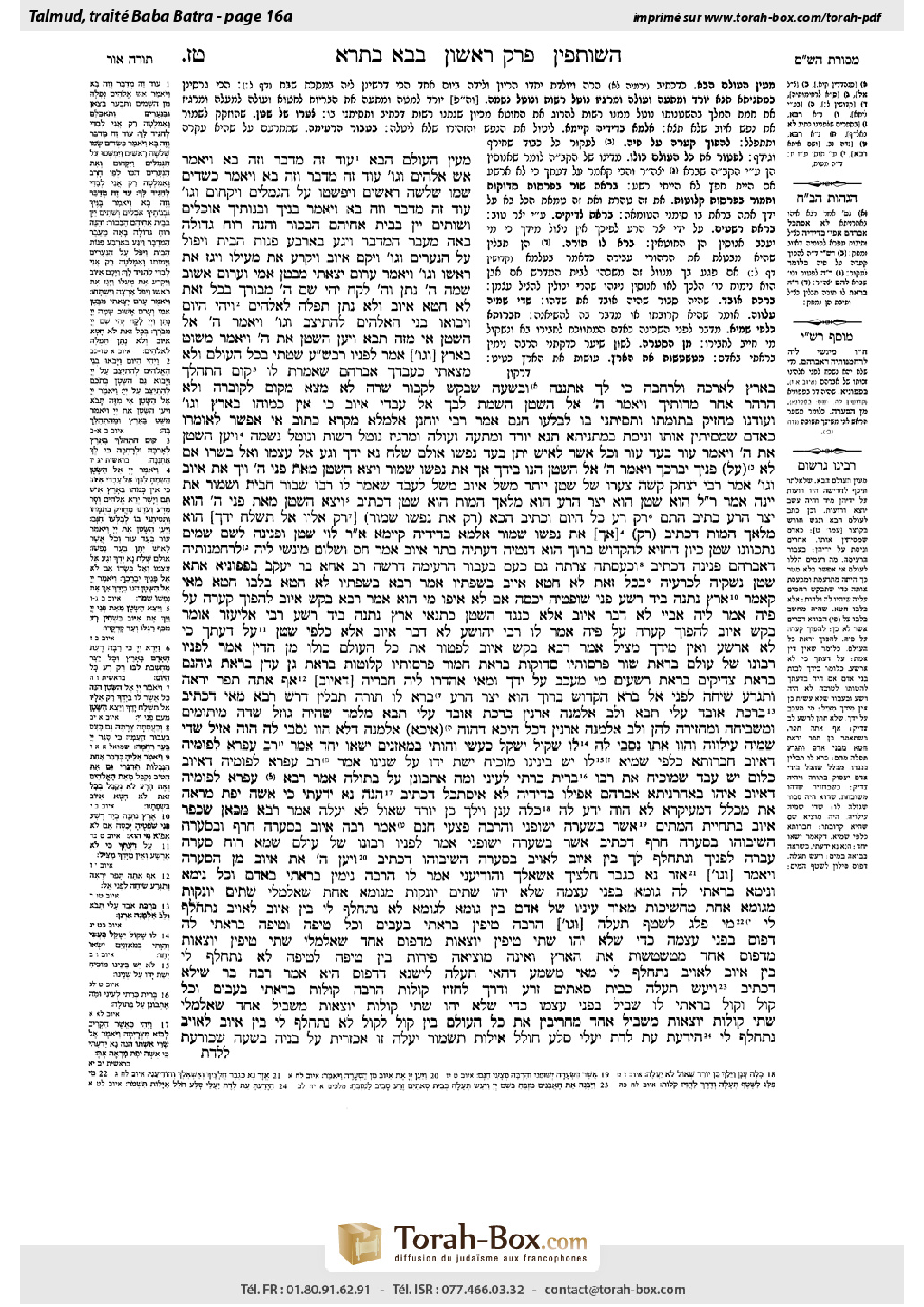
Bava Batra 16a: Talmud study for Daf Yomi
Study the Talmud for Daf Yomi with scanned pages, Hebrew text, English translations from Sefaria and AI-generated French translations.
Passage selection and English or AI-generated French translation are available where the scan has annotations. Daf Study is independent of Torah-Box and Sefaria.
Browse Bava Batra · בבא בתרא · All tractatesBava Batra 16a text and translations
This page of Bava Batra includes the Aramaic text, an English translation and an AI-generated French translation, alongside the scan above.
בבא בתרא י״ו א · Aramaic and Hebrew text
מֵעֵין הָעוֹלָם הַבָּא.
״עוֹד זֶה מְדַבֵּר – וְזֶה בָּא, וַיֹּאמַר: אֵשׁ אֱלֹהִים וְגוֹ׳. עוֹד זֶה מְדַבֵּר – וְזֶה בָּא, וַיֹּאמַר: כַּשְׂדִּים שָׂמוּ שְׁלֹשָׁה רָאשִׁים, וַיִּפְשְׁטוּ עַל הַגְּמַלִּים וַיִּקָּחוּם וְגוֹ׳. עוֹד זֶה מְדַבֵּר – וְזֶה בָּא, וַיֹּאמַר: בָּנֶיךָ וּבְנוֹתֶיךָ אוֹכְלִים וְשׁוֹתִים יַיִן בְּבֵית אֲחִיהֶם הַבְּכוֹר, וְהִנֵּה רוּחַ גְּדוֹלָה בָּאָה מֵעֵבֶר הַמִּדְבָּר, וַיִּגַּע בְּאַרְבַּע פִּנּוֹת הַבַּיִת וַיִּפֹּל עַל הַנְּעָרִים וְגוֹ׳. וַיָּקׇם אִיּוֹב וַיִּקְרַע אֶת מְעִלוֹ וַיָּגׇז אֶת רֹאשׁוֹ וְגוֹ׳, וַיֹּאמֶר: עָרוֹם יָצָאתִי מִבֶּטֶן אִמִּי, וְעָרוֹם אָשׁוּב שָׁמָּה; ה׳ נָתַן וַה׳ לָקָח, יְהִי שֵׁם ה׳ מְבוֹרָךְ. בְּכׇל זֹאת לֹא חָטָא אִיּוֹב וְלֹא נָתַן תִּפְלָה לֵאלֹהִים.
וַיְהִי הַיּוֹם, וַיָּבֹאוּ בְּנֵי הָאֱלֹהִים לְהִתְיַצֵּב וְגוֹ׳. וַיֹּאמֶר ה׳ אֶל הַשָּׂטָן: אֵי מִזֶּה תָּבֹא? וַיַּעַן הַשָּׂטָן אֶת ה׳, וַיֹּאמַר: מִשֻּׁט בָּאָרֶץ [וְגוֹ׳]״ – אָמַר לְפָנָיו: רִבּוֹנוֹ שֶׁל עוֹלָם, שַׁטְתִּי בְּכׇל הָעוֹלָם, וְלֹא מָצָאתִי כְּעַבְדְּךָ אַבְרָהָם – שֶׁאָמַרְתָּ לוֹ: ״קוּם הִתְהַלֵּךְ בָּאָרֶץ לְאׇרְכָּהּ וּלְרׇחְבָּהּ, כִּי לְךָ אֶתְּנֶנָּה״, וּבְשָׁעָה שֶׁבִּקֵּשׁ לִקְבּוֹר שָׂרָה, לֹא מָצָא מָקוֹם לְקוֹבְרָהּ – וְלֹא הִרְהֵר אַחַר מִדּוֹתֶיךָ.
״וַיֹּאמֶר ה׳ אֶל הַשָּׂטָן: הֲשַׂמְתָּ לִבְּךָ אֶל עַבְדִּי אִיּוֹב, כִּי אֵין כָּמֹהוּ בָּאָרֶץ וְגוֹ׳, וְעֹדֶנּוּ מַחֲזִיק בְּתֻמָּתוֹ, וַתְּסִיתֵנִי בוֹ לְבַלְּעוֹ חִנָּם״ –
אָמַר רַבִּי יוֹחָנָן: אִלְמָלֵא מִקְרָא כָּתוּב, אִי אֶפְשָׁר לְאוֹמְרוֹ – כְּאָדָם שֶׁמְּסִיתִין אוֹתוֹ וְנִיסָת.
בְּמַתְנִיתָא תָּנָא: יוֹרֵד וּמַתְעֶה, וְעוֹלֶה וּמַרְגִּיז, נוֹטֵל רְשׁוּת, וְנוֹטֵל נְשָׁמָה.
״וַיַּעַן הַשָּׂטָן אֶת ה׳ וַיֹּאמַר: עוֹר בְּעַד עוֹר, וְכֹל אֲשֶׁר לָאִישׁ יִתֵּן בְּעַד נַפְשׁוֹ. אוּלָם שְׁלַח נָא יָדְךָ וְגַע אֶל עַצְמוֹ וְאֶל בְּשָׂרוֹ, אִם לֹא עַל פָּנֶיךָ יְבָרְכֶךָּ. וַיֹּאמֶר ה׳ אֶל הַשָּׂטָן: הִנּוֹ בְיָדֶךָ, אַךְ אֶת נַפְשׁוֹ שְׁמֹר. וַיֵּצֵא הַשָּׂטָן מֵאֵת פְּנֵי ה׳, וַיַּךְ אֶת אִיּוֹב וְגוֹ׳״. אָמַר רַבִּי יִצְחָק: קָשֶׁה צַעֲרוֹ שֶׁל שָׂטָן, יוֹתֵר מִשֶּׁל אִיּוֹב – מָשָׁל לְעֶבֶד שֶׁאָמַר לוֹ רַבּוֹ: שְׁבוֹר חָבִית, וּשְׁמוֹר אֶת יֵינָהּ.
אָמַר רֵישׁ לָקִישׁ: הוּא שָׂטָן, הוּא יֵצֶר הָרָע, הוּא מַלְאַךְ הַמָּוֶת. הוּא שָׂטָן – דִּכְתִיב: ״וַיֵּצֵא הַשָּׂטָן מֵאֵת פְּנֵי ה׳״. הוּא יֵצֶר הָרָע – כְּתִיב הָתָם: ״רַק רַע כׇּל הַיּוֹם״, וּכְתִיב הָכָא: (״רַק אֶת נַפְשׁוֹ שְׁמֹר״) [״רַק אֵלָיו אַל תִּשְׁלַח יָדֶךָ״]. הוּא מַלְאַךְ הַמָּוֶת – דִּכְתִיב: ״(רַק) [אַךְ] אֶת נַפְשׁוֹ שְׁמֹר״ – אַלְמָא בְּדִידֵיהּ קָיְימָא.
אָמַר רַבִּי לֵוִי: שָׂטָן וּפְנִינָה לְשֵׁם שָׁמַיִם נִתְכַּוְּונוּ. שָׂטָן – כֵּיוָן דְּחַזְיֵא לְהַקָּדוֹשׁ בָּרוּךְ הוּא דְּנָטְיָה דַּעְתֵּיהּ בָּתַר אִיּוֹב, אָמַר: חַס וְשָׁלוֹם מִינְּשֵׁי לֵיהּ לְרַחְמָנוּתֵיהּ דְּאַבְרָהָם. פְּנִינָה – דִּכְתִיב: ״וְכִעֲסַתָּה צָרָתָהּ גַּם כַּעַס, בַּעֲבוּר הַרְּעִימָהּ״. דַּרְשַׁהּ רַב אַחָא בַּר יַעֲקֹב בְּפַפּוֹנְיָא. אֲתָא שָׂטָן, נַשְּׁקֵיהּ לְכַרְעֵיהּ.
״בְּכׇל זֹאת לֹא חָטָא אִיּוֹב בִּשְׂפָתָיו״. אָמַר רָבָא: בִּשְׂפָתָיו לֹא חָטָא, בְּלִבּוֹ חָטָא. מַאי קָאָמַר? ״אֶרֶץ נִתְּנָה בְיַד רָשָׁע, פְּנֵי שֹׁפְטֶיהָ יְכַסֶּה, אִם לֹא אֵיפוֹ מִי הוּא״ – אָמַר רָבָא: בִּקֵּשׁ אִיּוֹב לַהֲפוֹךְ קְעָרָה עַל פִּיהָ. אֲמַר לֵיהּ אַבָּיֵי: לֹא דִּבֵּר אִיּוֹב אֶלָּא כְּנֶגֶד הַשָּׂטָן.
כְּתַנָּאֵי: ״אֶרֶץ נִתְּנָה בְיַד רָשָׁע״ – רַבִּי אֱלִיעֶזֶר אוֹמֵר: בִּקֵּשׁ אִיּוֹב לַהֲפוֹךְ קְעָרָה עַל פִּיהָ. אָמַר לוֹ רַבִּי יְהוֹשֻׁעַ: לֹא דִּבֵּר אִיּוֹב אֶלָּא כְּלַפֵּי שָׂטָן.
״עַל דַּעְתְּךָ כִּי לֹא אֶרְשָׁע וְאֵין מִיָּדְךָ מַצִּיל״ – אָמַר רָבָא: בִּקֵּשׁ אִיּוֹב לִפְטוֹר אֶת כׇּל הָעוֹלָם כּוּלּוֹ מִן הַדִּין. אָמַר לְפָנָיו: רִבּוֹנוֹ שֶׁל עוֹלָם, בָּרָאתָ שׁוֹר – פַּרְסוֹתָיו סְדוּקוֹת, בָּרָאתָ חֲמוֹר – פַּרְסוֹתָיו קְלוּטוֹת; בָּרָאתָ גַּן עֵדֶן, בָּרָאתָ גֵּיהִנָּם; בָּרָאתָ צַדִּיקִים, בָּרָאתָ רְשָׁעִים. מִי מְעַכֵּב עַל יָדְךָ?
וּמַאי אַהְדַּרוּ לֵיהּ חַבְרֵיהּ [דְּאִיּוֹב] – ״אַף אַתָּה תָּפֵר יִרְאָה, וְתִגְרַע שִׂיחָה לִפְנֵי אֵל״; בָּרָא הַקָּדוֹשׁ בָּרוּךְ הוּא יֵצֶר הָרָע – בָּרָא לוֹ תּוֹרָה תַּבְלִין.
דָּרֵשׁ רָבָא, מַאי דִּכְתִיב: ״בִּרְכַּת אֹבֵד עָלַי תָּבֹא, וְלֵב אַלְמָנָה אַרְנִן״? ״בִּרְכַּת אֹבֵד עָלַי תָּבֹא״ – מְלַמֵּד שֶׁהָיָה גּוֹזֵל שָׂדֶה מִיְּתוֹמִים, וּמַשְׁבִּיחָהּ וּמַחְזִירָהּ לָהֶן״. ״וְלֵב אַלְמָנָה אַרְנִן״ – דְּכׇל הֵיכָא דַּהֲוָה אִיכָּא אַלְמָנָה דְּלָא הֲווֹ נָסְבִי לַהּ, הֲוָה אָזֵיל שָׁדֵי שְׁמֵיהּ עִילָּוַוהּ, וַהֲווֹ אָתוּ נָסְבִי לַהּ.
״לוּ שָׁקוֹל יִשָּׁקֵל כַּעְשִׂי וְהַוָּתִי, בְּמֹאזְנַיִם יִשְׂאוּ יָחַד״ – אָמַר רַב: עַפְרָא לְפוּמֵּיהּ דְּאִיּוֹב, חַבְרוּתָא כְּלַפֵּי שְׁמַיָּא! ״לוּ יֵשׁ בֵּינֵינוּ מוֹכִיחַ, יָשֵׁת יָדוֹ עַל שְׁנֵינוּ״ – אָמַר רַב: עַפְרָא לְפוּמֵּיהּ דְּאִיּוֹב, כְּלוּם יֵשׁ עֶבֶד שֶׁמּוֹכִיחַ אֶת רַבּוֹ?! ״בְּרִית כָּרַתִּי לְעֵינָי, וּמָה אֶתְבּוֹנֵן עַל בְּתוּלָה״ – אָמַר רָבָא: עַפְרָא לְפוּמֵּיהּ דְּאִיּוֹב, אִיהוּ – בְּאַחְרָנְיָתָא, אַבְרָהָם – אֲפִילּוּ בְּדִידֵיהּ לָא אִיסְתַּכַּל – דִּכְתִיב: ״הִנֵּה נָא יָדַעְתִּי כִּי אִשָּׁה יְפַת מַרְאֶה אָתְּ״ – מִכְּלָל דְּמֵעִיקָּרָא לָא הֲוָה יָדַע לַהּ.
״כָּלָה עָנָן וַיֵּלַךְ, כֵּן יוֹרֵד שְׁאוֹל לֹא יַעֲלֶה״ – אָמַר רָבָא: מִכָּאן שֶׁכָּפַר אִיּוֹב בִּתְחִיַּית הַמֵּתִים. ״אֲשֶׁר בִּשְׂעָרָה יְשׁוּפֵנִי, וְהִרְבָּה פְצָעַי חִנָּם״ – אָמַר רַבָּה: אִיּוֹב בִּסְעָרָה חֵרַף, וּבִסְעָרָה הֱשִׁיבוּהוּ.
בִּסְעָרָה חֵרַף – דִּכְתִיב: ״אֲשֶׁר בִּשְׂעָרָה יְשׁוּפֵנִי״; אָמַר לְפָנָיו: רִבּוֹנוֹ שֶׁל עוֹלָם, שֶׁמָּא רוּחַ סְעָרָה עָבְרָה לְפָנֶיךָ, וְנִתְחַלֵּף לְךָ בֵּין אִיּוֹב לְאוֹיֵב? בִּסְעָרָה הֱשִׁיבוּהוּ – דִּכְתִיב: וַיַּעַן ה׳ אֶת אִיּוֹב מִן הַסְּעָרָה, וַיֹּאמַר: [וְגוֹ׳] אֱזׇר נָא כְגֶבֶר חֲלָצֶיךָ, אֶשְׁאָלְךָ וְהוֹדִיעֵנִי.
אָמַר לוֹ: הַרְבֵּה נִימִין בָּרָאתִי בְּאָדָם; וְכׇל נִימָא וְנִימָא בָּרָאתִי לָהּ גּוּמָּא בִּפְנֵי עַצְמָהּ, שֶׁלֹּא יְהוּ שְׁתַּיִם יוֹנְקוֹת מִגּוּמָּא אַחַת; שֶׁאִלְמָלֵי שְׁתַּיִם יוֹנְקוֹת מִגּוּמָּא אַחַת – מַחְשִׁיכוֹת מְאוֹר עֵינָיו שֶׁל אָדָם. בֵּין גּוּמָּא לְגוּמָּא לֹא נִתְחַלֵּף לִי; בֵּין אִיּוֹב לְאוֹיֵב נִתְחַלֵּף לִי?!
״מִי פִלַּג לַשֶּׁטֶף תְּעָלָה [וְגוֹ׳]״ – הַרְבֵּה טִיפִּין בָּרָאתִי בֶּעָבִים, וְכׇל טִיפָּה וְטִיפָּה בָּרָאתִי לָהּ דְּפוּס בִּפְנֵי עַצְמָהּ, כְּדֵי שֶׁלֹּא יְהוּ שְׁתֵּי טִיפִּין יוֹצְאוֹת מִדְּפוּס אֶחָד; שֶׁאִלְמָלֵי שְׁתֵּי טִיפִּין יוֹצְאוֹת מִדְּפוּס אֶחָד – מְטַשְׁטְשׁוֹת אֶת הָאָרֶץ וְאֵינָהּ מוֹצִיאָהּ פֵּירוֹת. בֵּין טִיפָּה לְטִיפָּה לֹא נִתְחַלֵּף לִי; בֵּין אִיּוֹב לְאוֹיֵב נִתְחַלֵּף לִי?! מַאי מַשְׁמַע דְּהַאי תְּעָלָה לִישָּׁנָא דִּדְפוּס הִיא? אָמַר רַבָּה בַּר שֵׁילָא, דִּכְתִיב: ״וַיַּעַשׂ תְּעָלָה כְּבֵית סָאתַיִם זֶרַע״.
״וְדֶרֶךְ לַחֲזִיז קֹלוֹת״ – הַרְבֵּה קוֹלוֹת בָּרָאתִי בֶּעָבִים, וְכׇל קוֹל וְקוֹל בָּרָאתִי לוֹ שְׁבִיל בִּפְנֵי עַצְמוֹ, כְּדַי שֶׁלֹּא יְהוּ שְׁתֵּי קוֹלוֹת יוֹצְאוֹת מִשְּׁבִיל אֶחָד; שֶׁאִלְמָלֵי שְׁתֵּי קוֹלוֹת יוֹצְאוֹת מִשְּׁבִיל אֶחָד – מַחֲרִיבִין אֶת כׇּל הָעוֹלָם. בֵּין קוֹל לְקוֹל לֹא נִתְחַלֵּף לִי, בֵּין אִיּוֹב לְאוֹיֵב נִתְחַלֵּף לִי?!
״הֲיָדַעְתָּ עֵת לֶדֶת יַעֲלֵי סָלַע, חֹלֵל אַיָּלוֹת תִּשְׁמֹר״ – יְעֵלָה זוֹ אַכְזָרִית עַל בָּנֶיהָ, בְּשָׁעָה שֶׁכּוֹרַעַת
Bava Batra 16a · English translation
of the World-to-Come, when plowing and harvesting will take place at the same time. Here too, the oxen plowed and the donkeys grazed on the crops that grew from that effort.
The Gemara continues to interpret verses from the book of Job. “While he was yet speaking, there came also another and said: The fire of God has fallen from heaven, and has burned up the sheep, and the servants, and consumed them…While he was yet speaking, there came also another and said: The Chaldeans formed three bands, and fell among the camels, and have carried them away, and have slain the servants with the edge of the sword…While he was yet speaking, there came also another and said: Your sons and your daughters were eating and drinking wine in their eldest brother’s house; and, behold, there came a great wind from across the wilderness, and smote the four corners of the house, and it fell upon the young men, and they are dead…Then Job arose, and rent his coat, and shaved his head, and fell down on the ground and prostrated himself. And he said: I came naked out of my mother’s womb, and naked I shall return there; the Lord gave, and the Lord has taken away, blessed be the name of the Lord. In all this Job sinned not, nor did he lay reproach on God” (Job 1:16–22).
“Again there was a day when the sons of God came to present themselves before the Lord, and the Satan came also among them to present himself before God. And the Lord said to the Satan: From where do you come? And the Satan answered the Lord, and said: From going to and fro in the earth and from walking up and down in it” (Job 2:1–2). The Satan said before God: Master of the Universe, I have gone to and fro across the entire world and have not found anyone as faithful as your servant Abraham, to whom you said: “Arise, walk through the land in the length of it and in the breadth of it; for I will give it to you” (Genesis 13:17). And when he wanted to bury Sarah, he could not find a place to bury her, and yet he did not criticize Your ways, or accuse You of having failed to keep Your promise.
About this it says: “And the Lord said to the Satan: Have you considered My servant Job, that there is none like him on earth, a perfect and an upright man, one that fears God and turns away from evil? And still he holds fast to his integrity, although you moved Me against him, to destroy him without cause” (Job 2:3).
Rabbi Yoḥanan says: Were it not explicitly written in the verse, it would be impossible to say this, as it would be insulting to God’s honor. The verse states: “You moved Me against him,” like a person whom others persuade and allows himself to be persuaded, as if God had not wanted to do anything, but allowed Himself to be persuaded to bring harm to Job.
It was taught in a baraita with regard to the methods of the Satan: He descends to this world and misleads a person into sinning. He then ascends to Heaven, levels accusations against that very sinner, and inflames God’s anger against him. He then receives permission to act and takes away the sinner’s soul as punishment.
The Gemara returns to discuss the text of the book of Job: “And the Satan answered the Lord, and said: Skin for skin, for all that a man has he will give for his life. But put forth Your hand now, and touch his bone and his flesh, and he will curse You to Your face. And the Lord said to the Satan: Behold, he is in your hand; only spare his life. So the Satan went forth from the presence of the Lord, and smote Job with vile sores from the sole of his foot to his crown” (Job 2:4–7). Rabbi Yitzḥak says: Satan’s suffering was more difficult than that of Job. This can be explained by means of a parable involving a servant whose master said to him: Break the barrel but save its wine. Here too, God told the Satan that he could do whatever he liked short of taking Job’s life, and that limitation caused Satan to suffer.
Reish Lakish says: Satan, the evil inclination, and the Angel of Death are one, that is, they are three aspects of the same essence. He is the Satan who seduces people and then accuses them, as it is written: “So the Satan went forth from the presence of the Lord, and smote Job with vile sores” (Job 2:7). He is also the evil inclination, as it is written there: “The impulse of the thoughts of his heart was only evil continuously” (Genesis 6:5); and it is written here: “Only upon himself do not put forth your hand” (Job 1:12). The verbal analogy between the various uses of the word “only” teaches that the evil inclination is to be identified with the Satan. He is also the Angel of Death, as it is written: “Only spare his life” (Job 2:6); apparently Job’s life depends upon him, the Satan, and accordingly the Satan must also be the Angel of Death.
Rabbi Levi says: Both Satan, who brought accusations against Job, and Peninnah, who tormented Hannah, mother of Samuel the prophet, acted with intent that was for the sake of Heaven. As for Satan, when he saw that the Holy One, Blessed be He, inclined to favor Job and praised him, he said: Heaven forbid that He should forget the love of Abraham. With regard to Peninnah, as it is written: “And her rival wife also provoked her sore, to make her fret” (I Samuel 1:6), i.e., Peninnah upset Hannah in order to motivate her to pray. Rav Aḥa bar Ya’akov taught this in Paphunya, and Satan came and kissed his feet in gratitude for speaking positively about him.
The Gemara considers the character of Job. The verse states: “In all this Job did not sin with his lips” (Job 2:10). Rava says: A close reading of the verse indicates that he did not sin with his lips, but he sinned in his heart. What did he say that suggests that he had wicked thoughts? “The earth is given into the hand of the wicked, he covers the faces of its judges; if not he, then who is it?” (Job 9:24). Rava says: Job sought to turn the bowl upside down, that is to say, he alluded here to a heretical thought, as he said that the earth is given into the hand of the wicked, indicating that he had God in mind. Abaye said to him: Job was referring here only to the Satan, he being the wicked one into whose hands the land was given.
The Gemara comments: This is parallel to a dispute between tanna’im, as it was taught in a baraita: “The earth is given into the hand of the wicked.” Rabbi Eliezer says: Job sought to turn the bowl upside down; Rabbi Yehoshua said to him: Job was referring here only to the Satan.
The Gemara continues to discuss Job’s statements: “Although You know that I am not wicked, and there is none that can deliver out of Your hand” (Job 10:7). Rava says: Job sought to exempt the whole world from judgment, claiming that all of a person’s actions are directed by God, and therefore one cannot be held culpable for his misdeeds. Job said before God: Master of the Universe, You created the ox with split hooves, making it kosher, and You created the donkey with closed hooves, making it forbidden; You created the Garden of Eden, and You created Gehenna; and similarly, You created righteous people and You created wicked people; who can restrain You? Seeing that You created people as either righteous or wicked, You cannot later complain about their actions.
And how did Job’s friends answer him? “You do away with fear, and impair devotion before God” (Job 15:4) with such statements. True, the Holy One, Blessed be He, created the evil inclination, but He also created the Torah as an antidote to counter its effects and prevent it from gaining control of a person.
Rava interpreted a verse homiletically: What is the meaning of that which is written, Job saying about himself: “The blessing of him that was lost came upon me, and I caused the widow’s heart to sing for joy” (Job 29:13). “The blessing of him that was lost came upon me” teaches that Job used to steal a field from orphans, cultivate it, improve it, and then return it to them; consequently, they would bless him for the field they had lost. “I caused the widow’s heart to sing for joy” teaches that anywhere that there was a widow whom no one would marry, he would go and cast his name upon her, i.e., he would start a rumor that she was related to him, and then somebody would come forward and marry her.
Job further said: “O that my vexation were thoroughly weighed, and my calamity laid in the balances” (Job 6:2). Rav says: Dust should be put in the mouth of Job, meaning, he should not have spoken in such a manner, as if he were weighing his deeds against those of God; may one act as if he is in a friendship with Heaven? And similarly, Job said: “There is no arbiter between us, who may lay his hand upon us both” (Job 9:33). Rav says: Dust should be put in the mouth of Job for saying this; is there a servant who rebukes his master? Job also said: “I have made a covenant with my eyes; why then should I look upon a virgin?” (Job 31:1). Rava says: Dust should be put in the mouth of Job for saying this; he did not look at other women, but Abraham did not even look at his own wife, as it is written: “Now I know that you are a beautiful woman” (Genesis 12:11). One may learn by inference that initially he did not know how beautiful she was because he had not gazed at her.
Job further said: “As the cloud is consumed and vanishes away, so he who goes down to the grave shall come up no more” (Job 7:9). Rava says: From here it may be inferred that Job denied the resurrection of the dead, as he said that one who goes down to the grave will not come up and live again, just as a cloud that dissipates will not return. He also stated: “He crushes me with a tempest, and multiplies my wounds without cause” (Job 9:17). Rabba says: Job blasphemed with mention of a tempest and he was answered with mention of a tempest.
Rabba explains: He blasphemed with mention of a tempest [bise’ara], as it is written: “He crushes me with a tempest.” Job said before God: Master of the Universe, perhaps a tempest passed before You and You confused Iyov, Job, with oyev, enemy. He was answered with mention of a tempest, as it is written: “Then the Lord answered Job out of the tempest, and said: Who is this that darkens counsel by words without knowledge? Gird up now your loins like a man, for I will demand of you and let me know your answer” (Job 38:1–3).
What is the meaning of “out of the tempest”? God said to him: I have created many hairs [nimin] on a person, and for each hair I created its own follicle through which the hair is sustained, so that two hairs should not draw from one follicle. As were two hairs to draw from one follicle, they would impair a man’s vision. Now, if I do not confuse one follicle with another, would I confuse Iyov with oyev? The Hebrew word for tempest, se’ara, is phonetically identical to the Hebrew word for hair.
God further said to Job: “Who has divided a channel [te’ala] for the torrent of rain, or a path for the lightning of thunder”? (Job 38:25). I have created many drops of water in the clouds, and for each drop I created its own channel, so that two drops should not emerge from the same channel. As were two drops to emerge from the same channel they would destroy the earth and it would not yield produce. Now, if I do not confuse one drop with another, would I confuse Iyov with oyev? Incidentally, the Gemara asks: From where may it be inferred that this term te’ala means a channel? Rabba bar Sheila said: As it is written with regard to Elijah the prophet: “And he fashioned a channel [te’ala] about the altar, as great as would contain two se’a of seed” (I Kings 18:32).
The second half of the aforementioned verse in Job states: “Or a path for the lightning of thunder,” which is interpreted as follows: God said: I have created many thunderclaps in the clouds, and for each and every thunderclap I created its own path, so that two thunderclaps should not issue forth from the same path. As were two thunderclaps to issue from the same path, they would destroy the world. Now, if I do not confuse one thunderclap with another, would I confuse Iyov with oyev?
It is further stated there: “Do you know when the wild goats of the rock give birth? Can you mark when the hinds do calve?” (Job 39:1). This goat is cruel to her young and shows them no pity; when she squats
Bava Batra 16a · Traduction française (IA)
du Monde à Venir, où le labour et la moisson auront lieu en même temps. Ici aussi, les bœufs labouraient et les ânes paissaient sur les récoltes qui provenaient de cet effort.
La Guemara continue d'interpréter des versets du livre de Job. « Tandis qu'il parlait encore, voici qu'un autre vint et dit : Le feu de Dieu est tombé du ciel, et a brûlé les brebis, et les serviteurs, et les a dévorés… Tandis qu'il parlait encore, voici qu'un autre vint et dit : Les Chaldéens formèrent trois bandes, et s'attaquèrent aux chameaux, et les emportèrent, et tuèrent les serviteurs avec l'arme de l'épée… Tandis qu'il parlait encore, voici qu'un autre vint et dit : Vos fils et vos filles mangeaient et buvaient du vin dans la maison de leur frère aîné ; et voici qu'un grand vent vint du désert, et frappa les quatre coins de la maison, et elle tomba sur les jeunes hommes, et ils sont morts… Job se leva, et déchira sa robe, et rasait sa tête, et tomba à terre et s'inclina. Et il dit : Je suis né nu de la vie de ma mère, et nu je retournerai là ; l'Éternel a donné, et l'Éternel a ôté, béni soit le nom de l'Éternel. En tout cela Job ne pécha point, ni ne reprocha à Dieu » (Job 1:16–22).
« Un jour encore, les fils de l'homme vinrent se présenter devant l'Éternel, et le Satan vint aussi parmi eux se présenter devant Dieu. Et l'Éternel dit au Satan : D'où viens-tu ? Et le Satan répondit à l'Éternel, et dit : De marcher en terre et de marcher en travers de la terre » (Job 2:1–2). Le Satan dit devant Dieu : Seigneur du Monde, j'ai marché en travers de toute la terre et n'ai pas trouvé personne aussi fidèle que votre serviteur Abraham, à qui vous avez dit : « Lève-toi, marche dans le pays selon sa longueur et sa largeur ; car je te donnerai ce pays » (Genèse 13:17). Et lorsqu'il voulait enterrer Sara, il n'a pas trouvé de place pour l'enterrer, et pourtant il n'a pas critiqué vos voies, ni accusé Vous d'avoir échoué à tenir votre promesse.
« Et l'Éternel dit au Satan : As-tu considéré mon serviteur Job, qu'il n'y a point sur la terre comme lui, un homme parfait et droit, qui craint Dieu et s'éloigne du mal ? Et cependant il tient ferme à sa intégrité, bien que tu m'aies poussé contre lui, pour le détruire sans cause » (Job 2:3).
Rabbi Yoḥanan dit : S'il n'avait pas été explicitement écrit dans le verset, on ne pourrait pas dire cela, car cela serait insultant à l'honneur de Dieu. Le verset dit : « Tu m'as poussé contre lui », comme un homme que d'autres persuadent et qui permet lui-même d'être persuadé, comme si Dieu n'avait pas voulu faire quoi que ce soit, mais s'était laissé persuader de faire du mal à Job.
Il a été enseigné dans une baraïta concernant les méthodes du Satan : Il descend dans ce monde et induit une personne à pécher. Il monte alors au Ciel, accuse ce pécheur et excite la colère de Dieu contre lui. Il reçoit alors la permission d'agir et emporte l'âme du pécheur comme punition.
La Guemara reprend la discussion du texte du livre de Job : « Et le Satan répondit à l'Éternel, et dit : Peau pour peau, car tout ce qu'un homme a, il donnera pour sa vie. Mais étends maintenant ta main, et touche ses os et sa chair, et il te maudira à ton visage. Et l'Éternel dit au Satan : Voici qu'il est entre tes mains ; seulement épargne sa vie. Et le Satan sortit de la présence de l'Éternel, et frappa Job de vilaines pustules de la semelle de ses pieds à sa couronne » (Job 2:4–7). Rabbi Yitzḥak dit : La souffrance du Satan était plus difficile que celle de Job. Cela peut être expliqué par une parabole concernant un serviteur dont le maître lui dit : Casser le tonneau mais sauver son vin. Ici aussi, Dieu a dit au Satan qu'il pouvait faire ce qu'il voulait à l'exception de prendre la vie de Job, et cette limitation a causé la souffrance du Satan.
Reish Lakish dit : Le Satan, la tendance mauvaise, et l'Ange de la Mort sont un, c'est-à-dire trois aspects de la même essence. Il est le Satan qui séduit les gens et ensuite accuse, comme il est écrit : « Et le Satan sortit de la présence de l'Éternel, et frappa Job de pustules vilaines » (Job 2:7). Il est aussi la tendance mauvaise, comme il est écrit là : « L'impulsion des pensées de son cœur était seulement mauvaise continuellement » (Genèse 6:5) ; et il est écrit ici : « Ne tends pas ta main contre lui-même » (Job 1:12). L'analogie verbale entre les divers usages du mot « seulement » enseigne que la tendance mauvaise est identifiée avec le Satan. Il est aussi l'Ange de la Mort, comme il est écrit : « Seulement épargne sa vie » (Job 2:6) ; apparemment la vie de Job dépend de lui, le Satan, et donc le Satan doit aussi être l'Ange de la Mort.
Rabbi Levi dit : À la fois le Satan, qui a porté des accusations contre Job, et Peninnah, qui a tourmenté Hannah, mère de Samuel le prophète, agissaient avec l'intention qui était pour le Ciel. En ce qui concerne le Satan, lorsqu'il a vu que l'Éternel, béni soit Son nom, penchait vers la faveur de Job et le louait, il a dit : « Heureusement qu'Il ne doit pas oublier l'amour d'Abraham ». En ce qui concerne Peninnah, comme il est écrit : « Et sa rivale aussi l'a provoquée, pour la faire souffrir » (I Samuel 1:6), c'est-à-dire Peninnah a dérangé Hannah afin de la motiver à prier. Rav Aḥa bar Ya’akov a enseigné cela à Paphunya, et le Satan est venu et a baisé ses pieds en reconnaissance pour avoir parlé positivement à son sujet.
La Guemara examine le caractère de Job. Le verset dit : « En tout cela Job ne pécha point avec ses lèvres » (Job 2:10). Rava dit : Une lecture attentive du verset indique qu'il n'a pas péché avec ses lèvres, mais il a péché dans son cœur. Qu'est-ce qu'il a dit qui suggère qu'il avait des pensées malveillantes ? « La terre est donnée en main des méchants, il cache les visages de ses juges ; si ce n'est pas lui, alors qui est-ce ? » (Job 9:24). Rava dit : Job cherchait à renverser le bol, c'est-à-dire il faisait allusion ici à une pensée hérétique, comme il a dit que la terre est donnée en main des méchants, indiquant qu'il avait Dieu en tête. Abaye répondit à Rava : Job faisait référence ici seulement au Satan, lui étant le méchant en qui les mains de la terre étaient données.
La Guemara commente : cela est parallèle à un débat entre des tannaïm, comme il a été enseigné dans une baraïta : « La terre est mise entre les mains des méchants ». Rabbi Eliezer dit : Job voulait renverser la cuvette ; Rabbi Yéhoshua lui répondit : Job faisait référence ici uniquement au Satan.
La Guemara continue de discuter des paroles de Job : « Bien que tu saches que je ne suis pas mauvais, et qu'il n'y ait personne qui puisse tirer de ta main » (Job 10:7). Rava dit : Job voulait exempter tout le monde de jugement, affirmant que toutes les actions d'une personne sont dirigées par Dieu, et par conséquent, on ne peut pas être tenu responsable de ses fautes. Job disait à Dieu : Seigneur du Monde, tu as créé le bœuf avec des sabots fendus, le rendant kasher, et tu as créé le chameau avec des sabots fermés, le rendant interdit ; tu as créé le Jardin d'Éden, et tu as créé l'Enfer ; et de même, tu as créé des justes et tu as créé des méchants ; qui peut t'arrêter ? Voyant que tu as créé les gens soit justes soit méchants, tu ne peux pas ensuite t'plaindre de leurs actions.
Et comment les amis de Job ont-ils répondu à ses paroles ? « Tu détruis la crainte, et tu corromps la piété devant Dieu » (Job 15:4) avec de tels propos. En effet, le Saint, le Très Haut, a créé la tendance mauvaise, mais il a aussi créé la Torah comme antidote pour contrer ses effets et l'empêcher de prendre le contrôle d'une personne.
Rava interprète un verset de manière allégorique : Quelle est la signification de ce qui est écrit, Job disant à son sujet : « La bénédiction de celui qui a été perdu est tombée sur moi, et j'ai fait chanter le cœur de la veuve » (Job 29:13). « La bénédiction de celui qui a été perdu est tombée sur moi » enseigne que Job avait l'habitude de voler un champ aux orphelins, de le cultiver, de le rendre meilleur, puis de le leur rendre ; par conséquent, ils le bénissaient pour le champ qu'ils avaient perdu. « J'ai fait chanter le cœur de la veuve » enseigne que partout où il y avait une veuve que personne ne voulait épouser, il allait et faisait circuler la rumeur qu'elle était parente de lui, et alors quelqu'un venait se porter volontaire pour l'épouser.
Job a dit encore : « Que mon affliction fût pesée, et ma calamité placée sur les balances » (Job 6:2). Rav dit : On devrait mettre de la poussière dans la bouche de Job, c'est-à-dire qu'il ne devrait pas avoir parlé ainsi, comme si on pesait ses actes contre ceux de Dieu ; peut-on agir comme si on était en amitié avec le Ciel ? Et de même, Job a dit : « Il n'y a pas de juge entre nous, qui puisse poser sa main sur nous deux » (Job 9:33). Rav dit : On devrait mettre de la poussière dans la bouche de Job pour avoir dit cela ; y a-t-il un serviteur qui réprimande son maître ? Job a aussi dit : « J'ai fait un pacte avec mes yeux ; pourquoi donc devrais-je regarder une jeune fille ? » (Job 31:1). Rava dit : On devrait mettre de la poussière dans la bouche de Job pour avoir dit cela ; il n'avait pas regardé d'autres femmes, mais Abraham n'avait même pas regardé sa propre épouse, comme il est écrit : « Maintenant je sais que tu es une femme belle » (Genèse 12:11). On peut en déduire que d'abord il ne savait pas à quel point elle était belle, car il n'avait pas regardé en elle.
Job a dit encore : « Comme le nuage est consumé et s'évapore, ainsi celui qui descend dans la tombe ne reviendra pas » (Job 7:9). Rava dit : On peut en déduire que Job a rejeté la résurrection des morts, car il affirmait que celui qui descend dans la tombe ne reviendra pas et ne vivra plus, tout comme un nuage qui s'évapore ne revient pas. Il a aussi dit : « Il me brise avec un orage, et multiplie mes plaies sans cause » (Job 9:17). Rabba dit : Job a blasphémé en mentionnant un orage, et il a été répondu en mentionnant un orage.
Rabba explique : Il a blasphémé en mentionnant un orage [bise’ara], car il est écrit : « Il me brise avec un orage ». Job a dit devant Dieu : Seigneur du Monde, peut-être un orage est passé devant Toi et Tu as confondu Iyov, Job, avec oyev, l'ennemi. Il a été répondu en mentionnant un orage, car il est écrit : « Alors l'Éternel répondit à Iyov de l'orage, et dit : Qui es-tu, toi qui obscurcit le conseil par des paroles sans connaissance ? Déploie maintenant tes reins comme un homme, car je vais exiger de toi et je connaîtrai ta réponse » (Job 38:1–3).
Quelle est la signification de « de l'orage » ? Dieu dit à Iyov : J'ai créé beaucoup de cheveux [nimin] sur un homme, et pour chaque cheveu j'ai créé sa propre papille, par laquelle le cheveu est nourri, de sorte que deux cheveux ne tirent pas de la même papille. Si deux cheveux avaient tiré de la même papille, ils auraient altéré la vision d'un homme. Maintenant, si je ne confonds pas une papille avec une autre, serais-je capable de confondre Iyov avec oyev ? Le mot hébreu pour orage, se’ara, est phonétiquement identique au mot hébreu pour cheveu.
Dieu dit encore à Iyov : « Qui a divisé un canal [te’ala] pour le torrent de la pluie, ou un chemin pour la foudre du tonnerre ? » (Job 38:25). J'ai créé beaucoup de gouttes d'eau dans les nuages, et pour chaque goutte j'ai créé son propre canal, de sorte que deux gouttes ne sortent pas du même canal. Si deux gouttes sortaient du même canal, elles détruirait la terre et elle ne produirait pas de récolte. Maintenant, si je ne confonds pas une goutte avec une autre, serais-je capable de confondre Iyov avec oyev ? Par ailleurs, le Guemara demande : D'où peut-on déduire que ce terme te’ala signifie un canal ? Rabba bar Sheila dit : Comme il est écrit concernant le prophète Élie : « Et il fit un canal [te’ala] autour de l'autel, aussi grand que pouvait contenir deux se’a de grain » (I Rois 18:32).
La seconde moitié du verset mentionné précédemment dans Job dit : « Ou un chemin pour la foudre du tonnerre », ce qui est interprété comme suit : Dieu dit : J'ai créé beaucoup de tonnerres dans les nuages, et pour chaque tonnerre j'ai créé son propre chemin, de sorte que deux tonnerres ne sortent pas du même chemin. Si deux tonnerres sortaient du même chemin, elles détruirait le monde. Maintenant, si je ne confonds pas une tonnerre avec une autre, serais-je capable de confondre Iyov avec oyev ?
Il est dit encore là : « Connais-tu quand les chèvres sauvages des rochers donnent naissance ? Peux-tu marquer quand les bichons donnent naissance ? » (Job 39:1). Cette chèvre est cruelle envers ses petits et ne montre aucun pitié ; quand elle s'assied, elle les écrase sans pitié.
Traduction française générée par IA à partir de l’édition anglaise de Sefaria. Vérifie toujours un passage avec le texte source.
Text from Sefaria: William Davidson Edition - Vocalized Aramaic (CC BY NC); William Davidson Edition - English (CC BY NC).