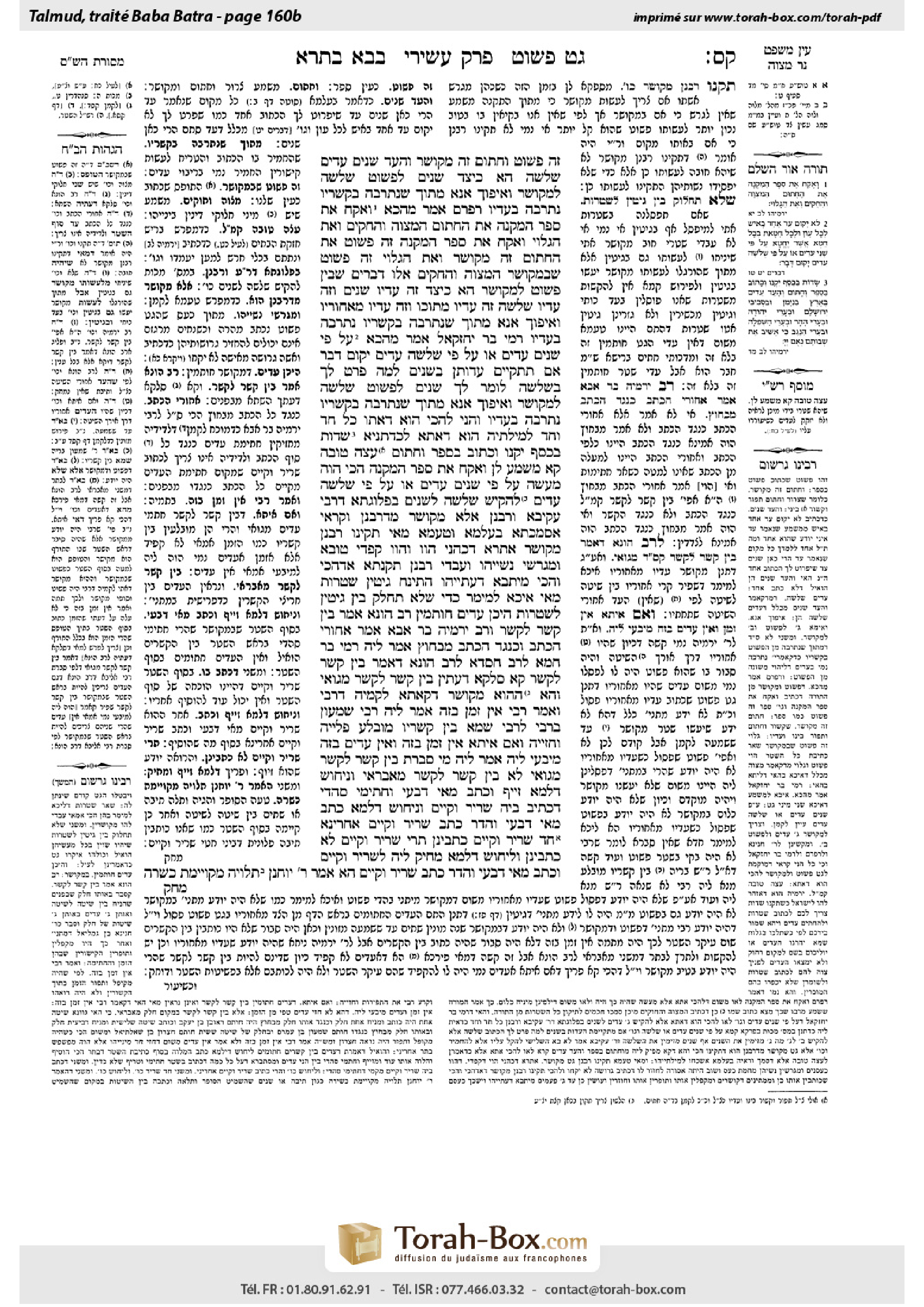
Bava Batra 160b: Talmud study for Daf Yomi
Study the Talmud for Daf Yomi with scanned pages, Hebrew text, English translations from Sefaria and AI-generated French translations.
Passage selection and English or AI-generated French translation are available where the scan has annotations. Daf Study is independent of Torah-Box and Sefaria.
Browse Bava Batra · בבא בתרא · All tractatesBava Batra 160b text and translations
This page of Bava Batra includes the Aramaic text, an English translation and an AI-generated French translation, alongside the scan above.
בבא בתרא ק״ס ב · Aramaic and Hebrew text
זֶה פָּשׁוּט. ״וְחָתוֹם״ – זֶה מְקוּשָּׁר. ״וְהָעֵד״ – שְׁנַיִם, ״עֵדִים״ – שְׁלֹשָׁה. הָא כֵּיצַד? שְׁנַיִם לְפָשׁוּט, שְׁלֹשָׁה לִמְקוּשָּׁר.
וְאֵיפוֹךְ אֲנָא! מִתּוֹךְ שֶׁנִּתְרַבָּה בִּקְשָׁרָיו, נִתְרַבָּה בְּעֵדָיו.
רַפְרָם אָמַר, מֵהָכָא: ״וָאֶקַּח אֶת סֵפֶר הַמִּקְנָה, אֶת הֶחָתוּם הַמִּצְוָה וְהַחֻקִּים, וְאֶת הַגָּלוּי״; ״וָאֶקַּח אֶת סֵפֶר הַמִּקְנָה״ – זֶה פָּשׁוּט. ״אֶת הֶחָתוּם״ – זֶה מְקוּשָּׁר. ״וְאֶת הַגָּלוּי״ – זֶה פָּשׁוּט שֶׁבַּמְקוּשָּׁר.
״הַמִּצְוָה וְהַחֻקִּים״ – אֵלּוּ דְּבָרִים שֶׁבֵּין פָּשׁוּט לִמְקוּשָּׁר. הָא כֵּיצַד? זֶה עֵדָיו שְׁנַיִם, וְזֶה עֵדָיו שְׁלֹשָׁה; זֶה עֵדָיו מִתּוֹכוֹ, וְזֶה עֵדָיו מֵאֲחוֹרָיו.
וְאֵיפוֹךְ אֲנָא! מִתּוֹךְ שֶׁנִּתְרַבָּה בִּקְשָׁרָיו, נִתְרַבָּה בְּעֵדָיו.
רָמֵי בַּר יְחֶזְקֵאל אָמַר, מֵהָכָא: ״עַל פִּי שְׁנַיִם עֵדִים אוֹ עַל פִּי שְׁלֹשָׁה עֵדִים יָקוּם דָּבָר״ – אִם תִּתְקַיֵּים עֵדוּתָן בִּשְׁנַיִם, לָמָּה פָּרַט לָךְ בִּשְׁלֹשָׁה? לוֹמַר לָךְ: שְׁנַיִם לְפָשׁוּט, שְׁלֹשָׁה לִמְקוּשָּׁר.
וְאֵיפוֹךְ אֲנָא! מִתּוֹךְ שֶׁנִּתְרַבָּה בִּקְשָׁרָיו, נִתְרַבָּה בְּעֵדָיו.
וְהָנֵי לְהָכִי הוּא דְּאָתוּ? כׇּל חַד וְחַד לְמִילְּתֵיהּ הוּא דַּאֲתָא – לְכִדְתַנְיָא: ״שָׂדוֹת בַּכֶּסֶף יִקְנוּ, וְכָתוֹב בַּסֵּפֶר וְחָתוֹם״ – עֵצָה טוֹבָה קָא מַשְׁמַע לַן. ״וָאֶקַּח אֶת סֵפֶר הַמִּקְנָה״ – הָכִי הֲוָה מַעֲשֶׂה. ״עַל פִּי שְׁנַיִם עֵדִים אוֹ עַל פִּי שְׁלֹשָׁה עֵדִים״ – לְהַקִּישׁ שְׁלֹשָׁה לִשְׁנַיִם, בִּפְלוּגְתָּא דְּרַבִּי עֲקִיבָא וְרַבָּנַן!
אֶלָּא מְקוּשָּׁר מִדְּרַבָּנַן, וּקְרָאֵי אַסְמַכְתָּא בְּעָלְמָא.
וְטַעְמָא מַאי תַּקִּינוּ רַבָּנַן מְקוּשָּׁר? אַתְרָא דְכָהֲנֵי הֲווֹ, וַהֲווֹ קָפְדִי טוּבָא וּמְגָרְשִׁי נָשַׁיְיהוּ; וְעָבְדִי רַבָּנַן תַּקַּנְתָּא, אַדְּהָכִי וְהָכִי מִיַּתְּבָא דַּעְתַּיְיהוּ.
הָתִינַח גִּיטִּין, שְׁטָרוֹת מַאי אִיכָּא לְמֵימַר? כְּדֵי שֶׁלֹּא תְּחַלֵּק בֵּין גִּיטִּין לִשְׁטָרוֹת.
הֵיכָן עֵדִים חוֹתְמִין? רַב הוּנָא אָמַר: בֵּין קֶשֶׁר לְקֶשֶׁר. וְרַב יִרְמְיָה בַּר אַבָּא אָמַר: אֲחוֹרֵי הַכְּתָב – וּכְנֶגֶד הַכְּתָב מִבַּחוּץ.
אֲמַר לֵיהּ רָמֵי בַּר חָמָא לְרַב חִסְדָּא: לְרַב הוּנָא דְּאָמַר בֵּין קֶשֶׁר לְקֶשֶׁר – קָא סָלְקָא דַּעְתִּין בֵּין קֶשֶׁר לְקֶשֶׁר מִגַּוַּאי – וְהָא הָהוּא מְקוּשָּׁר דַּאֲתָא לְקַמֵּיהּ דְּרַבִּי, וְאָמַר רַבִּי: אֵין זְמַן בָּזֶה! אֲמַר לֵיהּ רַבִּי שִׁמְעוֹן בְּרַבִּי לְרַבִּי: שֶׁמָּא בֵּין קְשָׁרָיו מוּבְלָע? פַּלְיֵיהּ, וְחַזְיֵיהּ. וְאִם אִיתָא, ״אֵין זְמַן בָּזֶה וְאֵין עֵדִים בָּזֶה״ מִיבַּעְיָא לֵיהּ!
אֲמַר לֵיהּ: מִי סָבְרַתְּ בֵּין קֶשֶׁר לְקֶשֶׁר – מִגַּוַּאי? לָא, בֵּין קֶשֶׁר לְקֶשֶׁר – מֵאַבָּרַאי.
וְנֵיחוּשׁ דִּלְמָא זַיֵּיף וְכָתֵב מַאי דְּבָעֵי, וַחֲתִימִי סָהֲדִי!
דִּכְתִיב בֵּיהּ: ״שָׁרִיר וְקַיָּים״.
וְנֵיחוּשׁ דִּלְמָא כָּתֵב מַאי דְּבָעֵי, וַהֲדַר כָּתֵב ״שָׁרִיר וְקַיָּים״ אַחֲרִינָא! חַד ״שָׁרִיר וְקַיָּים״ כָּתְבִינַן, תְּרֵי ״שָׁרִיר וְקַיָּים״ לָא כָּתְבִינַן.
וְלֵיחוּשׁ דִּלְמָא מָחֵיק לֵיהּ לְ״שָׁרִיר וְקַיָּים״, וְכָתַב מַאי דְּבָעֵי, וַהֲדַר כָּתֵב ״שָׁרִיר וְקַיָּים״! הָא אָמַר רַבִּי יוֹחָנָן: תְּלוּיָה; מְקוּיֶּימֶת – כְּשֵׁרָה,
Bava Batra 160b · English translation
this is referring to an ordinary document. When the verse states: “And seal them,” this is referring to a tied document. The next phrase, “and call witnesses [veha’ed edim],” which more literally would be translated: And have witnesses bear witness, is interpreted as follows: “And have bear witness [veha’ed],” this indicates the need for two witnesses, as the term “witness [ed]” in the Torah generally refers to two witnesses. As to the word “witnesses [edim],” this additional term indicates the need for three witnesses. How so? How can the verse call for both two witnesses and three witnesses? Rabbi Ḥanina explains: Two witnesses are required for an ordinary document, and three are required for a tied document.
The Gemara questions this explanation: But I can just as well reverse it, requiring two witnesses for a tied document and three for an ordinary one. The Gemara answers: Since the tied document requires more to be done with regard to its ties, it stands to reason that it requires more to be done with regard to its witnesses, requiring three rather than two.
Rafram says that there is a different source for two kinds of documents, from here: “So I took the deed of the purchase, that which was sealed, the terms and conditions, and that which was open” (Jeremiah 32:11). When the verse states: “So I took the deed of the purchase,” this is referring to an ordinary document. When it states: “That which was sealed,” this is referring to a tied document. When it states: “And that which was open,” this is referring to the ordinary, unfolded part of a tied document.
Rafram continues: With regard to the phrase: “The terms and conditions,” these are the matters that distinguish an ordinary document from a tied one. How so? What are the details that differentiate the two types of documents? This one, the ordinary document, has two witnesses, and that one, the tied document, has three witnesses. And in this one, the ordinary document, its witnesses are signed inside it, on the front side, while in that one, the tied document, its witnesses are signed on the back of it.
The Gemara questions this explanation: But I can just as well reverse it, requiring two witnesses for a tied document and three for an ordinary one. The Gemara answers: Since the tied document requires more to be done with regard to its ties, it stands to reason that it requires more to be done with regard to its witnesses, requiring three rather than two.
Rami bar Yeḥezkel said that there is a different source for two sets of halakhot for two types of documents from here: “At the mouth of two witnesses or at the mouth of three witnesses shall a matter be established” (Deuteronomy 19:15). If witnesses’ testimony is established with two witnesses, why did the verse specify for you that it is also established with three, which is self-evident? Rather, this verse serves to tell you that there is a requirement for two witnesses for an ordinary document, and a requirement for three witnesses for a tied document.
The Gemara questions this explanation: But I can just as well reverse it, requiring two witnesses for a tied document and three for an ordinary one. The Gemara answers: Since the tied document requires more to be done with regard to its ties, it stands to reason that it requires more to be done with regard to its witnesses, requiring three rather than two.
The Gemara asks: And is it so that these verses are coming for this purpose, to teach that there are two types of documents? But each and every one of them comes for its own purpose. The first verse comes for that which is taught in a baraita: When the verse states: “They shall buy fields for money, and subscribe the deeds, and seal them, and call witnesses” (Jeremiah 32:44), it is merely to teach us good advice, that people should carefully document their purchases in order to provide permanent proof of purchase. When the verse states: “So I took the deed of the purchase” (Jeremiah 32:11), this was merely how that incident occurred, and the phrase is not intended to teach any halakhot. When the verse states: “At the mouth of two witnesses or at the mouth of three witnesses shall a matter be established” (Deuteronomy 19:15), this is stated in order to juxtapose three witnesses with two witnesses for several reasons, as delineated in the dispute between Rabbi Akiva and the Rabbis (Makkot 5b).
The Gemara explains: Rather, the entire institution of the tied document is rabbinic in origin, and all these verses that were cited above by various amora’im were intended as mere support for the concept of a tied document, as opposed to actual sources.
The Gemara asks: And what is the reason that the Sages instituted the tied document? The Gemara explains: There was a place where there were many priests, and they were very quick tempered, and they would seek to divorce their wives impetuously. The halakha is that a priest may not marry a divorcée, even his own ex-wife. These priests, who acted impetuously, often regretted having divorced their wives. And therefore, the Sages instituted an ordinance that the bill of divorce for these people should be of the tied format, which is a long, drawn-out process, hoping that meanwhile, their composure would be regained and they would reconsider their decision to divorce.
The Gemara asks: This works out well for bills of divorce, but what can be said with regard to other documents? Why is this procedure used for other documents as well? The Gemara answers: This was instituted so that you should not differentiate between bills of divorce and other documents.
§ Where do the witnesses sign on a tied document? Rav Huna says: They sign between each tied fold. And Rav Yirmeya bar Abba says: They sign on the back of the written side, taking care that the signatures are exactly opposite the writing, on the outside.
Rami bar Ḥama said to Rav Ḥisda: According to Rav Huna, who says that the witnesses sign between each tied fold, it enters our mind that he meant between each tied fold on the inside of the document. But this is difficult, as there was a certain tied document that came before Rabbi Yehuda HaNasi, and Rabbi Yehuda HaNasi, not realizing it was tied, said: There is no date on this document, so it is not valid. Then, Rabbi Shimon, son of Rabbi Yehuda HaNasi, said to Rabbi Yehuda HaNasi: Perhaps the date is hidden between the tied folds. Rabbi Yehuda HaNasi opened it and saw that the date was in fact between the tied folds. And if it is so that the witnesses sign between each tied fold on the inside of the document, Rabbi Yehuda HaNasi should have had two objections, and said: There is no date on this document, and there are also no witnesses signed on this document.
Rav Ḥisda said to him: Do you maintain that Rav Huna meant that the witnesses sign between the tied folds on the inside? No, he meant between the tied folds on the outside of the document.
The Gemara questions Rav Huna’s opinion: But let us be concerned that perhaps the party holding the document falsified some information and wrote whatever he wanted. And this is a concern, as there are already witnesses signed on the document. In an ordinary document the witnesses sign immediately following the text, so there is no possibility of adding to the text. A tied document has part of its text written in the folds, but also has a part written on the face of the document on the unfolded paper, before or after the text in the folded part. If the witnesses sign between the folds there is the possibility of writing additional text in the unfolded section.
The Gemara explains: The case is one where it is written in the document: Everything is confirmed and established. That is, every folded document must contain this formula at the end of the text, to prevent forgery, as any writing after this formula would be disregarded.
The Gemara questions this explanation: But let us be concerned that perhaps the holder of the document wrote whatever he wanted and afterward wrote another time: Everything is confirmed and established. The Gemara explains: We write only one declaration of: Everything is confirmed and established; we do not write two declarations of: Everything is confirmed and established. Therefore, anything written after the first declaration would be rejected, even if followed by a repetition of the declaration.
The Gemara questions further: But let there be a concern that perhaps the holder of the document erased the declaration: Everything is confirmed and established, and then wrote whatever he wanted over the erasure, and afterward wrote the declaration: Everything is confirmed and established. The Gemara responds: How could this happen? Doesn’t Rabbi Yoḥanan say: A document that includes a suspended correction of text inserted between lines of the document, which is verified at the end of the document, is valid;
Bava Batra 160b · Traduction française (IA)
cela fait référence à un document ordinaire. Lorsque la Bible dit : « Et scelle-les », cela fait référence à un document lié. La phrase suivante, « et appelle des témoins [veha’ed edim] », qui se traduirait littéralement par « et fais témoigner des témoins », est interprétée ainsi : « Et fais témoigner [veha’ed] », cela indique la nécessité de deux témoins, car le terme « témoin [ed] » dans la Torah désigne généralement deux témoins. Quant au terme « témoins [edim] », ce terme supplémentaire indique la nécessité de trois témoins. Comment cela se produit-il ? Comment peut-il exiger à la fois deux témoins et trois témoins ? Rabbi Ḥanina explique : deux témoins sont requis pour un document ordinaire, et trois pour un document lié.
Le Guemara soulève une question à cet égard : mais je pourrais tout aussi bien inverser cela, exigeant deux témoins pour un document lié et trois pour un document ordinaire. Le Guemara répond : puisque le document lié nécessite plus d'attention concernant ses liens, il est logique qu'il nécessite plus d'attention concernant ses témoins, exigeant ainsi trois plutôt que deux.
Rafram dit que la source de deux types de documents est différente ici : « J'ai pris le contrat de l'achat, celui qui était scellé, les termes et conditions, et celui qui était ouvert » (Jérémie 32:11). Lorsque la Bible dit : « J'ai pris le contrat de l'achat », cela fait référence à un document ordinaire. Lorsqu'elle dit : « Celui qui était scellé », cela fait référence à un document lié. Lorsqu'elle dit : « Et celui qui était ouvert », cela fait référence à la partie ordinaire, dépliée, d'un document lié.
Rafram continue : concernant la phrase : « Les termes et conditions », ces sont les choses qui distinguent un document ordinaire d'un document lié. Comment cela se produit-il ? Quels sont les détails qui différencient ces deux types de documents ? Celui-ci, le document ordinaire, a deux témoins, et celui-là, le document lié, a trois témoins. Et dans celui-ci, le document ordinaire, ses témoins sont signés à l'intérieur, sur la face avant, tandis que dans celui-là, le document lié, ses témoins sont signés sur la face arrière.
Le Guemara soulève une question à cet égard : mais je pourrais tout aussi bien inverser cela, exigeant deux témoins pour un document lié et trois pour un document ordinaire. Le Guemara répond : puisque le document lié nécessite plus d'attention concernant ses liens, il est logique qu'il nécessite plus d'attention concernant ses témoins, exigeant ainsi trois plutôt que deux.
Rami bar Yeḥezkel dit que la source des deux catégories de halakhot pour les deux types de documents est différente ici : « À la bouche de deux témoins ou à la bouche de trois témoins doit être établi une affaire » (Deutéronome 19:15). Si le témoignage des témoins est établi avec deux témoins, pourquoi la Bible précise-t-elle que cela est aussi établi avec trois, ce qui est évident ? Plutôt, cette verset sert à vous dire qu'il y a une exigence de deux témoins pour un document ordinaire, et une exigence de trois témoins pour un document lié.
Le Guemara soulève une question à cet égard : mais je pourrais tout aussi bien inverser cela, exigeant deux témoins pour un document lié et trois pour un document ordinaire. Le Guemara répond : puisque le document lié nécessite plus d'attention concernant ses liens, il est logique qu'il nécessite plus d'attention concernant ses témoins, exigeant ainsi trois plutôt que deux.
Le Guemara pose une question : Et est-ce ainsi que ces versets sont révélés à cet effet, pour enseigner qu'il y a deux types de documents ? Mais chaque verset a sa propre raison. Le premier verset est révélé pour ce qui est enseigné dans une baraïta : lorsque la Bible dit : « Ils achèteront des champs avec de l'argent, et signeront les contrats, et les scelleront, et appelleront des témoins » (Jérémie 32:44), cela est simplement pour nous enseigner une bonne conseil, que les gens doivent bien documenter leurs achats afin de fournir une preuve permanente d'achat. Lorsque la Bible dit : « J'ai pris le contrat de l'achat » (Jérémie 32:11), cela était simplement comment cela s'est produit, et la phrase n'est pas destinée à enseigner aucune halakha. Lorsque la Bible dit : « À la bouche de deux témoins ou à la bouche de trois témoins doit être établi une affaire » (Deutéronome 19:15), cela est dit afin de juxtaposer trois témoins avec deux témoins pour plusieurs raisons, comme le démontre le débat entre Rabbi Akiva et les Rabbins (Makkot 5b).
Le Guemara explique : Plutôt, l'ensemble de l'institution du document lié est d'origine rabbinique, et tous ces versets cités ci-dessus par divers amoraïm étaient destinés à servir de soutien à la notion du document lié, plutôt que d'être des sources authentiques.
Le Guemara pose la question : Et quelle est la raison pour laquelle les Sages ont institué le document lié ? Le Guemara explique : Il y avait un lieu où il y avait beaucoup de prêtres, et ils étaient très impulsifs, et ils cherchaient à divorcer leurs épouses rapidement. La halakha est que le prêtre ne peut pas épouser une divorcée, même sa propre ex-épouse. Ces prêtres, qui agissaient impulsivement, regrettaient souvent d'avoir divorcé leurs épouses. Et donc, les Sages ont institué une ordonnance selon laquelle le document de divorce pour ces personnes devrait être de format lié, qui est un processus long et détaillé, espérant que pendant ce temps, leur calme serait retrouvé et ils réfléchiraient à leur décision de divorcer.
Le Guemara pose la question : cela fonctionne bien pour les documents de divorce, mais qu'en est-il des autres documents ? Pourquoi cette procédure est-elle utilisée pour d'autres documents également ? Le Guemara répond : cela a été institué afin que vous ne fassiez pas de distinction entre les documents de divorce et les autres documents.
§ Où les témoins signent-ils sur un document lié ? Rav Huna dit : Ils signent entre chaque pli lié. Et Rav Yirmeya bar Abba dit : Ils signent sur le côté arrière de la face écrite, en prenant soin que les signatures soient exactement opposées à l'écriture, sur l'extérieur.
Rami bar Ḥama a dit à Rav Ḥisda : Selon Rav Huna, qui dit que les témoins signent entre chaque pli lié, cela nous vient à l'esprit qu'il voulait dire entre chaque pli lié sur l'intérieur du document. Mais cela est difficile, car il y avait un certain document lié qui est venu devant Rabbi Yehuda HaNasi, et Rabbi Yehuda HaNasi, ne sachant pas qu'il était lié, a dit : Il n'y a pas de date sur ce document, donc il n'est pas valide. Puis, Rabbi Shimon, fils de Rabbi Yehuda HaNasi, a dit à Rabbi Yehuda HaNasi : Peut-être que la date est cachée entre les plis. Rabbi Yehuda HaNasi l'a ouvert et a vu que la date était en effet entre les plis. Et si c'est ainsi que les témoins signent entre chaque pli sur l'intérieur du document, Rabbi Yehuda HaNasi aurait dû avoir deux objections, et a dit : Il n'y a pas de date sur ce document, et il n'y a pas non plus de témoins signés sur ce document.
Rav Ḥisda a dit à lui : Maintenez-vous que Rav Huna voulait dire que les témoins signent entre les plis sur l'intérieur du document ? Non, il voulait dire entre les plis sur l'extérieur du document.
La Guemara questionne l'opinion de Rav Huna : Mais soyons inquiets que peut-être la personne qui tient le document ait falsifié certaines informations et écrit ce qu'elle voulait. Et cela est une préoccupation, car il y a déjà des témoins signés sur le document. Dans un document ordinaire, les témoins signent immédiatement après le texte, donc il n'y a pas de possibilité d'ajouter du texte. Un document lié a une partie de son texte écrit dans les plis, mais il a aussi une partie écrite sur la face du document, sur le papier déplié, avant ou après le texte dans la partie pliée. Si les témoins signent entre les plis, il y a la possibilité d'écrire un texte supplémentaire dans la partie dépliée.
La Guemara explique : Le cas est celui où il est écrit dans le document : Tout est confirmé et établi. C'est-à-dire que chaque document plié doit contenir cette formule à la fin du texte, afin d'éviter la contrefaçon, car toute écriture après cette formule serait rejetée.
La Guemara questionne cette explication : Mais soyons inquiets que peut-être la personne qui détient le document ait écrit ce qu'elle voulait, puis ait écrit plus tard : Tout est confirmé et établi. La Guemara explique : Nous écrivons seulement une déclaration de : Tout est confirmé et établi ; nous n'écrivons pas deux déclarations de : Tout est confirmé et établi. Par conséquent, toute écriture après la première déclaration serait rejetée, même si elle est suivie d'une répétition de la déclaration.
La Guemara questionne davantage : Mais soyons inquiets que peut-être la personne qui détient le document ait effacé la déclaration : Tout est confirmé et établi, puis ait écrit ce qu'elle voulait sur l'effacement, et ensuite ait écrit la déclaration : Tout est confirmé et établi. La Guemara répond : Comment cela pourrait-il arriver ? N'est-ce pas ce que Rabbi Yoḥanan dit : Un document qui contient une correction suspendue du texte insérée entre les lignes du document, qui est vérifiée à la fin du document, est valide ;
Traduction française générée par IA à partir de l’édition anglaise de Sefaria. Vérifie toujours un passage avec le texte source.
Text from Sefaria: William Davidson Edition - Vocalized Aramaic (CC BY NC); William Davidson Edition - English (CC BY NC).