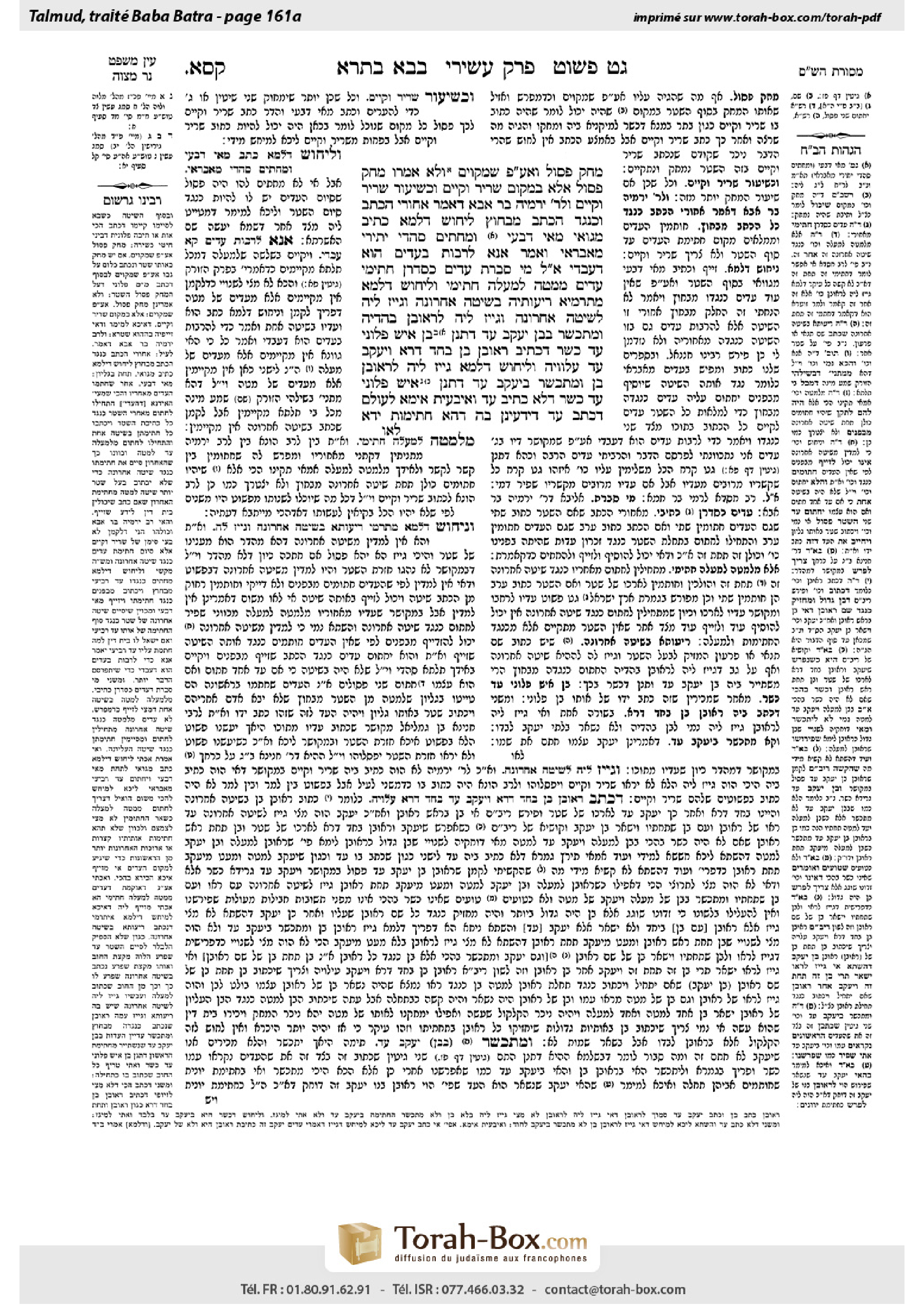
Bava Batra 161a: Talmud study for Daf Yomi
Study the Talmud for Daf Yomi with scanned pages, Hebrew text, English translations from Sefaria and AI-generated French translations.
Passage selection and English or AI-generated French translation are available where the scan has annotations. Daf Study is independent of Torah-Box and Sefaria.
Browse Bava Batra · בבא בתרא · All tractatesBava Batra 161a text and translations
This page of Bava Batra includes the Aramaic text, an English translation and an AI-generated French translation, alongside the scan above.
בבא בתרא קס״א א · Aramaic and Hebrew text
מְחָק – פָּסוּל, וְאַף עַל פִּי שֶׁמְּקוּיָּם.
וְלֹא אָמְרוּ מְחָק פָּסוּל – אֶלָּא בִּמְקוֹם ״שָׁרִיר וְקַיָּים״, וּכְשִׁיעוּר ״שָׁרִיר וְקַיָּים״.
וּלְרַב יִרְמְיָה בַּר אַבָּא, דְּאָמַר: אֲחוֹרֵי הַכְּתָב – וּכְנֶגֶד הַכְּתָב מִבַּחוּץ; לֵיחוּשׁ דִּלְמָא כָּתֵיב מִגַּוַּאי מַאי דְּבָעֵי, וּמַחְתִּים סָהֲדֵי יַתִּירֵי מֵאַבָּרַאי, וְאָמַר: אֲנָא לְרַבּוֹת בְּעֵדִים הוּא דַּעֲבַדִי!
אֲמַר לֵיהּ: מִי סָבְרַתְּ עֵדִים כְּסִדְרָן חֲתִימִי? עֵדִים מִמַּטָּה לְמַעְלָה חֲתִימִי.
וְלֵיחוּשׁ דִּלְמָא מִתְרַמְיָא רֵיעוּתָה בְּשִׁיטָה אַחֲרוֹנָה, וְגָיֵיז לַיהּ לְשִׁיטָה אַחֲרוֹנָה – וְגָיֵיז לֵיהּ לִרְאוּבֵן בַּהֲדֵיהּ, וּמִתַּכְשַׁר בְּ״בֶן יַעֲקֹב עֵד״; דִּתְנַן: ״בֶּן אִישׁ פְּלוֹנִי, עֵד״ – כָּשֵׁר!
דִּכְתִיב ״רְאוּבֵן בֶּן״ בְּחַד דָּרָא, וְ״יַעֲקֹב עֵד״ עִלָּוֵויהּ.
וְלִיחוֹשׁ דִּלְמָא גָּיֵיז לֵיהּ לִ״רְאוּבֵן בֶּן״, וּמִתַּכְשַׁר בְּ״יַעֲקֹב עֵד״ – דִּתְנַן: ״אִישׁ פְּלוֹנִי עֵד״, כָּשֵׁר!
דְּלָא כְּתִיב ״עֵד״.
וְאִיבָּעֵית אֵימָא: לְעוֹלָם דִּכְתִב ״עֵד״, דְּיָדְעִינַן בַּהּ דְּהָא חֲתִימוּת יְדָא –
Bava Batra 161a · English translation
but a document with a reference to words written over an erasure is not valid, even if it is verified at the end of the document. At the end of a document, before the formula: Everything is confirmed and established, is written, any corrections made in the document are verified by adding to the text: On line so-and-so, such and such a word has been added, or some similar formulation. This may be done only for inserted corrections, not for erasures.
The Gemara clarifies this statement: And they said that an erasure on a document renders the document not valid only if it is in a place on the document where the declaration: Everything is confirmed and established, should have been written, and only if the erasure is the measure of space in which the declaration: Everything is confirmed and established, can be written. The only concern with erasures is that the crucial formula: Everything is confirmed and established, might have been erased, as this would allow for unlimited forgery. If the erasure is such that this formula could not possibly have been erased, the document is valid.
§ Rami bar Ḥama asked Rav Ḥisda: And according to Rav Yirmeya bar Abba, who says that the witnesses sign on the back of the written side, taking care that the signatures are exactly opposite the writing, on the outside let there be a concern that perhaps the party holding the document will write whatever he wants on the inside, i.e., the front of the document, adding to the text, and then have extra witnesses sign on the outside, and he will say to anyone questioning the number of witnesses being more than the minimum: I did this in order to increase the number of witnesses, the more to publicize the matters written in the document.
Rav Ḥisda said to him: Do you maintain that the witnesses sign in order, that is, one under the other, starting from the top of the page on the back? This is not correct; rather, the witnesses sign from bottom to top. The witnesses sign in a perpendicular direction relative to the text of the document. The first signature begins at the reverse side of the last line of the document, and it continues upward toward the first line. There is therefore no possibility of adding to the text of the document, as, if the text extended beyond the beginning of the signatures, it would be recognized as a forgery.
Rami bar Ḥama continues to question the method of signature prescribed by Rav Yirmeya bar Abba: But let there be a concern that perhaps something detrimental to the holder of the document happens to appear in the final line of the document, and he excises the final line, and in doing so excises the first name of the witness on the opposite side as well. For instance, if the witness’s name is Reuven, son of Ya’akov, he will excise Reuven along with the final line of the document, and the document will be rendered valid with the remaining part of the signature: “Son of Ya’akov, witness.” As we learned in a mishna (Gittin 87b): If one signs: Son of so-and-so, witness, without mentioning his own name, the document is valid.
The Gemara answers: It is a case where it is written “Reuven, son of” on one line, i.e., opposite the final line of the document, and “Ya’akov, witness,” above it, beginning from the penultimate line of the document and continuing upward in a perpendicular manner. That is, a tied document is valid only if the witnesses sign in this manner. In this case, if the final line of the document is excised, all that will remain of the signature will be: “Ya’akov, witness.”
Rami bar Ḥama continues to ask: But let there be a concern that perhaps he will excise the final line of the document, along with the words “Reuven, son of,” and the document will be rendered valid with the remaining part of the signature: “Ya’akov, witness.” As we learned in a mishna (Gittin 87b): If someone signs just: So-and-so, witness, the document is valid.
The Gemara answers: It is a case where the word witness is not written after the witnesses’ names. That is, a tied document is valid only if the word witness does not appear after the signatures. It is only in such a case that the document cannot be materially changed by excising the final line without rendering the witnesses’ names disqualified.
And if you wish, say instead that actually the witness did write “witness” after his signature, and the case is one where we know for a fact that this signature, which consists of the words “Ya’akov, witness,”
Bava Batra 161a · Traduction française (IA)
mais un document comportant une référence à des mots écrits sur une effacement n'est pas valide, même s'il est vérifié à la fin du document. À la fin d'un document, avant l'écriture de la formule : Tout est confirmé et établi, est inscrit, toute correction effectuée dans le document est vérifiée en ajoutant au texte : Sur la ligne telle et telle, tel et tel mot a été ajouté, ou une formulation similaire. Cela peut être fait uniquement pour les corrections insérées, pas pour les effacements.
La Guemara clarifie cette déclaration : Et ils dirent qu'un effacement sur un document rend le document invalide uniquement si celui-ci se trouve dans un endroit du document où la déclaration : Tout est confirmé et établi, aurait dû être écrite, et uniquement si l'effacement est dans la mesure d'espace où la déclaration : Tout est confirmé et établi, pourrait être écrite. L'unique préoccupation concernant les effacements est que la formule cruciale : Tout est confirmé et établi, puisse avoir été effacée, car cela permettrait une contrefaçon illimitée. Si l'effacement est tel que cette formule ne pouvait pas avoir été effacée, le document est valide.
§ Rami bar Ḥama demande à Rav Ḥisda : Et selon Rav Yirmeya bar Abba, qui dit que les témoins signent sur le dos du côté écrit, en veillant à ce que les signatures soient exactement opposées à l'écriture, sur l'extérieur, il y a une préoccupation qu'une personne tenant le document puisse écrire ce qu'elle veut à l'intérieur, c'est-à-dire le devant du document, en ajoutant au texte, puis avoir des témoins supplémentaires signer sur l'extérieur, et il dira à quiconque questionnant le nombre de témoins étant supérieur au minimum : J'ai fait cela afin d'augmenter le nombre de témoins, afin de mieux publier les affaires écrites dans le document.
Rav Ḥisda dit à lui : Maintenez-vous que les témoins signent dans l'ordre, c'est-à-dire l'un sous l'autre, en commençant par le haut de la page sur le dos ? Cela n'est pas correct ; plutôt, les témoins signent du bas vers le haut. Les témoins signent dans une direction perpendiculaire par rapport au texte du document. La première signature commence au revers de la dernière ligne du document et continue vers le haut vers la première ligne. Il n'y a donc pas de possibilité d'ajouter au texte du document, car, si le texte s'étendait au-delà du début des signatures, cela serait reconnu comme une contrefaçon.
Rami bar Ḥama continue à questionner la méthode de signature prescrite par Rav Yirmeya bar Abba : Mais il y a une préoccupation qu'une chose nuisible pour le détenteur du document apparaisse dans la dernière ligne du document, et qu'il efface la dernière ligne, et en faisant cela, il efface également le premier nom du témoin sur le côté opposé. Par exemple, si le nom du témoin est Reuven, fils de Ya'akov, il effacera Reuven avec la dernière ligne du document, et le document sera rendu valide avec la partie restante de la signature : « Fils de Ya'akov, témoin ». Comme nous l'avons appris dans une michna (Gittin 87b) : Si l'on signe : Fils de tel et tel, témoin, sans mentionner son propre nom, le document est valide.
La Guemara répond : C'est un cas où il est écrit « Reuven, fils de » sur une ligne, c'est-à-dire opposé à la dernière ligne du document, et « Ya'akov, témoin », au-dessus d'elle, commençant par la ligne précédente du document et continuant vers le haut dans une direction perpendiculaire. C'est-à-dire un document lié est valide uniquement si les témoins signent ainsi. Dans ce cas, si la dernière ligne du document est effacée, il ne restera que : « Ya'akov, témoin ».
Rami bar Ḥama continue à poser la question : Mais il y a une préoccupation qu'il efface la dernière ligne du document, ainsi que les mots « Reuven, fils de », et le document sera rendu valide avec la partie restante de la signature : « Ya’akov, témoin ». Comme nous l'avons appris dans une michna (Gittin 87b) : Si quelqu'un signe simplement : tel et tel, témoin, le document est valide.
La Guemara répond : C'est un cas où le mot « témoin » n'est pas écrit après les noms des témoins. C'est-à-dire qu'un document lié est valide uniquement si le mot « témoin » n'apparaît pas après les signatures. C'est uniquement dans ce cas que le document ne peut pas être modifié matériellement en effaçant la dernière ligne sans rendre les noms des témoins incompatibles.
Et si vous le souhaitez, dites plutôt qu'en réalité le témoin a bien écrit « témoin » après sa signature, et le cas est celui où nous savons avec certitude que cette signature, qui consiste en les mots « Ya’akov, témoin »,
Traduction française générée par IA à partir de l’édition anglaise de Sefaria. Vérifie toujours un passage avec le texte source.
Text from Sefaria: William Davidson Edition - Vocalized Aramaic (CC BY NC); William Davidson Edition - English (CC BY NC).