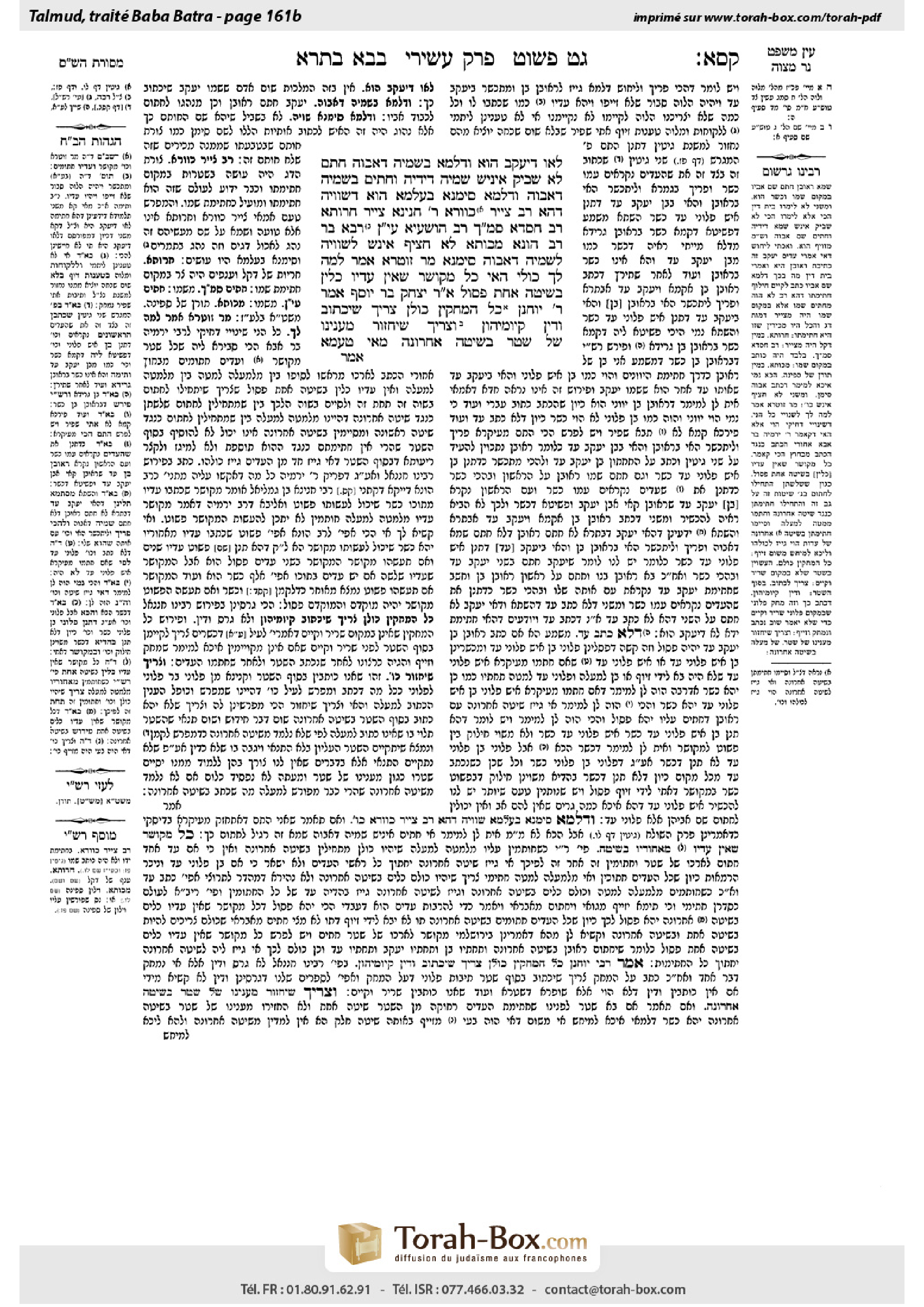
Bava Batra 161b: Talmud study for Daf Yomi
Study the Talmud for Daf Yomi with scanned pages, Hebrew text, English translations from Sefaria and AI-generated French translations.
Passage selection and English or AI-generated French translation are available where the scan has annotations. Daf Study is independent of Torah-Box and Sefaria.
Browse Bava Batra · בבא בתרא · All tractatesBava Batra 161b text and translations
This page of Bava Batra includes the Aramaic text, an English translation and an AI-generated French translation, alongside the scan above.
בבא בתרא קס״א ב · Aramaic and Hebrew text
לָאו דְּיַעֲקֹב הוּא.
וְדִלְמָא בִּשְׁמֵיהּ דַּאֲבוּהּ חֲתַם! לָא שָׁבֵיק אִינִישׁ שְׁמֵיהּ דִּידֵיהּ, וְחָתֵים בִּשְׁמֵיהּ דַּאֲבוּהּ.
וְדִלְמָא סִימָנָא בְּעָלְמָא הוּא דְּשַׁוְּויֵהּ! דְּהָא רַב צָיֵיר כְּווֹרָא, רַבִּי חֲנִינָא צָיֵיר חֲרוּתָא, רַב חִסְדָּא סָמֶךְ, רַב הוֹשַׁעְיָא – עַיִן, רָבָא בַּר רַב הוּנָא – מָכוּתָא! לָא חֲצִיף אִינָשׁ לְשַׁוּוֹיֵהּ לִשְׁמֵיהּ דַּאֲבוּהּ סִימָנָא.
מָר זוּטְרָא אָמַר: לְמָה לָךְ כּוּלֵּי הַאי? כׇּל מְקוּשָּׁר שֶׁאֵין עֵדָיו כָּלִין בְּשִׁיטָה אַחַת – פָּסוּל.
אָמַר רַב יִצְחָק בַּר יוֹסֵף אָמַר רַבִּי יוֹחָנָן: כׇּל הַמְּחָקִין כּוּלָּן, צָרִיךְ שֶׁיִּכְתּוֹב ״וְדֵין קִיּוּמֵיהוֹן״. וְצָרִיךְ שֶׁיַּחֲזוֹר מֵעִנְיָנוֹ שֶׁל שְׁטָר בְּשִׁיטָה אַחֲרוֹנָה; מַאי טַעְמָא?
Bava Batra 161b · English translation
is not Yaakov’s signature. That is, it is known for a fact that there is no one living in the city where the document was written who is named Ya’akov and whose signature matches the signature on this document. Therefore, the court will recognize that the signature must have originally stated: “So-and-so, son of Ya’akov, witness,” and that the last line had been excised, and they will invalidate it.
Rami bar Ḥama challenges: But perhaps this witness signed using the name of his father instead of his own name, as a gesture of respect toward his father. The Gemara answers: This is not done; a person does not discard his own name and sign using only the name of his father.
Rami bar Ḥama challenges further: But perhaps the witness made this name into a mere distinguishing mark that he uses as his signature, as it is known that Rav used to draw a fish as his signature mark, rather than signing his name, and Rabbi Ḥanina used to draw a palm branch as his signature mark, and Rav Ḥisda used to sign just the letter samekh, and Rav Hoshaya used to sign just the letter ayin, and Rava bar Rav Huna used to sign his name by drawing a ship’s mast [makhota]. The Gemara answers: A person is not so insolent as to use his father’s name as a distinguishing mark.
Mar Zutra said: Why do you need all this? Why go to such lengths to answer the question posed above? There is a simpler answer: Any tied document whose witnesses do not end on a single line is not valid. The Gemara had previously assumed that the witnesses sign one after the other, beginning at the document’s bottom line and going upward toward the first line; this arrangement leaves open the possibility that the signature of the first witness could be truncated by an unscrupulous party. Mar Zutra explains that this is not so; rather, the signatures are written with each one beginning opposite the bottom line and heading upward toward the beginning of the document. Therefore, if a line of text is excised from the bottom of the document, the names of all the witnesses on the reverse side will be truncated, and the forgery will become apparent.
§ Rav Yitzḥak bar Yosef says that Rabbi Yoḥanan says: There are two halakhot with regard to documents: For any erasures in a document, the scribe must write at the end of the document: And this is their verification. That is, he must list the erasures, stating that on line so-and-so there is an erasure and a correction stating such and such, for each erasure. And the second halakha is that the scribe must review some of the details of the document in the final line of the document. What is the reason for this second requirement?
Bava Batra 161b · Traduction française (IA)
Ce n'est pas la signature de Yaakov. Cela signifie que l'on sait avec certitude qu'il n'y a personne vivant dans la ville où le document a été rédigé qui s'appelle Ya'akov et dont la signature correspond à celle de ce document. Ainsi, le tribunal reconnaîtra que la signature devait originellement indiquer : « Cet homme, fils de Yaakov, témoin », et que la dernière ligne avait été effacée, et ils invalideront le document.
Rami bar Ḥama conteste : Mais peut-être que ce témoin a signé avec le nom de son père plutôt que le sien propre, en signe de respect envers son père. La Guemara répond : Cela n'est pas fait ; une personne ne renonce pas à son propre nom et ne signe qu'avec le nom de son père.
Rami bar Ḥama conteste davantage : Mais peut-être que le témoin a utilisé ce nom comme simple marque distinctive qu'il utilisait comme signature, sachant que Rav avait l'habitude de dessiner un poisson comme marque distinctive, plutôt que de signer son nom, et que Rabbi Ḥanina avait l'habitude de dessiner un buis, et que Rav Ḥisda signait seulement la lettre samekh, et que Rav Hoshaya signait seulement la lettre ayin, et que Rava bar Rav Huna signait son nom en dessinant un mât de navire [makhota]. La Guemara répond : Une personne n'est pas si insolente qu'elle utilise le nom de son père comme marque distinctive.
Mar Zutra dit : Pourquoi avez-vous besoin de tout cela ? Pourquoi aller jusqu'à ce point pour répondre à la question posée ci-dessus ? Il y a une réponse plus simple : Tout document lié dont les témoins ne s'alignent pas sur une seule ligne n'est pas valide. La Guemara avait précédemment supposé que les témoins signaient l'un après l'autre, commençant par la ligne du bas du document et remontant vers la première ligne ; cette disposition laissait ouverte la possibilité que la signature du premier témoin puisse être tronquée par une personne malveillante. Mar Zutra explique que cela n'est pas le cas ; plutôt, les signatures sont écrites avec chacune commençant à la ligne du bas et remontant vers le début du document. Ainsi, si une ligne de texte est effacée du bas du document, les noms de tous les témoins du côté opposé seront tronqués, et la contrefaçon deviendra évidente.
§ Rav Yitzḥak bar Yosef dit que Rabbi Yoḥanan dit : Il y a deux halakhot concernant les documents : Pour toute suppression dans un document, l'écrivain doit écrire à la fin du document : « Et ceci est leur vérification. » Cela signifie qu'il doit lister les suppressions, indiquant que sur la ligne telle que telle il y a une suppression et une correction disant telle que telle, pour chaque suppression. Et la deuxième halakha est que l'écrivain doit vérifier certains détails du document dans la dernière ligne du document. Quelle est la raison de cette deuxième exigence ?
Traduction française générée par IA à partir de l’édition anglaise de Sefaria. Vérifie toujours un passage avec le texte source.
Text from Sefaria: William Davidson Edition - Vocalized Aramaic (CC BY NC); William Davidson Edition - English (CC BY NC).