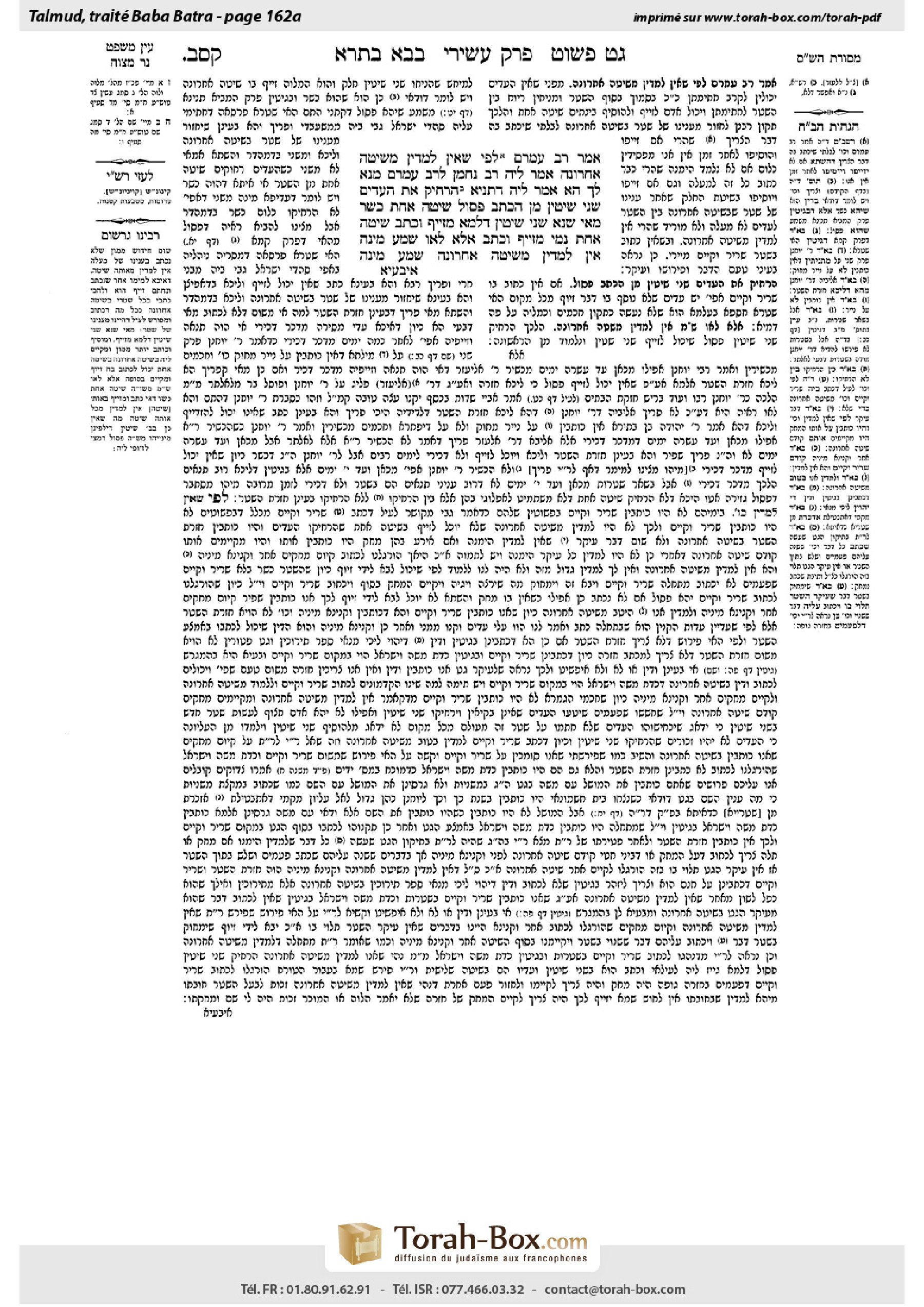
Bava Batra 162a: Talmud study for Daf Yomi
Study the Talmud for Daf Yomi with scanned pages, Hebrew text, English translations from Sefaria and AI-generated French translations.
Passage selection and English or AI-generated French translation are available where the scan has annotations. Daf Study is independent of Torah-Box and Sefaria.
Browse Bava Batra · בבא בתרא · All tractatesBava Batra 162a text and translations
This page of Bava Batra includes the Aramaic text, an English translation and an AI-generated French translation, alongside the scan above.
בבא בתרא קס״ב א · Aramaic and Hebrew text
אָמַר רַב עַמְרָם: לְפִי שֶׁאֵין לְמֵדִין מִשִּׁיטָה אַחֲרוֹנָה.
אֲמַר לֵיהּ רַב נַחְמָן לְרַב עַמְרָם: מְנָא לָךְ הָא? אֲמַר לֵיהּ, דְּתַנְיָא: הִרְחִיק אֶת הָעֵדִים שְׁנֵי שִׁיטִין מִן הַכְּתָב – פָּסוּל, שִׁיטָה אַחַת – כָּשֵׁר.
מַאי שְׁנָא שְׁנֵי שִׁיטִין – דִּלְמָא מְזַיֵּיף וְכָתֵב; שִׁיטָה אַחַת נָמֵי, מְזַיֵּיף וְכָתַב! אֶלָּא לָאו שְׁמַע מִינַּהּ אֵין לְמֵדִין מִשִּׁיטָה אַחֲרוֹנָה? שְׁמַע מִינַּהּ.
Bava Batra 162a · English translation
Rav Amram says: It is because one may not learn any new details from the final line of a document. There is a concern that the holder of the document may have written in an extra line of text to his advantage, between the text and the witnesses’ signatures. Therefore, any new information contained in the last line is disregarded. Since the final line is disregarded, it is necessary that the final line of a document contain only a review of what is already written in it.
Rav Naḥman said to Rav Amram: From where do you know this? Rav Amram said to him: As it is taught in a baraita (Tosefta 11:1): If one writing a document distanced the witnesses’ signatures two lines from the text of the document, leaving two lines blank, the document is not valid, as it would be possible for the holder of the document to fill in false information in those lines. But if one distanced the signatures one line from the text, the document is valid.
Rav Amram analyzes the baraita: What is different in the case of two blank lines that the document is not valid? If you say that perhaps the holder of the document will take advantage of those two blank lines, and forge unverified information and write it in those lines, then in the case of one line left blank as well, he can forge information and write it in that line. Rather, must one not conclude from the baraita that one may not learn any new details from the final line of a document? Therefore, only when two lines are left blank is there a concern that false information would be added to the penultimate line. The Gemara affirms: Conclude from this baraita that it is so.
Bava Batra 162a · Traduction française (IA)
Rav Amram dit : C'est parce qu'on ne peut pas apprendre de nouveaux détails à partir de la dernière ligne d'un document. Il y a une crainte que le détenteur du document ait écrit une ligne supplémentaire à son avantage, entre le texte et les signatures des témoins. Par conséquent, toute information nouvelle contenue dans la dernière ligne est ignorée. Puisque la dernière ligne est ignorée, il est nécessaire que la dernière ligne d'un document contienne uniquement une révision de ce qui est déjà écrit dans ce document.
Rav Naḥman a dit à Rav Amram : D'où sais-tu cela ? Rav Amram a répondu à lui : Comme il est enseigné dans une baraïta (Tosefta 11:1) : Si l'on écrit un document et qu'on place les signatures des témoins à deux lignes de distance du texte du document, laissant deux lignes vides, le document n'est pas valide, car il serait possible que le détenteur du document remplisse ces lignes avec des informations fausses. Mais si l'on place les signatures à une ligne de distance du texte, le document est valide.
Rav Amram analyse la baraïta : Qu'est-ce qui diffère dans le cas de deux lignes vides qui rendent le document invalide ? Si l'on dit que peut-être le détenteur du document profitera de ces deux lignes vides pour falsifier des informations et les écrire dans ces lignes, alors dans le cas d'une ligne vide également, il pourrait falsifier des informations et les écrire dans cette ligne. Plutôt, ne doit-on pas conclure de la baraïta que l'on ne peut pas apprendre de nouveaux détails à partir de la dernière ligne d'un document ? Par conséquent, seul dans le cas de deux lignes vides y a-t-il une crainte que des informations fausses soient ajoutées à la ligne précédente. La Guemara affirme : Concluez de cette baraïta qu'il en est ainsi.
Traduction française générée par IA à partir de l’édition anglaise de Sefaria. Vérifie toujours un passage avec le texte source.
Text from Sefaria: William Davidson Edition - Vocalized Aramaic (CC BY NC); William Davidson Edition - English (CC BY NC).