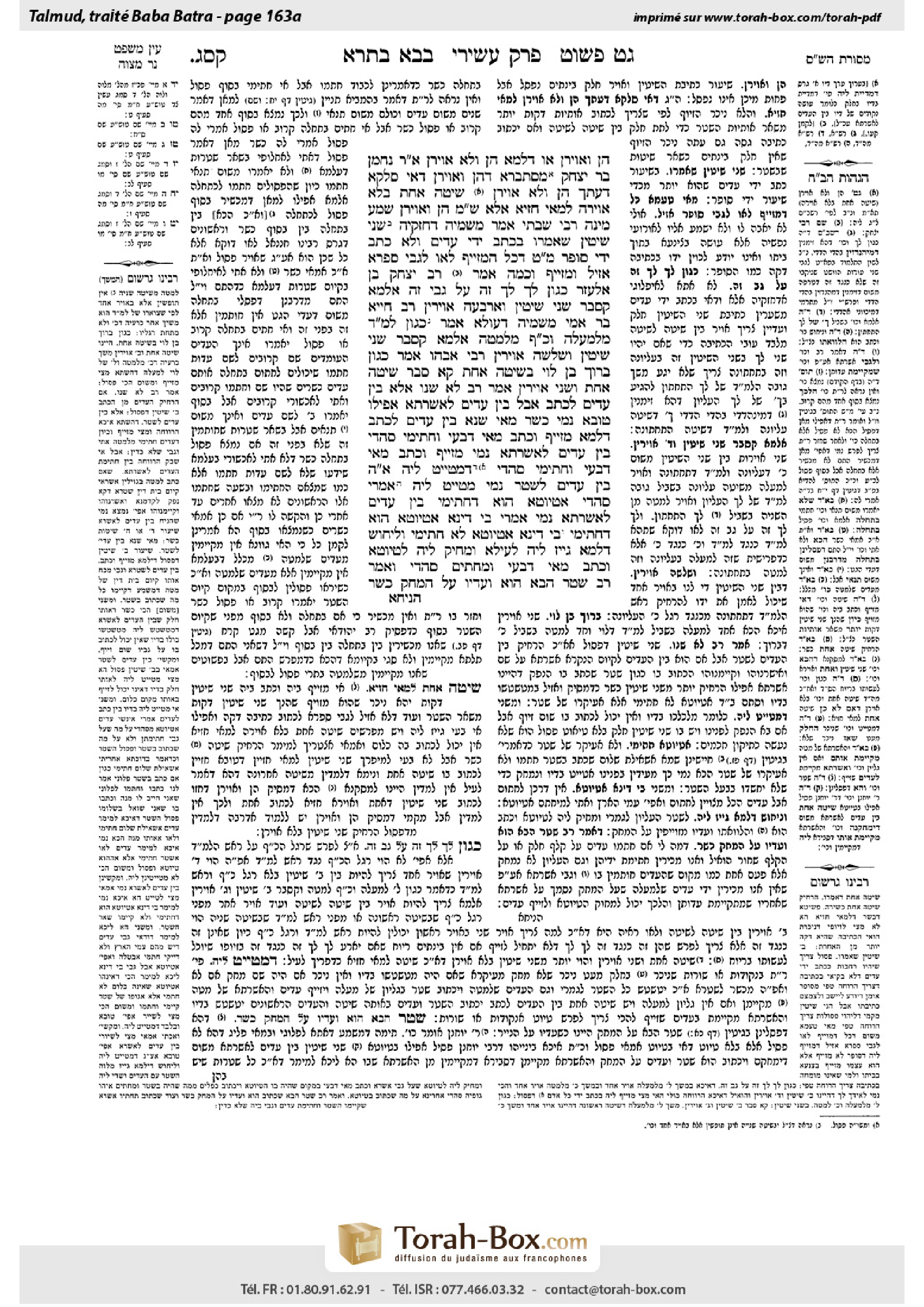
Bava Batra 163a: Talmud study for Daf Yomi
Study the Talmud for Daf Yomi with scanned pages, Hebrew text, English translations from Sefaria and AI-generated French translations.
Passage selection and English or AI-generated French translation are available where the scan has annotations. Daf Study is independent of Torah-Box and Sefaria.
Browse Bava Batra · בבא בתרא · All tractatesBava Batra 163a text and translations
This page of Bava Batra includes the Aramaic text, an English translation and an AI-generated French translation, alongside the scan above.
בבא בתרא קס״ג א · Aramaic and Hebrew text
הֵן וַאֲוִירָן, אוֹ דִלְמָא הֵן וְלֹא אֲוִירָן?
אָמַר רַב נַחְמָן בַּר יִצְחָק: מִסְתַּבְּרָא דְּהֵן וַאֲוִירָן, דְּאִי סָלְקָא דַּעְתָּךְ הֵן וְלֹא אֲוִירָן – שִׁיטָה אַחַת בְּלֹא אֲוִירָהּ, לְמַאי חַזְיָא? אֶלָּא שְׁמַע מִינַּהּ – הֵן וַאֲוִירָן! שְׁמַע מִינַּהּ.
רַבִּי שַׁבְּתַי אָמַר מִשְּׁמֵיהּ דְּחִזְקִיָּה: שְׁנֵי שִׁיטִין שֶׁאָמְרוּ – בִּכְתַב יְדֵי עֵדִים, וְלֹא כְּתַב יְדֵי סוֹפֵר. מַאי טַעְמָא? דְּכׇל הַמְזַיֵּיף, לָאו לְגַבֵּי סָפְרָא אָזֵיל וּמְזַיֵּיף.
וְכַמָּה? אָמַר רַב יִצְחָק בֶּן אֶלְעָזָר: כְּגוֹן ״לְךָ–לְךָ״ זֶה עַל גַּבֵּי זֶה. אַלְמָא קָסָבַר: שְׁנֵי שִׁיטִין, וְאַרְבָּעָה אֲוִירִין.
רַב חִיָּיא בַּר אַמֵּי מִשְּׁמֵיהּ דְּעוּלָּא אָמַר: כְּגוֹן לָמֶד מִלְּמַעְלָה וְכָף מִלְּמַטָּה. אַלְמָא קָסָבַר: שְׁנֵי שִׁיטִין וּשְׁלֹשָׁה אֲוִירִין.
רַבִּי אֲבָהוּ אָמַר: כְּגוֹן: ״בָּרוּךְ בֶּן לֵוִי״ בְּשִׁיטָה אַחַת. קָא סָבַר: שִׁיטָה אַחַת וּשְׁנֵי אֲוִירִין.
אָמַר רַב: לֹא שָׁנוּ אֶלָּא בֵּין עֵדִים לַכְּתָב, אֲבָל בֵּין עֵדִים לָאַשַּׁרְתָּא – אֲפִילּוּ טוּבָא נָמֵי כָּשֵׁר.
מַאי שְׁנָא בֵּין עֵדִים לַכְּתָב – דִּלְמָא מְזַיֵּיף וְכָתֵב מַאי דְּבָעֵי, וַחֲתִימִי סָהֲדִי; בֵּין עֵדִים לָאַשַּׁרְתָּא נָמֵי, מְזַיֵּיף וְכָתֵב מַאי דְּבָעֵי, וַחֲתִימִי סָהֲדִי!
דִּמְטַיֵּיט לֵיהּ. אִי הָכִי, בֵּין עֵדִים לַשְּׁטָר נָמֵי מְטַיֵּיט לֵיהּ!
אָמְרִי: סָהֲדֵי אַטְּיוּטָא הוּא דַּחֲתִימִי. בֵּין עֵדִים לָאַשַּׁרְתָּא נָמֵי, אָמְרִי: בֵּי דִינָא אַטְּיוּטָא הוּא דַּחֲתִימִי! בֵּי דִינָא אַטְּיוּטָא לָא חֲתִימִי.
וְלֵיחוּשׁ דִּלְמָא גָּיֵיז לֵיהּ לְעֵילָּא, וּמָחֵיק לֵיהּ לִטְיוּטָא, וְכָתֵב מַאי דְּבָעֵי, וּמַחְתִּים סָהֲדֵי; וְאָמַר רַב: שְׁטָר הַבָּא הוּא וְעֵדָיו עַל הַמְּחָק – כָּשֵׁר!
Bava Batra 163a · English translation
does this refer to the size of lines with the space between lines added? Or is it perhaps referring to lines of writing themselves, without their spaces?
Rav Naḥman bar Yitzḥak said: It stands to reason that it is referring to the lines with their spaces. As, if it were to enter your mind that it is referring to the lines without their spaces, for what is one line without its space fit? The baraita did not have to state that a document with a single blank line after the text, measured without counting spaces, is not forgeable; this is obvious. Rather, one may conclude from this claim that the reference is to two lines with their spaces. The Gemara affirms: Conclude from this claim that it is so.
Rabbi Shabbtai says in the name of Ḥizkiyya: With regard to the gap of two blank lines between the text and the signatures, which the Sages said invalidates the document, the lines are measured by the handwriting of witnesses, and not by the handwriting of a scribe, who is presumably skilled enough to write in a smaller script. What is the reason for this? Anyone who forges a document, adding additional lines to the document, would not go to a scribe and ask him to forge it; he would execute the forgery himself, or have another unscrupulous person who is not a professional scribe forge it. Therefore, in order to present a concern for possible forgery, a document must have two blank lines that are measured by the handwriting of an ordinary person, such as one of the witnesses.
The Gemara has established that the width of the gap required to invalidate the document is two lines with interlinear space. The Gemara clarifies: And how much interlinear space is necessary to invalidate the document? Rav Yitzḥak ben Elazar says: For example, enough to write the Hebrew word lekha, and then the Hebrew word lekha, this word on top of that one. These two words each consist of the two letters lamed and final khaf; the former has a projection that fully occupies the interlinear space above it, and the latter has a projection that fully occupies the interlinear space below it. Writing these words one under the other, then, would require an additional interlinear space above and below both lines. The Gemara concludes: Apparently, Rav Yitzḥak ben Elazar maintains that the empty space required to invalidate the document is the width of two written lines with four interlinear spaces.
Rav Ḥiyya bar Ami states a different opinion in the name of Ulla: For example, enough to write a lamed on the upper line and a final khaf on the lower line. The Gemara concludes: Apparently, Ulla maintains that the empty space required to invalidate the document is the width of two written lines with three interlinear spaces, one above the first line, one between the two lines, and one beneath the second line.
Rabbi Abbahu states a different opinion: For example, enough to write the name Barukh ben Levi on one line. Barukh contains a final khaf, and Levi contains a lamed. The Gemara concludes: Apparently, Rabbi Abbahu maintains that the empty space required to invalidate the document is the width of one written line with two interlinear spaces, one above the line and one beneath the line.
§ Rav says: They taught in the baraita that a gap of two lines invalidates the document only if that space is between the witnesses’ signatures and the text of the document. But if there is a gap between the witnesses’ signatures and a court’s ratification of the document, which follows the witnesses’ signatures, then even if there is more space than this, the document is valid.
The Gemara asks: What is different about the case where the gap is between the witnesses and the text, that it invalidates the document? There is a concern that perhaps the holder of the document may forge additional lines and write whatever he wants, and the witnesses have already signed at the bottom, giving the appearance that they attest to the added lines as well. But the same concern can be raised concerning a gap between the witnesses’ signatures and the court’s ratification as well: There, too, he can forge additional lines and write whatever he wants, and have witnesses sign it, with the court’s ratification giving the appearance that it attests to the added lines and signatures as well. Why is this document valid?
The Gemara explains: When is a gap between the witnesses’ signatures and the court’s ratification not problematic, according to Rav? Only when someone inks in the blank space with lines or dots, to prevent information from being added there. The Gemara asks: If so, the gap between the witnesses’ signatures and the text of the document should also be made irrelevant in this manner: Let the scribe ink in [metayyet] the blank space. Why, then, was it taught categorically that the witnesses must sign within two lines of the text?
The Gemara answers: Inking in the gap between the text and the signatures of the witnesses will not help, as people might say, i.e., the concern might be raised: The witnesses are signed only on the inking in. It is possible that the witnesses’ signatures were affixed only to attest that the inking was done in their presence and that the inking in is not a sign of duplicity, and their signatures do not relate to the actual text of the document. The Gemara asks: If so, raise the same concern when the gap between the witnesses’ signatures and the court’s ratification is inked in; there too, people might say: The court’s ratification is signed only for the inking in, and not for the actual text of the document. The Gemara answers: A court does not sign on mere inking in; their ratification is always in reference to the entire document.
The Gemara raises another issue: And let there be a concern that perhaps the holder of the document will excise the entire text that appears above the signatures, and then erase the inked-in part and write whatever he wants in that erased area, and have unscrupulous witnesses sign it. And this would be a valid document, as Rav says: A document that comes before the court for ratification in which its content and the signatures of its witnesses are both written over an erasure is valid. The court ratification would then be assumed to be referring to this new, forged document.
Bava Batra 163a · Traduction française (IA)
Est-ce que cela fait référence à la taille des lignes avec l'espace entre les lignes inclus ? Ou est-ce que cela fait référence aux lignes elles-mêmes, sans leurs espaces ?
Rav Naḥman bar Yitzḥak a dit : Il est logique qu'il s'agisse des lignes avec leurs espaces. Car, si l'on pensait qu'il s'agissait des lignes sans leurs espaces, à quoi servirait une ligne sans son espace ? La baraïta n'aurait pas eu besoin de préciser qu'un document avec une seule ligne blanche après le texte, mesuré sans compter les espaces, n'est pas falsifiable ; cela est évident. En revanche, on peut conclure de cette affirmation que la référence est à deux lignes avec leurs espaces. La Guemara confirme : Concluez de cette affirmation qu'il en est ainsi.
Rabbi Shabbatai, en nom de Chizkiyya, dit : En ce qui concerne l'espace de deux lignes vides entre le texte et les signatures, que les Sages ont dit rendre le document invalide, les lignes sont mesurées par la calligraphie des témoins, et non par celle d'un scribe, qui est probablement suffisamment habile pour écrire en un script plus petit. Pourquoi cela ? Tout celui qui falsifie un document, en ajoutant des lignes supplémentaires au document, ne se tournerait pas vers un scribe pour lui demander de le falsifier ; il exécuterait lui-même la falsification, ou il la laisserait faire par une autre personne peu scrupuleuse, qui n'est pas un scribe professionnel. Ainsi, afin de présenter une préoccupation en cas de falsification, un document doit avoir deux lignes vides mesurées par la calligraphie d'une personne ordinaire, telle qu'un des témoins.
La Guemara a établi que la largeur de l'espace requis pour invalider le document est de deux lignes avec deux espaces interlignes. La Guemara précise : Et combien d'espace interligne est nécessaire pour invalider le document ? Rav Yitzḥak ben Elazar dit : Par exemple, assez pour écrire le mot hébreu lekha, et ensuite le mot hébreu lekha, ce mot sur celui-ci. Ces deux mots sont composés des deux lettres lamed et final khaf ; le premier a une projection qui occupe pleinement l'espace interligne au-dessus de lui, et le second a une projection qui occupe pleinement l'espace interligne en dessous de lui. Écrire ces mots l'un sous l'autre, alors, nécessiterait un espace interligne supplémentaire au-dessus et en dessous des deux lignes. La Guemara conclut : Apparemment, Rav Yitzḥak ben Elazar maintient que l'espace vide requis pour invalider le document est la largeur de deux lignes écrites avec quatre espaces interlignes.
Rav Ḥiyya bar Ami énonce un avis différent en nom d'Ulla : Par exemple, assez pour écrire un lamed sur la ligne supérieure et un final khaf sur la ligne inférieure. La Guemara conclut : Apparemment, Ulla maintient que l'espace vide requis pour invalider le document est la largeur de deux lignes écrites avec trois espaces interlignes, un au-dessus de la première ligne, un entre les deux lignes, et un en dessous de la deuxième ligne.
Rabbi Abbahu énonce un avis différent : Par exemple, assez pour écrire le nom Barukh ben Levi sur une seule ligne. Barukh contient un final khaf, et Levi contient un lamed. La Guemara conclut : Apparemment, Rabbi Abbahu maintient que l'espace vide requis pour invalider le document est la largeur d'une seule ligne écrite avec deux espaces interlignes, un au-dessus de la ligne et un en dessous de la ligne.
Rav dit : Ils ont enseigné dans la baraïta que l'espace de deux lignes invalide le document uniquement si cet espace est entre les signatures des témoins et le texte du document. Mais si l'espace est entre les signatures des témoins et la ratification du tribunal du document, qui suit les signatures des témoins, alors même s'il y a plus d'espace que cela, le document est valide.
La Guemara pose la question : Qu'est-ce qui diffère dans le cas où l'espace est entre les signatures des témoins et le texte, ce qui invalide le document ? Il y a une préoccupation que peut-être le détenteur du document puisse falsifier des lignes supplémentaires et écrire ce qu'il veut, et les témoins ayant déjà signé en bas, donnant l'illusion qu'ils attestent également des lignes ajoutées. Mais la même préoccupation pourrait être soulevée concernant un espace entre les signatures des témoins et la ratification du tribunal : là aussi, il pourrait falsifier des lignes supplémentaires et écrire ce qu'il veut, et avoir des témoins signer, avec la ratification du tribunal donnant l'illusion qu'elle atteste également des lignes et signatures ajoutés. Pourquoi ce document est-il valide ?
La Guemara explique : Dans quel cas un espace entre les signatures des témoins et la ratification du tribunal n'est pas problématique, selon Rav ? Seulement lorsque quelqu'un trace dans l'espace vide des lignes ou des points, pour empêcher l'ajout d'informations là. La Guemara pose la question : Si c'est ainsi, l'espace entre les signatures des témoins et le texte du document devrait aussi être rendu inutile de cette manière : faites inscrire le vide par un scribe. Pourquoi, alors, a-t-il été enseigné de manière catégorique que les témoins doivent signer à deux lignes du texte ?
La Guemara répond : Inscrire dans l'espace entre le texte et les signatures des témoins n'aidera pas, car les gens pourraient dire, c'est-à-dire la préoccupation pourrait être soulevée : les témoins sont signés uniquement sur l'inscription. Il est possible que leurs signatures aient été apposées uniquement pour attester que l'inscription a été faite en leur présence et que l'inscription n'est pas un signe de duplicité, et leurs signatures ne concernent pas le texte réel du document. La Guemara pose la question : Si c'est ainsi, soulevez la même préoccupation lorsque l'espace entre les signatures des témoins et la ratification du tribunal est inscrit ; là aussi, les gens pourraient dire : la ratification du tribunal est signée uniquement pour l'inscription, et non pour le texte réel du document. La Guemara répond : un tribunal ne signe pas pour une simple inscription ; sa ratification est toujours en référence au document entier.
La Guemara soulève une autre question : Et peut-être qu'il y a une crainte que le détenteur du document efface tout le texte qui figure au-dessus des signatures, puis efface la partie encre et écrive ce qu'il veut dans cette zone effacée, et que des témoins peu scrupuleux y signent. Et ce serait un document valide, car Rav dit : Un document qui vient devant le tribunal pour être validé, dont le contenu et les signatures des témoins sont tous deux écrits sur une effacement, est valide. La validation du tribunal serait alors considérée comme se référant à ce nouveau document falsifié.
Traduction française générée par IA à partir de l’édition anglaise de Sefaria. Vérifie toujours un passage avec le texte source.
Text from Sefaria: William Davidson Edition - Vocalized Aramaic (CC BY NC); William Davidson Edition - English (CC BY NC).