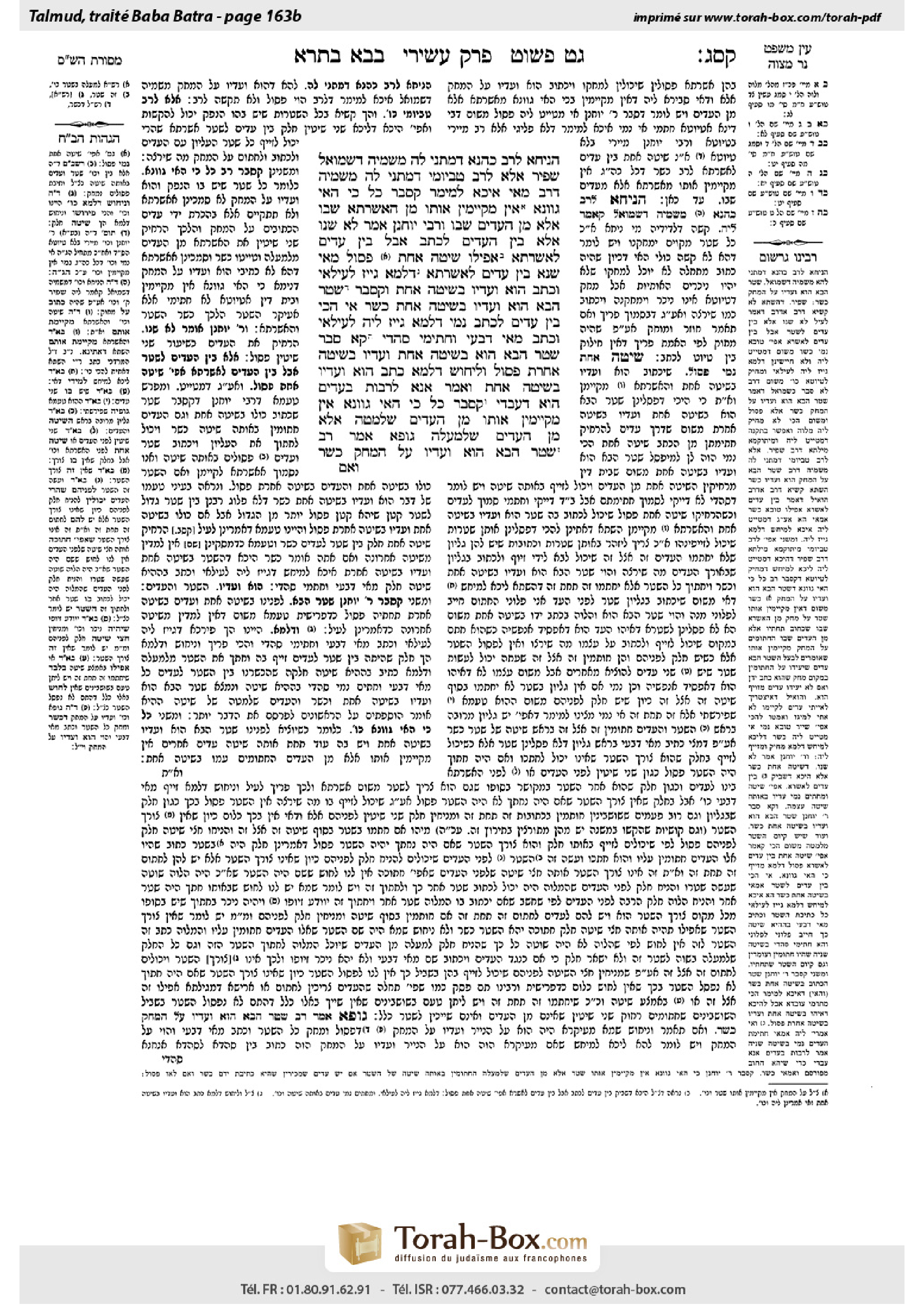
Bava Batra 163b: Talmud study for Daf Yomi
Study the Talmud for Daf Yomi with scanned pages, Hebrew text, English translations from Sefaria and AI-generated French translations.
Passage selection and English or AI-generated French translation are available where the scan has annotations. Daf Study is independent of Torah-Box and Sefaria.
Browse Bava Batra · בבא בתרא · All tractatesBava Batra 163b text and translations
This page of Bava Batra includes the Aramaic text, an English translation and an AI-generated French translation, alongside the scan above.
בבא בתרא קס״ג ב · Aramaic and Hebrew text
הָנִיחָא לְרַב כָּהֲנָא – דְּמַתְנֵי לַהּ מִשְּׁמֵיהּ דִּשְׁמוּאֵל, שַׁפִּיר; אֶלָּא לְרַב טָבְיוֹמֵי – דְּמַתְנֵי לַהּ מִשְּׁמֵיהּ דְּרַב, מַאי אִיכָּא לְמֵימַר?
קָסָבַר: כׇּל כִּי הַאי גַוְונָא, אֵין מְקַיְּימִין אוֹתוֹ מִן הָאַשַּׁרְתָּא שֶׁבּוֹ, אֶלָּא מִן הָעֵדִים שֶׁבּוֹ.
וְרַבִּי יוֹחָנָן אָמַר: לֹא שָׁנוּ אֶלָּא בֵּין הָעֵדִים לַכְּתָב, אֲבָל בֵּין עֵדִים לָאַשַּׁרְתָּא – אֲפִילּוּ שִׁיטָה אַחַת פָּסוּל.
מַאי שְׁנָא בֵּין עֵדִים לָאַשַּׁרְתָּא – דִּלְמָא גָּיֵיז לְעִילַּאי, וְכָתֵב הוּא וְעֵדָיו בְּשִׁיטָה אַחַת, וְקָסָבַר: שְׁטָר הַבָּא הוּא וְעֵדָיו בְּשִׁיטָה אַחַת – כָּשֵׁר;
אִי הָכִי, בֵּין עֵדִים לַכְּתָב נָמֵי – דִּלְמָא גָּיֵיז לֵיהּ לְעִילַּאי, וְכָתֵב מַאי דְּבָעֵי, וַחֲתִימִי סָהֲדֵי! קָא סָבַר: שְׁטָר הַבָּא הוּא בְּשִׁיטָה אַחַת, וְעֵדָיו בְּשִׁיטָה אַחֶרֶת – פָּסוּל.
וְלֵיחוּשׁ דִּלְמָא כָּתֵב הוּא וְעֵדָיו בְּשִׁיטָה אַחַת, וְאָמַר: אֲנָא לְרַבּוֹת בְּעֵדִים הוּא דַּעֲבַדִי!
קָסָבַר: כֹּל כִּי הַאי גַוְונָא – אֵין מְקַיְּימִין אוֹתוֹ מִן הָעֵדִים שֶׁלְּמַטָּה, אֶלָּא מִן הָעֵדִים שֶׁלְּמַעְלָה.
גּוּפָא – אָמַר רַב: שְׁטָר הַבָּא הוּא וְעֵדָיו עַל הַמְּחָק – כָּשֵׁר.
Bava Batra 163b · English translation
This works out well, i.e., this concern does not apply, according to Rav Kahana, who teaches in the name of Shmuel that a document in which its content and its witnesses’ signatures are both written over an erasure is valid; according to him, all is well. It is Rav who says that an inked-in gap between the witnesses’ signatures and the court’s ratification is acceptable, and it is Shmuel who says that a document that is written and signed over an erasure is acceptable. But according to Rav Tavyumei, who teaches this latter statement in the name of Rav, what can be said? According to him, Rav said both statements, and taken together they pose a difficulty: The inked-in gap between the witnesses’ signatures and the ratification can easily be erased and a new document with signatures can be written over the erasure.
The Gemara answers: Rav maintains that in all cases like this, where a document and its witnesses’ signatures are written over an erasure and there is a court ratification on a non-erased part of the paper, the later court ratifies the document not on the basis of the previous court’s ratification that is on it, but only on the basis of the signatures of the witnesses that are on it. Therefore, the forging of a document in this manner is impossible, as the prior ratification of the court is disregarded, and the witnesses will attest to what they signed upon.
The Gemara cites another opinion: And Rabbi Yoḥanan says: They taught in the baraita that a gap of one line does not invalidate the document only in the case where that space is between the witnesses’ signatures and the text of the document. But if the gap is between the witnesses’ signatures and a court’s ratification of the document, then a space of even one line renders the document not valid.
The Gemara asks: What is different about the case where there is a one-line gap between the witnesses’ signatures and the court’s ratification that you say it is not valid? The Gemara answers: There is a concern that perhaps the holder of the document will excise the entire text of the document at the top of the paper and then write a new, brief document, with its text and the signatures of its witnesses on one line. The court’s ratification will appear to verify the new, forged document. And Rabbi Yoḥanan holds that a document that comes before the court with its text and the signatures of its witnesses appearing on one line is valid.
The Gemara suggests: If so, the same problem also exists when there is a one-line gap between the witnesses’ signatures and the text: There should be a concern that perhaps he will excise the entire text of the document at the top of the paper and then write whatever he wants in a brief, one-line document. And the witnesses’ signatures on the next line, which are there from the old document, will still be signed there, appearing to attest to the veracity of the new, one-line document. The Gemara answers: Rabbi Yoḥanan holds that a document that comes before the court with its text on one line and the signatures of its witnesses appearing on another line, i.e., on the following line, is not valid.
The Gemara suggests: And let there be a concern that perhaps the holder of the document will excise the entire document, leaving only the blank line and the signatures that follow it, and he will write a brief document in which its text and the signatures of its witnesses are on one line, followed by the original signatures that remained from the original document, and he will say: I did this in order to increase the number of witnesses, the more to publicize the matter written in the document. The document is therefore still forgeable.
The Gemara answers: Rabbi Yoḥanan maintains that in all cases like this, where a document and its witnesses’ signatures are written on one line, followed by other signatures on subsequent lines, the court ratifies the document not on the basis of the signatures of the witnesses that are on the bottom, but on the basis of the signatures of the witnesses that are on top, on the same line as the text. Therefore, the forging of a document in this manner is impossible. The false signatures of the witnesses will be discovered when those witnesses attest to what they signed upon.
§ Having cited Rav’s statement, the Gemara discusses the matter itself. Rav says: A document that comes before the court in which its content and the signatures of its witnesses are both written over an erasure is valid.
Bava Batra 163b · Traduction française (IA)
Cela fonctionne bien, c'est-à-dire cette préoccupation ne s'applique pas, selon Rav Kahana, qui enseigne au nom de Shmuel que tout document dans lequel son contenu et les signatures des témoins sont tous deux écrits sur une effacement est valide ; selon lui, tout va bien. C'est Rav qui dit qu'un espace entre les signatures des témoins et la ratification du tribunal est acceptable, et c'est Shmuel qui dit qu'un document écrit et signé sur une effacement est acceptable. Mais selon Rav Tavyumei, qui enseigne cette dernière déclaration au nom de Rav, que peut-on dire ? Selon lui, Rav a dit les deux déclarations, et ensemble elles posent un problème : l'espace entre les signatures des témoins et la ratification du tribunal peut facilement être effacé et un nouveau document avec des signatures peut être écrit sur l'effacement.
La Guemara répond : Rav maintient que dans tous les cas semblables, où un document et les signatures des témoins sont écrits sur une effacement et où il y a une ratification du tribunal sur une partie non effacée du papier, le tribunal ultérieur ratifie le document non sur la base de la ratification précédente du tribunal qui est sur le document, mais uniquement sur la base des signatures des témoins qui sont sur le document. Ainsi, la falsification d'un document de cette manière est impossible, car la ratification précédente du tribunal est ignorée, et les témoins attesteront de ce qu'ils ont signé.
La Guemara cite un autre avis : Et Rabbi Yoḥanan dit : Ils ont enseigné dans la baraïta que l'espace d'une ligne ne rend pas invalide le document que dans le cas où cet espace est entre les signatures des témoins et le texte du document. Mais si l'espace est entre les signatures des témoins et la ratification du tribunal du document, alors un espace même d'une ligne rend le document invalide.
La Guemara pose la question : Qu'est-ce qui diffère dans le cas où il y a un espace d'une ligne entre les signatures des témoins et la ratification du tribunal que vous dites qu'il est invalide ? La Guemara répond : Il y a une préoccupation que peut-être le détenteur du document exciserait tout le texte du document en haut du papier et écrirait un nouveau document bref, avec son texte et les signatures de ses témoins sur une ligne. La ratification du tribunal apparaîtrait comme vérifiant le nouveau document falsifié. Et Rabbi Yoḥanan maintient qu'un document qui vient devant le tribunal avec son texte et les signatures de ses témoins apparaissant sur une ligne est valide.
La Guemara suggère : Si tel est le cas, le même problème existe également lorsque l'espace est d'une ligne entre les signatures des témoins et le texte : il devrait y avoir une préoccupation que peut-être il excisera tout le texte du document en haut du papier et écrira ce qu'il veut dans un document bref, sur une ligne. Et les signatures des témoins sur la ligne suivante, qui sont restées du document d'origine, apparaîtront comme attestant de la véracité du nouveau document bref. La Guemara répond : Rabbi Yoḥanan maintient qu'un document qui vient devant le tribunal avec son texte sur une ligne et les signatures des témoins sur une autre ligne, c'est-à-dire sur la ligne suivante, n'est pas valide.
La Guemara suggère : Et il y a une préoccupation que peut-être le détenteur du document excisera tout le document, laissant seulement la ligne vide et les signatures qui suivent, et il écrira un document bref dans lequel son texte et les signatures des témoins sont sur une ligne, suivis des signatures originales restantes du document d'origine, et il dira : J'ai fait cela afin d'augmenter le nombre de témoins, afin de publier davantage la chose écrite dans le document. Le document est donc toujours falsifiable.
La Guemara répond : Rabbi Yoḥanan affirme que dans tous les cas semblables, où un document et les signatures des témoins sont écrits sur une seule ligne, suivis d'autres signatures sur des lignes suivantes, le tribunal valide le document non sur la base des signatures des témoins qui sont en bas, mais sur la base des signatures des témoins qui sont en haut, sur la même ligne que le texte. Ainsi, la falsification d'un document de cette manière est impossible. Les signatures fausses des témoins seront découvertes lorsque ces témoins attesteront de ce qu'ils ont signé.
§ Ayant cité l'affirmation de Rav, la Guemara discute la question elle-même. Rav dit : Un document qui est présenté devant le tribunal, dans lequel son contenu et les signatures des témoins sont tous deux écrits sur une effacement, est valide.
Traduction française générée par IA à partir de l’édition anglaise de Sefaria. Vérifie toujours un passage avec le texte source.
Text from Sefaria: William Davidson Edition - Vocalized Aramaic (CC BY NC); William Davidson Edition - English (CC BY NC).