Bava Batra 164a: Talmud study for Daf Yomi
Study the Talmud for Daf Yomi with scanned pages, Hebrew text, English translations from Sefaria and AI-generated French translations.
Passage selection and English or AI-generated French translation are available where the scan has annotations. Daf Study is independent of Torah-Box and Sefaria.
Browse Bava Batra · בבא בתרא · All tractatesBava Batra 164a text and translations
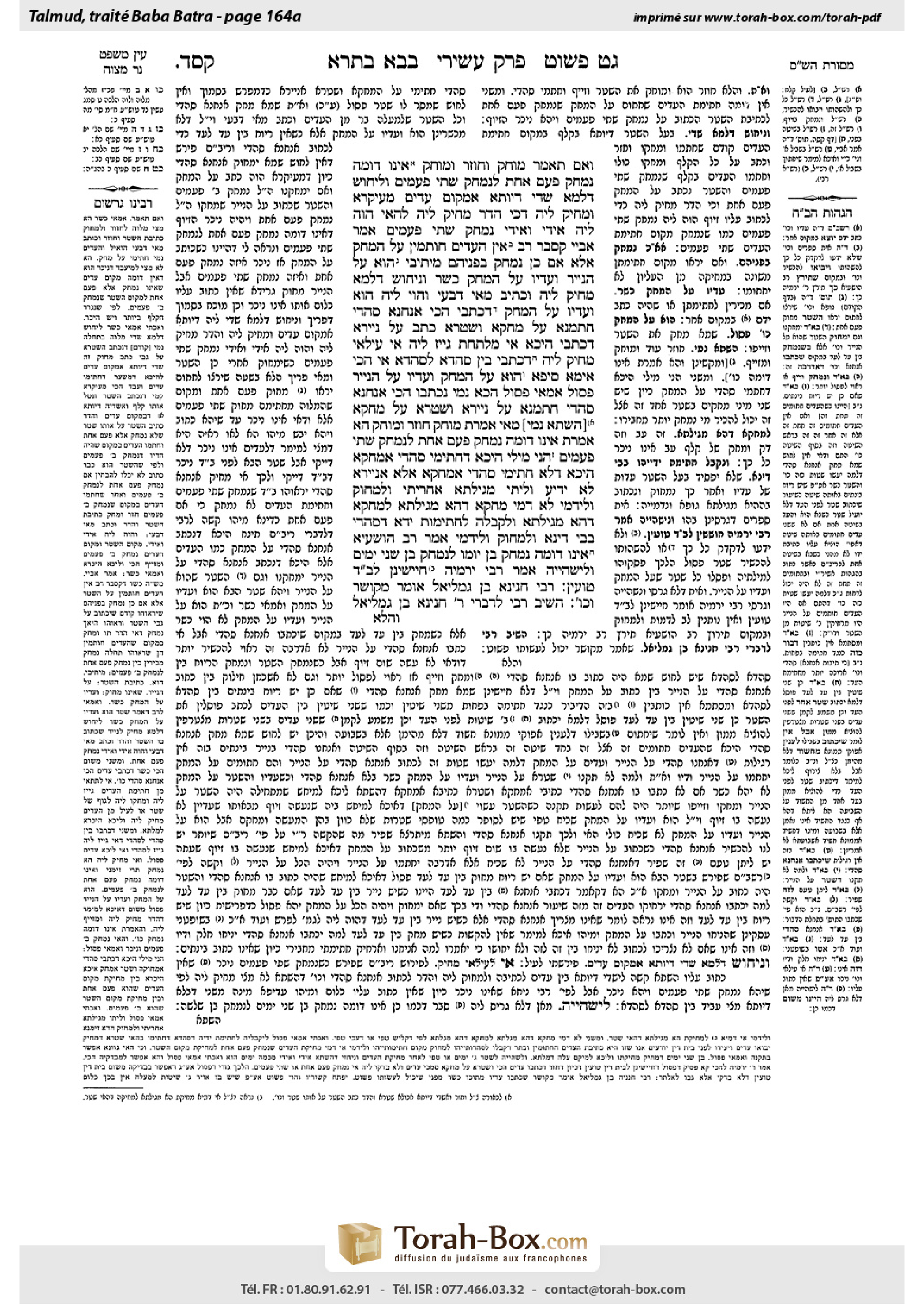
This page of Bava Batra includes the Aramaic text, an English translation and an AI-generated French translation, alongside the scan above.
בבא בתרא קס״ד א · Aramaic and Hebrew text
וְאִם תֹּאמַר: מוֹחֵק וְחוֹזֵר וּמוֹחֵק! אֵינוֹ דּוֹמֶה נִמְחַק פַּעַם אַחַת, לְנִמְחַק שְׁתֵּי פְעָמִים.
וְלֵיחוּשׁ דִּלְמָא שָׁדֵי דְּיוֹתָא אַמְּקוֹם עֵדִים מֵעִיקָּרָא, וּמָחֵיק לֵיהּ – דְּכִי הָדַר מָחֵיק לֵיהּ לְהַאי, הָוֵה לֵיהּ אִידֵּי וְאִידֵּי נִמְחַק שְׁתֵּי פְעָמִים!
אָמַר אַבָּיֵי, קָסָבַר רַב: אֵין הָעֵדִים חוֹתְמִין עַל הַמְּחָק, אֶלָּא אִם כֵּן נִמְחַק בִּפְנֵיהֶם.
מֵיתִיבִי: הוּא עַל הַנְּיָיר וְעֵדָיו עַל הַמְּחָק – כָּשֵׁר. וְנֵיחוּשׁ דִּלְמָא מָחֵיק לֵיהּ, וְכָתֵיב מַאי דְּבָעֵי, וְהָוֵי לֵיהּ הוּא וְעֵדָיו עַל הַמְּחָק!
דְּכָתְבִי הָכִי: ״אֲנַחְנָא סָהֲדֵי – חֲתַמְנָא עַל מְחָקָא, וּשְׁטָרָא – כְּתִב עַל נְיָירָא״.
דְּכָתְבִי הֵיכָא? אִי מִלְּתַחַת – גָּיֵיז לֵיהּ; אִי עִילַּאי – מָחֵיק לֵיהּ! דְּכָתְבִי בֵּין סָהֲדָא לְסָהֲדָא.
אִי הָכִי, אֵימָא סֵיפָא: הוּא עַל הַמְּחָק, וְעֵדָיו עַל הַנְּיָיר – פָּסוּל. אַמַּאי פָּסוּל? הָכָא נָמֵי, נִכְתְּבוּ הָכִי: ״אֲנַחְנָא סָהֲדֵי – חֲתַמְנָא עַל נְיָירָא, וּשְׁטָרָא – עַל מְחָקָא״!
[הַשְׁתָּא נָמֵי] מַאי אָמְרַתְּ – מוֹחֵק חוֹזֵר וּמוֹחֵק? הָא אָמְרַתְּ: אֵינוֹ דּוֹמֶה נִמְחַק פַּעַם אַחַת, לְנִמְחַק שְׁתֵּי פְעָמִים! הָנֵי מִילֵּי – הֵיכָא דַּחֲתִימִי סָהֲדֵי אַמְּחָקָא; הֵיכָא דְּלָא חֲתִימִי סָהֲדֵי אַמְּחָקָא אֶלָּא אַנְּיָירָא – לָא יְדִיעַ.
וְלַיְתֵי מְגִילְּתָא אַחֲרִיתִי, וְלִמְחוֹק וְלִידַמֵּי! לָא דָּמֵי מְחָקָא דְּהָא מְגִילְּתָא, לִמְחָקָא דְּהָא מְגִילְּתָא.
וּלְקַבְּלַהּ לַחֲתִימוּת יְדָא דְּסָהֲדִי בְּבֵי דִינָא, וְלִמְחוֹק וְלִידַמֵּי! אָמַר רַב הוֹשַׁעְיָא: אֵינוֹ דּוֹמֶה נִמְחַק בֶּן יוֹמוֹ, לְנִמְחַק בֶּן שְׁנֵי יָמִים.
וְלִישַׁהֲיֵיהּ! אָמַר רַבִּי יִרְמְיָה: חָיְישִׁינַן לְבֵית דִּין טוֹעִין.
רַבִּי חֲנִינָא בֶּן גַּמְלִיאֵל אוֹמֵר: מְקוּשָּׁר וְכוּ׳. הֵשִׁיב רַבִּי לְדִבְרֵי רַבִּי חֲנִינָא בֶּן גַּמְלִיאֵל:
Bava Batra 164a · English translation
And if you say: There is a possibility of forgery with such a document, as the holder of the document can erase the original writing on the paper, then write the text of the document and have witnesses sign on the part that had been erased, then erase the document text once again, substituting for it a text that is more to his advantage, leaving the original signatures in place, this is not a valid argument. Paper that has been erased once is not similar in appearance to paper that has been erased twice. It will be seen that the signatures are on a place that had been erased once and that the text is written on a place that had been erased twice, and the forgery will be noticed.
The Gemara suggests: But let there be a concern that perhaps the holder of the document will initially, after the entire original document, including the signatures, has been erased, but before the second one is written, throw some ink on the place where the witnesses are to sign under the text of the second document, and then erase that ink. He will do this so that when, after the witnesses have signed, he then erases the document text and writes a false text, it will emerge that both this, the new document’s text, and that, the signatures, will be on paper that had been erased twice.
Abaye said in response: Rav holds that witnesses may not sign a document written over an erasure unless the paper was erased in their presence, i.e., unless they saw the paper after its old text had been erased, before the new text was written. They will then see that the place where they are to sign has been erased twice, while the place where the document is to be written has been erased only once. They will realize that this leaves open an opportunity of subsequent erasing and falsification, and they will refrain from signing.
The Gemara raises an objection to the opinion of Rav from a baraita: A document in which its text is on a part of the paper that has never had writing erased and the signatures of its witnesses are on an erasure is valid. The Gemara suggests: But let us be concerned that perhaps the holder of the document will erase the text and write in its place whatever he wants, and it will then be a document where both its text and the signatures of its witnesses are on an erasure. Since Rav maintains that such a document is valid, it is easily forgeable in this manner.
The Gemara answers: Such a document is valid only in a case where the witnesses write this: We, the witnesses, signed on an erasure, but the document text was written on a part of the paper that never had writing erased. If the holder of the document then tries to erase the original text and write new text in its place, the forgery will be noticed.
The Gemara asks: Where do the witnesses write this declaration? If they write it underneath their signatures, the holder of the document can simply excise it. And if they write it above their signatures, the holder of the document can erase it along with the text of the document. The Gemara answers: They write the declaration between the signature of one witness and the signature of the other witness.
The Gemara asks: If that is so, that the baraita is discussing a case in which the witnesses write a declaration about the circumstances of the document’s condition, say the latter clause of the baraita: A document in which its text is on an erasure and the signatures of its witnesses are on a part of the paper that never had writing erased is not valid. The Gemara presents its question: Why is such a document not valid? Here, too, let the witnesses write this: We, the witnesses, signed on paper that never had writing erased, but the document text was written on an erasure.
Now in this case as well it should be valid, as what can you say to argue that it is a forgeable document? If you say that the holder of the document, having erased the original document, can erase the writing once again and write a new, false document, this is not a concern, as didn’t you say that paper that has been erased once is not similar in appearance to paper that has been erased twice? It would therefore be noticeable that the document had been erased a second time, and the forgery would be noticeable. The Gemara answers: That statement applies only when the witnesses are signed on an erasure, and the appearance of that erasure can be compared with the appearance of a double erasure. But in a case where the witnesses are signed not on an erasure but on paper that has not had its writing erased, so that there is no contrast between a single erasure and a double erasure, the forgery would not be known.
The Gemara suggests: But let the court bring another parchment, write something on it and erase it, and then compare this single erasure with the erasure on the document in question. If the document were erased twice, a contrast would be seen between a single erasure and a double erasure. The Gemara answers: The erasure of this parchment is not necessarily similar to the erasure of that parchment. A single erasure on one parchment might resemble a double erasure on a different parchment.
The Gemara continues to suggest: But let us accept, i.e., verify, the signatures of the witnesses on the document in court, after which they may safely be erased; and then erase the signatures and compare that erasure to the erasure of the document text, to see if it was erased once or twice. In response to this question Rav Hoshaya says: That which is erased on the same day that it was written is not necessarily similar to that which was erased two days ago, i.e., more than a day after it was written. An older erasure looks different from a new one, so the comparison might not show that there was a double erasure in the document.
The Gemara suggests: But let us retain the document for an extra day, at which point both erasures will be old and can be compared. Rabbi Yirmeya said in response: We are concerned for the possibility of an erring court. If such complicated procedures were used in order to declare a document valid, there would be a chance that a particular court would not apply them properly, and that court would end up ratifying a document that was not valid.
§ The mishna teaches that Rabbi Ḥanina ben Gamliel says: A tied document whose witnesses wrote their signatures inside of it is valid, because one can transform it into an ordinary document by untying it. Rabbi Yehuda HaNasi raised an objection to the statement of Rabbi Ḥanina ben Gamliel:
Bava Batra 164a · Traduction française (IA)
Et si l'on dit : Il y a une possibilité de contrefaçon avec un tel document, car le détenteur du document peut effacer l'écriture originale sur le papier, alors écrivez le texte du document et faites signer les témoins sur la partie qui avait été effacée, puis effacez à nouveau le texte du document, en le substituant à un texte plus avantageux pour lui, tout en laissant les signatures originales en place, cela n'est pas un argument valide. Le papier qui a été effacé une fois n'est pas semblable en apparence à celui qui a été effacé deux fois. On verra que les signatures sont sur une partie qui avait été effacée une fois et que le texte est écrit sur une partie qui avait été effacée deux fois, et la contrefaçon sera détectée.
La Guemara suggère : Mais supposons qu'il y ait une crainte que le détenteur du document, après avoir effacé l'ensemble du document original, y compris les signatures, mais avant d'écrire le second, verse de l'encre sur la place où les témoins doivent signer sous le texte du second document, puis efface cette encre. Il le fera ainsi que, lorsqu'après que les témoins ont signé, il efface à nouveau le texte du document et écrit un texte faux, il apparaîtra que à la fois ce nouveau texte du document et les signatures sont sur un papier qui avait été effacé deux fois.
Abaye répondit en ce sens : Rav considère que les témoins ne peuvent pas signer un document écrit sur une effacement, sauf si le papier avait été effacé devant eux, c'est-à-dire s'ils ont vu le papier après que son texte ancien avait été effacé, avant d'écrire le nouveau texte. Ils verront alors que la place où ils doivent signer a été effacée deux fois, tandis que la place où le document doit être écrit a été effacée une seule fois. Ils comprendront que cela laisse une possibilité d'effacement ultérieur et de contrefaçon, et ils refuseront de signer.
La Guemara soulève une objection contre l'opinion de Rav à partir d'une baraïta : Un document dont le texte est sur une partie du papier qui n'a jamais eu d'écriture effacée et les signatures des témoins sont sur une effacement est valide. La Guemara suggère : Mais supposons qu'il y ait une crainte que le détenteur du document efface le texte et écrive ce qu'il veut à sa place, et il deviendra alors un document où à la fois son texte et les signatures des témoins sont sur une effacement. Puisque Rav considère que tel document est valide, il est facilement contrefaisable ainsi.
La Guemara répond : Ce document est valide uniquement dans un cas où les témoins écrivent cela : Nous, les témoins, avons signé sur une effacement, mais le texte du document a été écrit sur une partie du papier qui n'a jamais eu d'écriture effacée. Si le détenteur du document tente alors d'effacer le texte original et d'écrire un nouveau texte à sa place, la contrefaçon sera détectée.
La Guemara pose une question : Où les témoins écrivent-ils cette déclaration ? Si ils l'écrivent sous leurs signatures, le détenteur du document peut simplement la supprimer. Et si ils l'écrivent au-dessus de leurs signatures, le détenteur du document peut l'effacer avec le texte du document. La Guemara répond : Ils écrivent la déclaration entre la signature d'un témoin et la signature de l'autre.
La Guemara pose la question : Si c'est ainsi, que la baraïta discute d'un cas où les témoins écrivent une déclaration sur les circonstances du document, disons la dernière clause de la baraïta : Un document dont le texte est écrit sur une effacement et les signatures des témoins sont sur une partie du papier qui n'a jamais eu d'écriture effacée n'est pas valide. La Guemara formule sa question : Pourquoi un tel document n'est-il pas valide ? Ici aussi, les témoins pourraient écrire cela : Nous, les témoins, avons signé sur un papier qui n'a jamais eu d'écriture effacée, mais le texte du document a été écrit sur une effacement.
Dans ce cas-ci également, il devrait être valide, car que pouvez-vous dire pour argumenter que ce document est facilement contrefaisable ? Si l'on dit que le détenteur du document, ayant effacé le document original, peut effacer à nouveau l'écriture et écrire un nouveau document faux, cela n'est pas une préoccupation, car n'avez-vous pas dit que le papier qui a été effacé une fois n'est pas semblable en apparence à celui qui a été effacé deux fois ? Il en résulterait donc que la contrefaçon serait détectée. La Guemara répond : Cette déclaration s'applique uniquement lorsque les témoins sont signés sur une effacement, et l'apparence de cette effacement peut être comparée à celle d'une effacement double. Mais dans un cas où les témoins sont signés non pas sur une effacement mais sur un papier qui n'a pas eu son écriture effacée, de sorte qu'il n'y a pas de contraste entre une effacement unique et une effacement double, la contrefaçon ne serait pas détectée.
La Guemara suggère : Mais la cour doit apporter un autre parchemin, écrire quelque chose dessus et l'effacer, puis comparer cette effacement unique à celui du document en question. Si le document avait été effacé deux fois, on aurait pu constater un contraste entre un effacement unique et un effacement double. La Guemara répond : L'effacement de ce parchemin n'est pas nécessairement semblable à celui du document en question. Un effacement unique sur un parchemin peut ressembler à un effacement double sur un autre parchemin.
La Guemara continue à suggérer : Mais acceptons, c'est-à-dire vérifions, les signatures des témoins sur le document en cour, après quoi elles peuvent être sûrement effacées ; puis effacez les signatures et comparez cette effacement à celle du texte du document, pour voir si elle a été effacée une ou deux fois. En réponse à cette question, Rav Hoshaya dit : Ce qui est effacé le même jour qu'il a été écrit n'est pas nécessairement semblable à ce qui a été effacé deux jours plus tôt, c'est-à-dire plus d'un jour après avoir été écrit. Une effacement plus ancienne a une apparence différente d'une effacement plus récente, donc la comparaison pourrait ne pas montrer qu'il y avait un effacement double dans le document.
La Guemara suggère : Mais conservons le document pour une journée supplémentaire, à ce moment-là les deux effacements seront anciens et pourront être comparés. Rabbi Yirmeya répondit : Nous craignons la possibilité d’un tribunal errant. Si de telles procédures complexes avaient été utilisées pour déclarer un document valide, il y aurait une chance qu’un tribunal particulier ne les applique pas correctement, et ce tribunal aurait fini par valider un document invalide.
§ La mitsva enseigne que Rabbi Ḥanina ben Gamliel dit : Un document lié dont les témoins ont écrit leurs signatures à l’intérieur est valide, car on peut le transformer en un document ordinaire en le dénouant. Rabbi Yehuda HaNasi a opposé un argument à la déclaration de Rabbi Ḥanina ben Gamliel :
Traduction française générée par IA à partir de l’édition anglaise de Sefaria. Vérifie toujours un passage avec le texte source.
Text from Sefaria: William Davidson Edition - Vocalized Aramaic (CC BY NC); William Davidson Edition - English (CC BY NC).