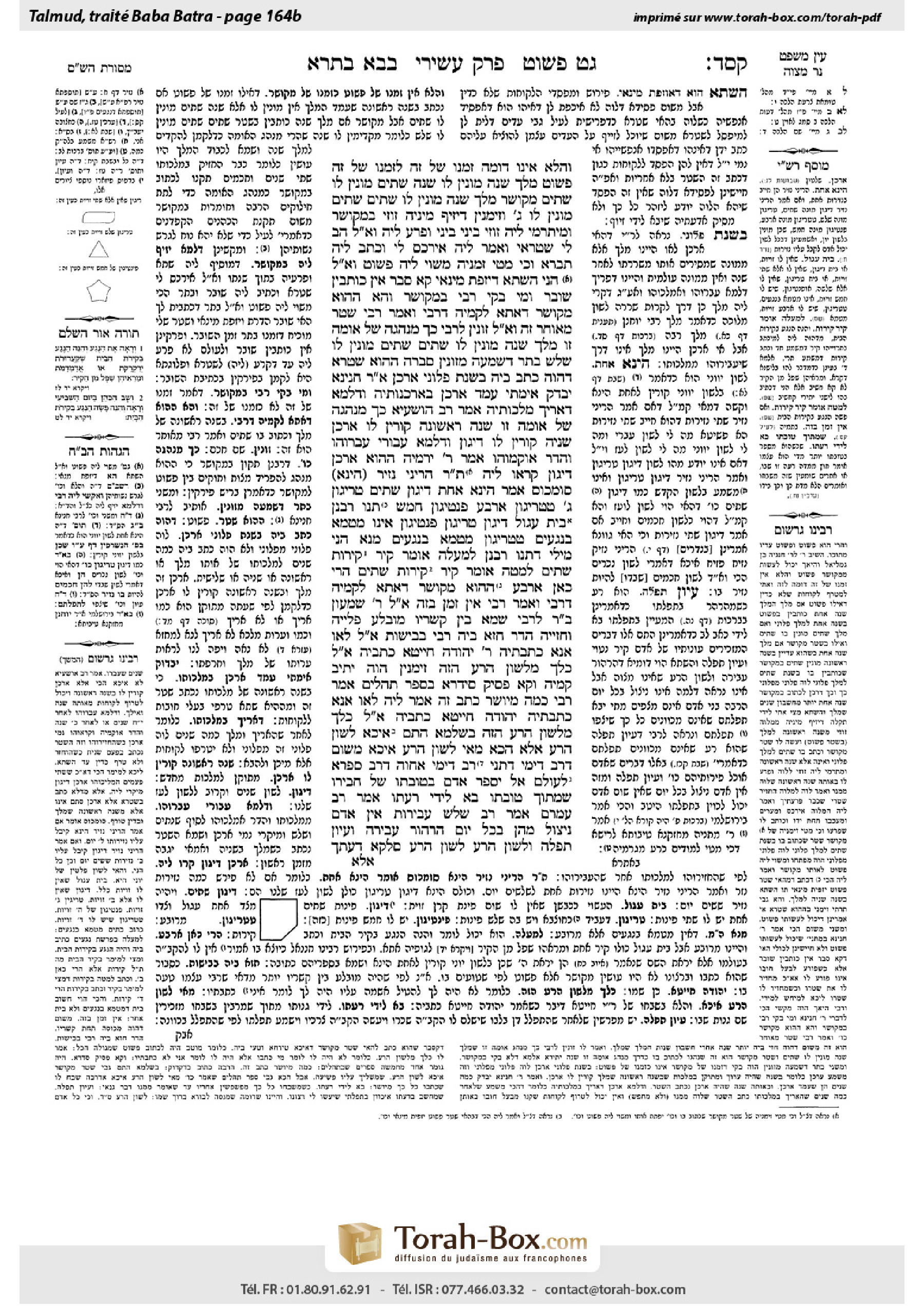
Bava Batra 164b: Talmud study for Daf Yomi
Study the Talmud for Daf Yomi with scanned pages, Hebrew text, English translations from Sefaria and AI-generated French translations.
Passage selection and English or AI-generated French translation are available where the scan has annotations. Daf Study is independent of Torah-Box and Sefaria.
Browse Bava Batra · בבא בתרא · All tractatesBava Batra 164b text and translations
This page of Bava Batra includes the Aramaic text, an English translation and an AI-generated French translation, alongside the scan above.
בבא בתרא קס״ד ב · Aramaic and Hebrew text
וַהֲלֹא אֵינוֹ דּוֹמֶה זְמַנּוֹ שֶׁל זֶה לִזְמַנּוֹ שֶׁל זֶה! פָּשׁוּט; מָלַךְ שָׁנָה – מוֹנִין לוֹ שָׁנָה, שְׁתַּיִם – מוֹנִין לוֹ שְׁתַּיִם. מְקוּשָּׁר; מָלַךְ שָׁנָה – מוֹנִין לוֹ שְׁתַּיִם, שְׁתַּיִם – מוֹנִין לוֹ שָׁלֹשׁ.
וְזִימְנִין דְּיָזֵיף מִינֵּיהּ זוּזֵי בִּמְקוּשָּׁר, וּמִיתְרְמֵי לֵיהּ זוּזֵי בֵּינֵי בֵּינֵי וּפָרַע לֵיהּ; וְאָמַר לֵיהּ: הַב לִי שְׁטָרַאי, וְאָמַר לֵיהּ: אִירְכַס לִי; וְכָתֵב לֵיהּ תְּבָרָא;
וְכִי מָטֵי זִמְנֵיהּ, מְשַׁוֵּי לֵיהּ פָּשׁוּט, וְאָמַר לֵיהּ: הָנֵי הַשְׁתָּא דִּיזַפְתְּ מִינַּאי!
קָא סָבַר: אֵין כּוֹתְבִין שׁוֹבָר.
וּמִי בָּקִי רַבִּי בִּמְקוּשָּׁר? וְהָא הָהוּא מְקוּשָּׁר דַּאֲתָא לְקַמֵּיהּ דְּרַבִּי, וְאָמַר רַבִּי: שְׁטָר מְאוּחָר זֶה! וְאָמַר לוֹ זוּנִין לְרַבִּי: כָּךְ מִנְהָגָהּ שֶׁל אוּמָּה זוֹ; מָלַךְ שָׁנָה – מוֹנִין לוֹ שְׁתַּיִם, שְׁתַּיִם – מוֹנִין לוֹ שָׁלֹשׁ!
בָּתַר דְּשַׁמְעַהּ מִזּוּנִין, סַבְרַהּ.
הָהוּא שְׁטָרָא דַּהֲוָה כְּתִב בֵּיהּ: ״בִּשְׁנַת פְּלוֹנִי אַרְכָן״. אָמַר רַבִּי חֲנִינָא: יִבְדֹּק אֵימָתַי עָמַד אַרְכָן בְּאַרְכָנוּתֵיהּ.
וְדִלְמָא דַּאֲרִיךְ מַלְכוּתֵיהּ! אָמַר רַב הוֹשַׁעְיָא: כָּךְ מִנְהָגָהּ שֶׁל אוּמָּה זוֹ; שָׁנָה רִאשׁוֹנָה – קוֹרִין לוֹ ״אַרְכָן״, שְׁנִיָּה – קוֹרִין לוֹ דִּיגוֹן.
וְדִלְמָא עַבּוֹרֵי עַבְּרוּהוּ, וַהֲדַר אוֹקְמוּהוּ! אָמַר רַבִּי יִרְמְיָה: הָהוּא ״אַרְכָן דִּיגוֹן״ קָרְאוּ לֵיהּ.
תָּנוּ רַבָּנַן: ״הֲרֵינִי נָזִיר הֵינָא״ – סוֹמְכוֹס אָמַר: ״הֵינָא״ – אַחַת. ״דִּיגוֹן״ – שְׁתַּיִם. ״טְרִיגוֹן״ – שָׁלֹשׁ. ״טֶטְרִיגוֹן״ – אַרְבַּע. ״פֶּנְטִיגוֹן״ – חָמֵשׁ.
תָּנוּ רַבָּנַן: בַּיִת עָגוֹל; דִּיגוֹן; טְרִיגוֹן; פֶּנְטִיגוֹן – אֵינוֹ מִטַּמֵּא בִּנְגָעִים. טֶטְרִיגוֹן – מִטַּמֵּא בִּנְגָעִים.
מְנָא הָנֵי מִילֵּי? דְּתָנוּ רַבָּנַן, לְמַעְלָה אוֹמֵר: ״קִיר–קִירֹת״ – שְׁתַּיִם; לְמַטָּה אוֹמֵר: ״קִיר–קִירֹת״ – שְׁתַּיִם; הֲרֵי כָּאן אַרְבַּע.
הָהוּא מְקוּשָּׁר דַּאֲתָא לְקַמֵּיהּ דְּרַבִּי, וְאָמַר רַבִּי: אֵין זְמַן בָּזֶּה?! אֲמַר לֵיהּ רַבִּי שִׁמְעוֹן בַּר רַבִּי לְרַבִּי: שֶׁמָּא בֵּין קְשָׁרָיו מוּבְלָע? פַּלְיֵיהּ, וְחַזְיֵיהּ. הֲדַר חֲזָא בֵּיהּ רַבִּי בְּבִישׁוּת. אֲמַר לֵיהּ: לָאו אֲנָא כְּתַבְתֵּיהּ, רַבִּי יְהוּדָה חַיָּיטָא כַּתְבֵיהּ. אֲמַר לֵיהּ: כְּלָךְ מִלָּשׁוֹן הָרָע הַזֶּה.
זִימְנִין הֲוָה יָתֵיב קַמֵּיהּ, וְקָא פָסֵיק סִידְרָא בְּסֵפֶר תְּהִלִּים; אָמַר רַבִּי: כַּמָּה מְיוּשָּׁר כְּתָב זֶה! אֲמַר לֵיהּ: לָאו אֲנָא כְּתַבְתֵּיהּ, יְהוּדָה חַיָּיטָא כַּתְבֵיהּ. אֲמַר לֵיהּ: כְּלָךְ מִלָּשׁוֹן הָרָע הַזֶּה.
בִּשְׁלָמָא הָתָם, אִיכָּא לָשׁוֹן הָרָע; אֶלָּא הָכָא, מַאי לָשׁוֹן הָרָע אִיכָּא? מִשּׁוּם דְּרַב דִּימִי – דְּתָנֵי רַב דִּימִי אֲחוּהּ דְּרַב סָפְרָא: לְעוֹלָם אַל יְסַפֵּר אָדָם בְּטוֹבָתוֹ שֶׁל חֲבֵירוֹ, שֶׁמִּתּוֹךְ טוֹבָתוֹ בָּא לִידֵי רָעָתוֹ.
אָמַר רַב עַמְרָם אָמַר רַב: שָׁלֹשׁ עֲבֵירוֹת אֵין אָדָם נִיצּוֹל מֵהֶן בְּכׇל יוֹם – הִרְהוּר עֲבֵירָה, וְעִיּוּן תְּפִלָּה, וְלָשׁוֹן הָרָע. לָשׁוֹן הָרָע סָלְקָא דַּעְתָּךְ?!
Bava Batra 164b · English translation
But the date of this one, a tied document, is not the same as the date of that one, an ordinary document. In an ordinary document, when the king has reigned for one year, one year is counted for him, and when he has reigned for two years, two years are counted for him. By contrast, in a tied document, when the king has reigned for one year, two years are counted for him, and when he has reigned for two years, three years are counted for him. If a tied document is simply opened up and used as an ordinary document, then it will emerge that it is postdated by a year.
Rabbi Yehuda HaNasi continues: And there are times this can be problematic, as in a case where the debtor borrows money from the creditor, and the details of the loan are written in a tied document. And the debtor chances upon some money in the interim, i.e., during the first year after the document was written, and he repays the creditor, and says to him: Give me back my promissory note, as I have just repaid you. And the creditor says to the debtor: I lost the document and cannot give it to you. And in lieu of returning the promissory note, the creditor writes a receipt for the debtor, as protection against a second collection.
Rabbi Yehuda HaNasi continues: And then, when the time for repayment written in the promissory note arrives, the creditor will make it into an ordinary document by undoing its stitches and opening it up, and he can then say to the debtor: It is now that you borrowed this money from me, as attested in this promissory note, and the receipt you have in your possession is for a previous debt, as its date precedes the date on my document.
The Gemara answers: Rabbi Ḥanina ben Gamliel holds that one does not write a receipt in such cases. If a creditor loses his promissory note, the debtor need not pay him at all, out of concern that the debt may one day be collected again when the promissory note is found. He is not required to pay the debt and accept only a receipt, which he will then have to guard permanently to protect himself against a second collection.
The Gemara asks with regard to the previous discussion: And was Rabbi Yehuda HaNasi expert in the halakhot of tied documents? But wasn’t there a certain tied document that came before Rabbi Yehuda HaNasi, and when Rabbi Yehuda HaNasi saw the date he said: This is a postdated document. And a Sage named Zunin said to Rabbi Yehuda HaNasi: Such is the custom of this nation; when the king has reigned for one year, two years are counted for him, and when he has reigned for two years, three years are counted for him. The document is therefore not postdated. From this anecdote it is clear that Rabbi Yehuda HaNasi himself had not been familiar with this practice.
The Gemara answers: After Rabbi Yehuda HaNasi heard it from Zunin he accepted the explanation and held this way himself, and that is what prompted him to raise his objection.
§ There was a certain document on which was written, as its date: In the year of so-and-so, Archon [Arkhan], a title for a ruler, without stating any particular year of his reign. Rabbi Ḥanina said: Let it be investigated when it was that this Archon rose to his position of archon, i.e., find out the year he came to power, and the validity of the document is established from that year.
The Gemara suggests: But perhaps the writer of the document was using an Aramaic or Hebrew term, and intended to say that the reign of so-and-so had already extended [arikh] for several years. Rav Hoshaya says: Such is the custom of this nation where the document was written: In the first year of the king’s reign they refer to him with the title Archon; in his second year they refer to him with the title Digon.
The Gemara suggests: But perhaps the people deposed the ruler and then reinstated him, and the document was written in the first year of his second reign. Rabbi Yirmeya said: In that case, they would refer to him with the title Archon Digon.
§ Apropos these Greek terms, the Gemara cites two baraitot that mention them. The Sages taught (Tosefta, Nazir 1:2) that if one said: I am hereby a nazirite heina, or stated a similar expression with other comparable Greek terms, Sumakhos said that his status depends on which term he used. If he used the word heina, he is a nazirite for one term of naziriteship, i.e., thirty days; if he said digon, he is a nazirite for two terms of thirty days each; if he said terigon, he is a nazirite for three terms; tetrigon, for four terms; pentigon, for five terms.
The Sages taught in another baraita (Tosefta, Nega’im 6:3): A round house, or one that is shaped like a digon, i.e., it has two walls, one straight and one curved, or one that is shaped like a terigon, i.e., a triangle, or one that is shaped like a pentagon, does not become susceptible to the ritual impurity of leprous spots. If it is shaped like a tetrigon, i.e., a quadrilateral, it becomes susceptible to the ritual impurity of leprous spots.
The Gemara asks: From where are these matters derived? The Gemara answers: It is as the Sages taught in a baraita: The Torah states above: “If the plague be in the walls of the house” (Leviticus 14:37). The verse did not state: A wall, but “walls,” indicating that the house in question has at least two walls. And where it states below: “If the plague has spread in the walls of the house” (Leviticus 14:39), instead of stating: A wall, the verse states “walls,” indicating another two walls. There are a total of four walls mentioned here in order to indicate that a house can become impure through leprous spots only if it has four sides.
§ The Gemara relates: There was a certain tied document that came before Rabbi Yehuda HaNasi, and Rabbi Yehuda HaNasi, not realizing it was a folded document, said: There is no date on this document, so it is not valid. Rabbi Shimon, son of Rabbi Yehuda HaNasi, said to Rabbi Yehuda HaNasi: Perhaps the date is hidden between its tied folds. Rabbi Yehuda HaNasi opened it and saw that the date was in fact between the tied folds. Afterward, Rabbi Yehuda HaNasi looked at his son disapprovingly, as he held that one should not write a tied document. His son said to him: I did not write it; Rabbi Yehuda Ḥayyata wrote it. Rabbi Yehuda HaNasi said to his son: Turn away from uttering this kind of malicious speech.
Another time, Rabbi Shimon was sitting before his father and reciting a section of the book of Psalms. Rabbi Yehuda HaNasi said to him: How straight and neat is this writing in this book from which you are reading. Rabbi Shimon said to him: I did not write it; Yehuda Ḥayyata wrote it. Rabbi Yehuda HaNasi told his son: Turn away from uttering this kind of malicious speech.
The Gemara asks: Granted, there, in the first episode, there is malicious speech involved, since Rabbi Yehuda HaNasi was displeased with the writer of the document, but here, in the second episode, what malicious speech is there? Rabbi Yehuda HaNasi was complimenting the writer of the book of Psalms, not criticizing him. The Gemara answers: It is because of what Rav Dimi teaches. As Rav Dimi, the brother of Rav Safra, teaches: A person should never speak the praises of another, as out of the praise spoken about him someone may come to speak to his detriment.
Rav Amram says that Rav says: There are three sins from which a person is not spared each day. They are: Having sinful thoughts, and committing sins concerning deliberation in prayer, and uttering malicious speech. The Gemara asks: Can it enter your mind that a person cannot go through the day without uttering malicious speech?
Bava Batra 164b · Traduction française (IA)
Mais la date de ce document lié n'est pas la même que celle d'un document ordinaire. Dans un document ordinaire, lorsque le roi a régné un an, on compte un an pour lui, et lorsque son règne a duré deux ans, on compte deux ans pour lui. En revanche, dans un document lié, lorsque le roi a régné un an, on compte deux ans pour lui, et lorsque son règne a duré deux ans, on compte trois ans pour lui. Si un document lié est simplement ouvert et utilisé comme un document ordinaire, il apparaîtra alors être daté d'un an plus tard.
Rabbi Yehuda HaNasi continue : Et il y a des cas où cela peut poser problème, comme dans un cas où un débiteur emprunte de l'argent à un créancier, et les détails du prêt sont inscrits dans un document lié. Et le débiteur découvre par hasard de l'argent pendant la première année suivant la rédaction du document, et il rembourse le créancier, en disant : Rends-moi mon reçu, car j'ai justement remboursé. Et le créancier répond au débiteur : J'ai perdu le document et ne peux pas te le rendre. Et en lieu et place de rendre le reçu, le créancier écrit un reçu au débiteur, comme protection contre une nouvelle collecte.
Rabbi Yehuda HaNasi continue : Et lors que l'échéance du prêt indiqué sur le reçu arrive, le créancier le transforme en un document ordinaire en dénouant ses coutures et en l'ouvrant, et il peut alors dire au débiteur : C'est maintenant que tu as emprunté cet argent à moi, comme le certifie ce reçu, et le reçu que tu possèdes est pour une dette antérieure, car sa date précède celle de mon document.
La Guemara répond : Rabbi Ḥanina ben Gamliel affirme qu'on ne rédige pas de reçu dans de tels cas. Si un créancier perd son promissoire, le débiteur n'a pas besoin de le payer du tout, par crainte que la dette ne soit un jour recueillie à nouveau lorsque le promissoire est retrouvé. Il n'est pas tenu de payer la dette et d'accepter uniquement un reçu, qu'il devra alors garder en permanence pour se protéger contre une nouvelle collecte.
La Guemara pose la question concernant la discussion précédente : Et était-ce que Rabbi Yehuda HaNasi était expert dans les halakhot des documents liés ? Mais n'y avait-il pas un document lié qui précède Rabbi Yehuda HaNasi, et lorsque Rabbi Yehuda HaNasi a vu la date, il a dit : Ce document est postdaté. Et un Sage nommé Zunin a dit à Rabbi Yehuda HaNasi : C'est la coutume de ce peuple ; lorsque le roi a régné un an, on compte deux ans pour lui, et lorsque son règne a duré deux ans, on compte trois ans pour lui. Le document n'est donc pas postdaté. De cette anecdote il est clair que Rabbi Yehuda HaNasi lui-même n'était pas familiarisé avec cette pratique.
La Guemara répond : Après que Rabbi Yehuda HaNasi ait entendu cela de Zunin, il a accepté l'explication et a adopté cette manière de penser lui-même, et c'est ce qui a motivé sa réclamation.
§ Il y avait un document sur lequel était inscrit, comme date : Dans l'année de tel ou tel, Archon [Arkhan], un titre pour un souverain, sans indiquer une année particulière de son règne. Rabbi Ḥanina dit : On doit investiguer à quel moment ce Archon est monté à sa charge d'archon, c'est-à-dire trouver l'année où il est monté sur le trône, et la validité du document est établie à partir de cette année.
La Guemara suggère : Mais peut-être que l'auteur du document utilisait un terme araméen ou hébreu, et voulait dire que le règne de tel ou tel avait déjà duré plusieurs années. Rav Hoshaya dit : C'est la coutume de ce peuple où le document a été rédigé : Dans la première année du règne du roi, on l'appelle Archon ; dans sa deuxième année, on l'appelle Digon.
La Guemara suggère : Mais peut-être que le peuple a destitué le souverain puis l'a rétabli, et le document a été rédigé dans la première année de son deuxième règne. Rabbi Yirmeya dit : Dans ce cas, on l'appellerait Archon Digon.
§ A propos de ces termes grecs, la Guemara cite deux baraitot qui les mentionnent. Les Sages enseignèrent (Tosefta, Nazir 1:2) que si l'on disait : Je suis désormais un nazirite heina, ou qu'on utilisait une expression similaire avec d'autres termes comparables grecs, Sumakhos dit que son statut dépend du terme utilisé. Si l'on utilisait le mot heina, il est un nazirite pendant un terme de nazirité, c'est-à-dire trente jours ; si l'on disait digon, il est un nazirite pendant deux termes de trente jours chacun ; si l'on disait terigon, il est un nazirite pendant trois termes ; tetrigon, pendant quatre termes ; pentigon, pendant cinq termes.
Les Sages enseignèrent dans une autre baraïta (Tosefta, Nega’im 6:3) : Une maison ronde, ou une maison qui a la forme de digon, c'est-à-dire qu'elle a deux murs, l'un droit et l'autre courbe, ou une maison qui a la forme de terigon, c'est-à-dire un triangle, ou une maison qui a la forme de pentagon, ne devient pas susceptible de la souillure rituelle des taches de lèpre. Si elle a la forme de tetrigon, c'est-à-dire un quadrilatère, elle devient susceptible de la souillure rituelle des taches de lèpre.
La Guemara pose la question : D'où ces choses sont-elles dérivées ? La Guemara répond : C'est comme les Sages enseignèrent dans une baraïta : La Torah dit au-dessus : « Si la maladie est dans les murs de la maison » (Lévitique 14:37). Le verset ne dit pas : Un mur, mais « des murs », indiquant que la maison en question a au moins deux murs. Et là où il dit en dessous : « Si la maladie s'est étendue dans les murs de la maison » (Lévitique 14:39), au lieu de dire : Un mur, le verset dit « des murs », indiquant deux autres murs. Il y a un total de quatre murs mentionnés ici afin d'indiquer qu'une maison peut devenir impure par des taches de lèpre uniquement si elle a quatre côtés.
§ La Guemara rapporte : Il y avait un document lié qui fut présenté devant Rabbi Yehuda HaNasi, et Rabbi Yehuda HaNasi, ne sachant pas qu'il s'agissait d'un document lié, dit : Ce document n'a pas de date, donc il n'est pas valide. Rabbi Shimon, fils de Rabbi Yehuda HaNasi, dit à Rabbi Yehuda HaNasi : Peut-être que la date est cachée entre les plis du document. Rabbi Yehuda HaNasi l'ouvrit et vit que la date était effectivement entre les plis. Par la suite, Rabbi Yehuda HaNasi regarda son fils avec dédain, car il considérait que l'on ne devrait pas écrire un document lié. Son fils lui dit : Je ne l'ai pas écrit ; Rabbi Yehuda Ḥayyata l'a écrit. Rabbi Yehuda HaNasi dit à son fils : Tourne-toi de parler de ce genre de paroles malveillantes.
Une autre fois, Rabbi Shimon était assis devant son père et lisait un passage du livre des Psaumes. Rabbi Yehuda HaNasi lui dit : Quellement et proprement est écrit ce texte dans ce livre que tu lis. Rabbi Shimon lui dit : Je ne l'ai pas écrit ; Rabbi Yehuda Ḥayyata l'a écrit. Rabbi Yehuda HaNasi dit à son fils : Tourne-toi de parler de ce genre de paroles malveillantes.
La Guemara demande : D'accord, là, dans le premier épisode, il y a des paroles malveillantes, car Rabbi Yehuda HaNasi était mécontent de l'auteur du document, mais ici, dans le second épisode, quels sont ces paroles malveillantes ? Rabbi Yehuda HaNasi complimentait l'auteur du livre des Psaumes, pas le critiquant. La Guemara répond : C'est à cause de ce que Rav Dimi enseigne. Comme Rav Dimi, frère de Rav Safra, enseigne : Une personne ne doit jamais élogier une autre, car à cause des éloges prononcés à son sujet, quelqu'un pourrait venir à son encontre.
Rav Amram dit que Rav dit : Il y a trois péchés dont une personne ne se débarrasse pas chaque jour. Ils sont : avoir des pensées pécheresses, et commettre des péchés concernant la réflexion dans la prière, et prononcer des paroles malveillantes. La Guemara demande : Est-ce que cela entre dans votre esprit que personne ne peut passer un jour sans prononcer des paroles malveillantes ?
Traduction française générée par IA à partir de l’édition anglaise de Sefaria. Vérifie toujours un passage avec le texte source.
Text from Sefaria: William Davidson Edition - Vocalized Aramaic (CC BY NC); William Davidson Edition - English (CC BY NC).