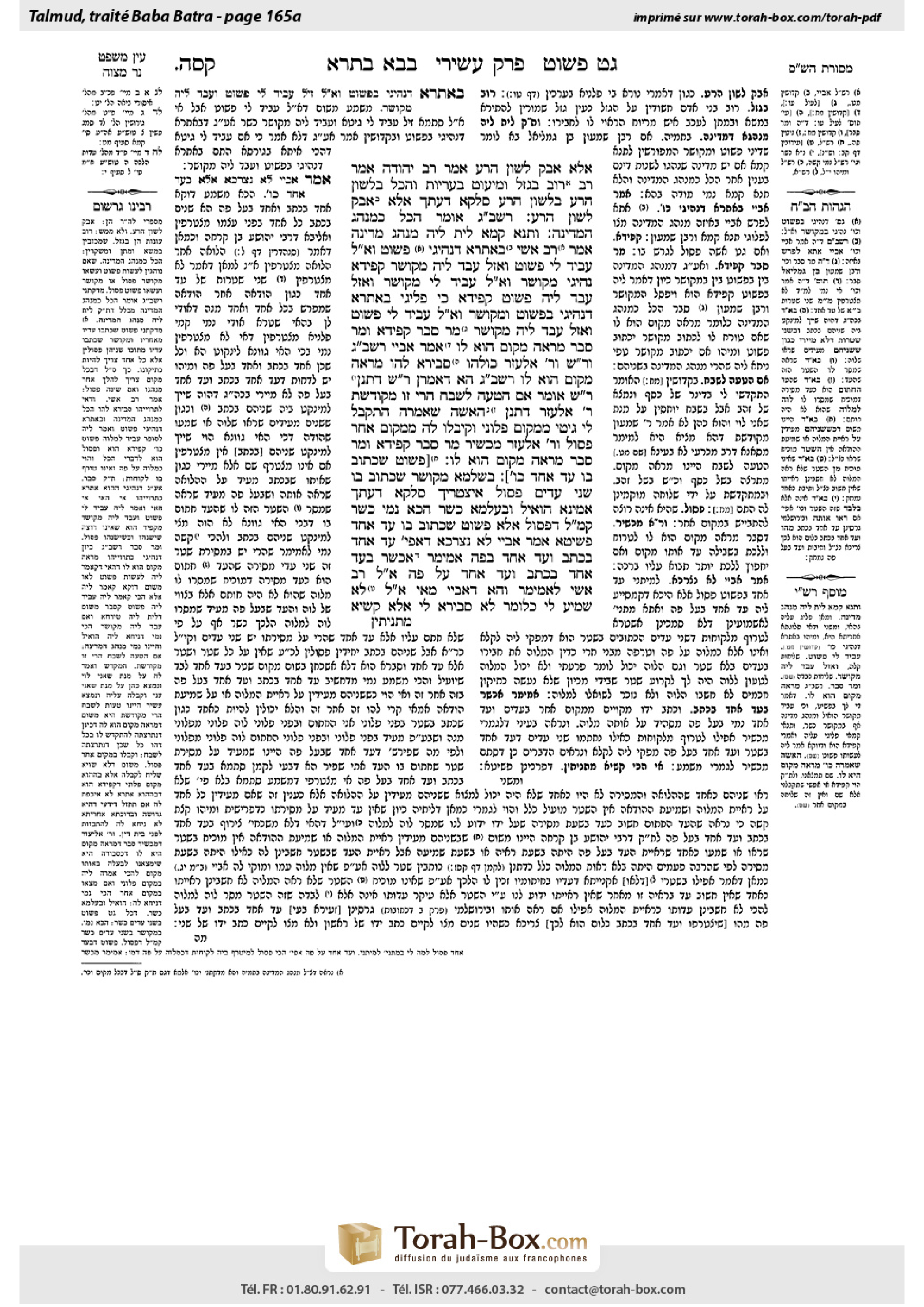
Bava Batra 165a: Talmud study for Daf Yomi
Study the Talmud for Daf Yomi with scanned pages, Hebrew text, English translations from Sefaria and AI-generated French translations.
Passage selection and English or AI-generated French translation are available where the scan has annotations. Daf Study is independent of Torah-Box and Sefaria.
Browse Bava Batra · בבא בתרא · All tractatesBava Batra 165a text and translations
This page of Bava Batra includes the Aramaic text, an English translation and an AI-generated French translation, alongside the scan above.
בבא בתרא קס״ה א · Aramaic and Hebrew text
אֶלָּא אֲבַק לָשׁוֹן הָרַע.
אָמַר רַב יְהוּדָה אָמַר רַב: רוֹב בְּגָזֵל, וּמִיעוּט בַּעֲרָיוֹת, וְהַכֹּל בְּלָשׁוֹן הָרָע. בְּלָשׁוֹן הָרָע סָלְקָא דַּעְתָּךְ?! אֶלָּא אֲבַק לָשׁוֹן הָרָע.
רַבָּן שִׁמְעוֹן בֶּן גַּמְלִיאֵל אוֹמֵר: הַכֹּל כְּמִנְהַג הַמְּדִינָה. וְתַנָּא קַמָּא לֵית לֵיהּ מִנְהַג מְדִינָה?
אָמַר רַב אָשֵׁי: בְּאַתְרָא דִּנְהִיגִי פָּשׁוּט, וַאֲמַר לֵיהּ: ״עֲבֵיד לִי פָּשׁוּט״, וַאֲזַל עֲבַד לֵיהּ מְקוּשָּׁר – קְפֵידָא. נְהִיגִי מְקוּשָּׁר, וַאֲמַר לֵיהּ: ״עֲבֵיד לִי מְקוּשָּׁר״, וַאֲזַל עֲבַד לֵיהּ פָּשׁוּט – קְפֵידָא.
כִּי פְּלִיגִי – בְּאַתְרָא דִּנְהִיגִי בְּפָשׁוּט וּמְקוּשָּׁר, וַאֲמַר לֵיהּ: ״עֲבֵיד לִי פָּשׁוּט״, וַאֲזַל עֲבַד לֵיהּ מְקוּשָּׁר; מָר סָבַר: קְפֵידָא, וּמָר סָבַר: מַרְאֶה מָקוֹם הוּא לוֹ.
אָמַר אַבָּיֵי: רַבָּן שִׁמְעוֹן בֶּן גַּמְלִיאֵל וְרַבִּי שִׁמְעוֹן וְרַבִּי אֶלְעָזָר – כּוּלְּהוּ סְבִירָא לְהוּ: מַרְאֶה מָקוֹם הוּא לוֹ.
רַבָּן שִׁמְעוֹן בֶּן גַּמְלִיאֵל – הָא דַּאֲמַרַן. רַבִּי שִׁמְעוֹן – דִּתְנַן,
רַבִּי שִׁמְעוֹן אוֹמֵר: אִם הִטְעָהּ לְשֶׁבַח, הֲרֵי זוֹ מְקוּדֶּשֶׁת.
רַבִּי אֶלְעָזָר – דִּתְנַן, הָאִשָּׁה שֶׁאָמְרָה: ״הִתְקַבֵּל לִי גִּיטִּי מִמָּקוֹם פְּלוֹנִי״, וְקִיבְּלוֹ לָהּ מִמָּקוֹם אַחֵר – פָּסוּל; וְרַבִּי אֶלְעָזָר מַכְשִׁיר. מָר סָבַר: קְפֵידָא, וּמָר סָבַר: מַרְאֶה מָקוֹם הוּא לוֹ.
[פָּשׁוּט שֶׁכָּתוּב בּוֹ עֵד אֶחָד כּוּ׳] בִּשְׁלָמָא מְקוּשָּׁר שֶׁכָּתוּב בּוֹ שְׁנֵי עֵדִים, פָּסוּל – אִיצְטְרִיךְ, סָלְקָא דַּעְתָּךְ אָמֵינָא: הוֹאִיל וּבְעָלְמָא כָּשֵׁר – הָכָא נָמֵי כָּשֵׁר; קָא מַשְׁמַע לַן דְּפָסוּל. אֶלָּא פָּשׁוּט שֶׁכָּתוּב בּוֹ עֵד אֶחָד – פְּשִׁיטָא!
אָמַר אַבָּיֵי: לָא נִצְרְכָא – דַּאֲפִילּוּ עֵד אֶחָד בִּכְתָב, וְעֵד אֶחָד בְּפֶה.
אַמֵּימָר אַכְשַׁר בְּעֵד אֶחָד בִּכְתָב וְעֵד אֶחָד עַל פֶּה. אֲמַר לֵיהּ רַב אָשֵׁי לְאַמֵּימָר: וְהָא דְּאַבָּיֵי, מַאי? אֲמַר לֵיהּ: לָא שְׁמִיעַ לִי – כְּלוֹמַר, לָא סְבִירָא לִי.
אֶלָּא קַשְׁיָא
Bava Batra 165a · English translation
The Gemara answers: Rather, Rav was referring to uttering a hint, i.e., words with a bare trace, of malicious speech.
Rav Yehuda says that Rav says: The majority of people succumb to sin with regard to robbery, and a minority of people succumb to sin with regard to sexual matters, and everyone succumbs to sin with regard to malicious speech. The Gemara asks: Can it enter your mind that all people sin with regard to malicious speech? The Gemara answers: Rather, Rav was referring to uttering a hint of malicious speech.
§ The mishna teaches, with regard to documents, that Rabban Shimon ben Gamliel says: Everything is in accordance with regional custom. The Gemara wonders: And does the first tanna not accept that one should follow the regional custom? It is not reasonable that he would take issue with such a basic concept.
Rav Ashi said in explanation: In a place where the custom is to write an ordinary document, and one said to a scribe: Make an ordinary document for me, and the scribe went and made a tied document for him, it is assumed that he was particular about wanting an ordinary document. Similarly, in a place where the custom is to write a tied document, and one said to a scribe: Make a tied document for me, and the scribe went and made an ordinary document for him, it is assumed that he was particular about wanting a tied document. In both of these cases, the document is considered to have been written without the consent of the one who requested it. If it is a bill of divorce it may not be used, as a bill of divorce must be written with the knowledge and consent of the husband.
When the tanna’im of the mishna disagree is in a place where the custom is to write both an ordinary document and a tied document, and one said to a scribe: Make an ordinary document for me, and the scribe went and made a tied document for him. In such a case, one Sage, the first tanna, holds that the one requesting the document was particular about wanting an ordinary document, and since the scribe wrote a tied document, it is considered to have been written without his consent. And one Sage, Rabban Shimon ben Gamliel, holds that the one requesting the document was merely indicating his position to the scribe, stating that if the scribe wanted to save himself the trouble of writing a tied document there would no objection.
Abaye said: Concerning Rabban Shimon ben Gamliel, and Rabbi Shimon, and Rabbi Elazar, they all hold that when one gives instructions to an agent, he is merely indicating his position to him, as opposed to expressing an insistence on certain details.
Rabban Shimon ben Gamliel holds this is the case, as we have just said. Rabbi Shimon holds this as well, as we learned in a mishna (Kiddushin 48a), as explained by the Gemara there, that the first tanna rules that if a woman appoints an agent to accept her betrothal money and tells him that the man will be giving a golden dinar, or that he will be giving a silver dinar, and he in fact gives the other type of dinar, the betrothal is not valid, as in accepting the wrong dinar the agent did not follow the woman’s instructions exactly.
But Rabbi Shimon says: If he misled her to her advantage, i.e., he told her he was going to give a silver dinar and gave her a golden dinar, she is betrothed. When the woman told the agent to receive the silver dinar she did not mean to insist that the dinar be silver as opposed to gold, but was only indicating her position, which is that she would have no objection to receiving only a silver dinar.
Abaye continues: Rabbi Elazar also holds this, as we learned in a mishna (Gittin 65a): With regard to the woman who, when designating her agent for receipt of her bill of divorce, said to her agent: Receive my bill of divorce for me in such and such a place, and he received it for her in another place, the divorce is invalid; and Rabbi Elazar deems it valid. One Sage, the first tanna, holds that the woman is particular that her instructions be followed, and one Sage, Rabbi Elazar, holds that she was merely indicating her position to the agent, informing him of where she thought her husband would be.
§ The mishna teaches: With regard to an ordinary document in which the signature of a single witness is written, and a tied document in which the signatures of only two witnesses are written, they are both not valid. The Gemara asks: Granted, it was necessary for the mishna to teach that a tied document in which the signatures of only two witnesses are written is not valid, as it might enter your mind to say that since generally a document is valid with two signatures, here too it is valid; therefore, the mishna teaches us that it is in fact not valid. But why was it necessary to state that an ordinary document in which the signature of a single witness is written is not valid; isn’t this obvious?
Abaye said: It is necessary to state this halakha only to teach that even if there is one witness signed on the document in writing and, in addition, one witness testifies orally to the contents of the document, the document is not valid.
The Gemara relates: Ameimar deemed a document valid in the case of one witness signed on the document in writing and one witness testifying orally to the contents of the document. Rav Ashi said to Ameimar: And what of that statement of Abaye, which deemed such a document invalid? Ameimar said to him: I did not hear of it, as though to say: I do not hold like it; I disagree with Abaye.
Rav Ashi asks: But if you disagree, the difficulty
Bava Batra 165a · Traduction française (IA)
La Guemara répond : En réalité, Rav faisait référence à l'émission d'un indice, c'est-à-dire à des mots qui laissent une trace fugace de paroles malveillantes.
Rav Yéhouda dit que Rav dit : La majorité des gens péchent en ce qui concerne le vol, et une minorité en ce qui concerne les relations sexuelles, et tout le monde péche en ce qui concerne les paroles malveillantes. La Guemara demande : Est-ce que cela entre dans votre tête que tous les gens péchent en ce qui concerne les paroles malveillantes ? La Guemara répond : En réalité, Rav faisait référence à l'émission d'un indice de paroles malveillantes.
§ La Michna enseigne, en ce qui concerne les documents, que Rabban Shimon ben Gamliel dit : Tout est selon la coutume locale. La Guemara se demande : Et le premier tanna ne ne pas accepter que l'on doive suivre la coutume locale ? Ce n'est pas raisonnable qu'il s'oppose à un concept aussi fondamental.
Rav Ashi dit en explication : Dans un lieu où la coutume est d'écrire un document ordinaire, et si l'on dit à un scribe : Écris-moi un document ordinaire, et le scribe va et écrit un document lié, on suppose qu'il était particulier à vouloir un document ordinaire. De même, dans un lieu où la coutume est d'écrire un document lié, et si l'on dit à un scribe : Écris-moi un document lié, et le scribe va et écrit un document ordinaire, on suppose qu'il était particulier à vouloir un document lié. Dans les deux cas, le document est considéré comme ayant été écrit sans le consentement de celui qui l'avait demandé. Si c'est un acte de divorce, il ne peut être utilisé, car un acte de divorce doit être écrit avec le savoir et le consentement du mari.
Lorsque les tannaïm de la Michna s'opposent, c'est dans un lieu où la coutume est d'écrire à la fois un document ordinaire et un document lié, et si l'on dit à un scribe : Écris-moi un document ordinaire, et le scribe va et écrit un document lié. Dans ce cas, un Sage, le premier tanna, affirme que celui qui demandait le document était particulier à vouloir un document ordinaire, et puisque le scribe a écrit un document lié, on considère que le document a été écrit sans son consentement. Et un autre Sage, Rabban Shimon ben Gamliel, affirme que celui qui demandait le document n'indiquait qu'une position, en disant que s'il voulait économiser la peine de rédiger un document lié, il n'y aurait pas d'objection.
Abaye dit : En ce qui concerne Rabban Shimon ben Gamliel, et Rabbi Shimon, et Rabbi Eléazar, ils tous affirment que lorsqu'on donne des instructions à un agent, on indique simplement sa position, contrairement à exprimer une exigence précise.
Rabban Shimon ben Gamliel affirme cela, comme nous l'avons dit. Rabbi Shimon affirme cela également, comme nous l'avons appris dans une Michna (Kiddushin 48a), comme l'explique la Guemara là-bas, que le premier tanna décide que si une femme désigne un agent pour accepter son argent de fiançailles et lui dit que le mari donnera un dinar d'or, ou qu'il donnera un dinar d'argent, et qu'il donne en réalité l'autre type de dinar, la fiançailles n'est pas valide, car en acceptant le mauvais dinar, l'agent n'a pas suivi exactement les instructions de la femme.
Mais Rabbi Shimon dit : Si il l'a trompée à son avantage, c'est-à-dire s'il lui a dit qu'il allait lui donner un dinar d'argent et qu'il lui a donné un dinar d'or, elle est fiancée. Lorsque la femme a dit à l'agent de recevoir un dinar d'argent, elle n'avait pas l'intention d'insister sur le fait que le dinar soit d'argent plutôt que d'or, mais elle indiquait simplement sa position, ce qui est qu'elle n'aurait pas d'objection à recevoir un dinar d'argent seulement.
Abaye continue : Rabbi Eléazar affirme cela également, comme nous l'avons appris dans une Michna (Gittin 65a) : En ce qui concerne la femme qui, lorsqu'elle désigne son agent pour la réception de son acte de divorce, lui dit : Reçois mon acte de divorce pour moi à tel endroit, et il le reçoit pour elle à un autre endroit, le divorce est invalide ; et Rabbi Eléazar considère qu'il est valide. Un Sage, le premier tanna, affirme que la femme est particulière à ce que ses instructions soient suivies, et un Sage, Rabbi Eléazar, affirme qu'elle indiquait simplement sa position à l'agent, en lui informant de l'endroit où elle pensait que son mari serait.
§ La Michna enseigne : En ce qui concerne un document ordinaire dans lequel la signature d'un seul témoin est écrite, et un document lié dans lequel les signatures de seulement deux témoins sont écrites, ils ne sont tous deux pas valides. La Guemara demande : D'accord, il était nécessaire que la Michna enseigne que le document lié dans lequel les signatures de seulement deux témoins sont écrites n'est pas valide, car il pourrait entrer en votre tête de dire que puisque généralement un document est valide avec deux signatures, ici aussi il est valide ; donc la Michna nous enseigne qu'il n'en est rien. Mais pourquoi était-il nécessaire de préciser que le document ordinaire dans lequel la signature d'un seul témoin est écrite n'est pas valide ; n'est-ce pas évident ?
Abaye dit : Il est nécessaire de préciser cette halakha uniquement pour enseigner que même si un témoin est signé sur le document par écrit et, en plus, un témoin témoigne oralement du contenu du document, le document n'est pas valide.
La Guemara rapporte : Ameimar considérait un document comme valide dans le cas d'une signature d'un seul témoin écrite sur le document et d'un témoin qui témoigne oralement du contenu du document. Rav Ashi dit à Ameimar : Et que de cette déclaration d'Abaye, qui considérait ce document comme invalide ? Ameimar dit à lui : Je n'ai pas entendu cela, comme si on disait : Je ne suis pas d'accord avec cela ; je suis en désaccord avec Abaye.
Rav Ashi demande : Mais si vous avez raison, la difficulté
Traduction française générée par IA à partir de l’édition anglaise de Sefaria. Vérifie toujours un passage avec le texte source.
Text from Sefaria: William Davidson Edition - Vocalized Aramaic (CC BY NC); William Davidson Edition - English (CC BY NC).