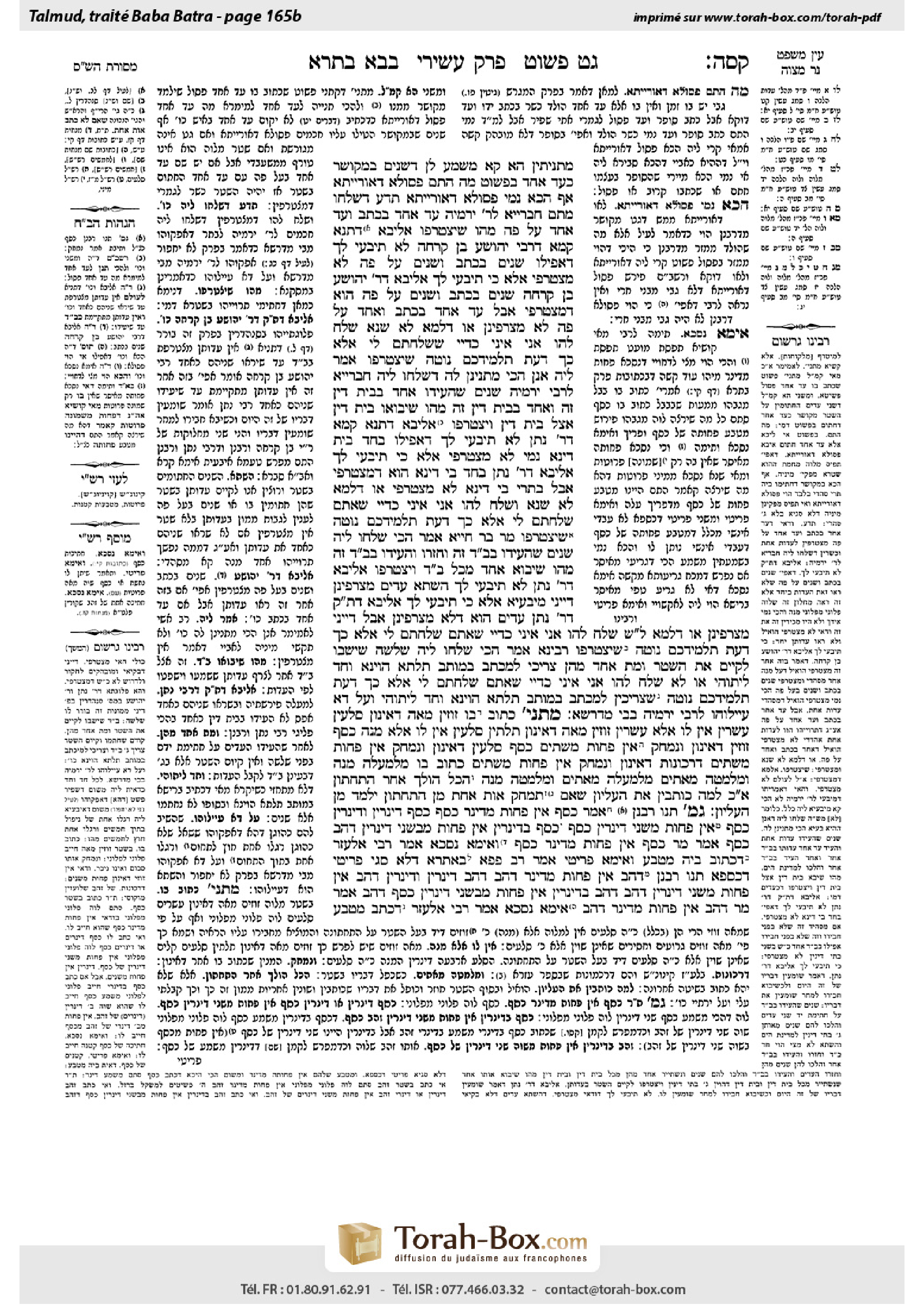
Bava Batra 165b: Talmud study for Daf Yomi
Study the Talmud for Daf Yomi with scanned pages, Hebrew text, English translations from Sefaria and AI-generated French translations.
Passage selection and English or AI-generated French translation are available where the scan has annotations. Daf Study is independent of Torah-Box and Sefaria.
Browse Bava Batra · בבא בתרא · All tractatesBava Batra 165b text and translations
This page of Bava Batra includes the Aramaic text, an English translation and an AI-generated French translation, alongside the scan above.
בבא בתרא קס״ה ב · Aramaic and Hebrew text
מַתְנִיתִין!
הָא קָא מַשְׁמַע לַן – דִּשְׁנַיִם בִּמְקוּשָּׁר, כְּעֵד אֶחָד בְּפָשׁוּט; מָה הָתָם – פְּסוּלָא דְאוֹרָיְיתָא, אַף הָכָא נָמֵי – פְּסוּלָא דְאוֹרָיְיתָא.
תִּדַּע, דִּשְׁלַחוּ מִתָּם חַבְרַיָּיא לְרַבִּי יִרְמְיָה:
עֵד אֶחָד בִּכְתָב וְעֵד אֶחָד עַל פֶּה, מַהוּ שֶׁיִּצְטָרְפוּ?
אַלִּיבָּא דְּתַנָּא קַמָּא דְּרַבִּי יְהוֹשֻׁעַ בֶּן קׇרְחָה – לָא תִּיבְּעֵי לָךְ, דַּאֲפִילּוּ שְׁנַיִם בִּכְתָב וּשְׁנַיִם עַל פֶּה לָא מִצְטָרְפִי. אֶלָּא כִּי תִּיבְּעֵי לָךְ, אַלִּיבָּא דְּרַבִּי יְהוֹשֻׁעַ בֶּן קׇרְחָה – שְׁנַיִם בִּכְתָב וּשְׁנַיִם עַל פֶּה הוּא דְּמִצְטָרְפִי, אֲבָל עֵד אֶחָד בִּכְתָב וְאֶחָד עַל פֶּה לָא מְצָרְפִינַן; אוֹ דִלְמָא לָא שְׁנָא?
שְׁלַח לְהוּ: אֲנִי אֵינִי כְּדַיי שֶׁשְּׁלַחְתֶּם לִי, אֶלָּא כָּךְ דַּעַת תַּלְמִידְכֶם נוֹטָה – שֶׁיִּצְטָרְפוּ.
אֲמַר לֵיהּ: אֲנַן הָכִי מַתְנֵינַן לָהּ – דִּשְׁלַחוּ לֵיהּ חַבְרַיָּיא לְרַבִּי יִרְמְיָה: שְׁנַיִם שֶׁהֵעִידוּ – אֶחָד בְּבֵית דִּין זֶה, וְאֶחָד בְּבֵית דִּין זֶה; מַהוּ שֶׁיָּבוֹאוּ בֵּית דִּין אֵצֶל בֵּית דִּין, וְיִצְטָרְפוּ?
אַלִּיבָּא דְּתַנָּא קַמָּא דְּרַבִּי נָתָן לָא תִּיבְּעֵי לָךְ – דַּאֲפִילּוּ בְּחַד בֵּית דִּינָא נָמֵי לָא מִצְטָרְפִי; אֶלָּא כִּי תִּיבְּעֵי לָךְ אַלִּיבָּא דְּרַבִּי נָתָן – בְּחַד בֵּי דִינָא הוּא דְּמִצְטָרְפִי, אֲבָל בִּתְרֵי בֵּי דִינָא לָא מִצְטָרְפִי; אוֹ דִלְמָא לָא שְׁנָא?
וּשְׁלַח לְהוּ: אֲנִי – אֵינִי כְּדַיי שֶׁאַתֶּם שְׁלַחְתֶּם לִי, אֶלָּא כָּךְ דַּעַת תַּלְמִידְכֶם נוֹטֶה – שֶׁיִּצְטָרְפוּ.
מָר בַּר חִיָּיא אָמַר, הָכִי שְׁלַחוּ לֵיהּ: שְׁנַיִם שֶׁהֵעִידוּ בְּבֵית דִּין זֶה, וְחָזְרוּ וְהֵעִידוּ בְּבֵית דִּין זֶה – מַהוּ שֶׁיָּבוֹא אֶחָד מִכׇּל בֵּית דִּין וְיִצְטָרְפוּ?
אַלִּיבָּא דְּרַבִּי נָתָן לָא תִּיבְּעֵי לָךְ – הַשְׁתָּא עֵדִים מְצָרְפִינַן, דַּיָּינֵי מִיבַּעְיָא? אֶלָּא כִּי תִּיבְּעֵי לָךְ, אַלִּיבָּא דְּתַנָּא קַמָּא דְּרַבִּי נָתָן – עֵדִים הוּא דְּלָא מְצָרְפִינַן, אֲבָל דַּיָּינֵי מְצָרְפִינַן; אוֹ דִלְמָא לָא שְׁנָא?
שְׁלַח לְהוּ: אֲנִי – אֵינִי כְּדַיי שֶׁאַתֶּם שְׁלַחְתֶּם לִי, אֶלָּא כָּךְ דַּעַת תַּלְמִידְכֶם נוֹטֶה – שֶׁיִּצְטָרְפוּ.
רָבִינָא אָמַר, הָכִי שְׁלַחוּ לֵיהּ: שְׁלֹשָׁה שֶׁיָּשְׁבוּ לְקַיֵּים אֶת הַשְּׁטָר, וּמֵת אֶחָד מֵהֶן; צְרִיכִי לְמִכְתַּב ״בְּמוֹתָב תְּלָתָא הֲוֵינָא, וְחַד לֵיתוֹהִי״, אוֹ לָא?
שְׁלַח לְהוּ: אֲנִי – אֵינִי כְּדַיי שֶׁאַתֶּם שְׁלַחְתֶּם לִי, אֶלָּא כָּךְ דַּעַת תַּלְמִידְכֶם נוֹטֶה – שֶׁצְּרִיכִין לְמִכְתַּב: ״בְּמוֹתַב תְּלָתָא הֲוֵינָא, וְחַד לֵיתוֹהִי״.
וְעַל דָּא עַיְּילוּהוּ לְרַבִּי יִרְמְיָה בְּבֵי מִדְרְשָׁא.
מַתְנִי׳ כָּתוּב בּוֹ: ״זוּזִין מְאָה, דְּאִינּוּן סִלְעִין עֶשְׂרִין״ – אֵין לוֹ אֶלָּא עֶשְׂרִין. ״זוּזִין מְאָה, דְּאִינּוּן תְּלָתִין סִלְעִין״ – אֵין לוֹ אֶלָּא מָנֶה.
״כְּסַף זוּזִין דְּאִינּוּן״, וְנִמְחַק – אֵין פָּחוֹת מִשְּׁתַּיִם. ״כְּסַף סִלְעִין דְּאִינּוּן״, וְנִמְחַק – אֵין פָּחוֹת מִשְּׁתַּיִם. ״דַּרְכּוֹנוֹת דְּאִינּוּן״, וְנִמְחַק – אֵין פָּחוֹת מִשְּׁתַּיִם.
כָּתוּב בּוֹ מִלְּמַעְלָה מָנֶה וּמִלְּמַטָּה מָאתַיִם; מִלְּמַעְלָה מָאתַיִם וּמִלְּמַטָּה מָנֶה – הַכֹּל הוֹלֵךְ אַחַר הַתַּחְתּוֹן. אִם כֵּן, לָמָה כּוֹתְבִין אֶת הָעֶלְיוֹן? שֶׁאִם תִּמָּחֵק אוֹת אַחַת מִן הַתַּחְתּוֹן – יִלְמַד מִן הָעֶלְיוֹן.
גְּמָ׳ תָּנוּ רַבָּנַן: אָמַר ״כֶּסֶף״ – אֵין פָּחוֹת מִדִּינָר כֶּסֶף. ״כֶּסֶף דִּינָרִין״ וְ״דִינָרִין כֶּסֶף״ – אֵין פָּחוֹת מִשְּׁנֵי דִּינָרִין כֶּסֶף. ״כֶּסֶף בְּדִינָרִין״ – אֵין פָּחוֹת מִבִּשְׁנֵי דִינָרִין דְּהַב, כֶּסֶף.
אָמַר מָר: ״כֶּסֶף״ – אֵין פָּחוֹת מִדִּינָר כֶּסֶף. וְאֵימָא נְסָכָא! אָמַר רַבִּי אֶלְעָזָר: דְּכָתוּב בֵּיהּ ״מַטְבֵּעַ״. וְאֵימָא פְּרִיטֵי! אָמַר רַב פָּפָּא: בְּאַתְרָא דְּלָא סָגֵי פְּרִיטֵי דְכַסְפָּא.
תָּנוּ רַבָּנַן: ״דְּהַב״ – אֵין פָּחוֹת מִדִּינָר דְּהַב. ״דְּהַב דִּינָרִין״ וְ״דִינָרִין דְּהַב״ – אֵין פָּחוֹת מִשְּׁנֵי דִינָרִין דְּהַב. ״דְּהַב בְּדִינָרִין״ – אֵין פָּחוֹת מִבִּשְׁנֵי דִינָרִין כֶּסֶף, דְּהַב.
אָמַר מָר: ״דְּהַב״ – אֵין פָּחוֹת מִדִּינָר דְּהַב. אֵימָא נְסָכָא! אָמַר רַבִּי אֶלְעָזָר: דִּכְתַב ״מַטְבֵּעַ״.
Bava Batra 165b · English translation
with the mishna remains: Why does the mishna state that which is obvious, that a document with a single witness’s signature is not valid?
The Gemara answers that the mishna teaches us this: That the case of two witnesses signed on a tied document is similar to the case of one witness signed on an ordinary document: Just as there, in the case of a single witness signed on an ordinary document, the disqualification is by Torah law, so too here, in the case of two witnesses signed on a tied document, the disqualification is by Torah law.
Ameimar added: Know that the signature of one witness on a document and the oral testimony of one person about it can be combined into a single testimony, as the colleagues of the academy sent a question from there, i.e., Eretz Yisrael, to Rabbi Yirmeya seeking clarification of a baraita. The baraita states that the first tanna holds that the testimony of two witnesses to an event can be combined into a single testimony only if both of them witnessed the event together, while Rabbi Yehoshua ben Korḥa holds that the testimony can be combined even if they saw the event one after the other. Furthermore, the first tanna holds that their testimony is accepted only if they both testify together. By contrast, Rabbi Natan holds that the testimony of one witness may be accepted today, and when the other witness comes the next day his testimony may be accepted, and the two testimonies may thereby be combined.
The dilemma they posed to Rabbi Yirmeya was this: In the case of a loan for which there is one witness in writing, signed on a promissory note, and one other witness who testifies to the loan orally, what is the halakha with regard to the possibility that the two of them will combine to testify as two witnesses?
The dilemma is clarified: According to the opinion of the first tanna of the baraita, who engages in a dispute with Rabbi Yehoshua ben Korḥa, you should not raise the dilemma, as according to his opinion there are situations where even two testimonies in writing or two oral testimonies are not combined into a single testimony. All the more so they are not combined when one is written and one is oral. Rather, when should you raise the dilemma? Raise it according to the opinion of Rabbi Yehoshua ben Korḥa. The dilemma is: Is it only testimonies of two witnesses in writing or two oral witnesses that are combined into a single testimony, but we do not combine testimony of one witness in writing and one orally? Or perhaps there is no difference between these cases.
Rabbi Yirmeya humbly sent back his response to the colleagues of the academy: I am not worthy of being the recipient of the query that you sent to me. But this is how the opinion of your student, i.e., himself, leans: That the testimonies should be combined. This exchange between Rabbi Yirmeya and his questioners indicates that Ameimar’s opinion is accepted.
Rav Ashi said to Ameimar: We teach this entire incident with Rabbi Yirmeya differently, as follows: That the colleagues of the academy sent this question to Rabbi Yirmeya: If there are two witnesses who testified, one in this court and one in that court, what is the halakha with regard to the possibility that the judges of one court could come to the other court and in this manner the two testimonies will be combined to become a valid testimony of two witnesses?
The dilemma is clarified: According to the opinion of the first tanna of the baraita, who also engages in a dispute with Rabbi Natan, you should not raise the dilemma, as according to his opinion, testimonies that are not given concurrently are not combined even in one court; all the more so when they are given in two different courts. Rather, when should you raise the dilemma? Raise it according to the opinion of Rabbi Natan. The dilemma is: Is it in one court that the two separate testimonies are combined, but when they are given in two separate courts they are not combined? Or perhaps there is no difference.
And Rabbi Yirmeya sent back his response to them: I am not worthy of being the recipient of the query that you sent to me. But this is how the opinion of your student leans: That they should be combined. According to this version of the exchange between Rabbi Yirmeya and his questioners there is no relevance to Ameimar’s statement.
Mar bar Ḥiyya said yet a third version, that the dilemma the colleagues of the academy sent to Rabbi Yirmeya is as follows: If there are two witnesses who testified in this court and then testified in that court, what is the halakha with regard to the possibility that one judge would come from each court to one location and relate the testimony he had heard to the other, and in this manner the two testimonies will be combined?
The dilemma is clarified: According to the opinion of Rabbi Natan you should not raise the dilemma. Now that he maintains that we combine two individual witnesses, is it necessary to ask if judges may be combined in this manner? They certainly can be combined. Rather, when should you raise the dilemma? Raise it according to the opinion of the first tanna of the baraita, who engages in a dispute with Rabbi Natan. The dilemma is: Is it only testimony of witnesses that we do not combine into a single testimony, but we do combine judges from two different courts? Or perhaps there is no difference.
Rabbi Yirmeya sent back his response to them: I am not worthy of being the recipient of the query that you sent to me. But this is how the opinion of your student leans: That they should be combined.
Ravina said a fourth version, that the dilemma the colleagues of the academy sent to Rabbi Yirmeya is as follows: If there were three judges who sat as a court to ratify a document, and, after verifying the signatures of the witnesses, one of the judges died, must they mention this in their statement of ratification, to account for why the declaration is signed by only two judges, and write: We were sitting in a group of three judges, and one of the judges is no longer alive? Or perhaps they are not required to write this.
Rabbi Yirmeya sent back his response to them: I am not worthy of being the recipient of the query that you sent to me. But this is how the opinion of your student leans: That they are required to write: We were sitting in a group of three judges, and one of the judges is no longer alive.
The Gemara relates: And it was because of this fitting answer, to whichever version of the dilemma that is adopted, that the Sages brought Rabbi Yirmeya into the study hall after he had been expelled, as related earlier in this tractate (23b).
MISHNA: If it is written in a document that someone owes: One hundred dinars, which are twenty sela, which is internally inconsistent since there are twenty-five sela in a hundred dinars, the holder of the document has the right to claim only twenty sela, the lower of the two amounts. If it is written that he owes: One hundred dinars, which are thirty sela, the holder of the document has the right to claim only one hundred dinars, again the lower of the two amounts.
If it is written that someone owes: Silver dinars that are, and the remainder of the text, where the number of dinars should be specified, was erased, the amount must be no less than two dinars, the lowest amount to which the plural word dinars can be referring. That is what the creditor can claim. Similarly, if it is written: Silver sela that are, and the remainder of the text was erased, the amount must be no less than two sela. And if it is written: Darics that are, and the remainder of the text was erased, the amount must be no less than two darics.
If it is written in the document above, in an earlier place in the document, that someone owes one hundred dinars, and below, toward the end of the document, it is written that the amount owed is two hundred dinars, or if above it is written two hundred dinars and below one hundred dinars, everything follows the bottom amount. If so, why does one write the information in the upper part of the document at all? It is a safety measure, so that if one letter is erased from the lower part of the document, thereby rendering it illegible, the information can be learned from the upper part of the document.
GEMARA: The Sages taught (Tosefta 11:2): If a document states that someone owes silver, without specifying which silver coin, the amount must be no less than a silver dinar. If it states: Silver dinars, or: Dinars silver, the amount must be no less than two silver dinars, the lowest amount to which that phrase can refer. If it states: Silver, in dinars, the amount must be no less than two golden dinars’ worth of silver.
The Gemara analyzes the beginning of the baraita. The Master says: If a document states that someone owes silver, without specifying which silver coin, the amount must be no less than a silver dinar. The Gemara asks: But why not say that the intention of the word silver is not to a coin at all, but to a small piece of silver? Rabbi Elazar said: The case of the baraita is where the word coin is written in the document. The Gemara asks further: But why not say that the intent is not a dinar, but smaller coins, such as perutot? Rav Pappa said: The halakha of the baraita is stated with regard to a place where silver perutot do not circulate.
The Sages taught in the continuation of the baraita: If it is written in a document that someone owes gold, the amount must be no less than a golden dinar. If it is written: Golden dinars, or: Dinars golden, the amount must be no less than two golden dinars. If it is written: Gold, in dinars, the amount must be no less than two silver dinars’ worth of gold.
The Gemara analyzes the beginning of this section of the baraita. The Master says: If it is written in a document that someone owes gold, the amount must be no less than a golden dinar. The Gemara asks: But why not say that the intention of the word gold is not to a coin at all, but to a small piece of gold? Rabbi Elazar said: The case of the baraita is where the word coin is written in the document.
Bava Batra 165b · Traduction française (IA)
avec la michna il reste : pourquoi la michna énonce-t-elle ce qui est évident, à savoir qu'un document signé par un seul témoin n'est pas valide ?
La Guemara répond que la michna nous enseigne cela : que le cas de deux témoins signant un document lié est semblable au cas d'un seul témoin signant un document ordinaire : aussi bien que dans ce dernier cas, où un seul témoin signe un document ordinaire, l'invalidation est selon la loi divine, ainsi aussi ici, dans le cas de deux témoins signant un document lié, l'invalidation est selon la loi divine.
Ameimar ajouta : Sache que la signature d'un seul témoin sur un document et le témoignage oral d'une seule personne à ce sujet peuvent être combinés en un seul témoignage, comme les collègues de l'académie ont envoyé une question d'où ils étaient, c'est-à-dire d'Israël, à Rabbi Yirmeya pour clarifier une baraïta. La baraïta énonce que le premier tanna maintient que le témoignage de deux témoins sur un événement peut être combiné en un seul témoignage uniquement si les deux ont témoin de l'événement ensemble, tandis que Rabbi Yehoshua ben Korḥa maintient que le témoignage peut être combiné même si les deux ont vu l'événement l'un après l'autre. De plus, le premier tanna maintient que leur témoignage est accepté uniquement s'ils témoignent ensemble. À l'inverse, Rabbi Natan maintient que le témoignage d'un seul témoin peut être accepté aujourd'hui, et lorsque le second témoin vient le lendemain, son témoignage peut être accepté, et les deux témoignages peuvent ainsi être combinés.
Le dilemme qu'ils posèrent à Rabbi Yirmeya était le suivant : dans le cas d'un prêt dont il y a un seul témoin en écrit, signé sur une promesse de paiement, et un autre témoin qui témoigne oralement du prêt, quelle est la halakha concernant la possibilité que les deux puissent combiner leur témoignage pour devenir deux témoins ?
Le dilemme est clarifié : selon l'opinion du premier tanna de la baraïta, qui entre en désaccord avec Rabbi Yehoshua ben Korḥa, vous ne devriez pas poser ce dilemme, car selon son opinion, il existe des cas où même deux témoignages écrits ou deux témoignages oraux ne sont pas combinés en un seul témoignage. Et encore plus, ils ne sont pas combinés lorsqu'un est écrit et l'autre oral. Par contre, quand devriez-vous poser ce dilemme ? Posez-le selon l'opinion de Rabbi Yehoshua ben Korḥa. Le dilemme est : est-ce seulement les témoignages de deux témoins écrits ou deux témoins oraux qui sont combinés en un seul témoignage, mais nous ne combinons pas le témoignage d'un témoin écrit et d'un témoin oral ? Ou peut-être qu'il n'y a pas de différence entre ces cas.
Rabbi Yirmeya envoya humblement sa réponse à ses collègues de l'académie : Je ne mérite pas d'être le destinataire de la question que vous m'avez envoyée. Mais voici comment l'opinion de votre élève, c'est-à-dire la sienne, penche : que les témoignages devraient être combinés. Ce dialogue entre Rabbi Yirmeya et ses questionneurs indique que l'opinion d'Ameimar est acceptée.
Rav Ashi dit à Ameimar : Nous enseignons tout cet incident avec Rabbi Yirmeya différemment, comme suit : les collègues de l'académie ont envoyé cette question à Rabbi Yirmeya : s'il y a deux témoins qui ont témoigné, l'un dans cette cour et l'autre dans l'autre cour, quelle est la halakha concernant la possibilité que les juges d'une cour viennent dans l'autre cour et ainsi les deux témoignages soient combinés pour devenir un témoignage valide de deux témoins ?
Le dilemme est clarifié : selon l'opinion du premier tanna de la baraïta, qui entre en désaccord avec Rabbi Natan, vous ne devriez pas poser ce dilemme, car selon son opinion, les témoignages qui ne sont pas donnés en même temps ne sont pas combinés même dans une seule cour ; encore plus lorsqu'ils sont donnés dans deux cours différentes. Par contre, quand devriez-vous poser ce dilemme ? Posez-le selon l'opinion de Rabbi Natan. Le dilemme est : est-ce dans une seule cour que les deux témoignages séparés sont combinés, mais lorsqu'ils sont donnés dans deux cours différentes ils ne sont pas combinés ? Ou peut-être qu'il n'y a pas de différence.
Et Rabbi Yirmeya envoya sa réponse à eux : Je ne mérite pas d'être le destinataire de la question que vous m'avez envoyée. Mais voici comment l'opinion de votre élève penche : qu'ils devraient être combinés. Selon cette version du dialogue entre Rabbi Yirmeya et ses questionneurs, il n'y a pas de pertinence à l'expression d'Ameimar.
Mar bar Ḥiyya dit une troisième version, que le dilemme que les collègues de l'académie ont envoyé à Rabbi Yirmeya est le suivant : s'il y a deux témoins qui ont témoigné dans cette cour et ensuite dans celle-ci, quelle est la halakha concernant la possibilité qu'un juge vienne de chaque cour vers un lieu et rapporte le témoignage qu'il a entendu à l'autre, et ainsi les deux témoignages soient combinés ?
Le dilemme est clarifié : selon l'opinion de Rabbi Natan, vous ne devriez pas poser ce dilemme. Maintenant qu'il maintient que nous combinons deux témoins individuels, est-il nécessaire de demander si les juges peuvent être combinés ainsi ? Ils peuvent certainement être combinés. Par contre, quand devriez-vous poser ce dilemme ? Posez-le selon l'opinion du premier tanna de la baraïta, qui entre en désaccord avec Rabbi Natan. Le dilemme est : est-ce seulement le témoignage des témoins que nous ne combinons pas en un seul témoignage, mais nous combinons les juges provenant de deux cours différentes ? Ou peut-être qu'il n'y a pas de différence.
Rabbi Yirmeya envoya sa réponse à eux : Je ne mérite pas d'être le destinataire de la question que vous m'avez envoyée. Mais voici comment l'opinion de votre élève penche : qu'ils devraient être combinés.
Ravina a dit une quatrième version, selon laquelle le dilemme que les collègues de l'académie ont envoyé à Rabbi Yirmeya est le suivant : Si trois juges avaient siégé en cour pour valider un document, et, après avoir vérifié les signatures des témoins, l'un des juges est mort, doit-on mentionner cela dans leur déclaration de validation, pour expliquer pourquoi le document est signé par seulement deux juges, et écrire : Nous étions assis en groupe de trois juges, et l'un des juges n'est plus vivant ? Ou peut-être ne sont-ils pas tenus d'écrire cela.
Rabbi Yirmeya a répondu à leur question en disant : Je ne mérite pas d'être le destinataire de la question que vous m'avez envoyée. Mais voici comment penche l'opinion de votre élève : qu'ils doivent écrire : Nous étions assis en groupe de trois juges, et l'un des juges n'est plus vivant.
La Guemara rapporte : Et c'est à cause de cette réponse appropriée, à quelle que soit la version du dilemme adoptée, que les Sages ont fait entrer Rabbi Yirmeya dans la salle de étude après qu'il avait été expulsé, comme mentionné plus tôt dans ce traité (23b).
MICHNA : Si un document indique qu'une personne doit : Cent dinars, ce qui sont vingt sela, ce qui est incohérent puisqu'il y a vingt-cinq sela dans cent dinars, le détenteur du document a le droit de réclamer seulement vingt sela, la somme la plus basse des deux. Si on écrit qu'il doit : Cent dinars, ce qui sont trente sela, le détenteur du document a le droit de réclamer seulement cent dinars, à nouveau la somme la plus basse des deux.
Si on écrit qu'une personne doit : Des dinars d'argent, et le reste du texte, où le nombre de dinars devrait être précisé, a été effacé, la somme doit être d'au moins deux dinars, la plus basse somme à laquelle le mot pluriel dinars peut faire référence. C'est ce que le créancier peut réclamer. De même, si on écrit : Des sela d'argent, et le reste du texte a été effacé, la somme doit être d'au moins deux sela. Et si on écrit : Des darics, et le reste du texte a été effacé, la somme doit être d'au moins deux darics.
Si on écrit dans le document, dans une partie précédente du document, qu'une personne doit cent dinars, et plus bas, vers la fin du document, on écrit qu'elle doit deux cents dinars, ou si on écrit deux cents dinars en haut et cent dinars en bas, tout suit la somme du bas. Si c'est ainsi, pourquoi écrit-on l'information en haut du document ? C'est une mesure de sécurité, afin que si une lettre est effacée dans la partie inférieure du document, rendant ainsi l'écriture illisible, l'information puisse être apprise à partir de la partie supérieure du document.
GUEMARA : Les Sages ont enseigné (Tosefta 11:2) : Si un document indique qu'une personne doit de l'argent, sans préciser quel type de monnaie, la somme doit être d'au moins un dinar d'argent. Si on écrit : Dinars d'argent, ou : Dinars d'argent, la somme doit être d'au moins deux dinars d'argent, la plus basse somme à laquelle cette phrase peut faire référence. Si on écrit : Argent, en dinars, la somme doit être d'au moins deux dinars d'or équivalant à de l'argent.
La Guemara analyse le début de la baraïta. Le Maître dit : Si un document indique qu'une personne doit de l'argent, sans préciser quel type de monnaie, la somme doit être d'au moins un dinar d'argent. La Guemara demande : Mais pourquoi ne pas dire que l'intention du mot argent n'est pas une monnaie, mais un petit morceau d'argent ? Rabbi Elazar dit : Le cas de la baraïta est celui où le mot monnaie est écrit dans le document. La Guemara demande davantage : Mais pourquoi ne pas dire que l'intention n'est pas un dinar, mais des pièces plus petites, comme les perutot ? Rav Pappa dit : La halakha de la baraïta est énoncée dans un lieu où les perutot d'argent ne circulent pas.
Les Sages ont enseigné dans la continuation de la baraïta : Si un document indique qu'une personne doit de l'or, la somme doit être d'au moins un dinar d'or. Si on écrit : Dinars d'or, ou : Dinars d'or, la somme doit être d'au moins deux dinars d'or. Si on écrit : Or, en dinars, la somme doit être d'au moins deux dinars d'argent équivalant à de l'or.
La Guemara analyse le début de cette section de la baraïta. Le Maître dit : Si on écrit dans un document qu'une personne doit de l'or, la somme doit être d'au moins un dinar d'or. La Guemara demande : Mais pourquoi ne pas dire que l'intention du mot or n'est pas une monnaie, mais un petit morceau d'or ? Rabbi Elazar dit : Le cas de la baraïta est celui où le mot monnaie est écrit dans le document.
Traduction française générée par IA à partir de l’édition anglaise de Sefaria. Vérifie toujours un passage avec le texte source.
Text from Sefaria: William Davidson Edition - Vocalized Aramaic (CC BY NC); William Davidson Edition - English (CC BY NC).