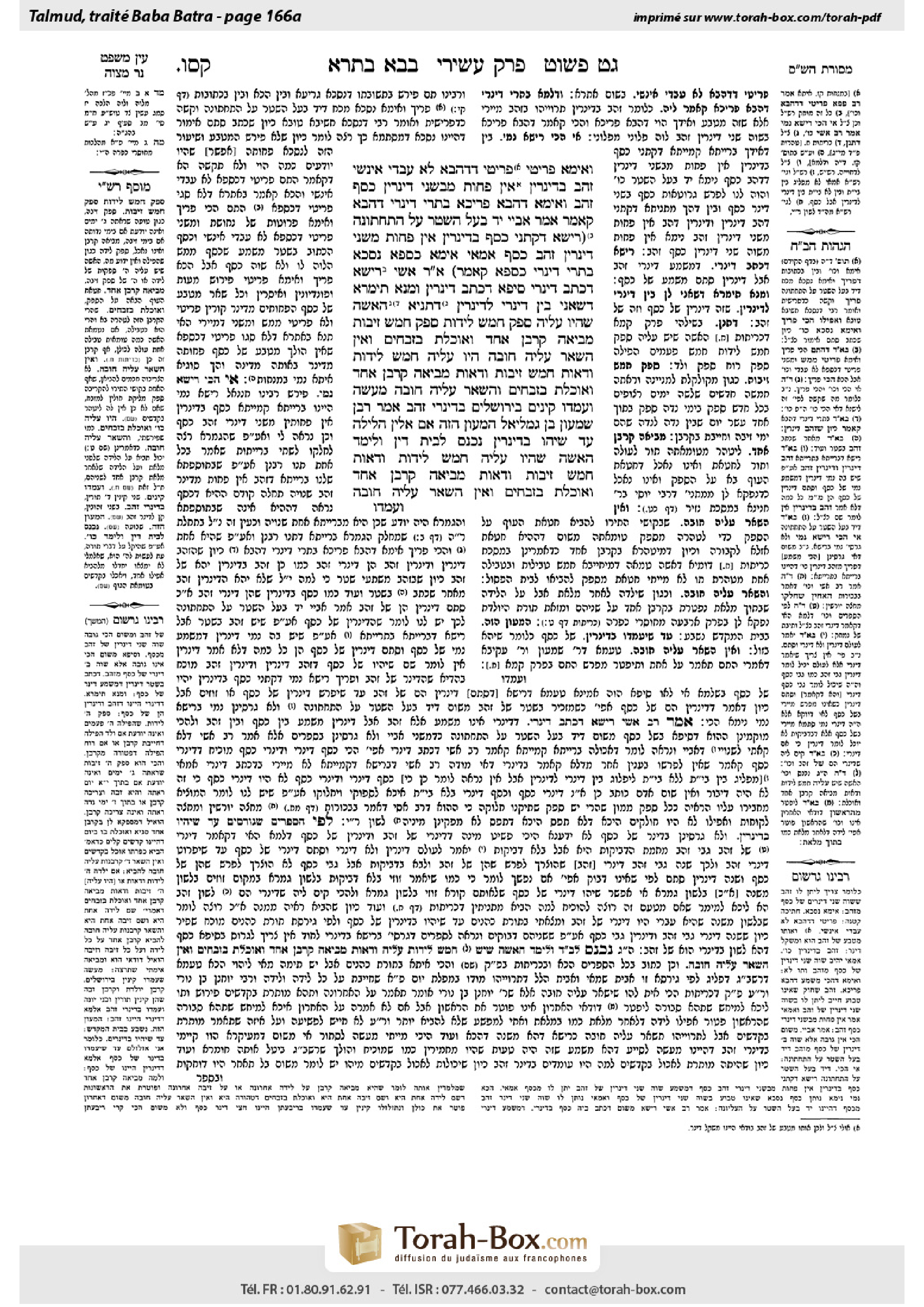
Bava Batra 166a: Talmud study for Daf Yomi
Study the Talmud for Daf Yomi with scanned pages, Hebrew text, English translations from Sefaria and AI-generated French translations.
Passage selection and English or AI-generated French translation are available where the scan has annotations. Daf Study is independent of Torah-Box and Sefaria.
Browse Bava Batra · בבא בתרא · All tractatesBava Batra 166a text and translations
This page of Bava Batra includes the Aramaic text, an English translation and an AI-generated French translation, alongside the scan above.
בבא בתרא קס״ו א · Aramaic and Hebrew text
וְאֵימָא פְּרִיטֵי! פְּרִיטֵי דְּדַהֲבָא לָא עָבְדִי אִינָשֵׁי.
״זָהָב בְּדִינָרִין״ – אֵין פָּחוֹת מִבִּשְׁנֵי דִינָרִין כֶּסֶף, זָהָב. וְאֵימָא דַּהֲבָא פְּרִיכָא בִּתְרֵי דִינָרֵי דַּהֲבָא קָאָמַר! אָמַר אַבָּיֵי: יַד בַּעַל הַשְּׁטָר עַל הַתַּחְתּוֹנָה.
רֵישָׁא דְּקָתָנֵי: ״כֶּסֶף בְּדִינָרִין״ – אֵין פָּחוֹת מִשְּׁנֵי דִּינָרִין זָהָב, כֶּסֶף; אַמַּאי? אֵימָא כַּסְפָּא – נְסָכָא בִּתְרֵי דִּינָרֵי כַּסְפָּא קָאָמַר!
אָמַר רַב אָשֵׁי: רֵישָׁא דִּכְתַב ״דִּינָרֵי״, סֵיפָא דִּכְתַב ״דִּינָרִין״.
וּמְנָא תֵּימְרָא דְּשָׁאנֵי בֵּין ״דִּינָרֵי״ לְ״דִינָרִין״?
דְּתַנְיָא: הָאִשָּׁה שֶׁהָיוּ עָלֶיהָ סְפֵק חָמֵשׁ לֵידוֹת; סְפֵק חָמֵשׁ זִיבוֹת – מְבִיאָה קׇרְבָּן אֶחָד וְאוֹכֶלֶת בִּזְבָחִים, וְאֵין הַשְּׁאָר עָלֶיהָ חוֹבָה. הָיוּ עָלֶיהָ חָמֵשׁ לֵידוֹת וַדָּאוֹת; חָמֵשׁ זִיבוֹת וַדָּאוֹת – מְבִיאָה קׇרְבָּן אֶחָד וְאוֹכֶלֶת בִּזְבָחִים, וְהַשְּׁאָר עָלֶיהָ חוֹבָה.
מַעֲשֶׂה וְעָמְדוּ קִינִּים בִּירוּשָׁלַיִם בְּדִינְרֵי זָהָב, אָמַר רַבָּן שִׁמְעוֹן בֶּן גַּמְלִיאֵל: הַמָּעוֹן הַזֶּה! אִם אָלִין הַלַּיְלָה עַד שֶׁיְּהוּ בְּדִינָרִין. נִכְנַס לְבֵית דִּין וְלִימֵּד: הָאִשָּׁה שֶׁהָיוּ עָלֶיהָ חָמֵשׁ לֵידוֹת וַדָּאוֹת; חָמֵשׁ זִיבוֹת וַדָּאוֹת – מְבִיאָה קׇרְבָּן אֶחָד וְאוֹכֶלֶת בִּזְבָחִים, וְאֵין הַשְּׁאָר עָלֶיהָ חוֹבָה.
Bava Batra 166a · English translation
The Gemara asks further: But why not say that the intent is not a dinar, but smaller coins, such as perutot? The Gemara answers: People do not make perutot of gold.
The Gemara continues its analysis of the baraita, which states: If it is written: Gold, in dinars, the amount must be no less than two silver dinars’ worth of gold. The Gemara asks: But why not say that the document is speaking of two golden dinars’ worth of pieces of gold? Abaye says: This interpretation is also possible, but the guiding principle in all interpretations of ambiguities is that the holder of the document is at a disadvantage.
The Gemara asks a question from the first clause of the baraita, which teaches that if the document states: Silver in dinars, the amount must be no less than two golden dinars’ worth of silver. Why is he entitled to so much? Say that the document is speaking of silver only, and means: Two silver dinars’ worth of silver pieces. This interpretation would be a lower value than the interpretation assigned to it by the baraita, and would be in keeping with the principle that the holder of the document is at a disadvantage.
Rav Ashi said in reply that the text of the baraita should be emended: In the first clause the case is that the scribe wrote: Silver in dinars, using the plural form dinarei, which refers specifically to golden dinars. In the latter clause, the case is that the scribe wrote: Gold in dinars, using the plural form dinarin, which denotes silver dinars specifically.
The Gemara supports its assertion that there is a difference between these two plural forms: And from where do you say that there is a difference between the words dinarei and dinarin?
This is as it is taught in a mishna (Karetot 8a): In the case of a woman for whom there was uncertainty with regard to five births, and likewise a woman for whom there was uncertainty with regard to five irregular discharges of blood from the uterus [ziva], she brings one offering, and then she may partake of the meat of offerings. And the remaining offerings are not an obligation for her. If she has in her case five definite births or five definite discharges of a zava, she brings one offering, and then she may partake of the meat of offerings. And the remaining offerings are an obligation for her.
That mishna continues: There was an incident where the price of nests, i.e., pairs of birds, stood in Jerusalem at golden dinarei, as the great demand for birds for the offerings of a woman after childbirth and a zava led to an increase in the price. Rabban Shimon ben Gamliel said: I take an oath by this abode of the Divine Presence that I will not lie down tonight until the price of nests will be in dinarin. Ultimately, he entered the court and taught: A woman for whom there were five definite births or five definite discharges of a zava brings one offering, and then she may partake of the meat of offerings. And the remaining offerings are not an obligation for her.
Bava Batra 166a · Traduction française (IA)
La Guemara pose une question supplémentaire : Mais pourquoi ne pas dire que l'intention n'est pas un dinar, mais des pièces plus petites, telles que des perutot ? La Guemara répond : Les gens ne font pas de perutot en or.
La Guemara continue son analyse de la baraïta, qui stipule : Si on écrit : Or, en dinars, la quantité doit être au moins égale à deux dinars d'argent en or. La Guemara pose une question : Mais pourquoi ne pas dire que le document parle de deux dinars d'or en argent ? Abaye dit : Cette interprétation est également possible, mais le principe dominant dans toutes les interprétations des ambiguïtés est que le détenteur du document est désavantagé.
La Guemara pose une question à partir de la première clause de la baraïta, qui enseigne que si le document stipule : Argent en dinars, la quantité doit être au moins égale à deux dinars d'or en argent. Pourquoi est-il autorisé à en recevoir autant ? Disons que le document parle uniquement d'argent et signifie : Deux dinars d'argent en pièces d'argent. Cette interprétation serait une valeur inférieure par rapport à celle attribuée par la baraïta, et correspondrait au principe que le détenteur du document est désavantagé.
Rav Ashi répond en disant que le texte de la baraïta devrait être corrigé : Dans la première clause, le cas est que l'écrivain a écrit : Argent en dinars, en utilisant la forme plurielle dinarei, qui désigne spécifiquement les dinars d'or. Dans la dernière clause, le cas est que l'écrivain a écrit : Or en dinars, en utilisant la forme plurielle dinarin, qui désigne spécifiquement les dinars d'argent.
La Guemara soutient son affirmation selon laquelle il y a une différence entre ces deux formes plurielles : Et d'où dis-tu qu'il y a une différence entre les mots dinarei et dinarin ?
C'est ce qui est enseigné dans une mitsva (Karetot 8a) : Dans le cas d'une femme dont on était incertain quant à cinq accouchements, et de même pour une femme dont on était incertain quant à cinq saignements irréguliers du utérus [ziva], elle apporte une seule offrande, puis elle peut manger la viande des offrandes. Les autres offrandes ne sont pas une obligation pour elle. Si elle a dans son cas cinq accouchements certains ou cinq saignements certains d'une zava, elle apporte une seule offrande, puis elle peut manger la viande des offrandes. Les autres offrandes sont une obligation pour elle.
Cette mitsva continue : Il y avait un cas où le prix des nids, c'est-à-dire des couples d'oiseaux, à Jérusalem était en dinare d'or, en raison de la forte demande d'oiseaux pour les offrandes d'une femme après l'accouchement et d'une zava, ce qui a entraîné une hausse du prix. Rabban Shimon ben Gamliel dit : Je jure par cette demeure de la Divine Présence que je ne me coucherai pas cette nuit jusqu'à ce que le prix des nids soit en dinar. Finalement, il est entré dans la cour et a enseigné : Une femme dont on a eu cinq accouchements certains ou cinq saignements certains d'une zava apporte une seule offrande, puis elle peut manger la viande des offrandes. Les autres offrandes ne sont pas une obligation pour elle.
Traduction française générée par IA à partir de l’édition anglaise de Sefaria. Vérifie toujours un passage avec le texte source.
Text from Sefaria: William Davidson Edition - Vocalized Aramaic (CC BY NC); William Davidson Edition - English (CC BY NC).