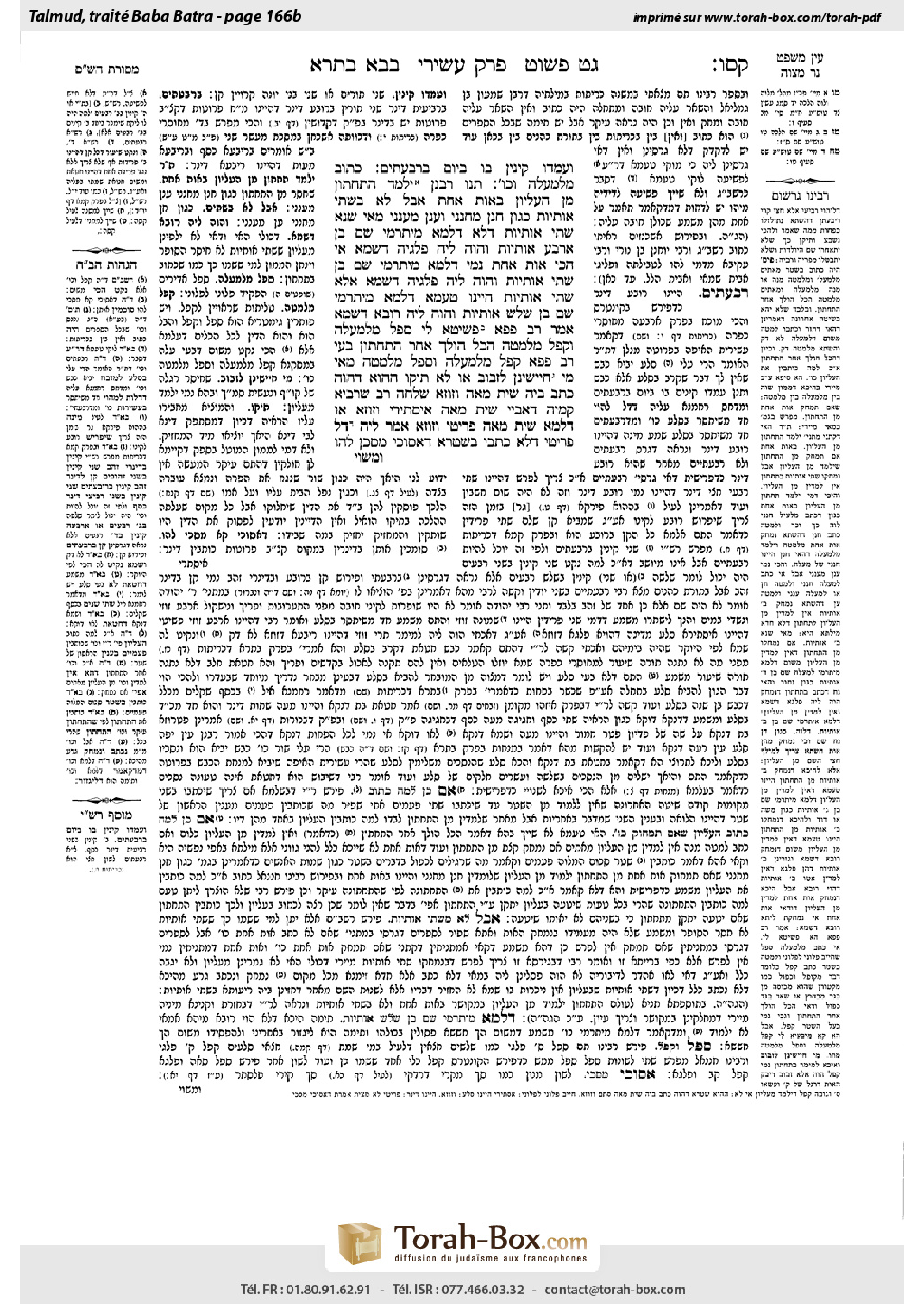
Bava Batra 166b: Talmud study for Daf Yomi
Study the Talmud for Daf Yomi with scanned pages, Hebrew text, English translations from Sefaria and AI-generated French translations.
Passage selection and English or AI-generated French translation are available where the scan has annotations. Daf Study is independent of Torah-Box and Sefaria.
Browse Bava Batra · בבא בתרא · All tractatesBava Batra 166b text and translations
This page of Bava Batra includes the Aramaic text, an English translation and an AI-generated French translation, alongside the scan above.
בבא בתרא קס״ו ב · Aramaic and Hebrew text
וְעָמְדוּ קִינִּין בּוֹ בַּיּוֹם בְּרִבְעָתַיִם.
כָּתוּב מִלְּמַעְלָה וְכוּ׳. תָּנוּ רַבָּנַן: יִלְמַד הַתַּחְתּוֹן מִן הָעֶלְיוֹן – בְּאוֹת אַחַת; אֲבָל לֹא בִּשְׁתֵּי אוֹתִיּוֹת –
כְּגוֹן ״חָנָן״ מֵ״חֲנָנִי״ וְ״עָנָן״ מֵ״עֲנָנִי״.
מַאי שְׁנָא שְׁתֵּי אוֹתִיּוֹת דְּלָא – דִּלְמָא מִיתְרְמֵי שֵׁם בֶּן אַרְבַּע אוֹתִיּוֹת, וְהָוֵה לֵיהּ פַּלְגֵיהּ דִּשְׁמָא; אִי הָכִי, אוֹת אַחַת נָמֵי – דִּלְמָא מִיתְרְמֵי שֵׁם בֶּן שְׁתֵּי אוֹתִיּוֹת, וְהָוֵה לֵיהּ פַּלְגֵיהּ דִּשְׁמָא!
אֶלָּא שְׁתֵּי אוֹתִיּוֹת הַיְינוּ טַעְמָא – דִּלְמָא מִיתְרְמֵי שֵׁם בֶּן שָׁלֹשׁ אוֹתִיּוֹת, וְהָוֵה לֵיהּ רוּבָּא דִשְׁמָא.
אָמַר רַב פָּפָּא: פְּשִׁיטָא לִי – ״סֵפֶל״ מִלְּמַעְלָה וְ״קֵפֶל״ מִלְּמַטָּה – הַכֹּל הוֹלֵךְ אַחַר הַתַּחְתּוֹן.
בָּעֵי רַב פָּפָּא: ״קֵפֶל״ מִלְּמַעְלָה וְ״סֵפֶל״ מִלְּמַטָּה, מַאי – מִי חָיְישִׁינַן לִזְבוּב, אוֹ לָא? תֵּיקוּ.
הָהוּא דַּהֲוָה כְּתִב בֵּיהּ: ״שֵׁית מְאָה וְזוּזָא״, שַׁלְחֵהּ רַב שֵׁרֵבְיָא קַמֵּיהּ דְּאַבָּיֵי: שֵׁית מְאָה אִיסְתֵּירֵי וְזוּזָא, אוֹ דִלְמָא שֵׁית מְאָה פְּרִיטֵי וְזוּזָא? אֲמַר לֵיהּ: דַּל פְּרִיטֵי, דְּלָא כָּתְבִי בִּשְׁטָרָא – דַּאֲסוֹכֵי מַסְכַּן לְהוּ,
Bava Batra 166b · English translation
The mishna concludes: And as a result, the price of the nests stood that day at one-quarter of a silver dinar, as the demand for nests decreased. It is clear in the mishna that the term dinarei indicates a higher value than the term dinarin.
§ The mishna teaches: If it is written in the document above that someone owes one hundred dinars, and below it is written two hundred dinars, or if above it is written two hundred and below one hundred, everything follows the bottom amount. If so, why does one write the information in the upper part of the document at all? It is a safety measure, so that if one letter is erased from the lower part of the document, thereby rendering it illegible, the information can be learned from the upper part of the document. The Sages taught in a baraita (Tosefta 11:4): Information concerning what is written below may be learned from what is written above if the lower text is missing one letter, but not if it is missing two letters. In that case, in the event of a discrepancy between information written above and information written below, the document is not valid.
For example, if the name of one party is written as Ḥanan below and Ḥanani above, it may be derived from the word Ḥanani written above that the party is named Ḥanani. And similarly, if a name is written Anan below, it may be learned from the name Anani written above that the party is named Anani.
The Gemara asks: What is different about two letters missing, that the baraita teaches that the name written below cannot be corrected from the name written above? The Gemara suggests: It is out of concern that perhaps it will occur by chance that there is a four-letter name, and the omission of two letters would be half of the name, and for this reason the Sages extended this concern to all cases where two letters are missing. The Gemara challenges: If so, the same could be said when one letter is missing as well, as perhaps it will occur by chance that there is a two-letter name, and the omission of one letter would be half of the name.
The Gemara explains: Rather, this is the reason that when two letters are missing the name written below cannot be corrected from the name written above: The concern is that perhaps it will occur by chance that there is a three-letter name, and the omission of two letters would be a majority of the name. The Sages applied this concern to all cases where two letters are missing.
The Gemara continues to discuss discrepancies between the information written above and below in a document. Rav Pappa said: It is obvious to me that if a document states above that one owes a sefel, a type of cup, and below it states kefel, a type of garment, everything is determined by the information written below. In this case there is not a missing letter at the bottom but an altered letter. Therefore, the information written below is not corrected from the information written above.
Rav Pappa raises a dilemma: What if it is stated kefel above and sefel below? The difference between the two words is that the former begins with kuf, whereas the latter begins with samekh. The orthographical difference between these two letters is a single stroke that extends downward, as the omission of the extension of this stroke would change kuf into samekh. Rav Pappa’s dilemma is: Are we concerned for the possibility that a fly landed on the stroke of the kuf, removing the ink and changing it into samekh? Or are we not concerned with this possibility? The Gemara comments: The dilemma shall stand unresolved.
§ The Gemara relates: There was a certain document in which it was written that the amount due was six hundred and a dinar, without specifying to which denomination the six hundred amount referred. Rav Sherevya sent this question before Abaye: Does the holder of the document collect six hundred istira and a dinar? Istira is another name for a sela, which equals four dinars. Or is he perhaps entitled to collect only six hundred perutot and a dinar, a peruta being a small fraction of a dinar? Abaye said to him: Remove the possibility of six hundred perutot, since people do not write large numbers of perutot in a document, as they instead combine them into larger denominations
Bava Batra 166b · Traduction française (IA)
La michna conclut : Et ainsi, le prix des nids était ce jour-là d'un quart de dinar d'argent, car la demande pour les nids avait diminué. Il est clair dans la michna que le terme dinarei indique une valeur supérieure au terme dinarin.
§ La michna enseigne : Si on écrit dans le document supérieur que quelqu'un doit cent dinars, et en dessous on écrit deux cents dinars, ou si on écrit deux cents en haut et cent en bas, tout suit la quantité écrite en bas. Si c'est ainsi, pourquoi écrit-on l'information dans la partie supérieure du document ? C'est une mesure de sécurité, afin que si une lettre est effacée dans la partie inférieure du document, rendant l'écriture illisible, l'information puisse être tirée de la partie supérieure. Les Sages ont enseigné dans une baraïta (Tosefta 11:4) : L'information concernant ce qui est écrit en bas peut être tirée de ce qui est écrit en haut si le texte inférieur manque une lettre, mais pas si deux lettres sont manquantes. Dans ce cas, en cas de dissonance entre l'information écrite en haut et celle écrite en bas, le document n'est pas valide.
Par exemple, si le nom d'une partie est écrit Ḥanan en bas et Ḥanani en haut, on peut déduire du mot Ḥanani écrit en haut que la partie s'appelle Ḥanani. De même, si un nom est écrit Anan en bas, on peut en déduire du nom Anani écrit en haut que la partie s'appelle Anani.
La Guemara pose la question : Qu'est-ce qui diffère dans le cas de deux lettres manquantes, que la baraïta enseigne que le nom écrit en bas ne peut pas être corrigé à partir du nom écrit en haut ? La Guemara suggère : C'est par crainte qu'il puisse arriver par hasard qu'il y ait un nom à quatre lettres, et que l'omission de deux lettres soit la moitié du nom, et pour cette raison les Sages ont étendu cette crainte à tous les cas où deux lettres sont manquantes. La Guemara conteste : Si c'est ainsi, on pourrait dire la même chose dans le cas où une seule lettre est manquante, car peut-être il arrive par hasard qu'il y ait un nom à deux lettres, et l'omission d'une lettre serait la moitié du nom.
La Guemara explique : Plutôt, c'est pour cette raison que lorsqu'il manque deux lettres, le nom écrit en bas ne peut pas être corrigé à partir du nom écrit en haut : la crainte est que cela puisse arriver par hasard qu'il y ait un nom à trois lettres, et que l'omission de deux lettres soit la majorité du nom. Les Sages ont appliqué cette crainte à tous les cas où deux lettres sont manquantes.
La Guemara continue à discuter des divergences entre l'information écrite en haut et en bas dans un document. Rav Pappa dit : Il me semble évident que si un document indique en haut qu'on doit un sefel, un type de coupe, et en bas qu'on doit un kefel, un type de vêtement, tout est déterminé par l'information écrite en bas. Dans ce cas, il n'y a pas une lettre manquante en bas mais une lettre altérée. Par conséquent, l'information écrite en bas ne peut pas être corrigée à partir de celle écrite en haut.
Rav Pappa soulève un dilemme : Qu'est-ce qui se passe si on écrit kefel en haut et sefel en bas ? La différence entre les deux mots est que le premier commence par kuf, tandis que le second commence par samekh. La différence orthographique entre ces deux lettres est une seule ligne qui s'étend vers le bas, car l'omission de cette extension changerait kuf en samekh. Le dilemme de Rav Pappa est : Sommes-nous préoccupés par la possibilité qu'un moustique se soit posé sur la ligne de la kuf, enlevant l'encre et la transformant en samekh ? Ou ne sommes-nous pas préoccupés par cette possibilité ? La Guemara commente : Ce dilemme restera sans réponse.
§ La Guemara rapporte : Il y avait un certain document dans lequel on écrivait que la somme due était six cents et un dinar, sans préciser à quel dénomination les six cents faisaient référence. Rav Sherevya envoya cette question à Abaye : Le détenteur du document peut-il récupérer six cents istira et un dinar ? L'istira est un autre nom pour un sela, qui égale quatre dinars. Ou est-il possible qu'il soit seulement autorisé à récupérer six cents perutot et un dinar, une peruta étant une petite fraction d'un dinar ? Abaye dit à lui : Éliminez la possibilité de six cents perutot, car les gens n'écrivent pas de grands nombres de perutot dans un document, car ils les combinent plutôt en dénominations plus grandes.
Traduction française générée par IA à partir de l’édition anglaise de Sefaria. Vérifie toujours un passage avec le texte source.
Text from Sefaria: William Davidson Edition - Vocalized Aramaic (CC BY NC); William Davidson Edition - English (CC BY NC).