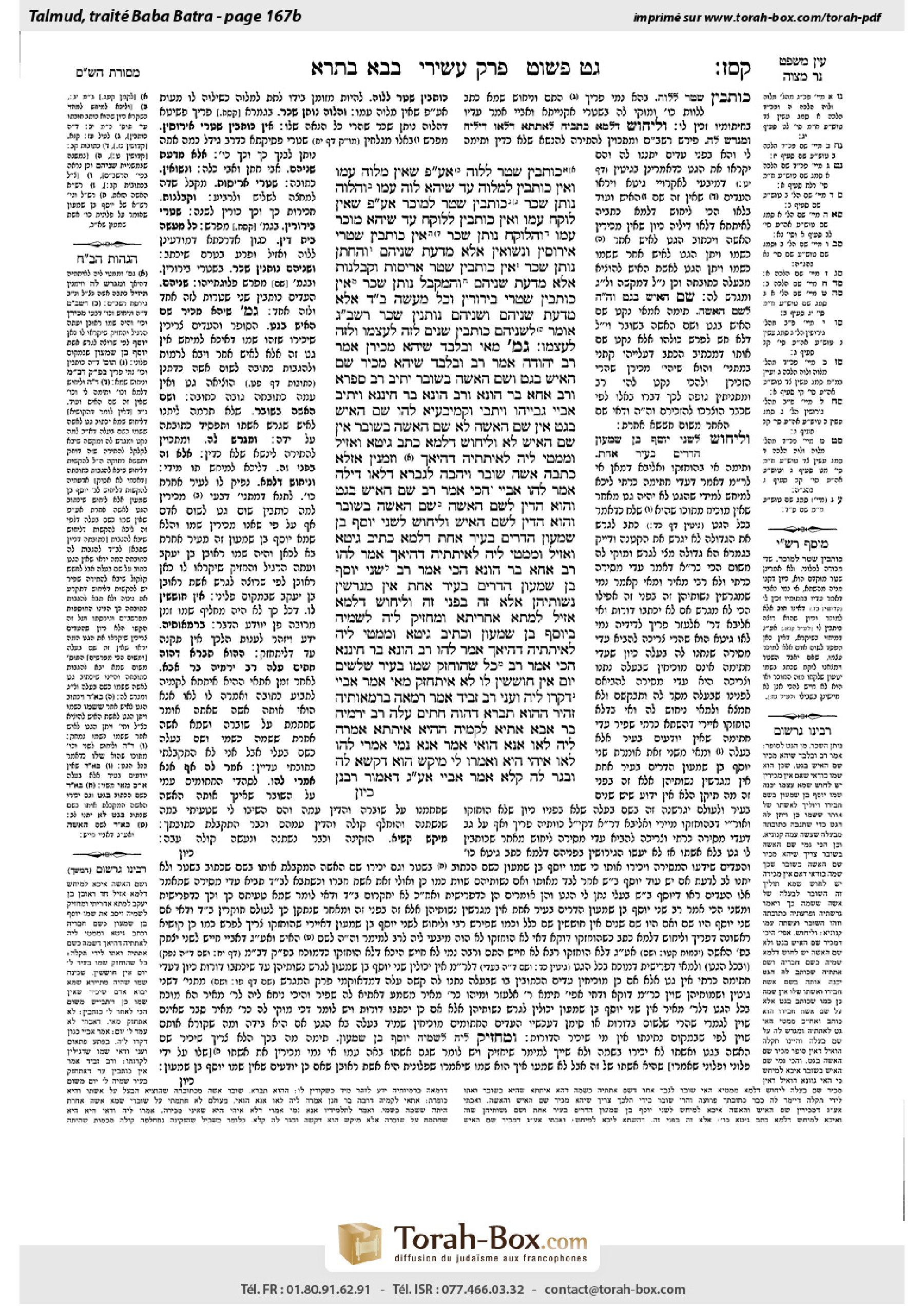
Bava Batra 167b: Talmud study for Daf Yomi
Study the Talmud for Daf Yomi with scanned pages, Hebrew text, English translations from Sefaria and AI-generated French translations.
Passage selection and English or AI-generated French translation are available where the scan has annotations. Daf Study is independent of Torah-Box and Sefaria.
Browse Bava Batra · בבא בתרא · All tractatesBava Batra 167b text and translations
This page of Bava Batra includes the Aramaic text, an English translation and an AI-generated French translation, alongside the scan above.
בבא בתרא קס״ז ב · Aramaic and Hebrew text
כּוֹתְבִין שְׁטָר לַלֹּוֶה – אַף עַל פִּי שֶׁאֵין מַלְוֶה עִמּוֹ, וְאֵין כּוֹתְבִין לַמַּלְוֶה – עַד שֶׁיְּהֵא לֹוֶה עִמּוֹ. וְהַלֹּוֶה נוֹתֵן שָׂכָר.
כּוֹתְבִין שְׁטָר לַמּוֹכֵר – אַף עַל פִּי שֶׁאֵין לוֹקֵחַ עִמּוֹ, וְאֵין כּוֹתְבִין לַלּוֹקֵחַ – עַד שֶׁיְּהֵא מוֹכֵר עִמּוֹ. וְהַלּוֹקֵחַ נוֹתֵן שָׂכָר.
אֵין כּוֹתְבִין שְׁטָרֵי אֵירוּסִין וְנִשּׂוּאִין אֶלָּא מִדַּעַת שְׁנֵיהֶם, וְהֶחָתָן נוֹתֵן שָׂכָר.
אֵין כּוֹתְבִין שְׁטַר אֲרִיסוּת וְקַבְּלָנוּת אֶלָּא מִדַּעַת שְׁנֵיהֶם, וְהַמְקַבֵּל נוֹתֵן שָׂכָר.
אֵין כּוֹתְבִין שְׁטָרֵי בֵּירוּרִין וְכׇל מַעֲשֵׂה בֵּית דִּין – אֶלָּא מִדַּעַת שְׁנֵיהֶם, וּשְׁנֵיהֶם נוֹתְנִין שָׂכָר. רַבָּן שִׁמְעוֹן בֶּן גַּמְלִיאֵל אוֹמֵר: לִשְׁנֵיהֶם כּוֹתְבִין שְׁנַיִם – לָזֶה לְעַצְמוֹ וְלָזֶה לְעַצְמוֹ.
גְּמָ׳ מַאי ״וּבִלְבַד שֶׁיְּהֵא מַכִּירָן״? אָמַר רַב יְהוּדָה אָמַר רַב: וּבִלְבַד שֶׁיְּהֵא מַכִּיר שֵׁם הָאִישׁ בַּגֵּט, וְשֵׁם הָאִשָּׁה בַּשּׁוֹבָר.
יָתֵיב רַב סָפְרָא וְרַב אַחָא בַּר הוּנָא וְרַב הוּנָא בַּר חִינָּנָא, וְיָתֵיב אַבָּיֵי גַּבַּיְיהוּ, וְיָתְבִי וְקָמִיבַּעְיָא לְהוּ: שֵׁם הָאִישׁ בַּגֵּט – אִין, שֵׁם הָאִשָּׁה – לָא?! שֵׁם הָאִשָּׁה בַּשּׁוֹבָר – אִין, שֵׁם הָאִישׁ – לָא?!
וְלֵיחוּשׁ דִּלְמָא כָּתֵב גִּיטָּא, וְאָזֵיל וּמַמְטֵי לֵיהּ לְאִיתְּתֵיהּ דְּהַיְאךְ!
וְזִמְנִין אָזְלָא כָּתְבָה אִשָּׁה שׁוֹבָר, וְיָהֲבָה לְגַבְרָא דְּלָאו דִּילַהּ!
אֲמַר לְהוּ אַבָּיֵי, הָכִי אָמַר רַב: שֵׁם הָאִישׁ בַּגֵּט – וְהוּא הַדִּין לְשֵׁם הָאִשָּׁה. שֵׁם הָאִשָּׁה בַּשּׁוֹבָר – וְהוּא הַדִּין לְשֵׁם הָאִישׁ.
וְלֵיחוּשׁ לִשְׁנֵי יוֹסֵף בֶּן שִׁמְעוֹן הַדָּרִים בְּעִיר אַחַת – דִּלְמָא כָּתֵיב גִּיטָּא, וְאָזֵיל וּמַמְטֵי לֵיהּ לְאִיתְּתֵיהּ דְּהַיְאךְ! אֲמַר לְהוּ רַב אַחָא בַּר הוּנָא, הָכִי אָמַר רַב: שְׁנֵי יוֹסֵף בֶּן שִׁמְעוֹן הַדָּרִים בְּעִיר אַחַת – אֵין מְגָרְשִׁין נְשׁוֹתֵיהֶן אֶלָּא זֶה בִּפְנֵי זֶה.
וְלֵיחוּשׁ דִּלְמָא אָזֵיל לְמָתָא אַחְרִיתָא וּמַחְזֵיק לֵיהּ לִשְׁמֵיהּ בְּיוֹסֵף בֶּן שִׁמְעוֹן, וְכָתֵיב גִּיטָּא וּמַמְטֵי לֵיהּ לְאִיתְּתֵיהּ דְּהַיְאךְ!
אֲמַר לְהוּ רַב הוּנָא בַּר חִינָּנָא, הָכִי אָמַר רַב: כׇּל שֶׁהוּחְזַק שְׁמוֹ בָּעִיר שְׁלֹשִׁים יוֹם – אֵין חוֹשְׁשִׁין לוֹ.
לָא אִיתַּחְזַק, מַאי? אָמַר אַבָּיֵי: דְּקָרוּ לֵיהּ וְעָנֵי. רַב זְבִיד אָמַר: רַמָּאָה – בְּרַמָּאוּתֵיהּ זְהִיר.
הָהוּא תְּבָרָא דַּהֲוָה חֲתִים עֲלַהּ רַב יִרְמְיָה בַּר אַבָּא. אָתְיָא לְקַמֵּיהּ הָהִיא אִיתְּתָא, אֲמַרָה לֵיהּ: לָאו אֲנָא הֲוַאי. אָמַר, אֲנָא נָמֵי אֲמַרִי לְהוּ: לָאו אִיהִי הִיא, וַאֲמַרוּ לִי: מִיקָּשׁ הוּא דְּקַשָּׁא לַהּ – וּבְגַר לַהּ קָלָא.
אָמַר אַבָּיֵי, אַף עַל גַּב דַּאֲמוּר רַבָּנַן:
Bava Batra 167b · English translation
A scribe may write a promissory note for a debtor who requests one, even if the creditor is not with him when he requests the document, but a scribe may not write a promissory note for a creditor who requests it unless the debtor is with him and consents. And it is the debtor who gives the scribe his wages.
A scribe may write a bill of sale for a seller of a field who requests one even if the purchaser is not with him when he presents his request, but a scribe may not write a bill of sale for a purchaser who requests it unless the seller is with him and consents. And it is the purchaser who gives the scribe his wages.
A scribe may not write documents of betrothal and documents of marriage except with the consent of both parties, the groom and the bride. And it is the groom who gives the scribe his wages.
A scribe may not write contracts for sharecroppers and contractors except with the consent of both parties, i.e., the sharecropper or contractor and the one who hires him. And it is the sharecropper or contractor who gives the scribe his wages.
A scribe may not write documents testifying to arbitration agreements or any other court enactment except with the consent of both parties to the litigation. And both parties give the scribe his wages. Rabban Shimon ben Gamliel says: The scribe writes two documents for the two parties, one for this one by himself, and one for that one by himself.
GEMARA: What is meant by: Provided that the scribe recognizes the parties requesting the document? Rav Yehuda says that Rav says: It means provided that he recognizes the man’s name in the case of the bill of divorce and the woman’s name in the case of the receipt.
The Gemara relates: Rav Safra and Rav Aḥa bar Huna and Rav Huna bar Ḥinnana were sitting, and Abaye was sitting near them. And as they were sitting, they raised a dilemma: Did Rav mean that with regard to the man’s name in the case of bill of divorce bill, yes, it must be known to the scribe, but the woman’s name need not be known to the scribe? And did he mean that with regard to the woman’s name in the case of the receipt, yes, it must be known to the scribe, but the man’s name need not be known to the scribe?
But if so, let there be a concern that perhaps the man who made the request writes the bill of divorce and intends to go and give it to the wife of another man with the same name.
And similarly, in the case of the receipt let there be a concern that there will be times when the woman writes the receipt and intends to give it to a man who is not her husband, whose wife shares her name.
Abaye said to them: You are not understanding Rav’s statement correctly. This is what Rav says: The man’s name in the case of the bill of divorce must be known to the scribe, and the same is true of the woman’s name, which must also be known to the scribe. And the woman’s name in the case of the receipt must be known to the scribe, and the same is true of the man’s name, which must also be known to the scribe.
They continued their line of questioning: And even if both names are known to the scribe, let there be a concern for the possibility of two men with the same name, such as two men named Yosef ben Shimon, who live in one city and whose wives share the same name as well, and perhaps the man who made the request will write the bill of divorce and intend to go and give it to the wife of the other man who bears the same name as him. Rav Aḥa bar Huna said to them in reply that this is what Rav says: If there are two men named Yosef ben Shimon who live in one city and are married to women who share the same name, they may divorce their wives only in the presence of one another.
They continued to ask: But even if the scribe knows the man’s name and the name of the man’s wife, let there be a concern that perhaps someone will go to another city and establish a false name for himself as Yosef ben Shimon, and he will write the bill of divorce and give it to the wife of the other man, whose name really is Yosef ben Shimon.
Rav Huna bar Ḥinnana said to them that this is what Rav says: With regard to anyone whose name has been established in a city for thirty days, there is no concern harbored about him that his name is false. It is assumed that this is his true name.
They continued to ask: What if his name has not been established for thirty days? How can a newcomer in a town have a bill of divorce drawn up for him? Abaye said: It is sufficient that people call him by the name he claims for himself and he responds to that call. Rav Zevid said: A liar is careful about upholding his lies, and just because he responds to being called by a particular name does not prove he is telling the truth. A newcomer would therefore have to wait thirty days before requesting that a scribe write him a bill of divorce.
§ There was a certain receipt of payment of a marriage contract upon which Rav Yirmeya bar Abba was signed as a witness. That woman, whose name matched the name on the receipt, came before Rav Yirmeya, seeking to collect payment of her marriage contract. Rav Yirmeya recognized her name, but not her appearance. The woman said to him: It was not I whose name was on the receipt that you signed, but another woman with the same name; I have not collected payment of my marriage contract. Rav Yirmeya said: I, too, said to the other witnesses signed on the document: The woman for whom we signed the receipt is not she. But they said to me: It is in fact the same woman, but she has aged and her voice has matured and changed, and that is why you do not recognize her.
Abaye said that although the Sages said:
Bava Batra 167b · Traduction française (IA)
Un scribe peut écrire une promesse de paiement pour un débiteur qui en fait la demande, même si le créancier n'est pas présent lorsqu'il formule la demande, mais un scribe ne peut pas écrire une promesse de paiement pour un créancier qui en fait la demande sans que le débiteur soit présent et ait donné son consentement. Et c'est le débiteur qui paie le salaire du scribe.
Un scribe peut écrire un acte de vente pour un vendeur de champ qui en fait la demande, même si l'acheteur n'est pas présent lorsqu'il présente sa demande, mais un scribe ne peut pas écrire un acte de vente pour un acheteur qui en fait la demande sans que le vendeur soit présent et ait donné son consentement. Et c'est l'acheteur qui paie le salaire du scribe.
Un scribe ne peut pas écrire des documents de fiancailles ou de mariage sans le consentement des deux parties, à savoir le marié et la mariée. Et c'est le marié qui paie le salaire du scribe.
Un scribe ne peut pas écrire des contrats pour des cultivateurs en partage ou des entrepreneurs sans le consentement des deux parties, à savoir le cultivateur en partage ou l'entrepreneur et celui qui l'engage. Et c'est le cultivateur en partage ou l'entrepreneur qui verse le salaire au scribe.
Un scribe ne peut pas écrire des documents témoignant d'accords de médiation ou d'autres édictats de tribunal sans le consentement des deux parties en litige. Et les deux parties versent le salaire au scribe. Rabban Shimon ben Gamliel dit : Le scribe écrit deux documents pour les deux parties, un pour celui-ci seul, et un pour celui-là seul.
GUEMARA : De quoi parle-t-on lorsqu'on dit : À condition que le scribe reconnaisse les parties demandant le document ? Rav Yehuda dit que Rav dit : Cela signifie à condition qu'il reconnaisse le nom de l'homme dans le cas d'un acte de divorce et le nom de la femme dans le cas d'un reçu.
La Guemara rapporte : Rav Safra et Rav Aḥa bar Huna et Rav Huna bar Ḥinnana étaient assis, et Abaye était assis à côté d'eux. Et alors qu'ils étaient assis, ils soulevèrent un problème : Rav voulait-il dire que concernant le nom de l'homme dans le cas d'un acte de divorce, oui, il doit être connu du scribe, mais le nom de la femme n'a pas besoin d'être connu du scribe ? Et voulait-il dire que concernant le nom de la femme dans le cas d'un reçu, oui, il doit être connu du scribe, mais le nom de l'homme n'a pas besoin d'être connu du scribe ?
Mais si c'est ainsi, il y a un risque que l'homme qui a formulé la demande écrive l'acte de divorce et veuille ensuite le donner à la femme d'un autre homme ayant le même nom.
Et de même, dans le cas d'un reçu, il faut avoir en compte le cas où la femme écrit le reçu et a l'intention de le donner à un homme qui n'est pas son mari, dont la femme partage le même nom.
Abaye dit à ceux-ci : Vous ne comprenez pas correctement la déclaration de Rav. C'est ce que dit Rav : Le nom de l'homme dans le cas d'un acte de divorce doit être connu par l'écrivain, et de même pour le nom de la femme, qui doit également être connu par l'écrivain. Et le nom de la femme dans le cas d'un acte de divorce doit être connu par l'écrivain, et de même pour le nom de l'homme, qui doit également être connu par l'écrivain.
Ils continuèrent leur questionnement : Et même si les deux noms sont connus par l'écrivain, il faut avoir en compte la possibilité qu'il y ait deux hommes ayant le même nom, tels que deux hommes nommés Yosef ben Shimon, qui habitent dans la même ville et dont les épouses partagent le même nom, et peut-être que l'homme qui a formulé la demande écrira l'acte de divorce et aura l'intention d'aller le donner à l'épouse de l'autre homme qui porte le même nom que lui. Rav Aḥa bar Huna répondit à ceux-ci en disant que c'est ce que dit Rav : Si deux hommes nommés Yosef ben Shimon habitent dans la même ville et sont mariés à des femmes qui partagent le même nom, ils ne peuvent divorcer de leurs épouses qu'en présence l'un de l'autre.
Ils continuèrent à poser des questions : Mais même si l'écrivain connaît le nom de l'homme et le nom de la femme de l'homme, il faut avoir en compte le cas où quelqu'un ira dans une autre ville et établira un faux nom pour lui-même, comme Yosef ben Shimon, et il écrira l'acte de divorce et le donnera à l'épouse de l'autre homme, dont le vrai nom est Yosef ben Shimon.
Rav Huna bar Ḥinnana dit à ceux-ci que c'est ce que dit Rav : Concernant toute personne dont le nom est établi dans une ville pendant trente jours, il n'y a pas de crainte qu'il s'agisse d'un nom faux. On suppose que c'est son vrai nom.
Ils continuèrent à poser des questions : Et si son nom n'a pas été établi pendant trente jours ? Comment un nouveau venu dans une ville peut-il demander qu'on lui écrive un acte de divorce ? Abaye dit : Il suffit que les gens l'appellent par le nom qu'il affirme et qu'il réponde à cet appel. Rav Zevid dit : Un menteur est prudent dans la conservation de ses mensonges, et simplement parce qu'il répond à l'appel d'un nom particulier ne prouve pas qu'il dit la vérité. Un nouveau venu devrait donc attendre trente jours avant de demander qu'un écrivain lui écrive un acte de divorce.
§ Il y avait un certain reçu de paiement d'un contrat de mariage sur lequel Rav Yirmeya bar Abba était signé comme témoin. Cette femme, dont le nom correspondait au nom sur le reçu, vint devant Rav Yirmeya pour récupérer le paiement de son contrat de mariage. Rav Yirmeya reconnut son nom, mais pas son apparence. La femme lui dit : Ce n'était pas moi dont le nom figurait sur le reçu que vous avez signé, mais une autre femme ayant le même nom ; je n'ai pas récupéré le paiement de mon contrat de mariage. Rav Yirmeya dit : Je disais aussi aux autres témoins signés sur le document : La femme pour laquelle nous avons signé le reçu n'est pas elle. Mais ils me dirent : En réalité, c'est la même femme, mais elle a vieilli et sa voix a mûri et changé, et c'est pourquoi vous ne la reconnaissez pas.
Abaye dit que bien que les Sages aient dit :
Traduction française générée par IA à partir de l’édition anglaise de Sefaria. Vérifie toujours un passage avec le texte source.
Text from Sefaria: William Davidson Edition - Vocalized Aramaic (CC BY NC); William Davidson Edition - English (CC BY NC).