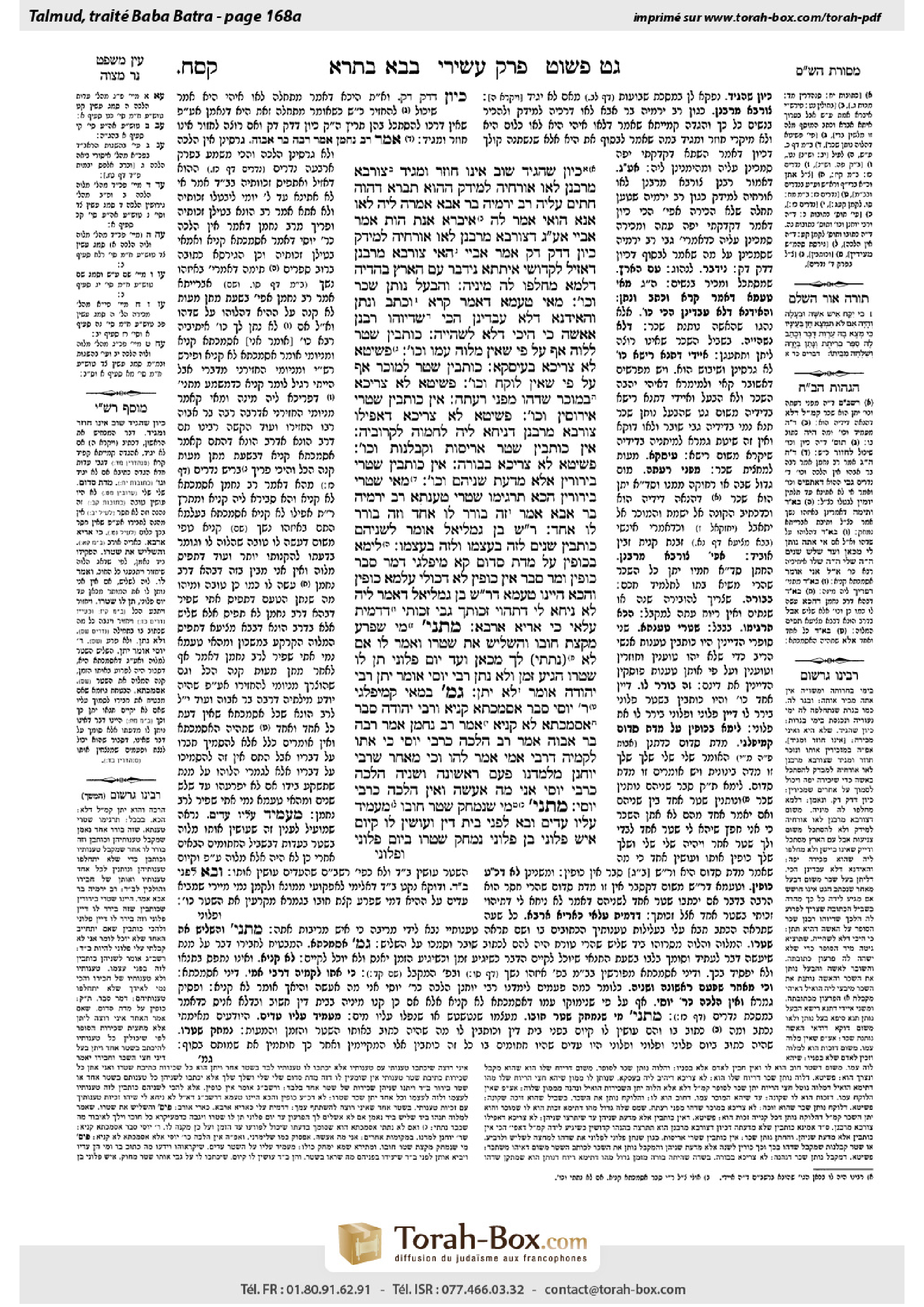
Bava Batra 168a: Talmud study for Daf Yomi
Study the Talmud for Daf Yomi with scanned pages, Hebrew text, English translations from Sefaria and AI-generated French translations.
Passage selection and English or AI-generated French translation are available where the scan has annotations. Daf Study is independent of Torah-Box and Sefaria.
Browse Bava Batra · בבא בתרא · All tractatesBava Batra 168a text and translations
This page of Bava Batra includes the Aramaic text, an English translation and an AI-generated French translation, alongside the scan above.
בבא בתרא קס״ח א · Aramaic and Hebrew text
כֵּיוָן שֶׁהִגִּיד, שׁוּב אֵינוֹ חוֹזֵר וּמַגִּיד; צוּרְבָּא מֵרַבָּנַן לָאו אוֹרְחֵיהּ לְמֵידַק.
הָהוּא תְּבָרָא דַּהֲוָה חֲתִים עֲלֵיהּ רַב יִרְמְיָה בַּר אַבָּא. אֲמַרָה לֵיהּ: לָאו אֲנָא הֲוַאי. אָמַר לַהּ: אִיבְרָא אַנְתְּ הֲוִת. אֲמַר אַבָּיֵי: אַף עַל גַּב דְּצוּרְבָּא מֵרַבָּנַן לָאו אוֹרְחֵיהּ לְמֵידַק, כֵּיוָן דְּדָק – דָּק.
אָמַר אַבָּיֵי: הַאי צוּרְבָּא מֵרַבָּנַן דְּאָזֵיל לְקַדּוֹשֵׁי אִיתְּתָא – נִידְבַּר עַם הָאָרֶץ בַּהֲדֵיהּ, דִּלְמָא מְחַלְּפוּ לַהּ מִינֵּיהּ.
וְהַבַּעַל נוֹתֵן שָׂכָר וְכוּ׳. מַאי טַעְמָא? דְּאָמַר קְרָא: ״וְכָתַב״ ״וְנָתַן״. וְהָאִידָּנָא דְּלָא עָבְדִינַן הָכִי, שַׁדְיוּהוּ רַבָּנַן אַאִשָּׁה כִּי הֵיכִי דְּלָא לְשַׁהֲיֵיהּ.
כּוֹתְבִין שְׁטָר לַלֹּוֶה – אַף עַל פִּי שֶׁאֵין מַלְוֶה עִמּוֹ וְכוּ׳. פְּשִׁיטָא! לָא צְרִיכָא, בְּעִיסְקָא.
כּוֹתְבִין שְׁטָר לַמּוֹכֵר אַף עַל פִּי שֶׁאֵין לוֹקֵחַ וְכוּ׳. פְּשִׁיטָא! לָא צְרִיכָא, בְּמוֹכֵר שָׂדֵהוּ מִפְּנֵי רָעָתָהּ.
אֵין כּוֹתְבִין שְׁטָרֵי אֵירוּסִין וְכוּ׳. פְּשִׁיטָא! לָא צְרִיכָא, דַּאֲפִילּוּ צוּרְבָּא מֵרַבָּנַן דְּנִיחָא לֵיהּ לַחֲמוּהּ לְקָרוֹבֵיהּ.
אֵין כּוֹתְבִין שְׁטַר אֲרִיסוּת וְקַבְּלָנוּת וְכוּ׳. פְּשִׁיטָא! לָא צְרִיכָא, בְּבוּרָה.
אֵין כּוֹתְבִין שְׁטָרֵי בֵירוּרִין אֶלָּא מִדַּעַת שְׁנֵיהֶם וְכוּ׳. מַאי ״שְׁטָרֵי בֵירוּרִין״? הָכָא תַּרְגִּימוּ: שְׁטָרֵי טַעֲנָתָא. רַב יִרְמְיָה בַּר אַבָּא אָמַר: זֶה בּוֹרֵר לוֹ אֶחָד, וְזֶה בּוֹרֵר לוֹ אֶחָד.
רַבָּן שִׁמְעוֹן בֶּן גַּמְלִיאֵל אוֹמֵר: לִשְׁנֵיהֶם כּוֹתְבִין שְׁנַיִם – לְזֶה בְּעַצְמוֹ וּלְזֶה בְּעַצְמוֹ. לֵימָא בְּכוֹפִין עַל מִדַּת סְדוֹם קָא מִיפַּלְגִי –
דְּמָר סָבַר: כּוֹפִין, וּמַר סָבַר: אֵין כּוֹפִין?
לָא, דְּכוּלֵּי עָלְמָא כּוֹפִין; וְהָכָא הַיְינוּ טַעְמָא דְּרַבָּן שִׁמְעוֹן בֶּן גַּמְלִיאֵל – דַּאֲמַר לֵיהּ: לָא נִיחָא לִי דְּתֶהְוֵי זְכוּתָךְ גַּבֵּי זְכוּתִי, דְּדָמֵית עֲלַאי כִּי אַרְיָא אָרְבָא.
מַתְנִי׳ מִי שֶׁפָּרַע מִקְצָת חוֹבוֹ, וְהִשְׁלִישׁ אֶת שְׁטָרוֹ – וְאָמַר לוֹ: ״אִם לֹא נָתַתִּי לְךָ מִכָּאן וְעַד יוֹם פְּלוֹנִי, תֵּן לוֹ שְׁטָרוֹ״, הִגִּיעַ זְמַן וְלֹא נָתַן – רַבִּי יוֹסֵי אוֹמֵר: יִתֵּן, רַבִּי יְהוּדָה אוֹמֵר: לֹא יִתֵּן.
גְּמָ׳ בְּמַאי קָמִיפַּלְגִי? רַבִּי יוֹסֵי סָבַר: אַסְמַכְתָּא קָנְיָא, וְרַבִּי יְהוּדָה סָבַר: אַסְמַכְתָּא לָא קָנְיָא.
אָמַר רַב נַחְמָן אָמַר רַבָּה בַּר אֲבוּהּ אָמַר רַב: הֲלָכָה כְּרַבִּי יוֹסֵי. כִּי אֲתוֹ לְקַמֵּיהּ דְּרַבִּי אַמֵּי, אֲמַר לְהוּ: וְכִי מֵאַחַר שֶׁרַבִּי יוֹחָנָן מְלַמְּדֵנוּ פַּעַם רִאשׁוֹנָה וּשְׁנִיָּה הֲלָכָה כְּרַבִּי יוֹסֵי, אֲנִי מָה אֶעֱשֶׂה?
וְאֵין הֲלָכָה כְּרַבִּי יוֹסֵי.
מַתְנִי׳ מִי שֶׁנִּמְחַק שְׁטַר חוֹבוֹ – מַעֲמִיד עָלָיו עֵדִים, וּבָא לִפְנֵי בֵּית דִּין, וְעוֹשִׂין לוֹ קִיּוּם: ״אִישׁ פְּלוֹנִי בֶּן פְּלוֹנִי נִמְחַק שְׁטָרוֹ בְּיוֹם פְּלוֹנִי,
Bava Batra 168a · English translation
Once one has stated his testimony he may not then state a revision, this case of Rav Yirmeya is an exception, and he can retract his initial statement in which he supported the woman’s claim. The reason is that it is not the manner of a Torah scholar to be careful about identifying women, for reasons of modesty.
The Gemara relates: There was a certain receipt of payment for a marriage contract upon which Rav Yirmeya bar Abba was signed. A woman whose name appeared on the receipt, who was seeking to collect payment of her marriage contract, said to him: It was not I, but another woman with the same name, who had this receipt written. He said to her: But it was you, and you are lying now. Abaye said: Although I said that it is not the manner of a Torah scholar to be careful about identifying women, once he is careful about such an identification and states positively that he recognizes a particular woman, he is careful.
Abaye said: A Torah scholar who goes to betroth a woman should take an ignoramus with him to establish a positive identity of the woman, lest people exchange another woman for her when given to him for marriage, taking advantage of his innocence.
§ The mishna teaches that the husband gives the scribe’s wages for writing a bill of divorce. The Gemara asks: What is the reason for this? The Gemara answers: As the verse states: “When a man takes a wife and marries her, and it comes to pass, if she finds no favor in his eyes, because he has found some unseemly matter in her, he shall write her a scroll of severance and give it in her hand” (Deuteronomy 24:1). It is therefore the husband’s responsibility to have the bill of divorce written. The Gemara adds: But today, the reason that we do not do so, but instead have the woman pay the scribe, is that the Sages placed the burden upon the woman, so that the husband should not delay the divorce by refusing to pay the scribe.
The mishna teaches: A scribe may write a promissory note for a debtor who requests one, even if the creditor is not with him, and it is the debtor who gives the scribe his wages. The Gemara asks: Isn’t it obvious that the debtor pays the wages? After all, he is the beneficiary of the loan. The Gemara answers: No, it is necessary for the mishna to state this, as there are times when the loan is beneficial to the creditor as well, as in a case of a joint venture, where the creditor receives a share of the profits engendered by the money provided to the borrower (see Bava Metzia 104a).
The mishna teaches: A scribe may write a bill of sale for a seller of property who requests one, even if the purchaser is not with him when he presents his request, and it is the purchaser who provides the scribe’s wages. The Gemara asks: Isn’t it obvious that the purchaser pays the wages? After all, he is the beneficiary of the sale. The Gemara answers: No, it is necessary for the mishna to state this, as sometimes the sale is beneficial to the seller as well, as in a case of one who sells a field because of its poor quality, as he is anxious to be rid of it.
The mishna teaches: A scribe may not write documents of betrothal and documents of marriage except with the consent of both the groom and the bride, and it is the groom who provides the scribe’s wages. The Gemara asks: Isn’t it obvious that the groom pays the wages? After all, he is the one acquiring his betrothed. The Gemara answers: No, it is necessary for the mishna to state this, to teach us that it applies even when the groom is a Torah scholar, in which case it gives his father-in-law satisfaction to bring him into his family by having him marry his daughter. Even in such a case, where the bride’s family is a beneficiary, it is the groom who pays the wages.
The mishna teaches: A scribe may not write contracts for sharecroppers and contractors except with the consent of both parties, i.e., the sharecropper or contractor and the one who hires him, and it is the sharecropper or contractor who provides the scribe’s wages. The Gemara asks: Isn’t it obvious that the contractor pays the wages? After all, the contract details his rights to the field. The Gemara answers: No, it is necessary for the mishna to state this, as sometimes the deal is detrimental to the contractor, as in the case of a fallow field. It might have been thought that in this case the cost of the document is borne by the landowner.
The mishna teaches: A scribe may not write documents testifying to arbitration or any other court enactment except with the consent of both parties to the litigation. The Gemara asks: What is meant by documents testifying to arbitration? Here in Babylonia the Sages interpreted it to mean documents recording the claims of the two parties to the litigation. Rav Yirmeya bar Abba says: A document testifying to arbitration is one that records the procedure in which the composition of the court is chosen, as described in tractate Sanhedrin (23a), whereby this litigant chooses one judge and that litigant chooses one judge, and these two judges choose the third one.
§ The mishna teaches that Rabban Shimon ben Gamliel says: The scribe writes two documents for the two parties, one for this one by himself and one for that one by himself. The Gemara analyzes the disagreement between Rabban Shimon ben Gamliel and the first tanna, who did not call for two separate documents: Shall we say that they disagree with regard to the principle that the court coerces people to prevent conduct characteristic of Sodom, i.e., selfish behavior? That is, the case is where one of the litigants does not want to contribute to the writing of a joint document, and insists that each litigant pay to have his own document written, which would entail an additional expenditure on the part of the other party.
The dispute is then as follows: As one Sage, the first tanna, holds that the court coerces people to prevent this conduct, so the obstinate litigant is forced to pay his share of a joint document, and one Sage, Rabban Shimon ben Gamliel, holds that the court does not coerce people to prevent this conduct, and a litigant can insist upon paying only for a document of his own.
The Gemara rejects this analysis: No, everyone in the mishna holds that the court coerces people to prevent conduct characteristic of Sodom, and here this is the reason for the ruling of Rabban Shimon ben Gamliel: It is because the litigant demanding separate documents is not making a pointless, selfish request at all, as he says to the other litigant: It is not amenable for me that your defense, i.e., the record of your claims, should be together with my defense, as you are to me like an ambushing lion, i.e., our interests are in conflict.
MISHNA: In the case of a debtor who repaid part of his debt and with the agreement of the creditor deposited the promissory note with a third party serving as a trustee to ensure that the creditor would not collect the full amount, and the debtor said to the trustee: If I have not given you the balance from now until such and such a day, give the creditor his promissory note, thereby enabling him to collect the full amount stated on the note, if the stipulated time arrived and the debtor did not give the balance to the trustee, Rabbi Yosei says: The trustee should give the promissory note to the creditor, in accordance with the debtor’s stipulation. Rabbi Yehuda says: The trustee should not give it, as the stipulation is void.
GEMARA: With regard to what principle do Rabbi Yosei and Rabbi Yehuda disagree? Rabbi Yosei holds that a transaction with inconclusive consent [asmakhta] effects acquisition. In this case, the debtor willingly undertook a penalty if he would not repay the remainder of the debt on time. Yet, he did not think that he would miss the deadline and be held accountable to pay that penalty. Rabbi Yosei holds that he is nevertheless bound by his word. And Rabbi Yehuda holds that an asmakhta does not effect acquisition, i.e., it is not binding.
Rav Naḥman says that Rabba bar Avuh says that Rav says: The halakha is in accordance with the opinion of Rabbi Yosei. When questioners came before Rabbi Ami, inquiring of him what the halakha is in this matter, he said to them: But since it is the case that Rabbi Yoḥanan taught us a first time and a second time, i.e., repeatedly, that the halakha is in accordance with the opinion of Rabbi Yosei, what can I do to contradict his words?
The Gemara concludes: But in fact the halakha is not in accordance with the opinion of Rabbi Yosei, i.e., an asmakhta is not binding.
MISHNA: In the case of a creditor whose promissory note has become erased, he should produce witnesses who remember the details of the document to testify about it. And they come before the court, and they ratify his promissory note for him, stating: The promissory note of so-and-so was erased, and it stated that a loan for such and such an amount took place on such and such a date,
Bava Batra 168a · Traduction française (IA)
Une fois que l'on a déclaré son témoignage, on ne peut plus ensuite en faire une révision, ce cas de Rav Yirmeya est une exception, et il peut rétracter son premier témoignage dans lequel il soutenait la déclaration de la femme. La raison est que ce n'est pas la manière d'un savant de la Torah de se soucier de l'identification des femmes, pour des raisons de modestie.
La Guemara rapporte : Il y avait un certain reçu de paiement pour un contrat de mariage sur lequel Rav Yirmeya bar Abba avait signé. Une femme dont le nom figurait sur le reçu, qui cherchait à récupérer le paiement de son contrat de mariage, lui dit : Ce n'est pas moi, mais une autre femme portant le même nom, qui avait ce reçu rédigé. Il lui répondit : Mais c'est toi, et tu mens maintenant. Abaye dit : Bien que j'aie dit que ce n'est pas la manière d'un savant de la Torah de se soucier de l'identification des femmes, une fois qu'il est attentif à une telle identification et affirme positivement qu'il reconnaît une femme particulière, il est attentif.
Abaye dit : Un savant de la Torah qui va se fiancer à une femme devrait prendre un ignorant avec lui pour établir une identification positive de la femme, afin que les gens ne remplacent pas une autre femme à sa place lorsqu'ils lui donnent une femme en mariage, en se servant de son ignorance.
§ La Michna enseigne que le mari paie les honoraires du scribe pour la rédaction d'un acte de divorce. La Guemara demande : Quelle est la raison de cela ? La Guemara répond : Comme le texte saint dit : « Quand un homme prend une femme et l'épouse, et cela arrive, si elle ne lui plaît pas, parce qu'il a trouvé quelque chose de laid en elle, il doit écrire un parchemin de séparation et le lui donner » (Deutéronome 24:1). Il est donc la responsabilité du mari de faire rédiger l'acte de divorce. La Guemara ajoute : Mais aujourd'hui, la raison pour laquelle nous ne le faisons pas, mais plutôt que la femme paie le scribe, est que les Sages ont transféré la charge sur la femme, afin que le mari ne tarde pas le divorce en refusant de payer le scribe.
La Michna enseigne : Un scribe peut rédiger un billet de créance pour un débiteur qui le demande, même si le créancier n'est pas présent, et c'est le débiteur qui paie les honoraires du scribe. La Guemara demande : N'est-ce pas évident que le débiteur paie les honoraires ? Après tout, il est le bénéficiaire du prêt. La Guemara répond : Non, il est nécessaire que la Michna le précise, car il y a des cas où le prêt est bénéfique pour le créancier également, comme dans un cas de partenariat, où le créancier reçoit une part des profits générés par l'argent fourni au prêteur (voir Bava Metzia 104a).
La Michna enseigne : Un scribe peut rédiger un acte de vente pour un vendeur de propriété qui le demande, même si l'acheteur n'est pas présent lorsqu'il présente sa demande, et c'est l'acheteur qui paie les honoraires du scribe. La Guemara demande : N'est-ce pas évident que l'acheteur paie les honoraires ? Après tout, il est le bénéficiaire de la vente. La Guemara répond : Non, il est nécessaire que la Michna le précise, car parfois la vente est bénéfique pour le vendeur également, comme dans le cas d'une personne qui vend un champ à cause de sa mauvaise qualité, car il est anxieux de s'en débarrasser.
La Michna enseigne : Un scribe ne peut pas rédiger des documents de fiançailles ou de mariage sans le consentement des deux parties, le mari et la mariée, et c'est le mari qui paie les honoraires du scribe. La Guemara demande : N'est-ce pas évident que le mari paie les honoraires ? Après tout, c'est lui qui acquiert sa fiancée. La Guemara répond : Non, il est nécessaire que la Michna le précise, afin de nous enseigner qu'il s'applique même lorsque le mari est un savant de la Torah, dans le cas où il est agréable à son beau-père de l'introduire dans sa famille en le mariant à sa fille. Même dans ce cas, où la famille de la mariée est un bénéficiaire, c'est le mari qui paie les honoraires.
La Michna enseigne : Un scribe ne peut pas rédiger des contrats pour des cultivateurs en partage ou des entrepreneurs sans le consentement des deux parties, c'est-à-dire le cultivateur ou l'entrepreneur et celui qui l'engage, et c'est le cultivateur ou l'entrepreneur qui paie les honoraires du scribe. La Guemara demande : N'est-ce pas évident que l'entrepreneur paie les honoraires ? Après tout, le contrat détaille ses droits sur le champ. La Guemara répond : Non, il est nécessaire que la Michna le précise, car parfois le deal est défavorable à l'entrepreneur, comme dans le cas d'un champ abandonné. Il aurait pu être pensé que dans ce cas, le coût du document est supporté par le propriétaire du champ.
La Michna enseigne : Un scribe ne peut pas rédiger des documents témoignant d'un arbitrage ou d'autres ordonnances de tribunal sans le consentement des deux parties en litige. La Guemara demande : De quoi parle-t-on lorsqu'on dit des documents témoignant d'un arbitrage ? Ici en Babylone, les Sages l'ont interprété comme des documents enregistrant les revendications des deux parties en litige. Rav Yirmeya bar Abba dit : Un document témoignant d'un arbitrage est celui qui enregistre la procédure par laquelle le tribunal est composé, comme décrit dans le traité Sanhédrin (23a), où ce litigeant choisit un juge et celui-ci choisit un juge, et ces deux juges choisissent le troisième.
§ La Michna enseigne que Rabban Shimon ben Gamliel dit : Le scribe rédige deux documents pour les deux parties, un pour celui-ci par lui-même et un pour celui-là par lui-même. La Guemara analyse le désaccord entre Rabban Shimon ben Gamliel et le premier tanna, qui n'a pas demandé deux documents séparés : Devons-nous dire qu'ils s'opposent sur le principe que le tribunal force les gens à éviter les comportements caractéristiques de Sodome, c'est-à-dire le comportement égoïste ? C'est-à-dire le cas où l'un des parties en litige ne veut pas contribuer à la rédaction d'un document commun, et insiste pour que chaque partie paie pour avoir son propre document rédigé, ce qui entraînerait un coût supplémentaire pour l'autre partie.
Le débat est alors le suivant : Un sage, le premier tanna, affirme que la cour force les gens à ne pas agir ainsi, de sorte que le litige obstiné est contraint de payer sa part d'un document partagé, et un autre sage, Rabban Shimon ben Gamliel, affirme que la cour ne force pas les gens à ne pas agir ainsi, et un litigeur ne peut exiger de payer qu'un document qui lui appartient.
La Guemara rejette cette analyse : Non, tout le monde dans la michna affirme que la cour force les gens à ne pas agir ainsi, et ici c'est la raison du jugement de Rabban Shimon ben Gamliel : C'est parce que le litigeur exigeant des documents séparés ne fait pas une demande vaine et égoïste, car il dit à l'autre litigeur : Il ne m'est pas agréable que votre défense, c'est-à-dire l'enregistrement de vos revendications, soit avec ma défense, car vous êtes pour moi comme un lion qui attaque, c'est-à-dire que nos intérêts sont en conflit.
MICHNA : Dans le cas d'un débiteur qui a remboursé une partie de sa dette et, avec l'accord du créancier, a déposé le billet de change avec un tiers agissant en tant que gardien pour garantir que le créancier ne pourrait pas récupérer le montant total, et que le débiteur a dit au gardien : Si je n'ai pas vous donné le reste depuis maintenant jusqu'à une telle date, donnez le billet de change au créancier, ce qui permettrait à ce dernier de récupérer le montant indiqué sur le billet, si la date stipulée est arrivée et que le débiteur n'a pas donné le reste au gardien, Rabbi Yosei dit : Le gardien devrait donner le billet de change au créancier, conformément à la stipulation du débiteur. Rabbi Yehuda dit : Le gardien ne devrait pas le donner, car la stipulation est nulle.
GUEMARA : Sur quel principe Rabbi Yosei et Rabbi Yehuda s'opposent-ils ? Rabbi Yosei affirme qu'une transaction avec un consentement indéterminé [asmakhta] constitue un acte d'acquisition. Dans ce cas, le débiteur a volontairement accepté une sanction s'il ne remboursait pas le reste de sa dette à temps. Cependant, il n'avait pas pensé qu'il manquerait le délai et serait tenu responsable de cette sanction. Rabbi Yosei affirme qu'il est tout de même lié par ses paroles. Et Rabbi Yehuda affirme qu'une asmakhta ne constitue pas un acte d'acquisition, c'est-à-dire qu'elle n'est pas contraignante.
Rav Naḥman dit que Rabba bar Avuh dit que Rav dit : La halakha suit l'opinion de Rabbi Yosei. Lorsque des questionneurs sont venus devant Rabbi Ami, en cherchant à savoir quelle est la halakha dans cette affaire, il a dit à ceux-ci : Mais puisque c'est le cas que Rabbi Yoḥanan nous a appris une première fois et une deuxième fois, c'est-à-dire répétamment, que la halakha suit l'opinion de Rabbi Yosei, que puis-je faire pour contredire ses paroles ?
La Guemara conclut : En réalité, la halakha ne suit pas l'opinion de Rabbi Yosei, c'est-à-dire qu'une asmakhta n'est pas contraignante.
MICHNA : Dans le cas d'un créancier dont le billet de change s'est effacé, il doit produire des témoins qui se souviennent des détails du document pour témoigner à son sujet. Et ils s'adressent devant la cour, et ils ratifient son billet de change pour lui, en disant : Le billet de change de tel et tel s'est effacé, et il stipulait qu'un prêt d'un tel montant a eu lieu le tel jour.
Traduction française générée par IA à partir de l’édition anglaise de Sefaria. Vérifie toujours un passage avec le texte source.
Text from Sefaria: William Davidson Edition - Vocalized Aramaic (CC BY NC); William Davidson Edition - English (CC BY NC).