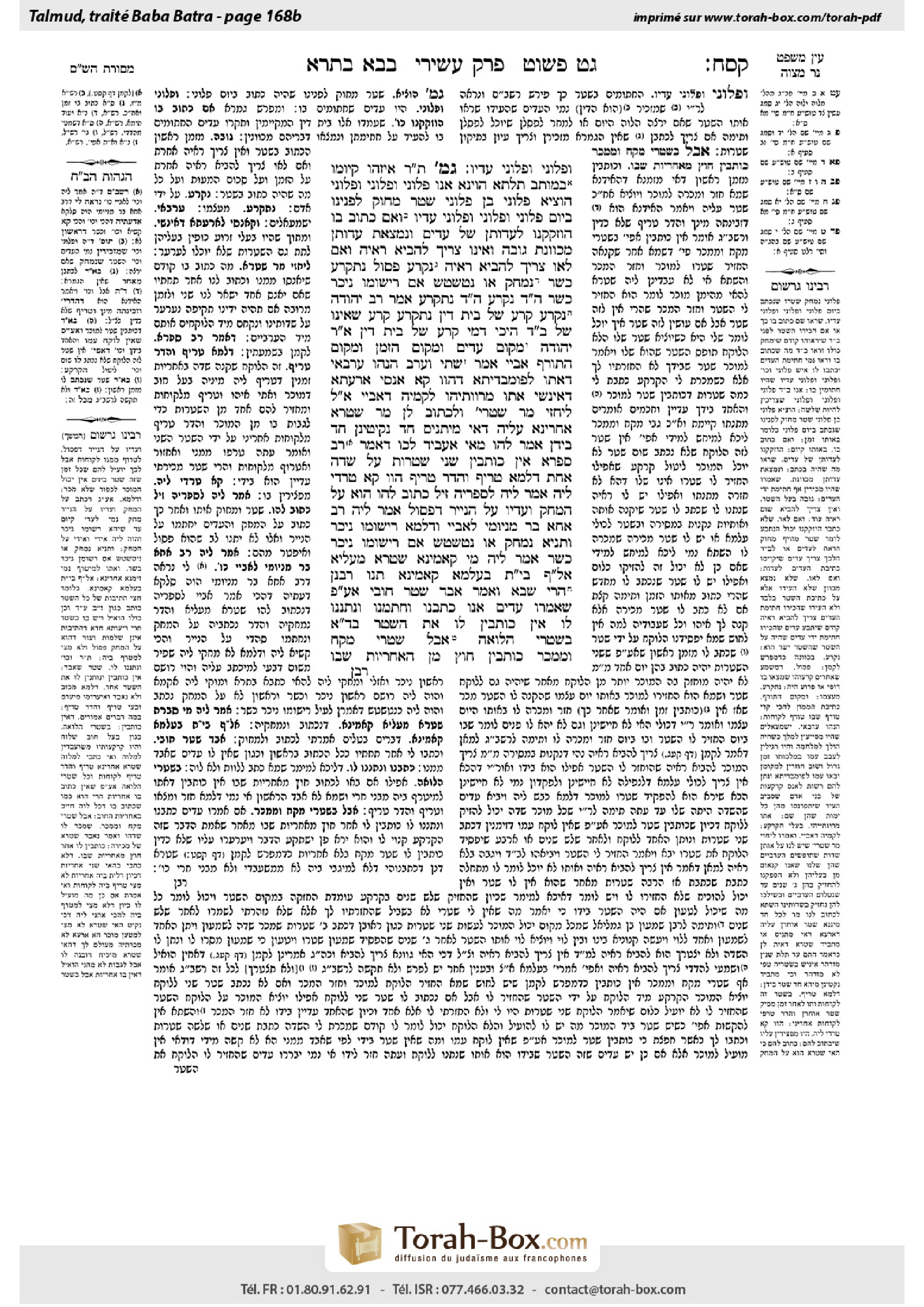
Bava Batra 168b: Talmud study for Daf Yomi
Study the Talmud for Daf Yomi with scanned pages, Hebrew text, English translations from Sefaria and AI-generated French translations.
Passage selection and English or AI-generated French translation are available where the scan has annotations. Daf Study is independent of Torah-Box and Sefaria.
Browse Bava Batra · בבא בתרא · All tractatesBava Batra 168b text and translations
This page of Bava Batra includes the Aramaic text, an English translation and an AI-generated French translation, alongside the scan above.
בבא בתרא קס״ח ב · Aramaic and Hebrew text
וּפְלוֹנִי וּפְלוֹנִי עֵדָיו״.
גְּמָ׳ תָּנוּ רַבָּנַן: אֵיזֶהוּ קִיּוּמוֹ? ״בְּמוֹתַב תְּלָתָא הֲוֵינָא אָנוּ פְּלוֹנִי וּפְלוֹנִי וּפְלוֹנִי, הוֹצִיא פְּלוֹנִי בֶּן פְּלוֹנִי שְׁטָר מָחוּק לְפָנֵינוּ בְּיוֹם פְּלוֹנִי, וּפְלוֹנִי וּפְלוֹנִי עֵדָיו״. וְאִם כָּתוּב בּוֹ: ״הוּזְקַקְנוּ לְעֵדוּתָן שֶׁל עֵדִים, וְנִמְצֵאת עֵדוּתָן מְכֻוֶּונֶת״ – גּוֹבֶה, וְאֵינוֹ צָרִיךְ לְהָבִיא רְאָיָה. וְאִם לָאו, צָרִיךְ לְהָבִיא רְאָיָה.
נִקְרַע – פָּסוּל, נִתְקָרַע – כָּשֵׁר. נִמְחַק אוֹ נִטַּשְׁטֵשׁ – אִם רִישּׁוּמוֹ נִיכָּר, כָּשֵׁר.
הֵיכִי דָּמֵי נִקְרַע, הֵיכִי דָּמֵי נִתְקָרַע? אָמַר רַב יְהוּדָה: נִקְרַע – קֶרַע שֶׁל בֵּית דִּין, נִתְקָרַע – קֶרַע שֶׁאֵינוֹ שֶׁל בֵּית דִּין.
הֵיכִי דָּמֵי קֶרַע שֶׁל בֵּית דִּין? אָמַר רַב יְהוּדָה: מְקוֹם עֵדִים וּמְקוֹם הַזְּמַן וּמְקוֹם הַתּוֹרֶף. אַבָּיֵי אָמַר: שְׁתִי וָעֵרֶב.
הָנְהוּ עַרְבָאֵי דַּאֲתוֹ לְפוּמְבְּדִיתָא, דַּהֲווֹ קָא אָנְסִי אַרְעָתָא דְאִינָשֵׁי. אֲתוֹ מָרָווֹתַיְהוּ לְקַמֵּיהּ דְּאַבָּיֵי, אֲמַרוּ לֵיהּ: לִיחְזֵי מָר שְׁטָרִין, וְלִכְתּוֹב לַן מָר שְׁטָרָא אַחֲרִינָא עֲלֵיהּ, דְּאִי מִיתְּנִיס חַד – נְקִיטִינַן חַד בִּידַן.
אֲמַר לְהוּ: מַאי אֶעֱבֵיד לְכוּ? דְּאָמַר רַב סָפְרָא: אֵין כּוֹתְבִין שְׁנֵי שְׁטָרוֹת עַל שָׂדֶה אַחַת, דִּלְמָא טָרֵיף וַהֲדַר טָרֵיף.
הֲווֹ קָא טָרְדִי לֵיהּ, אֲמַר לֵיהּ לְסָפְרֵיהּ: זִיל כְּתוֹב לְהוּ הוּא עַל הַמְּחָק וְעֵדָיו עַל הַנְּיָיר, דְּפָסוּל.
אֲמַר לֵיהּ רַב אַחָא בַּר מִנְיוֹמֵי לְאַבָּיֵי: וְדִלְמָא רִישּׁוּמוֹ נִיכָּר, וְתַנְיָא: נִמְחַק אוֹ נִטַּשְׁטֵשׁ – אִם רִישּׁוּמוֹ נִיכָּר, כָּשֵׁר! אָמַר לֵיהּ: מִי קָאָמֵינָא שְׁטָרָא מְעַלְּיָא? ״אָלֶף בֵּית״ בְּעָלְמָא קָאָמֵינָא.
תָּנוּ רַבָּנַן: הֲרֵי שֶׁבָּא וְאָמַר ״אָבַד שְׁטַר חוֹבִי״, אַף עַל פִּי שֶׁאָמְרוּ עֵדִים ״אָנוּ כָּתַבְנוּ וְחָתַמְנוּ וְנָתַנְנוּ לוֹ״ – אֵין כּוֹתְבִין לוֹ אֶת הַשְּׁטָר. בַּמֶּה דְּבָרִים אֲמוּרִים – בְּשִׁטְרֵי הַלְוָאָה, אֲבָל שִׁטְרֵי מִקָּח וּמִמְכָּר – כּוֹתְבִין, חוּץ מִן הָאַחְרָיוּת שֶׁבּוֹ.
Bava Batra 168b · English translation
and so-and-so and so-and-so were its witnesses. The ratification document is signed, and it may be used as a replacement for the erased document.
GEMARA: The Sages taught (Tosefta, Bava Metzia 1:16): What is the text of the ratification document of an erased document? The court writes as follows: We, so-and-so and so-and-so and so-and-so, were sitting as three judges, and so-and-so, son of so-and-so, produced an erased document before us, which was written on such and such a date, and so-and-so and so-and-so were its witnesses. And if it is written in this ratification document also: We engaged in the investigation of the testimony of the witnesses and their testimony has been found to be congruent, the creditor can collect his debt on the basis of this ratification document, and he does not need to bring further proof. But if this formula is not written, the creditor needs to bring further proof of the loan in order to collect it.
The baraita continues with its discussion of damaged documents: If a promissory note was torn intentionally it is not valid, but if it became torn accidentally it is valid. In a case where it was erased or smudged, if its imprint is recognizable, i.e., if the words are still legible, though barely, it is valid.
The Gemara seeks to clarify the terms in the second part of the baraita: What are the circumstances, i.e., what are the defining characteristics, of a document that was torn, and what are the circumstances of a document that became torn? Rav Yehuda says: A document that was torn means that it had a tear created by the court, because they wished to render it not valid due to payment of the loan or some other circumstance. A document that became torn means it had a tear that was not created by the court.
The Gemara seeks further clarification: What are the circumstances, i.e., what are the signs, of a document that had a tear created by the court? Rav Yehuda says: The document has a tear that ruins the place of the witnesses’ signatures and the place of the date and the place of the essential part of a document. Abaye says: It has a tear that goes both lengthwise and widthwise.
§ The Gemara relates: There was once a certain group of Arabs who came to Pumbedita and who would rob people’s land and force the victims to surrender the deeds to their property to prevent subsequent legal action. The owners of land who had not yet fallen victim to these Arabs came before Abaye and said to him: Let the Master look at our deeds to our property and let the Master write us another deed for it, so that if one of the deeds is robbed we will have the other one in our possession.
Abaye said to them: What can I do for you? I cannot comply with your request, as Rav Safra says: One may not write two deeds of ownership for one field, lest the owner of that land repossess property once and then go back and repossess it once again. Generally, whenever real estate is sold there is a guarantee given to the purchaser in the event that the land is repossessed by the seller’s creditor or by someone else who proves that the land rightfully belongs to him. If the seller of the repossessed land has no money to honor the guarantee, the purchaser can repossess property from others who had purchased property from the same seller subsequent to the sale of the repossessed land. In order to do so, he would have to produce the bill of sale proving that he had purchased the repossessed property. If he has two such deeds, he would be able to collect payment twice. To eliminate this possibility, duplicate property deeds are not written.
The landowners kept badgering Abaye to write the duplicate documents, until, in order to be rid of them, he said to his scribe: Go write the document for them, but first write on paper and then erase it, and then write the desired document over the erased text, so that the text of the document will be written over an erasure, and the signatures of its witnesses will be on a part of the paper where the writing had not been erased, a situation in which the document is not valid.
Rav Aḥa bar Minyumi said to Abaye: But perhaps the first writing on the paper was not erased thoroughly, so its imprint is recognizable, and it is taught in the baraita that in a case where the writing on a document was erased or smudged, if its imprint is recognizable, the document is valid. Abaye said to him: Did I say that he should write a proper document and then erase it? I said, i.e., I intended, that he should merely write letters of the alphabet [alef beit], not actual words.
§ The Sages taught in a baraita: In a case where one came to court and said: My promissory note was lost, even if witnesses said: We wrote and signed such a promissory note and gave it to this man, the court may not write a new document for him. The Gemara asks: In what case is this statement said? In the case of documents detailing loans. But in a case of deeds of buying and selling land, the court may write a replacement document, excluding the standard guarantee that was in the first document, which states that if the field is repossessed the seller will compensate the purchaser for his loss.
Bava Batra 168b · Traduction française (IA)
et tels et tels furent ses témoins. Le document de ratification est signé, et il peut être utilisé comme remplacement du document effacé.
GUEMARA : Les Sages enseignent (Tosefta, Bava Metzia 1:16) : Quel est le texte du document de ratification d’un document effacé ? Le tribunal écrit comme suit : Nous, tels et tels et tels, étions assis comme trois juges, et tels, fils de tels, a présenté un document effacé devant nous, qui avait été écrit le tel jour, et tels et tels furent ses témoins. Et si on écrit dans ce document de ratification également : Nous avons mené une enquête sur le témoignage des témoins et leur témoignage a été trouvé conforme, le créancier peut récupérer son créance sur la base de ce document de ratification, et il n’a pas besoin de présenter d’autres preuves. Mais si cette formule n’est pas écrite, le créancier a besoin de présenter d’autres preuves du prêt afin de le récupérer.
La baraïta continue avec sa discussion sur les documents endommagés : Si un billet de promesse avait été déchiré intentionnellement, il n’est pas valide, mais si il s’était déchiré accidentellement, il est valide. Dans le cas où il avait été effacé ou sali, si son empreinte est reconnaissable, c’est-à-dire si les mots sont encore lisibles, même à peine, il est valide.
La Guemara cherche à clarifier les termes dans la deuxième partie de la baraïta : Quels sont les circonstances, c’est-à-dire quels sont les caractéristiques définissantes, d’un document qui a été déchiré, et quels sont les circonstances d’un document qui s’est déchiré ? Rav Yehuda dit : Un document qui a été déchiré signifie qu’il avait une déchirure créée par le tribunal, car ils souhaitaient le rendre non valide en raison du paiement du prêt ou d’un autre motif. Un document qui s’est déchiré signifie qu’il avait une déchirure qui n’a pas été créée par le tribunal.
La Guemara cherche à clarifier davantage : Quelles sont les circonstances, c’est-à-dire quels sont les signes, d’un document qui avait une déchirure créée par le tribunal ? Rav Yehuda dit : Le document a une déchirure qui détruit la place des signatures des témoins et la place de la date et la place de la partie essentielle d’un document. Abaye dit : Il a une déchirure qui s’étend à la fois longitudinalement et transversalement.
§ La Guemara rapporte : Il y avait une fois un groupe d’Arabes qui sont venus à Pumbedita et qui volaient les terres des gens et forçaient les victimes à remettre les actes de propriété de leurs terres afin d’éviter toute action juridique ultérieure. Les propriétaires de terres qui n’avaient pas encore été victimes de ces Arabes se sont présentés devant Abaye et lui ont dit : Que le Maître examine nos actes de propriété et que le Maître écrive pour nous un autre acte, afin que si l’un des actes est volé, nous ayons l’autre en notre possession.
Abaye dit à eux : Que puis-je faire pour vous ? Je ne peux pas répondre à votre demande, car Rav Safra dit : On ne peut pas écrire deux actes de propriété pour un même champ, de peur que le propriétaire de cette terre réclame la propriété une fois et puis revienne à nouveau réclamer la propriété. Généralement, chaque fois qu’un terrain est vendu, un garant est donné à l’acheteur en cas de réclamation de ce terrain par le créancier du vendeur ou par quelqu’un d’autre qui prouve que le terrain appartient légitimement à lui. Si le vendeur du terrain réclamé n’a pas d’argent pour honorer ce garant, l’acheteur peut réclamer la propriété à d’autres qui ont acheté des terrains du même vendeur après la vente du terrain réclamé. Pour cela, il devrait produire le contrat de vente prouvant qu’il avait acheté le terrain réclamé. Si il a deux tels actes, il pourrait récupérer le paiement deux fois. Pour éliminer cette possibilité, les actes de propriété ne sont pas rédigés en double.
Les propriétaires de terres ont continué à harceler Abaye pour écrire les documents doubles, jusqu’à ce qu’il dise à son secrétaire : Écris le document pour eux, mais d’abord écris sur du papier et ensuite efface, puis écris le document souhaité sur l’écriture effacée, de sorte que le texte du document soit écrit sur une effacement, et les signatures des témoins soient sur une partie du papier où l’écriture n’avait pas été effacée, une situation où le document n’est pas valide.
Rav Aḥa bar Minyumi dit à Abaye : Mais peut-être que l’écriture précédente sur le papier n’a pas été effacée complètement, de sorte que son empreinte est reconnaissable, et il est enseigné dans la baraïta que dans le cas où l’écriture d’un document a été effacée ou salie, si son empreinte est reconnaissable, le document est valide. Abaye dit à lui : Ai-je dit que je devais écrire un document correct et ensuite l’effacer ? J’ai dit, c’est-à-dire j’intendais, qu’il devait simplement écrire des lettres de l’alphabet [alef beit], pas des mots réels.
§ Les Sages enseignent dans une baraïta : Dans le cas où l’on vient devant le tribunal et dit : Mon billet de promesse a été perdu, même si les témoins disent : Nous avons écrit et signé un tel billet de promesse et nous l’avons donné à cette personne, le tribunal ne peut pas écrire un nouveau document pour lui. La Guemara demande : Dans quel cas cette déclaration est-elle dite ? Dans le cas des documents détaillant des prêts. Mais dans le cas des actes de vente et d’achat de terres, le tribunal peut écrire un document de remplacement, excluant la garantie standard qui était dans le premier document, qui stipule que si le terrain est réclamé, le vendeur compensera l’acheteur pour sa perte.
Traduction française générée par IA à partir de l’édition anglaise de Sefaria. Vérifie toujours un passage avec le texte source.
Text from Sefaria: William Davidson Edition - Vocalized Aramaic (CC BY NC); William Davidson Edition - English (CC BY NC).