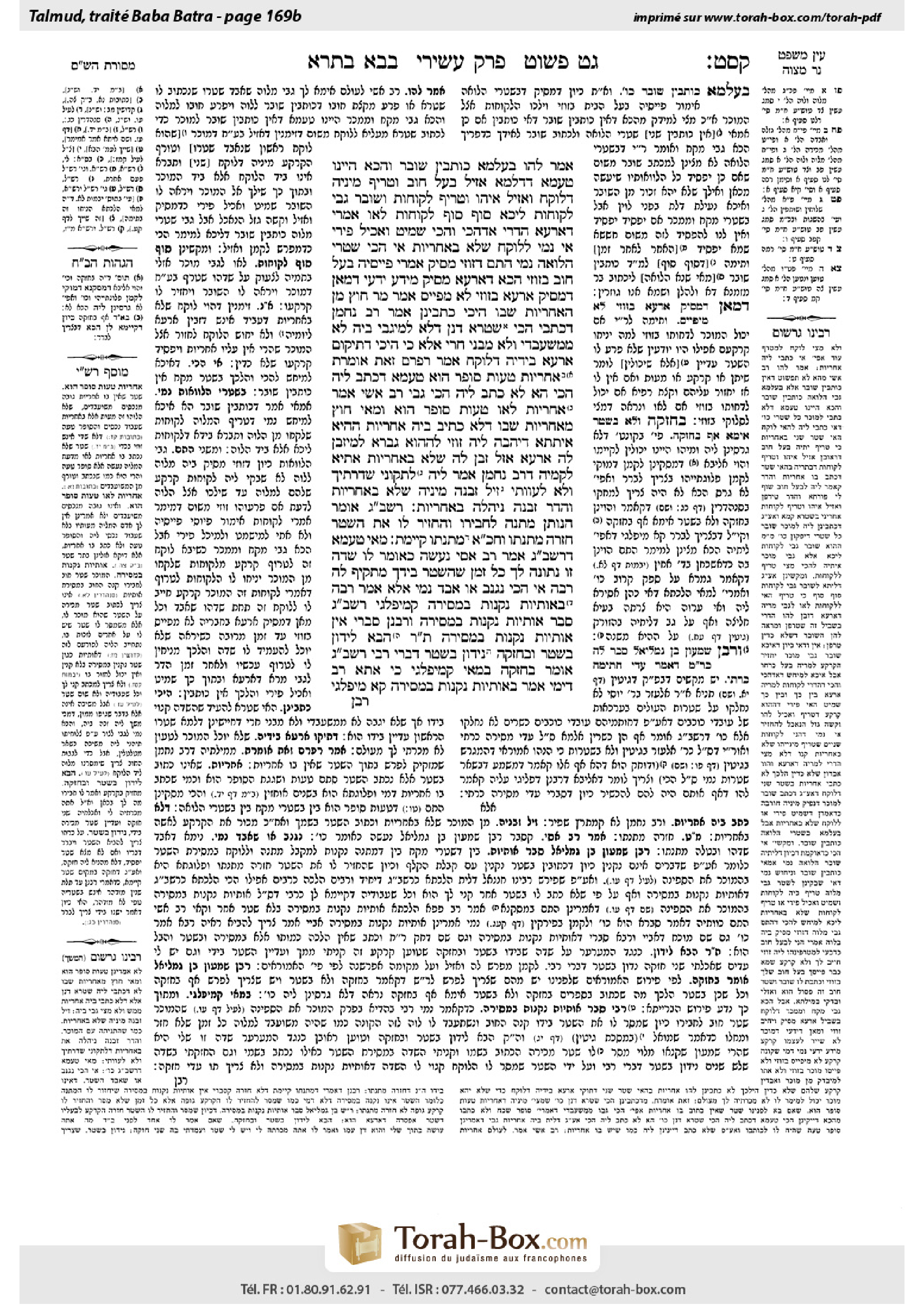
Bava Batra 169b: Talmud study for Daf Yomi
Study the Talmud for Daf Yomi with scanned pages, Hebrew text, English translations from Sefaria and AI-generated French translations.
Passage selection and English or AI-generated French translation are available where the scan has annotations. Daf Study is independent of Torah-Box and Sefaria.
Browse Bava Batra · בבא בתרא · All tractatesBava Batra 169b text and translations
This page of Bava Batra includes the Aramaic text, an English translation and an AI-generated French translation, alongside the scan above.
בבא בתרא קס״ט ב · Aramaic and Hebrew text
אֲמַר לְהוּ: בְּעָלְמָא כּוֹתְבִין שׁוֹבָר, וְהָכָא הַיְינוּ טַעְמָא – דְּדִלְמָא אָזֵיל בַּעַל חוֹב וְטָרֵיף מִינֵּיהּ דְּלוֹקֵחַ, וְאָזֵיל אִיהוּ וְטָרֵיף לָקוֹחוֹת, וְשׁוֹבָר גַּבֵּי לָקוֹחוֹת לֵיכָּא.
סוֹף סוֹף, לָקוֹחוֹת לָאו אַמָּרֵי דְאַרְעָא הָדְרִי?
אַדְּהָכִי וְהָכִי שָׁמֵיט וְאָכֵיל פֵּירֵי.
אִי נָמֵי, לְלוֹקֵחַ שֶׁלֹּא בְּאַחְרָיוּת.
אִי הָכִי, שְׁטָרֵי הַלְוָאָה נָמֵי!
הָתָם, דְּזוּזֵי מַסֵּיק – אָמְרִי: פַּיְּיסֵיהּ בַּעַל חוֹב בְּזוּזֵי. הָכָא, דְּאַרְעָא מַסֵּיק – מִידָּע יָדְעִי דְּמַאן דְּמַסֵּיק אַרְעָא, בְּזוּזֵי לָא מִפַּיַּיס.
אָמַר מָר: חוּץ מִן הָאַחְרָיוּת שֶׁבּוֹ. הֵיכִי כָּתְבִינַן? אָמַר רַב נַחְמָן, דְּכָתְבִי הָכִי: ״שְׁטָרָא דְּנַן דְּלָא לְמִיגְבֵּי בֵּיהּ לָא מִמְּשַׁעְבְּדִי וְלָא מִבְּנֵי חָרֵי, אֶלָּא כִּי הֵיכִי דְּתֵיקוּם אַרְעָא בִּידֵיהּ דְּלוֹקֵחַ״.
אָמַר רַפְרָם, זֹאת אוֹמֶרֶת: אַחְרָיוּת – טָעוּת סוֹפֵר הוּא; טַעְמָא דִּכְתַב לֵיהּ הָכִי, הָא לָא כְּתַב לֵיהּ הָכִי – גָּבֵי.
רַב אָשֵׁי אָמַר: אַחְרָיוּת – לָאו טָעוּת סוֹפֵר הוּא, וּמַאי ״חוּץ מֵאַחְרָיוּת שֶׁבּוֹ״ – דְּלָא כְּתִיב בֵּיהּ אַחְרָיוּת.
הָהִיא אִיתְּתָא דִּיהַבָה לֵיהּ זוּזֵי לְהָהוּא גַּבְרָא לְמִיזְבַּן לַהּ אַרְעָא, אֲזַל זְבַן לַהּ שֶׁלֹּא בְּאַחְרָיוּת. אָתְיָא לְקַמֵּיהּ דְּרַב נַחְמָן,
אֲמַר לֵיהּ: ״לְתַקּוֹנֵי שַׁדַּרְתָּיךָ, וְלָא לְעַוּוֹתֵי. זִיל זִבְנַהּ מִינֵּיהּ שֶׁלֹּא בְּאַחְרָיוּת, וַהֲדַר זַבְּנַהּ נִיהֲלַהּ בְּאַחְרָיוּת״.
רַבָּן שִׁמְעוֹן בֶּן גַּמְלִיאֵל אוֹמֵר: הַנּוֹתֵן מַתָּנָה לַחֲבֵירוֹ, וְהֶחְזִיר לוֹ אֶת הַשְּׁטָר – חָזְרָה מַתְּנָתוֹ. וַחֲכָמִים אוֹמְרִים: מַתְּנָתוֹ קַיֶּימֶת. מַאי טַעְמָא דְּרַבָּן שִׁמְעוֹן בֶּן גַּמְלִיאֵל? אָמַר רַב אַסִּי, נַעֲשָׂה כְּאוֹמֵר לוֹ: שָׂדֶה זוֹ נְתוּנָה לְךָ כׇּל זְמַן שֶׁהַשְּׁטָר בְּיָדְךָ.
מַתְקֵיף לַהּ רַבָּה: אִי הָכִי, נִגְנַב אוֹ אָבַד נָמֵי!
אֶלָּא אָמַר רַבָּה: בְּאוֹתִיּוֹת נִקְנוֹת בִּמְסִירָה קָמִיפַּלְגִי – רַבָּן שִׁמְעוֹן בֶּן גַּמְלִיאֵל סָבַר: אוֹתִיּוֹת נִקְנוֹת בִּמְסִירָה, וְרַבָּנַן סָבְרִי: אֵין אוֹתִיּוֹת נִקְנוֹת בִּמְסִירָה.
תָּנוּ רַבָּנַן: הַבָּא לִידּוֹן בִּשְׁטָר וּבַחֲזָקָה, נִידּוֹן בִּשְׁטָר; דִּבְרֵי רַבִּי. רַבָּן שִׁמְעוֹן בֶּן גַּמְלִיאֵל אוֹמֵר: בַּחֲזָקָה.
בְּמַאי קָמִיפַּלְגִי? כִּי אֲתָא רַב דִּימִי, אָמַר: בְּאוֹתִיּוֹת נִקְנוֹת בִּמְסִירָה קָא מִיפַּלְגִי –
Bava Batra 169b · English translation
Rav Pappa or Rav Ashi said to them: Do not draw this conclusion. It is possible that the tanna of the baraita holds that generally the court writes a receipt when a creditor has lost his promissory note. And here, this is the reason that it does not write a receipt: As, perhaps the creditor, i.e., the one from whom the property was stolen, will go and repossess property from the purchaser who bought the stolen land, and the purchaser, seeking reimbursement in accordance with the guarantee, will go and repossess property from other purchasers who had later bought property from the same seller. And the receipt will not help, because it is not with the purchasers who bought property from the seller, but is in the possession of the seller himself. The purchasers, who are the ones who will suffer from the double collection, have no protection; they will in fact not even be aware that they are the victims of a double collection.
The Gemara asks: Ultimately, don’t these purchasers go back to the owner, i.e., the seller, of the land to demand reimbursement? At that point the seller will produce the receipt, exposing the double collection, and the entire process will be reversed, so that ultimately the purchaser who suffered from the unjust collection will obtain possession of his property.
The Gemara answers: While it is true that ultimately the deception will be discovered, in the interim, between the time the land was unjustly repossessed from the purchaser and the time when the injustice is reversed, the one who repossessed the land seizes the land and consumes its produce, i.e., he enjoys the profits produced by the land, and it will be difficult to receive full reimbursement for this stolen produce.
Alternatively, the reason the option of writing a receipt for the seller of the land is not pursued here is that there is a concern about one who purchases land without a guarantee. As such a purchaser knows that he has no recourse to be reimbursed from the seller if the land he bought is repossessed, he will never contact the seller and discover that the seller has a receipt and that he has been the victim of an unjust double collection.
The Gemara asks: If so, the same concern should be taken into consideration in the case of promissory notes as well. And yet Rav Pappa, or Rav Ashi, said that the tanna of the baraita concedes that a receipt may be written for the debtor to enable the collection of a debt in the event of the loss of the promissory note. Why are the aforementioned concerns not applicable to the case of debt collection?
The Gemara answers: There, where the debtor owes money, when the creditor seeks to repossess sold land, the purchaser of that land will say to himself: There is a possibility that the debtor appeased the creditor by paying him money, since debts are usually settled with money. I will therefore investigate the matter with the debtor before allowing the creditor to repossess my land. At that point the receipt, held by the debtor, will be discovered, and double collection will be prevented. Here, where he owes land, as the issue is that the claim is based on reimbursement for having bought stolen land, the purchaser knows that it is not common for one who is owed land to be appeased with money in such cases. The purchaser will therefore allow his land to be repossessed and will seek reimbursement at a later time.
§ The Gemara returns to the baraita and analyzes one of its statements. The Master says in the baraita: With regard to deeds of buying and selling land, the court may write a replacement document, excluding the guarantee that was in the first document that if the field is repossessed the seller will compensate the purchaser for his loss. How do we write a bill of sale in such a way that it does not include this guarantee? Rav Naḥman said that the case is one in which the court writes as follows: Our deed is not intended to enable the collection of reimbursement in event of repossession, neither collection from liened property that has been sold nor collection from unsold property; rather, it is intended merely to ensure that the land is established in the possession of the purchaser.
Rafram says: This statement of Rav Naḥman serves to say that the omission of the guarantee of the sale from a document is a scribal error. That is, it is assumed that when one purchases land he expects to have his purchase guaranteed, and that if such a clause is not stated in the document it is presumed to be a mere scribal oversight, and a guarantee is in effect. Rav Naḥman said, in explaining the baraita, that the only reason a land purchase would not have a guarantee is that the scribe wrote this for him, i.e., he wrote that there is no guarantee, explicitly in the deed; this indicates that if the scribe did not write this explicitly for the purchaser, but left out the subject of the guarantee altogether, the purchaser would nevertheless have the guarantee and would be able to collect reimbursement from the seller in the event of repossession.
Rav Ashi disagrees and says: The omission of the guarantee of the sale from a document is not a scribal error. Accordingly, if mention of a guarantee is omitted from a bill of sale, there is in fact no guarantee. And what does the baraita mean when it says: Excluding the guarantee that was in the first document? It means simply that in this case there was no clause about a guarantee written in it at all.
The Gemara relates: There was a certain woman who gave money to a certain man to act as her agent and purchase land for her. The agent went and purchased land for her, but he conducted the purchase in such a way that it was without a guarantee. The woman wanted to take action against the agent and came before Rav Naḥman to ask what recourse she had.
Rav Naḥman said to the agent: The principle with regard to an agent is that if he acts to the detriment of the one who appointed him, the one who appointed him can say: I sent you to act for my benefit and not to my detriment. Therefore, the entire agency is null and void, thereby negating the purchase. Nevertheless, you agreed to purchase the land without a guarantee. Therefore, go yourself and purchase the land from him without a guarantee, and then sell it to this woman with a guarantee that you will reimburse her in the event the land is repossessed.
§ The baraita teaches that Rabban Shimon ben Gamliel says: In the case of one who gives a gift of land to another, and the recipient returned the deed to him, his gift of land returns to him as well. But the Rabbis say: His gift of land remains in the possession of the recipient. The Gemara asks: What is the reason for the opinion of Rabban Shimon ben Gamliel? Rav Asi says: It becomes as if the giver said to the recipient: This field is given to you only as long as the deed remains in your possession. Therefore, by returning the deed to the giver, the recipient is canceling the gift.
Rabba objects to this: If that is so that these are the conditions of the gift, then when the deed is stolen from or lost by the recipient, the gift should also be canceled.
Rather, Rabba said a different explanation: Rabban Shimon ben Gamliel and the Rabbis disagree about whether or not the letters, i.e., the contents of a promissory note, are acquired by merely transferring the document from one holder of the document to another. Rabban Shimon ben Gamliel holds that the letters are acquired by transferring the document. Therefore, if the recipient returns the bill of sale to the giver, the land returns to the giver as well. And the Rabbis hold that the letters are not acquired by transferring the document.
The Sages taught in a baraita: With regard to one who comes to court to be judged over a claim that land that is in his possession belongs to another, if he claims ownership based on a deed, i.e., a bill of sale, and claims further that he is the owner based on presumptive ownership of the land, as it was in his uncontested possession for three years, and he therefore does not need the deed as proof, his claim is judged based on the deed. This is the statement of Rabbi Yehuda HaNasi. Rabban Shimon ben Gamliel says: His claim is judged based on his presumptive ownership.
The Gemara analyzes the baraita: With regard to what do Rabbi Yehuda HaNasi and Rabban Shimon ben Gamliel disagree? When Rav Dimi came from Eretz Yisrael to Babylonia he said: They disagree about whether or not letters are acquired by transferring the document from one holder of the document to another.
Bava Batra 169b · Traduction française (IA)
Rav Pappa ou Rav Ashi a dit à ceux-ci : Ne tirez pas cette conclusion. Il est possible que le tanna de la baraïta considère généralement que la cour écrit un reçu lorsque le créancier a perdu son billet de change. Et ici, c'est la raison pour laquelle elle ne l'écrit pas : car, peut-être le créancier, c'est-à-dire celui dont la propriété a été volée, ira récupérer la propriété auprès de l'acheteur qui a acheté la terre volée, et l'acheteur, cherchant une réparation conformément à la garantie, ira récupérer la propriété auprès d'autres acheteurs qui ont plus tard acheté une propriété auprès du même vendeur. Et le reçu ne sera pas utile, car il n'est pas avec les acheteurs qui ont acheté la propriété auprès du vendeur, mais il est en possession du vendeur lui-même. Les acheteurs, qui sont ceux qui subiront la double collecte, n'ont aucune protection ; ils ne seront même pas conscients d'être les victimes d'une double collecte.
La Guemara demande : Finalement, ne reviennent pas ces acheteurs auprès du propriétaire, c'est-à-dire du vendeur, de la terre pour demander une réparation ? À ce moment, le vendeur produira le reçu, exposant la double collecte, et tout le processus sera inversé, de sorte que finalement l'acheteur qui a subi une collecte injuste obtiendra la possession de sa propriété.
La Guemara répond : Bien que la tromperie soit finalement découverte, pendant l'intervalle entre le moment où la terre a été injustement récupérée par l'acheteur et le moment où l'injustice est réparée, celui qui a récupéré la terre s'empare de la terre et consomme ses produits, c'est-à-dire qu'il profite des profits produits par la terre, et il sera difficile de récupérer pleinement la réparation de ce produit volé.
Une autre alternative est que la raison pour laquelle l'option d'écrire un reçu pour le vendeur de la terre n'est pas suivie ici est que l'on craint que quelqu'un achète une terre sans garantie. Comme un tel acheteur sait qu'il n'a pas de recours pour obtenir une réparation auprès du vendeur si la terre qu'il a achetée est récupérée, il ne contactera jamais le vendeur et ne découvrira pas que le vendeur possède un reçu et qu'il a été la victime d'une collecte injuste double.
La Guemara demande : Si c'est ainsi, la même crainte devrait être prise en compte dans le cas des billets de change également. Et pourtant, Rav Pappa ou Rav Ashi a dit que le tanna de la baraïta reconnaît que l'on peut écrire un reçu pour le débiteur afin de permettre la collecte d'une dette en cas de perte du billet de change. Pourquoi ces craintes ne s'appliquent-elles pas au cas de la collecte de dettes ?
La Guemara répond : Là, où le débiteur doit de l'argent, lorsque le créancier cherche à récupérer la terre vendue, l'acheteur de cette terre se dira : Il est possible que le débiteur ait rassuré le créancier en lui payant de l'argent, puisque les dettes sont généralement réglées en argent. Je vais donc investiguer la situation avec le débiteur avant de permettre au créancier de récupérer ma terre. À ce moment, le reçu, tenu par le débiteur, sera découvert, et la double collecte sera évitée. Ici, où il doit une terre, comme la réclamation est basée sur la réparation d'avoir acheté une terre volée, l'acheteur sait que ce n'est pas courant que celui qui est dû une terre soit rassuré avec de l'argent dans de tels cas. L'acheteur permettra donc la récupération de sa terre et cherchera une réparation ultérieurement.
§ La Guemara reprend la baraïta et analyse l'une de ses déclarations. Le Maître dit dans la baraïta : En ce qui concerne les actes de vente et d'achat de terre, la cour peut écrire un document de remplacement, excluant la garantie qui était dans le premier document, à savoir que si le champ est récupéré, le vendeur compensera l'acheteur pour sa perte. Comment écrivons-nous un acte de vente de telle sorte qu'il ne contienne pas cette garantie ? Rav Naḥman dit que le cas est celui où la cour écrit comme suit : Notre acte n'a pas pour but de permettre la collecte d'une réparation en cas de récupération, ni la collecte d'une propriété liée qui a été vendue ni la collecte d'une propriété non vendue ; il a pour but uniquement de garantir que la terre est établie en possession de l'acheteur.
Rafram dit : Cette déclaration de Rav Naḥman sert à dire que l'omission de la garantie de la vente dans un document est une erreur d'écriture. C'est-à-dire qu'on suppose que lorsqu'on achète une terre, on s'attend à ce que l'achat soit garanti, et que si une telle clause n'est pas mentionnée dans le document, on suppose qu'il s'agit d'une simple erreur d'écriture, et la garantie est en vigueur. Rav Naḥman dit, en expliquant la baraïta, que la seule raison pour laquelle un achat de terre n'aurait pas de garantie est que l'écrivain a écrit cela pour lui, c'est-à-dire qu'il a écrit explicitement que la garantie n'existe pas dans l'acte ; cela indique que si l'écrivain n'a pas écrit cela explicitement pour l'acheteur, mais a omis la question de la garantie, l'acheteur aurait tout de même la garantie et pourrait récupérer la réparation auprès du vendeur en cas de récupération.
Rav Ashi désaccorde et dit : L'omission de la garantie de la vente dans un document n'est pas une erreur d'écriture. Ainsi, si la mention de la garantie est omise d'un acte de vente, il n'y a en effet pas de garantie. Et que signifie la baraïta lorsqu'elle dit : Excluant la garantie qui était dans le premier document ? Elle signifie simplement que dans ce cas, il n'y avait pas de clause concernant la garantie écrite dans le document du tout.
La Guemara rapporte : Il y avait une certaine femme qui avait donné de l'argent à un certain homme pour qu'il agisse en son nom et achète une terre pour elle. L'agent est allé acheter une terre pour elle, mais il avait effectué l'achat de telle sorte qu'il n'y avait pas de garantie. La femme voulait prendre des mesures contre l'agent et est venue devant Rav Naḥman pour demander quel recours elle avait.
Rav Naḥman dit à l'agent : Le principe concernant un agent est que s'il agit à préjudice de celui qui l'a désigné, celui qui l'a délégué peut dire : J'ai envoyé toi agir en mon intérêt et non à mon préjudice. Ainsi, l'entièreté de l'agence est nulle et non avenue, annulant ainsi l'achat. Cependant, vous avez convenu d'acheter la terre sans garantie. Ainsi, allez vous-même acheter la terre auprès de lui sans garantie, puis vendez-la à cette femme avec une garantie que vous lui rembourserez en cas de reprise de la terre par l'État.
§ La baraïta enseigne que Rabban Shimon ben Gamliel dit : Dans le cas d'une personne qui donne une terre à une autre, et que le destinataire rend le document à son propriétaire, la terre donnée revient également à son propriétaire. Mais les Sages disent : La terre donnée demeure en possession du destinisateur. La Guemara pose la question : Quel est le fondement de l'opinion de Rabban Shimon ben Gamliel ? Rav Asi dit : Cela devient comme si le donneur disait au destinataire : Cette terre est donnée à toi uniquement tant que le document reste en ton possession. Ainsi, en rendant le document au donneur, le destinataire annule la donation.
Rabba s'oppose à cela : Si c'est ainsi que ces sont les conditions de la donation, alors lorsque le document est volé ou perdu par le destinataire, la donation devrait également être annulée.
En réalité, Rabba a donné une autre explication : Rabban Shimon ben Gamliel et les Sages s'opposent sur le fait que les lettres, c'est-à-dire le contenu d'une promesse de vente, soient acquis par la simple transmission du document d'un détenteur à un autre. Rabban Shimon ben Gamliel considère que les lettres sont acquis par la transmission du document. Ainsi, si le destinataire rend le document de vente au donneur, la terre revient également au donneur. Et les Sages considèrent que les lettres ne sont pas acquis par la transmission du document.
Les Sages ont enseigné dans une baraïta : Concernant celui qui vient devant le tribunal pour être jugé sur une revendication concernant une terre qui est en son possession et qui appartient à un autre, si il affirme la propriété sur la base d'un document, c'est-à-dire d'une promesse de vente, et affirme en outre qu'il est propriétaire sur la base de la propriété présumée de la terre, puisque c'était en son possession sans contestation pendant trois ans, et qu'il n'a donc pas besoin du document comme preuve, sa revendication est jugée sur la base du document. C'est la déclaration de Rabbi Yehuda HaNasi. Rabban Shimon ben Gamliel dit : Sa revendication est jugée sur sa propriété présumée.
La Guemara analyse la baraïta : Sur quel point Rabbi Yehuda HaNasi et Rabban Shimon ben Gamliel s'opposent-ils ? Lorsque Rav Dimi est venu de la Terre d'Israël vers Babylone, il a dit : Ils s'opposent sur le fait que les lettres soient acquis par la transmission du document d'un détenteur à un autre.
Traduction française générée par IA à partir de l’édition anglaise de Sefaria. Vérifie toujours un passage avec le texte source.
Text from Sefaria: William Davidson Edition - Vocalized Aramaic (CC BY NC); William Davidson Edition - English (CC BY NC).