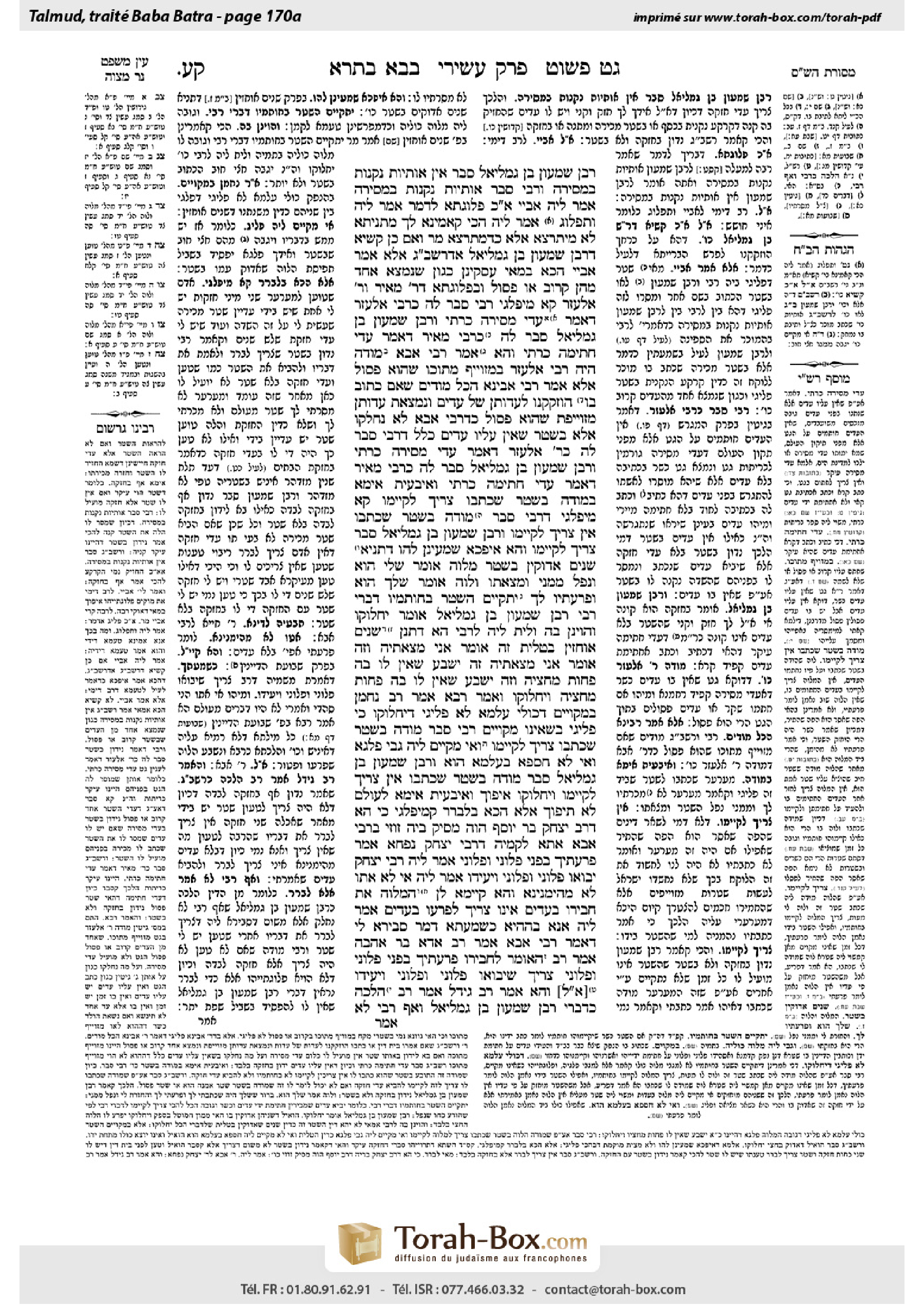
Bava Batra 170a: Talmud study for Daf Yomi
Study the Talmud for Daf Yomi with scanned pages, Hebrew text, English translations from Sefaria and AI-generated French translations.
Passage selection and English or AI-generated French translation are available where the scan has annotations. Daf Study is independent of Torah-Box and Sefaria.
Browse Bava Batra · בבא בתרא · All tractatesBava Batra 170a text and translations
This page of Bava Batra includes the Aramaic text, an English translation and an AI-generated French translation, alongside the scan above.
בבא בתרא ק״ע א · Aramaic and Hebrew text
רַבָּן שִׁמְעוֹן בֶּן גַּמְלִיאֵל סָבַר: אֵין אוֹתִיּוֹת נִקְנוֹת בִּמְסִירָה, וְרַבִּי סָבַר: אוֹתִיּוֹת נִקְנוֹת בִּמְסִירָה.
אֲמַר לֵיהּ אַבָּיֵי: אִם כֵּן, פְּלוּגְתָּא לִדְמָר! אֲמַר לֵיהּ: וְתִפְלוֹג!
אֲמַר לֵיהּ, הָכִי קָאָמֵינָא לָךְ: מַתְנִיתָא לָא מִיתָּרְצָא אֶלָּא כְּדִמְתָרְצָא מָר, וְאִם כֵּן קַשְׁיָא דְּרַבָּן שִׁמְעוֹן בֶּן גַּמְלִיאֵל אַדְּרַבָּן שִׁמְעוֹן בֶּן גַּמְלִיאֵל!
אֶלָּא אָמַר אַבָּיֵי: הָכָא בְּמַאי עָסְקִינַן – כְּגוֹן שֶׁנִּמְצָא אֶחָד מֵהֶן קָרוֹב אוֹ פָּסוּל;
וּבִפְלוּגְתָּא דְּרַבִּי מֵאִיר וְרַבִּי אֶלְעָזָר קָא מִיפַּלְגִי – רַבִּי סָבַר לַהּ כְּרַבִּי אֶלְעָזָר, דְּאָמַר: עֵדֵי מְסִירָה כָּרְתִי,
וְרַבָּן שִׁמְעוֹן בֶּן גַּמְלִיאֵל סָבַר לַהּ כְּרַבִּי מֵאִיר, דְּאָמַר: עֵדֵי חֲתִימָה כָּרְתִי.
וְהָא אָמַר רַבִּי אַבָּא: מוֹדֶה הָיָה רַבִּי אֶלְעָזָר בִּמְזוּיָּיף מִתּוֹכוֹ, שֶׁהוּא פָּסוּל!
אֶלָּא אָמַר רַבִּי אֲבִינָא, הַכֹּל מוֹדִים שֶׁאִם כָּתוּב בּוֹ: ״הוּזְקַקְנוּ לְעֵדוּתָן שֶׁל עֵדִים, וְנִמְצֵאת עֵדוּתָן מְזוּיֶּיפֶת״ – שֶׁהוּא פָּסוּל, כִּדְרַבִּי אַבָּא; לֹא נֶחְלְקוּ אֶלָּא בִּשְׁטָר שֶׁאֵין עָלָיו עֵדִים כְּלָל, דְּרַבִּי סָבַר לַהּ כְּרַבִּי אֶלְעָזָר, דְּאָמַר: עֵדֵי מְסִירָה כָּרְתִי. וְרַבָּן שִׁמְעוֹן בֶּן גַּמְלִיאֵל סָבַר לַהּ כְּרַבִּי מֵאִיר, דְּאָמַר: עֵדֵי חֲתִימָה כָּרְתִי.
וְאִיבָּעֵית אֵימָא: בְּמוֹדֶה בַּשְּׁטָר שֶׁכְּתָבוֹ צָרִיךְ לְקַיְּימוֹ קָא מִיפַּלְגִי,
דְּרַבִּי סָבַר: מוֹדֶה בִּשְׁטָר שֶׁכְּתָבוֹ – אֵין צָרִיךְ לְקַיְּימוֹ. וְרַבָּן שִׁמְעוֹן בֶּן גַּמְלִיאֵל סָבַר: צָרִיךְ לְקַיְּימוֹ.
וְהָא אִיפְּכָא שָׁמְעִינַן לְהוּ! דְּתַנְיָא: שְׁנַיִם אֲדוּקִין בִּשְׁטָר, מַלְוֶה אוֹמֵר ״שֶׁלִּי הוּא וְנָפַל מִמֶּנִּי וּמְצָאתוֹ״, וְלֹוֶה אוֹמֵר ״שֶׁלְּךָ הוּא וּפְרַעְתִּיו לָךְ״ – יִתְקַיֵּים הַשְּׁטָר בְּחוֹתְמָיו. דִּבְרֵי רַבִּי, רַבָּן שִׁמְעוֹן בֶּן גַּמְלִיאֵל אוֹמֵר: יַחְלוֹקוּ.
וְהָוֵינַן בַּהּ – וְלֵית לֵיהּ לְרַבִּי הָא דִּתְנַן: שְׁנַיִם אוֹחֲזִין בְּטַלִּית, זֶה אוֹמֵר ״אֲנִי מְצָאתִיהָ״ וְזֶה אוֹמֵר ״אֲנִי מְצָאתִיהָ״ – זֶה יִשָּׁבַע שֶׁאֵין לוֹ בָּהּ פָּחוֹת מֵחֶצְיָהּ, וְזֶה יִשָּׁבַע שֶׁאֵין לוֹ בָּהּ פָּחוֹת מֵחֶצְיָהּ, וְיַחְלוֹקוּ?
וְאָמַר רָבָא אָמַר רַב נַחְמָן: בִּמְקוּיָּים – דְּכוּלֵּי עָלְמָא לָא פְּלִיגִי דְּיַחֲלוֹקוּ. כִּי פְּלִיגִי – בְּשֶׁאֵינוֹ מְקוּיָּים, רַבִּי סָבַר: מוֹדֶה בִּשְׁטָר שֶׁכְּתָבוֹ צָרִיךְ לְקַיְּימוֹ, וְאִי מְקַיֵּים לֵיהּ – גָּבֵי פַּלְגָא, וְאִי לָא – חַסְפָּא בְּעָלְמָא הוּא;
וְרַבָּן שִׁמְעוֹן בֶּן גַּמְלִיאֵל סָבַר: מוֹדֶה בִּשְׁטָר שֶׁכְּתָבוֹ – אֵין צָרִיךְ לְקַיְּימוֹ, וְיַחְלוֹקוּ.
אֵיפוֹךְ.
וְאִיבָּעֵית אֵימָא: לְעוֹלָם לָא תֵּיפוֹךְ, אֶלָּא הָכָא בִּלְבָרֵר קָמִיפַּלְגִי –
כִּי הָא דְּרַב יִצְחָק בַּר יוֹסֵף הֲוָה מַסֵּיק בֵּיהּ זוּזֵי בְּרַבִּי אַבָּא. אֲתָא לְקַמֵּיהּ דְּרַבִּי יִצְחָק נַפָּחָא, אָמַר: פְּרַעְתִּיךָ בִּפְנֵי פְּלוֹנִי וּפְלוֹנִי. אֲמַר לֵיהּ רַבִּי יִצְחָק: יָבוֹאוּ פְּלוֹנִי וּפְלוֹנִי וְיָעִידוּ. אֲמַר לֵיהּ: אִי לָא אָתוּ – לָא מְהֵימְנִינָא?! וְהָא קַיְימָא לַן: הַמַּלְוֶה אֶת חֲבֵירוֹ בְּעֵדִים – אֵינוֹ צָרִיךְ לְפׇרְעוֹ בְּעֵדִים!
אֲמַר לֵיהּ: אֲנָא בְּהָהִיא – כִּשְׁמַעְתָּא דְמָר סְבִירָא לִי, דְּאָמַר רַבִּי אַבָּא אָמַר רַב אַדָּא בַּר אַהֲבָה אָמַר רַב: הָאוֹמֵר לַחֲבֵירוֹ ״פְּרַעְתִּיךָ בִּפְנֵי פְּלוֹנִי וּפְלוֹנִי״ – צָרִיךְ שֶׁיָּבוֹאוּ פְּלוֹנִי וּפְלוֹנִי וְיָעִידוּ. [אֲמַר לֵיהּ,] וְהָא אָמַר רַב גִּידֵּל אָמַר רַב: הֲלָכָה כְּדִבְרֵי רַבָּן שִׁמְעוֹן בֶּן גַּמְלִיאֵל, וְאַף רַבִּי לֹא
Bava Batra 170a · English translation
The Gemara explains: This is a case where one party sold land to another, who then sold it to a third party by transferring the bill of sale to him. Rabban Shimon ben Gamliel holds that the letters are not acquired by transferring possession of the document. Handing the bill to the third party is therefore not a valid act of acquisition. In order to establish that the land is his, one must prove presumptive ownership by demonstrating that he has lived in the land uncontested for three years. And Rabbi Yehuda HaNasi holds that the letters are acquired by transferring possession of the document. Therefore, if the third party produces the bill of sale that had been transferred to him, this is sufficient proof that the land is his.
Abaye objected and said to Rav Dimi: If that is so, that Rabban Shimon ben Gamliel holds that letters are not acquired by transferring possession of the bill of sale, this would be in disagreement with what the Master, Rabba, said earlier, that Rabban Shimon ben Gamliel maintains that letters are acquired by transferring possession of the bill of sale. Rav Dimi said back to him: And let it be in disagreement. I am not obligated to be in agreement with Rabba.
Abaye clarified his objection and said to him: This is what I meant to say to you. The baraita (168b), which Rabba was explaining, can be explained only the way the Master, Rabba, explained it. And if so, i.e., if you do not agree with Rabba’s understanding of the opinion of Rabban Shimon ben Gamliel, there is a difficulty, as there is a contradiction between one statement of Rabban Shimon ben Gamliel and the other statement of Rabban Shimon ben Gamliel.
Rather, Abaye said that the explanation of the baraita concerning one who appears before a court to be judged is as follows: With what are we dealing here? We are dealing with a case where one of the witnesses signed on the bill was found to be a relative to one of the parties, or he was found to be disqualified from bearing witness for another reason, and therefore the document is rendered invalid.
Abaye continues: And the two opinions in the baraita disagree with regard to the issue that is the subject of the dispute between Rabbi Meir and Rabbi Elazar. Rabbi Yehuda HaNasi holds in accordance with the opinion of Rabbi Elazar, who says: The witnesses of the transmission of the document effect the transaction, meaning that witnesses are not required to be signed on a document at all, provided that there are witnesses who saw the transfer of the document to the relevant party. It is therefore inconsequential that one of the witnesses that signed the document is disqualified. This is why Rabbi Yehuda HaNasi says that the claim is judged based on the deed, i.e., the deed is valid.
And Rabban Shimon ben Gamliel holds in accordance with the opinion of Rabbi Meir, who says: The signatory witnesses on the document effect the transaction, meaning that it is necessary for a document to have witnesses sign it. If there are no witnesses or if one or both of them are disqualified, the document is not valid even if its transmission is witnessed by qualified witnesses. This is why Rabban Shimon ben Gamliel says that the claim is judged based on the claimant’s presumptive ownership; this is his only valid proof since the deed he possesses is not valid.
The Gemara objects to Abaye’s explanation: But doesn’t Rabbi Abba say that Rabbi Elazar concedes that in the case of a document whose falsification is inherent in it that it is not valid? Rabbi Elazar said only that a document that has no witnesses signed on it at all is valid if its transmission was witnessed. If the document has disqualified witnesses, he agrees it is not valid.
Rather, Rabbi Avina said a modification of Abaye’s explanation. All concede that if it is written in the document: We, the court, engaged in an investigation of the testimony of the witnesses and have determined that they signed the document, and their testimony was found to be false, the document is not valid, in accordance with the statement of Rabbi Abba. They disagree only with regard to a document upon which there are no witnesses signed at all. As Rabbi Yehuda HaNasi holds in accordance with the opinion of Rabbi Elazar, who says: The witnesses of the transmission of the document effect the transaction. Signatory witnesses are not necessary, and the deed can therefore be used as proof. And Rabban Shimon ben Gamliel holds in accordance with the opinion of Rabbi Meir, who says: The signatory witnesses on the document effect the transaction, so the deed cannot be used. Therefore, the only valid proof would be based on his presumptive ownership.
The Gemara suggests: And if you wish, say instead: The case in the baraita is one where the alleged purchaser has a bill of sale for the land, but the alleged seller, although he admits that the document was written with his consent, claims that the sale did not ultimately occur, and that the alleged purchaser took the document from him. And the tanna’im in the baraita disagree, with regard to the halakha in the case of a debtor who admits that he wrote a promissory note, whether the creditor is required to ratify it in court in order to collect, and, by extension, in a case where a seller admits that he wrote a bill of sale, whether the purchaser must ratify it in court in order to establish its validity.
As, Rabbi Yehuda HaNasi holds that in the case of a debtor who admits that he wrote a promissory note, the creditor is not required to ratify it in court in order to collect what is owed to him. In this case as well, the purchaser can use the bill of sale as proof that he is the rightful owner of the property. And Rabban Shimon ben Gamliel holds that in the case of a debtor who admits that he wrote a promissory note, the creditor is required to ratify it in court in order to use it to collect the debt. In this case as well, since the purchaser is unable to ratify it, his only recourse to prove his ownership is showing that he lived in the land uncontested for three years.
The Gemara asks: But didn’t we hear the opposite concerning Rabbi Yehuda HaNasi and Rabban Shimon ben Gamliel? As it is taught in a baraita (Tosefta, Bava Metzia 1:8) that if two people, the debtor and the creditor, are grasping a promissory note, and the creditor says: It is mine, i.e., the debt has not yet been paid, and it fell from me, and you, the debtor, found it, and the debtor says: It is in fact yours, i.e., I did borrow the money from you, but I paid you and was given the promissory note, and it fell from me, and you found it, the promissory note must be ratified through its signatories, even though the debtor admits it is a valid document. This is the statement of Rabbi Yehuda HaNasi. Rabban Shimon ben Gamliel says: They should divide the amount written in the promissory note, i.e., the debtor must pay half of the recorded sum to the creditor.
The Gemara explains: And we discussed it once before and asked the following question about it: But doesn’t Rabbi Yehuda HaNasi agree to that which we learned in a mishna (Bava Metzia 2a), with regard to two people who came to court holding a garment, where this one is saying: I found it, and that one is saying: I found it; that this one takes an oath that he does not have claim to less than half of it, and that one takes an oath that he does not have claim to less than half of it, and they divide it? Why does Rabbi Yehuda HaNasi not maintain that in a case where the debtor and creditor are grasping a promissory note, there too they should divide the money?
And in response to this question Rava said that Rav Naḥman said: In the case of a ratified promissory note, everyone agrees that they should divide it. Where they disagree is in the case of a note that is not ratified. Rabbi Yehuda HaNasi holds that in the case of a debtor who admits that he wrote a promissory note, the creditor is required to ratify it in court in order to collect the debt from him. And if he successfully ratifies it, the creditor collects half of the recorded sum, since the two parties are contesting ownership of the document. And if he is not successful in ratifying the note, it is merely a shard, i.e., a worthless piece of paper.
And Rabban Shimon ben Gamliel holds that in the case of a debtor who admits that he wrote a promissory note, the creditor is not required to ratify it in court in order to collect payment. Since the note is valid and fit for collection, they should divide it, i.e., the creditor collects half the sum, as the ownership of the document is contested. The positions of Rabbi Yehuda HaNasi and Rabban Shimon ben Gamliel are therefore the reverse of what the Gemara proposed in its explanation of the first baraita.
The Gemara answers: Reverse the way the opinions of Rabbi Yehuda HaNasi and Rabban Shimon ben Gamliel are recorded in one of the two baraitot so that they are consistent in both baraitot.
And if you wish, say instead: Actually, do not reverse their opinions. There is no contradiction between them, because the issue in the first baraita is not whether or not a bill of sale must be ratified when the seller admits that he wrote it. Rather, here the tanna’im disagree with regard to verifying, i.e., they disagree about whether a litigant is required to verify all his claims in circumstances where his case is strong enough to have the court rule in his favor even if they were to disregard some of his claims. Generally, if one has evidence of presumptive ownership of a field he does not have to produce a bill of sale for it. Here, Rabbi Yehuda HaNasi holds that since the one occupying the land claims that he has a bill of sale, he must verify this claim by producing it. Rabban Shimon ben Gamliel holds that he is not required to produce it, as the claim of presumptive ownership suffices.
The Gemara explains: It is like this case where Rav Yitzḥak bar Yosef was owed money by Rabbi Abba. The case came before Rabbi Yitzḥak Nappaḥa. Rabbi Abba said: I already repaid you the debt in the presence of so-and-so and so-and-so. Rabbi Yitzḥak Nappaḥa said to Rabbi Abba: The witnesses you have named, so-and-so and so-and-so, must come and testify that they saw you repay the loan. Rabbi Abba said to Rabbi Yitzḥak Nappaḥa: If they do not come, am I not deemed credible to say that I repaid the loan? But don’t we maintain that with regard to one who lends money to another in the presence of witnesses, the debtor need not repay him in the presence of witnesses, as he is deemed credible to say he repaid the debt even with no supporting testimony?
Rabbi Yitzḥak Nappaḥa said to Rabbi Abba: With regard to this issue, I hold like the halakha said by the Master, i.e., you yourself. As Rabbi Abba says that Rav Adda bar Ahava said that Rav says: If one says to another, i.e., if a debtor says to his creditor: I repaid you in the presence of so-and-so and so-and-so, it is required that so-and-so and so-and-so come to court and testify that they witnessed the repayment. Rabbi Abba said to Rabbi Yitzḥak Nappaḥa: But doesn’t Rav Giddel say that Rav says that the halakha is in accordance with the statement of Rabban Shimon ben Gamliel, that it is not required that a litigant verify all his stated claims if his case is sufficiently strong without those claims? And moreover, even Rabbi Yehuda HaNasi did not
Bava Batra 170a · Traduction française (IA)
La Guemara explique : Il s'agit d'un cas où une partie a vendu un terrain à une autre, qui a ensuite vendu ce terrain à un troisième en lui transmettant le contrat de vente. Rabban Shimon ben Gamliel affirme que les lettres ne sont pas acquises par la transmission du document. Donc, la transmission du contrat au troisième n'est pas un acte valide d'acquisition. Pour établir que le terrain est à lui, il faut prouver la propriété par l'habitation non contestée du terrain pendant trois ans. Rabbi Yehuda HaNasi affirme que les lettres sont acquises par la transmission du document. Ainsi, si le troisième produit le contrat de vente qui lui a été transmis, cela suffit à prouver que le terrain est à lui.
Abaye s'est opposé et a dit à Rav Dimi : Si c'est ainsi, c'est-à-dire que Rabban Shimon ben Gamliel affirme que les lettres ne sont pas acquises par la transmission du contrat de vente, cela serait en désaccord avec ce que le Maître, Rabba, avait dit plus tôt, à savoir que Rabban Shimon ben Gamliel maintient que les lettres sont acquises par la transmission du contrat de vente. Rav Dimi a répondu à lui : Et laissez-le être en désaccord. Je ne suis pas tenu de m'accorder avec Rabba.
Abaye a clarifié son objection et a dit à lui : C'est ce que j'avais l'intention de vous dire. La baraïta (168b), que Rabba expliquait, peut être expliquée uniquement de la manière dont le Maître, Rabba, l'avait expliquée. Et si c'est ainsi, c'est-à-dire si vous ne convenez pas de la compréhension de Rabba sur l'opinion de Rabban Shimon ben Gamliel, il y a une difficulté, car il y a une contradiction entre l'une des déclarations de Rabban Shimon ben Gamliel et l'autre.
Plutôt, Abaye a dit que l'explication de la baraïta concernant celui qui apparaît devant un tribunal pour être jugé est la suivante : De quoi sommes-nous en train de parler ici ? Nous parlons d'un cas où l'un des témoins qui a signé sur le contrat a été trouvé être un parent de l'une des parties, ou il a été trouvé être inéligible à témoigner pour une autre raison, et donc le document est rendu invalide.
Abaye continue : Et les deux opinions dans la baraïta divergent concernant l'objet du débat entre Rabbi Meir et Rabbi Elazar. Rabbi Yehuda HaNasi suit l'opinion de Rabbi Elazar, qui dit : Les témoins de la transmission du document effectuent la transaction, c'est-à-dire que les témoins ne sont pas nécessaires à signer le document, à condition qu'il y ait des témoins qui aient vu la transmission du document à la partie concernée. C'est pourquoi Rabbi Yehuda HaNasi dit que la revendication est jugée sur la base du contrat, c'est-à-dire que le contrat est valide.
Et Rabban Shimon ben Gamliel suit l'opinion de Rabbi Meir, qui dit : Les témoins signataires du document effectuent la transaction, c'est-à-dire qu'il est nécessaire que le document ait des témoins signataires. Si aucun témoins ou si l'un ou les deux sont inéligibles, le document n'est pas valide même si sa transmission est témoin par des témoins éligibles. C'est pourquoi Rabban Shimon ben Gamliel dit que la revendication est jugée sur la base de la propriété présumée, c'est-à-dire que c'est sa seule preuve valide puisque le contrat qu'il possède n'est pas valide.
La Guemara s'oppose à l'explication d'Abaye : Mais ne dit pas Rabbi Abba que Rabbi Elazar reconnaît que dans le cas d'un document dont la falsification est inhérente, il n'est pas valide ? Rabbi Elazar a dit seulement que un document sans témoins signataires est valide si sa transmission a été témoin. Si le document a des témoins inéligibles, il convient qu'il n'est pas valide.
Plutôt, Rabbi Avina a dit une modification de l'explication d'Abaye. Tout le monde convient que si il est écrit dans le document : Nous, la cour, avons mené une enquête sur le témoignage des témoins et avons déterminé qu'ils ont signé le document, et que leur témoignage a été trouvé faux, le document n'est pas valide, conformément à l'affirmation de Rabbi Abba. Ils divergent seulement concernant un document sur lequel il n'y a aucun témoins signataires. Comme Rabbi Yehuda HaNasi suit l'opinion de Rabbi Elazar, qui dit : Les témoins de la transmission du document effectuent la transaction. Les témoins signataires ne sont pas nécessaires, et le contrat peut donc être utilisé comme preuve. Et Rabban Shimon ben Gamliel suit l'opinion de Rabbi Meir, qui dit : Les témoins signataires du document effectuent la transaction, donc le contrat ne peut pas être utilisé. Ainsi, la seule preuve valide serait basée sur sa propriété présumée.
La Guemara suggère : Et si vous le souhaitez, dites plutôt : Le cas dans la baraïta est celui où l'acheteur prétendu possède un contrat de vente pour le terrain, mais le vendeur prétendu, bien qu'il admette que le document a été rédigé avec son consentement, affirme que la vente n'a pas eu lieu, et que l'acheteur prétendu a pris le document de lui. Et les tannaïm dans la baraïta divergent concernant la halakha dans le cas d'un débiteur qui admet qu'il a rédigé une note de remboursement, savoir si le créancier est tenu de le valider devant un tribunal afin de récupérer ce qui lui est dû, et, par extension, dans le cas où un vendeur admet qu'il a rédigé un contrat de vente, savoir si l'acheteur doit le valider devant un tribunal afin d'établir sa validité.
Rabbi Yehuda HaNasi affirme que dans le cas d'un débiteur qui admet qu'il a rédigé une note de remboursement, le créancier n'est pas tenu de le valider devant un tribunal afin de récupérer ce qui lui est dû. Dans ce cas également, l'acheteur peut utiliser le contrat de vente comme preuve qu'il est le propriétaire légitime de la propriété. Et Rabban Shimon ben Gamliel affirme que dans le cas d'un débiteur qui admet qu'il a rédigé une note de remboursement, le créancier est tenu de le valider devant un tribunal afin de l'utiliser pour récupérer la dette. Dans ce cas également, puisque l'acheteur ne peut pas le valider, son seul recours pour prouver sa propriété est de montrer qu'il a habité le terrain sans contestation pendant trois ans.
La Guemara pose la question : Mais n’avons-nous pas entendu l’opposé concernant Rabbi Yéhuda Hanassi et Rabban Shimon ben Gamliel ? Comme il est enseigné dans une baraïta (Tosefta, Bava Métsia 1:8) : si deux personnes, le débiteur et le créancier, tiennent un billet de change, et le créancier dit : C’est à moi, c’est-à-dire la dette n’a pas encore été payée, et il est tombé de moi, et vous, le débiteur, l’avez trouvé, et le débiteur dit : C’est effectivement à vous, c’est-à-dire j’ai emprunté l’argent à vous, mais j’ai payé et été donné le billet de change, et il est tombé de moi, et vous l’avez trouvé, le billet de change doit être ratifié par ses signataires, même si le débiteur admet qu’il s’agit d’un document valide. C’est l’affirmation de Rabbi Yéhuda Hanassi. Rabban Shimon ben Gamliel dit : Ils doivent diviser la somme écrite sur le billet de change, c’est-à-dire le débiteur doit payer la moitié de la somme indiquée au créancier.
La Guemara explique : Et nous avions discuté de cela auparavant et nous avons posé la question suivante à ce sujet : Mais ne convient-il pas à Rabbi Yéhuda Hanassi d’accepter ce que nous avons appris dans une mitsna (Bava Métsia 2a), concernant deux personnes qui sont venues devant le tribunal avec une robe, où l’un dit : Je l’ai trouvée, et l’autre dit : Je l’ai trouvée ; celui-ci jure qu’il ne revendique pas moins de la moitié, et celui-là jure qu’il ne revendique pas moins de la moitié, et ils divisent la robe ? Pourquoi Rabbi Yéhuda Hanassi ne maintient-il pas que dans le cas où le débiteur et le créancier tiennent un billet de change, ils devraient aussi diviser la somme ?
Et en réponse à cette question, Rava a dit que Rav Naḥman a dit : Dans le cas d’un billet de change ratifié, tout le monde convient qu’il doit être divisé. Où ils divergent, c’est dans le cas d’un billet de change non ratifié. Rabbi Yéhuda Hanassi considère que dans le cas d’un débiteur qui admet avoir écrit un billet de change, le créancier doit le ratifier devant le tribunal afin de récupérer la dette. Et si le créancier réussit à le ratifier, il récupère la moitié de la somme indiquée, puisque les deux parties contestent la possession du document. Et si le créancier ne réussit pas à ratifier le billet, il est simplement un fragment, c’est-à-dire un morceau de papier sans valeur.
Et Rabban Shimon ben Gamliel considère que dans le cas d’un débiteur qui admet avoir écrit un billet de change, le créancier n’a pas besoin de le ratifier devant le tribunal afin de récupérer le paiement. Puisque le billet est valide et apte à être récupéré, ils doivent le diviser, c’est-à-dire le créancier récupère la moitié de la somme, puisque la possession du document est contestée. Les positions de Rabbi Yéhuda Hanassi et de Rabban Shimon ben Gamliel sont donc inversées par rapport à ce que la Guemara avait proposé dans son explication de la première baraïta.
La Guemara répond : Inversez la manière dont les opinions de Rabbi Yéhuda Hanassi et de Rabban Shimon ben Gamliel sont enregistrées dans l’une des deux baraitot afin qu’elles soient cohérentes dans les deux baraitot.
Et si vous le souhaitez, dites plutôt : En réalité, ne réversons pas leurs opinions. Il n’y a pas de contradiction entre elles, car l’affaire de la première baraïta ne porte pas sur le fait que le billet de vente doit être ratifié lorsque le vendeur admet avoir écrit ce dernier. En effet, ici les tannaïm divergent concernant la vérification, c’est-à-dire qu’ils divergent sur le fait que le litigant est tenu de vérifier toutes ses réclamations dans les cas où sa cause est suffisamment solide pour que le tribunal statue en sa faveur même si on néglige certaines de ses réclamations. Généralement, si l’on a des preuves de propriété présumée d’un champ, on n’a pas besoin de présenter un billet de vente pour ce champ. Ici, Rabbi Yéhuda Hanassi considère que puisque celui qui occupe la terre affirme avoir un billet de vente, il doit vérifier cette affirmation en le produisant. Rabban Shimon ben Gamliel considère qu’il n’est pas nécessaire de le produire, puisque la revendication de propriété présumée suffit.
La Guemara explique : C’est comme ce cas où Rav Yitzḥak bar Yosef était dû de l’argent par Rabbi Abba. L’affaire est venue devant Rabbi Yitzḥak Nappaḥa. Rabbi Abba a dit : J’ai déjà remboursé votre dette en présence de telle et telle. Rabbi Yitzḥak Nappaḥa a dit à Rabbi Abba : Les témoins que vous avez nommés, telle et telle, doivent venir témoigner qu’ils ont vu votre remboursement. Rabbi Abba a dit à Rabbi Yitzḥak Nappaḥa : Si ils n’ont pas venu, ne suis-je pas considéré comme crédible pour dire que j’ai remboursé la dette ? Mais ne maintenons-nous pas que, concernant celui qui prête de l’argent à un autre en présence de témoins, le débiteur n’a pas besoin de rembourser en présence de témoins, puisqu’il est considéré comme crédible pour dire qu’il a remboursé la dette même sans témoignage ?
Rabbi Yitzḥak Nappaḥa a dit à Rabbi Abba : Concernant cette affaire, je tiens l’opinion de la halakha telle que dite par le Maître, c’est-à-dire vous-même. Comme Rabbi Abba dit que Rav Adda bar Ahava a dit que Rav dit : Si l’un dit à l’autre, c’est-à-dire si un débiteur dit à son créancier : J’ai remboursé en présence de telle et telle, il est nécessaire que telle et telle viennent devant le tribunal et témoignent qu’ils ont vu le remboursement. Rabbi Abba a dit à Rabbi Yitzḥak Nappaḥa : Mais ne dit-on pas que Rav Giddel dit que Rav dit que la halakha suit l’affirmation de Rabban Shimon ben Gamliel, que ce n’est pas nécessaire que le litige vérifie toutes ses réclamations si sa cause est suffisamment solide sans ces réclamations ? Et de plus, même Rabbi Yéhuda Hanassi n’a pas
Traduction française générée par IA à partir de l’édition anglaise de Sefaria. Vérifie toujours un passage avec le texte source.
Text from Sefaria: William Davidson Edition - Vocalized Aramaic (CC BY NC); William Davidson Edition - English (CC BY NC).