Bava Batra 16b: Talmud study for Daf Yomi
Study the Talmud for Daf Yomi with scanned pages, Hebrew text, English translations from Sefaria and AI-generated French translations.
Passage selection and English or AI-generated French translation are available where the scan has annotations. Daf Study is independent of Torah-Box and Sefaria.
Browse Bava Batra · בבא בתרא · All tractatesBava Batra 16b text and translations
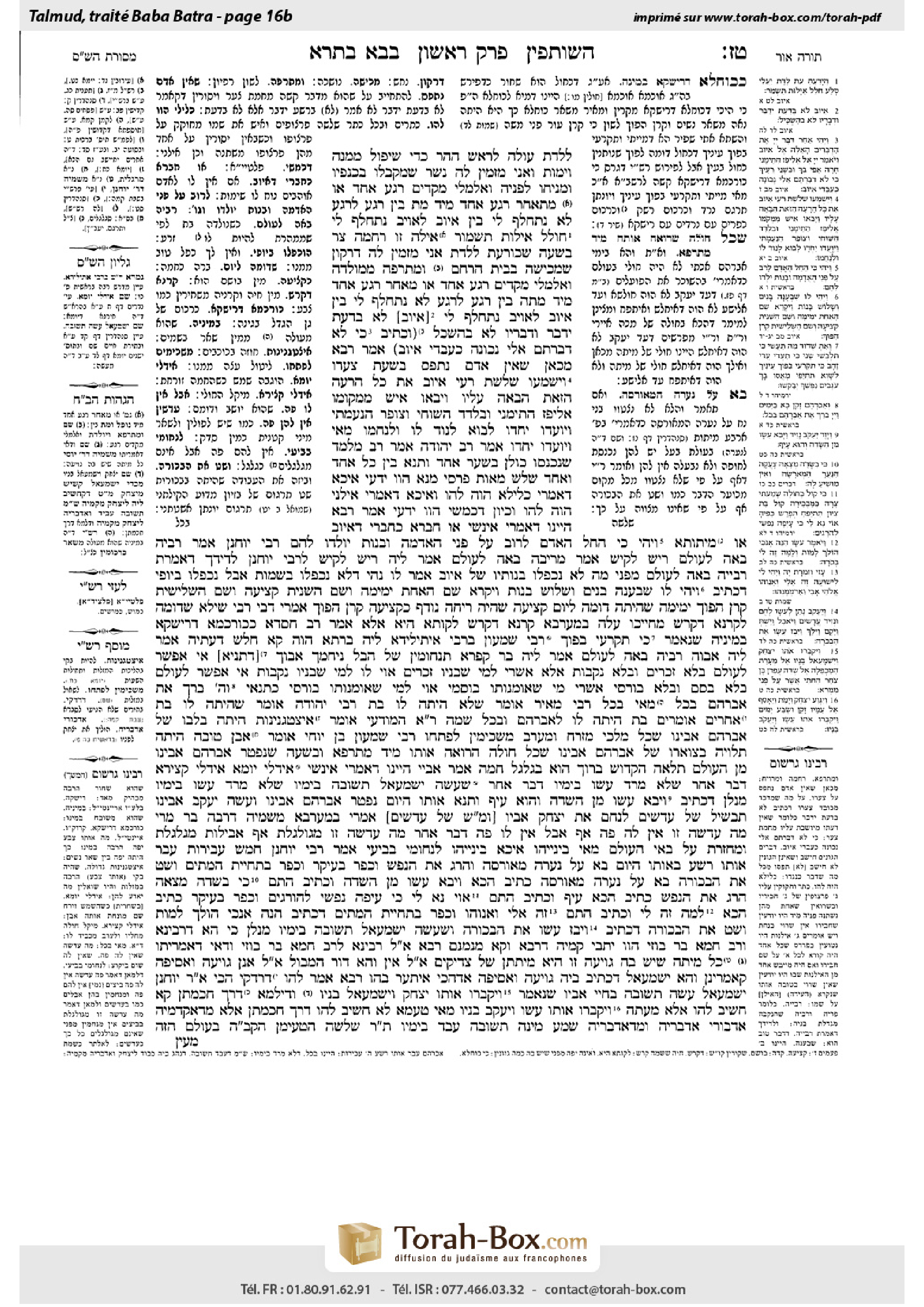
This page of Bava Batra includes the Aramaic text, an English translation and an AI-generated French translation, alongside the scan above.
בבא בתרא י״ו ב · Aramaic and Hebrew text
לָלֶדֶת, עוֹלָה לְרֹאשׁ הָהָר כְּדֵי שֶׁיִּפּוֹל מִמֶּנָּה וְיָמוּת; וַאֲנִי מַזְמִין לָהּ נֶשֶׁר שֶׁמְּקַבְּלוֹ בִּכְנָפָיו וּמַנִּיחוֹ לְפָנֶיהָ, וְאִלְמָלֵי מַקְדִּים רֶגַע אֶחָד אוֹ מִתְאַחֵר רֶגַע אֶחָד – מִיָּד מֵת. בֵּין רֶגַע לְרֶגַע לֹא נִתְחַלֵּף לִי, בֵּין אִיּוֹב לְאוֹיֵב נִתְחַלֵּף לִי?!
״חֹלֵל אַיָּלוֹת תִּשְׁמֹר״ – אַיָּלָה זוֹ רַחְמָהּ צַר; בְּשָׁעָה שֶׁכּוֹרַעַת לָלֶדֶת, אֲנִי מַזְמִין לָהּ דְּרָקוֹן שֶׁמַּכִּישָׁהּ בְּבֵית הָרֶחֶם, וּמִתְרַפָּה מִמּוֹלָדָהּ; וְאִלְמָלֵי מַקְדִּים רֶגַע אֶחָד אוֹ מְאַחֵר רֶגַע אֶחָד מִיָּד מֵתָה. בֵּין רֶגַע לְרֶגַע לֹא נִתְחַלֵּף לִי, בֵּין אִיּוֹב לְאוֹיֵב נִתְחַלֵּף לִי?!
״[אִיּוֹב] לֹא בְדַעַת יְדַבֵּר, וּדְבָרָיו לֹא בְהַשְׂכֵּל״; וּכְתִיב: ״כִּי לֹא דִבַּרְתֶּם אֵלַי נְכוֹנָה כְּעַבְדִּי אִיּוֹב״! אָמַר רָבָא: מִכָּאן שֶׁאֵין אָדָם נִתְפָּס בִּשְׁעַת צַעֲרוֹ.
״וַיִּשְׁמְעוּ שְׁלֹשֶׁת רֵעֵי אִיּוֹב אֵת כׇּל הָרָעָה הַזֹּאת הַבָּאָה עָלָיו, וַיָּבֹאוּ אִישׁ מִמְּקוֹמוֹ – אֱלִיפַז הַתֵּימָנִי וּבִלְדַּד הַשּׁוּחִי וְצוֹפַר הַנַּעֲמָתִי, וַיִּוָּעֲדוּ יַחְדָּו לָבוֹא לָנוּד לוֹ וּלְנַחֲמוֹ״ – מַאי ״וַיִּוָּעֲדוּ יַחְדָּו״? אָמַר רַב יְהוּדָה אָמַר רַב: מְלַמֵּד שֶׁנִּכְנְסוּ כּוּלָּן בְּשַׁעַר אֶחָד. וְתָנָא: בֵּין כׇּל אֶחָד וְאֶחָד שְׁלֹשׁ מֵאוֹת פַּרְסֵי.
מְנָא הֲווֹ יָדְעִי? אִיכָּא דְּאָמְרִי: כְּלִילָא הֲוָה לְהוּ. וְאִיכָּא דְּאָמְרִי: אִילָנֵי הֲוָה לְהוּ, וְכֵיוָן דְּכָמְשִׁי הֲווֹ יָדְעִי. אָמַר רָבָא: הַיְינוּ דְּאָמְרִי אִינָשֵׁי: אוֹ חַבְרָא כְּחַבְרֵי דְּאִיּוֹב, אוֹ מִיתוּתָא.
״וַיְהִי כִּי הֵחֵל הָאָדָם לָרֹב עַל פְּנֵי הָאֲדָמָה, וּבָנוֹת יֻלְּדוּ לָהֶם״ – רַבִּי יוֹחָנָן אָמַר: רְבִיָּיה בָּאָה לְעוֹלָם. רֵישׁ לָקִישׁ אָמַר: מְרִיבָה בָּאָה לָעוֹלָם. אֲמַר לֵיהּ רֵישׁ לָקִישׁ לְרַבִּי יוֹחָנָן: לְדִידָךְ דְּאָמְרַתְּ רְבִיָּיה בָּאָה לְעוֹלָם, מִפְּנֵי מָה לֹא נִכְפְּלוּ בְּנוֹתָיו שֶׁל אִיּוֹב?
אָמַר לוֹ: נְהִי דְּלֹא נִכְפְּלוּ בְּשֵׁמוֹת, אֲבָל נִכְפְּלוּ בְּיוֹפִי – דִּכְתִיב: ״וַיְהִי לוֹ שִׁבְעָנָה בָנִים וְשָׁלוֹשׁ בָּנוֹת, וַיִּקְרָא שֵׁם הָאַחַת יְמִימָה, וְשֵׁם הַשֵּׁנִית קְצִיעָה, וְשֵׁם הַשְּׁלִישִׁית קֶרֶן הַפּוּךְ״.
יָמִימָה – שֶׁהָיְתָה דּוֹמָה לַיּוֹם. קְצִיעָה – שֶׁהָיָה רֵיחָהּ נוֹדֵף כִּקְצִיעָה. קֶרֶן הַפּוּךְ – אָמְרִי דְּבֵי רַבִּי שֵׁילָא: שֶׁדּוֹמָה לְקַרְנָא דְקֶרֶשׁ. מְחַיְּיכוּ עֲלַהּ בְּמַעְרְבָא, קַרְנָא דְקֶרֶשׁ לָקוּתָא הִיא! אֶלָּא אָמַר רַב חִסְדָּא: כְּכוּרְכְּמָא דְרִישְׁקָא בְּמִינֵיהּ – שֶׁנֶּאֱמַר: ״כִּי תִקְרְעִי בַּפּוּךְ״.
רַבִּי שִׁמְעוֹן בְּרַבִּי אִיתְיְלִידָא לֵיהּ בְּרַתָּא, הֲוָה קָא חָלַשׁ דַּעְתֵּיהּ. אֲמַר לֵיהּ אֲבוּהּ: רְבִיָּה בָּאָה לָעוֹלָם. אֲמַר לֵיהּ בַּר קַפָּרָא: תַּנְחוּמִין שֶׁל הֶבֶל נִיחֶמְךָ אֲבוּךְ – [דְּתַנְיָא:] אִי אֶפְשָׁר לָעוֹלָם בְּלֹא זְכָרִים וּבְלֹא נְקֵבוֹת; אֶלָּא אַשְׁרֵי לְמִי שֶׁבָּנָיו זְכָרִים, אוֹי לוֹ לְמִי שֶׁבָּנָיו נְקֵבוֹת. אִי אֶפְשָׁר לָעוֹלָם בְּלֹא בַּסָּם וּבְלֹא בּוּרְסִי; אַשְׁרֵי מִי שֶׁאוּמָּנוּתוֹ בּוּסְמִי, אוֹי לְמִי שֶׁאוּמָּנוּתוֹ בּוּרְסִי.
כְּתַנָּאֵי: ״וַה׳ בֵּרַךְ אֶת אַבְרָהָם בַּכֹּל״ – מַאי ״בַּכֹּל״? רַבִּי מֵאִיר אוֹמֵר: שֶׁלֹּא הָיְתָה לוֹ בַּת. רַבִּי יְהוּדָה אוֹמֵר: שֶׁהָיְתָה לוֹ בַּת. אֲחֵרִים אוֹמְרִים: בַּת הָיְתָה לוֹ לְאַבְרָהָם, וּ״בַכֹּל״ שְׁמָהּ. רַבִּי אֶלְעָזָר הַמּוֹדָעִי אוֹמֵר: אִיצְטַגְנִינוּת הָיְתָה בְּלִבּוֹ שֶׁל אַבְרָהָם אָבִינוּ, שֶׁכׇּל מַלְכֵי מִזְרָח וּמַעֲרָב מַשְׁכִּימִין לְפִתְחוֹ. רַבִּי שִׁמְעוֹן בֶּן יוֹחַי אוֹמֵר: אֶבֶן טוֹבָה הָיְתָה תְּלוּיָה בְּצַוָּארוֹ שֶׁל אַבְרָהָם אָבִינוּ, שֶׁכׇּל חוֹלֶה הָרוֹאֶה אוֹתוֹ מִיָּד מִתְרַפֵּא; וּבְשָׁעָה שֶׁנִּפְטַר אַבְרָהָם אָבִינוּ מִן הָעוֹלָם – תְּלָאָהּ הַקָּדוֹשׁ בָּרוּךְ הוּא בְּגַלְגַּל חַמָּה. אָמַר אַבָּיֵי, הַיְינוּ דְּאָמְרִי אִינָשֵׁי: אִידַּלִּי יוֹמָא אִידַּלִּי קְצִירָא.
דָּבָר אַחֵר: שֶׁלֹּא מָרַד עֵשָׂו בְּיָמָיו. דָּבָר אַחֵר: שֶׁעָשָׂה יִשְׁמָעֵאל תְּשׁוּבָה בְּיָמָיו. שֶׁלֹּא מָרַד עֵשָׂו בְּיָמָיו – מְנָלַן? דִּכְתִיב: ״וַיָּבֹא עֵשָׂו מִן הַשָּׂדֶה, וְהוּא עָיֵף״, וְתָנָא: אוֹתוֹ הַיּוֹם נִפְטַר אַבְרָהָם אָבִינוּ, וְעָשָׂה יַעֲקֹב אָבִינוּ תַּבְשִׁיל שֶׁל עֲדָשִׁים לְנַחֵם אֶת יִצְחָק אָבִיו.
[וּמַאי שְׁנָא שֶׁל עֲדָשִׁים?] אָמְרִי בְּמַעְרְבָא מִשְּׁמֵיהּ דְּרַבָּה בַּר מָרִי: מָה עֲדָשָׁה זוֹ אֵין לָהּ פֶּה, אַף אָבֵל אֵין לוֹ פֶּה. דָּבָר אַחֵר: מָה עֲדָשָׁה זוֹ מְגוּלְגֶּלֶת, אַף אֲבֵילוּת מְגַלְגֶּלֶת וּמְחַזֶּרֶת עַל בָּאֵי הָעוֹלָם. מַאי בֵּינַיְיהוּ? אִיכָּא בֵּינַיְיהוּ לְנַחוֹמֵי בְּבֵיעֵי.
אָמַר רַבִּי יוֹחָנָן: חָמֵשׁ עֲבֵירוֹת עָבַר אוֹתוֹ רָשָׁע בְּאוֹתוֹ הַיּוֹם – בָּא עַל נַעֲרָה מְאוֹרָסָה, וְהָרַג אֶת הַנֶּפֶשׁ, וְכָפַר בָּעִיקָּר, וְכָפַר בִּתְחִיַּית הַמֵּתִים, וְשָׁט אֶת הַבְּכוֹרָה.
בָּא עַל נַעֲרָה מְאוֹרָסָה – כְּתִיב הָכָא: ״וַיָּבֹא עֵשָׂו מִן הַשָּׂדֶה״, וּכְתִיב הָתָם: ״כִּי בַשָּׂדֶה מְצָאָהּ״. הָרַג אֶת הַנֶּפֶשׁ – כְּתִיב הָכָא: ״עָיֵף״, וּכְתִיב הָתָם: ״אוֹי נָא לִי כִּי עָיְפָה נַפְשִׁי לְהֹרְגִים״. וְכָפַר בָּעִיקָּר – כְּתִיב הָכָא: ״לָמָּה זֶה לִי״, וּכְתִיב הָתָם: ״זֶה אֵלִי וְאַנְוֵהוּ״. וְכָפַר בִּתְחִיַּית הַמֵּתִים – דִּכְתִיב: ״הִנֵּה אָנֹכִי הוֹלֵךְ לָמוּת״. וְשָׁט אֶת הַבְּכוֹרָה – דִּכְתִיב: ״וַיִּבֶז עֵשָׂו אֶת הַבְּכוֹרָה״.
וְשֶׁעָשָׂה יִשְׁמָעֵאל תְּשׁוּבָה בְּיָמָיו – מְנָלַן? כִּי הָא דְּרָבִינָא וְרַב חָמָא בַּר בּוּזִי הֲווֹ יָתְבִי קַמֵּיהּ דְּרָבָא, וְקָא מְנַמְנֵם רָבָא. אֲמַר לֵיהּ רָבִינָא לְרַב חָמָא בַּר בּוּזִי, וַדַּאי דְּאָמְרִיתוּ: כׇּל מִיתָה שֶׁיֵּשׁ בָּהּ ״גְּוִיעָה״ – זוֹ הִיא מִיתָתָן שֶׁל צַדִּיקִים? אֲמַר לֵיהּ: אִין. וְהָא דּוֹר הַמַּבּוּל! אֲמַר לֵיהּ: אֲנַן ״גְּוִיעָה״ וַ״אֲסִיפָה״ קָאָמְרִינַן.
וְהָא יִשְׁמָעֵאל, דִּכְתִיב בֵּיהּ ״גְּוִיעָה״ וַ״אֲסִיפָה״! אַדְּהָכִי אִיתְּעַר בְּהוּ רָבָא, אֲמַר לְהוּ: דַּרְדְּקֵי, הָכִי אָמַר רַבִּי יוֹחָנָן: יִשְׁמָעֵאל עָשָׂה תְּשׁוּבָה בְּחַיֵּי אָבִיו, שֶׁנֶּאֱמַר: ״וַיִּקְבְּרוּ אֹתוֹ יִצְחָק וְיִשְׁמָעֵאל בָּנָיו״.
וְדִילְמָא דֶּרֶךְ חׇכְמָתָן קָא חָשֵׁיב לְהוּ! אֶלָּא מֵעַתָּה, ״וַיִּקְבְּרוּ אוֹתוֹ עֵשָׂו וְיַעֲקֹב בָּנָיו״, מַאי טַעְמָא לָא חָשֵׁיב לְהוּ דֶּרֶךְ חׇכְמָתָן? אֶלָּא מִדְּאַקְדְּמֵיהּ – אַדְבּוֹרֵי אַדְבְּרֵיהּ, וּמִדְּאַדְבְּרֵיהּ – שְׁמַע מִינַּהּ תְּשׁוּבָה עֲבַד בְּיָמָיו.
תָּנוּ רַבָּנַן: שְׁלֹשָׁה הִטְעִימָן הַקָּדוֹשׁ בָּרוּךְ הוּא בָּעוֹלָם הַזֶּה
Bava Batra 16b · English translation
to give birth she ascends to the top of a mountain so that the kid should fall down from her and die. And I summon her an eagle that receives it with his wings and places it before her; and if the eagle reached her one moment early or was one moment late, the kid would immediately die. Now, if I do not confuse one moment with another moment, would I confuse Iyov with oyev?
Similarly: “Can you mark when the hinds do calve?” (Job 39:1). The womb of this hind is narrow, which makes for a difficult delivery. When she squats to give birth, I summon her a snake [derakon] that bites her at the opening of the womb, which then becomes loose, and she gives birth, and if the snake reached her one moment early or was one moment late, she would immediately die. Now, if I do not confuse one moment with another moment, would I confuse Iyov with oyev?
The Gemara comments: On the one hand, the text states: “Job has spoken without knowledge, and his words were without wisdom” (Job 34:35). But on the other hand, it is written with regard to Job’s friends: “You have not spoken of Me the thing that is right, like my servant Job” (Job 42:8). Rava said: From here it may be inferred that a person is not held responsible for what he says when he is in distress. Although Job uttered certain words that were wrong and inappropriate, he was not punished for them because he said them at a time of pain and hardship.
The verse states: “And Job’s three friends heard of all this evil that was come upon him, they came every one from his own place, Eliphaz the Temanite, and Bildad the Shuhite, and Zophar the Naamathite; for they had made an appointment together to come to mourn with him and to comfort him” (Job 2:11). What does “they had made an appointment together” mean? Rav Yehuda says that Rav says: This phrase teaches that they all entered through one gate at the same time. And a Sage taught in a baraita: There were three hundred parasangs between each and every one of them, i.e., each one lived three hundred parasangs away from the other.
The Gemara asks: How did they all know at the same time what had happened to Job so that the three of them came together? There are those who say that they each had a crown which displayed certain signs when something happened to one of the others. And there are those who say they each had trees and when the trees withered they knew that sorrow had visited one of them. Rava said that this closeness between Job and his friends explains the adage that people say: Either a friend like the friends of Job or death. If a person lacks close friends, he is better off dead.
The Gemara cites another place where Job is mentioned. “And it came to pass, when men began to multiply [larov] on the face of the earth, and daughters were born to them” (Genesis 6:1). Rabbi Yoḥanan says: Larov means that propagation [reviyya] came to the world through these daughters. Reish Lakish says: Strife [meriva] came to the world. Once daughters were born, the men began to fight among themselves over them. Reish Lakish said to Rabbi Yoḥanan: According to you who say that due to the daughters propagation came to the world, for what reason were the number of Job’s daughters not doubled, when at the end of the story God doubled everything that Job had lost (see Job 1:3, 42:12)?
Rabbi Yoḥanan said to him: Granted, the numbers of Job’s daughters were not doubled in name, meaning they did not become twice as many, but they were doubled in beauty, as it is written: “He had also seven sons and three daughters. And he called the name of the first Jemimah, and the name of the second was Keziah, and the name of the third one was Keren-happuch” (Job 42:13–14). All three names relate to the daughters’ beauty.
Jemimah [Yemima]; in her beauty she was similar to the day [yom]. Keziah; her scent wafted like the cassia [ketzia] tree. Keren-happuch; in the school of Rav Sheila they say: She was similar to the horn [keren] of a keresh, an animal whose horns are particularly beautiful. They laughed at this in the West, Eretz Yisrael, since it is considered a blemish when a person resembles the horn of a keresh. Rather, Rav Ḥisda said: She was like garden saffron [kekurkema derishka], which is the best of its kind. Keren refers to a garden, and pukh means ornament, as it is stated: “Though you enlarge your eyes with paint [pukh], you beautify yourself in vain” (Jeremiah 4:30).
It is reported that a daughter was born to Rabbi Shimon, son of Rabbi Yehuda HaNasi, and he was upset that he did not have a son. His father said to him: Propagation has come to the world through the birth of a daughter. Bar Kappara said to Rabbi Shimon: Your father has consoled you with meaningless consolation, as it is taught in a baraita: The world cannot endure without males and females, as both are needed for the perpetuation of humanity. But fortunate is he whose children are males and woe to him whose children are females. Similarly, the world cannot endure without either a spice dealer whose wares are sweet-smelling, or a tanner [bursi], who is engaged in a foul-smelling occupation. Fortunate is he whose occupation is a spice seller, and woe to him whose occupation is a tanner.
The Gemara comments that this disagreement is parallel to a dispute between tanna’im: The Torah states: “And the Lord blessed Abraham with everything [bakkol]” (Genesis 24:1), and the Sages disagree about what bakkol means. Rabbi Meir says: The blessing is that he did not have a daughter. Rabbi Yehuda says: On the contrary, the blessing was that he had a daughter. Others say: Abraham had a daughter and her name was Bakkol. Rabbi Elazar HaModa’i says: Abraham our forefather was so knowledgeable in astrology [itztagninut] that all the kings of the East and the West would come early to his door due to his wisdom. This is the blessing of bakkol, that he possessed knowledge that everybody needed. Rabbi Shimon ben Yoḥai says: A precious stone hung around the neck of Abraham our forefather; any sick person who looked at it would immediately be healed. When Abraham our forefather died, the Holy One, Blessed be He, hung this stone from the sphere of the sun, which from that point on brought healing to the sick. Abaye said: This explains the adage that people say: As the day progresses, sickness is lifted.
Alternatively, what is the blessing of bakkol? That Esau did not rebel in Abraham’s lifetime, that is to say, as long as Abraham lived Esau did not sin. Alternatively, the blessing of bakkol is that Ishmael repented in Abraham’s lifetime. The Gemara explains: From where do we derive that Esau did not rebel in Abraham’s lifetime? As it is written: “And Jacob was cooking a stew and Esau came in from the field and he was faint” (Genesis 25:29), and a baraita taught: On that day Abraham our forefather passed away, and Jacob our forefather prepared a lentil stew to comfort Isaac, his father, as it was customary to serve mourners lentil stew.
The Gemara explains: And what is different about lentils that they in particular are the fare customarily offered to mourners? They say in the West, Eretz Yisrael, in the name of Rabba bar Mari: Just as this lentil has no mouth, i.e., it does not have a crack like other legumes, so too a mourner has no mouth, that is, his anguish prevents him from speaking. Alternatively, just as this lentil is completely round, so too mourning comes around to the inhabitants of the world. The Gemara asks: What is the practical difference between the two explanations? The Gemara answers: There is a practical difference between them with regard to whether it is appropriate to console a mourner with eggs, which have no opening but are not completely round.
Rabbi Yoḥanan says: That wicked Esau committed five transgressions on that day that Abraham died: He engaged in sexual intercourse with a betrothed maiden, he killed a person, he denied the principle of God’s existence, he denied resurrection of the dead, and he despised the birthright.
The Gemara cites proofs to support these charges. He engaged in sexual intercourse with a betrothed maiden, as it is written here: “And Esau came in from the field”; and it is written there with regard to rape of a betrothed maiden: “For he found her in a field” (Deuteronomy 22:27). He killed a person, as it is written here: “And he was faint”; and it is written there: “Woe is me, for my soul faints before the slayers” (Jeremiah 4:31). And he denied the principle of God’s existence, as it is written here: “What profit is this to me” (Genesis 25:32); and it is written there: “This is my God and I will glorify Him” (Exodus 15:2). When he questioned the profit of “this,” he was challenging the assertion that “this is my God.” And he denied resurrection of the dead, as it is written: “Behold, I am at the point of death” (Genesis 25:32), indicating that he did not believe in resurrection after death. And he despised the birthright, as it is written: “And Esau despised the birthright” (Genesis 25:34).
And from where do we derive that Ishmael repented in Abraham’s lifetime? From the incident involving Ravina and Rav Ḥama bar Buzi, who were sitting before Rava, and Rava was dozing while they were talking. Ravina said to Rav Ḥama bar Buzi: Is it true that you say that any death with regard to which the word gevia, expire, is mentioned is the death of the righteous? Rav Ḥama bar Buzi said to him: Yes. For example: “And Isaac expired [vayyigva], and died” (Genesis 35:29). Ravina objected: But with regard to the generation of the flood it states: “And all flesh expired [vayyigva]” (Genesis 7:21), and there they died for their wickedness. Rav Ḥama bar Buzi said to him: We say this only when both gevia and asifa, gathering, are used; when these two terms are mentioned together they indicate the death of a righteous person.
Ravina asked: But isn’t there Ishmael, about whom gevia and asifa are written, as it is stated: “And these are the years of the life of Yishmael…and he expired and died [vayyigva vayyamot]; and was gathered to his people” (Genesis 25:17)? Meanwhile Rava, who had heard the discussion in his dozed state, fully awoke and said to them: Children [dardekei], this is what Rabbi Yoḥanan says: Ishmael repented in the lifetime of his father, as it is stated: “And Isaac and Ishmael, his sons, buried him” (Genesis 25:9). The fact that Ishmael allowed Isaac to precede him demonstrates that he had repented and accepted his authority.
The Gemara asks: But perhaps the verse listed them in the order of their wisdom; that is to say, perhaps in fact Ishmael preceded Isaac but the Torah did not list them in that order. The Gemara answers: But if that is so, consider that the verse states: “And Esau and Jacob, his sons, buried him” (Genesis 35:29). What is the reason that the verse there did not list them in the order of their wisdom? Rather, since Ishmael allowed Isaac to precede him, it is clear that he made Isaac his leader, and since he made him his leader, learn from it that he repented in Abraham’s lifetime.
Incidental to the discussion of the verse “And God blessed Abraham with everything” (Genesis 24:1), the Gemara states that the Sages taught: There were three people to whom the Holy One, Blessed be He, gave already in this world
Bava Batra 16b · Traduction française (IA)
Pour donner naissance, elle monte au sommet d'une montagne afin que le petit tombe de sa part et meure. Et je l'appelle un aigle qui le reçoit avec ses ailes et le place devant elle ; et si l'aigle l'a atteinte un moment trop tôt ou un moment trop tard, le petit mourrait aussitôt. Maintenant, si je ne confonds pas un moment avec un autre moment, confondrais-je Iyov avec oyev ?
De même : « Peux-tu marquer quand les biches donnent naissance ? » (Job 39:1). La vulnérabilité de cette biche est étroite, ce qui rend l'accouchement difficile. Lorsqu'elle s'assied pour accoucher, je l'appelle un serpent [derakon] qui la mord à l'ouverture du ventre, ce qui le fait s'ouvrir, et elle accouche, et si le serpent l'a atteinte un moment trop tôt ou un moment trop tard, elle mourrait aussitôt. Maintenant, si je ne confonds pas un moment avec un autre moment, confondrais-je Iyov avec oyev ?
La Guemara commente : D'une part, le texte dit : « Iyov a parlé sans connaissance, et ses paroles n'étaient pas de sagesse » (Job 34:35). Mais d'autre part, il est écrit concernant les amis d'Iyov : « Vous n'avez pas parlé de moi selon la vérité, comme mon serviteur Iyov » (Job 42:8). Rava dit : On peut en déduire que la personne n'est pas tenue responsable de ce qu'elle dit lorsqu'elle est en détresse. Bien que Iyov ait prononcé certaines paroles qui étaient fausses et inappropriées, il n'a pas été puni pour cela car il les a dites en un moment de souffrance et de difficulté.
Le verset dit : « Et les trois amis d'Iyov entendirent tout ce mal qui était arrivé à lui, ils vinrent chacun de leur lieu, Eliphaz le Temanite, et Bildad le Shuhite, et Zophar le Naamathite ; car ils avaient fait une promesse ensemble de venir pleurer avec lui et de le consoler » (Job 2:11). Que signifie « ils avaient fait une promesse ensemble » ? Rav Yehuda dit que Rav dit : Cette expression enseigne qu'ils sont tous entrés par la même porte en même temps. Et un Sage a enseigné dans une baraïta : Il y avait trois cents parasangs entre chacun d'eux, c'est-à-dire chacun habitait trois cents parasangs loin des autres.
La Guemara pose la question : Comment ont-ils tous su en même temps ce qui était arrivé à Iyov afin que les trois viennent ensemble ? Certains disent qu'ils avaient chacun un diadème qui montrait certains signes lorsqu'un événement arrivait à l'un d'eux. D'autres disent qu'ils avaient des arbres et lorsqu'les arbres dépérissaient, ils savaient que la tristesse avait visité l'un d'eux. Rava dit que cette proximité entre Iyov et ses amis explique l'adage que les gens disent : Soit un ami comme les amis d'Iyov, soit la mort. Si une personne manque de proches amis, il est préférable qu'elle soit morte.
La Guemara cite un autre passage où Iyov est mentionné. « Et il arriva, lorsqu'on commença à multiplier [larov] sur la face de la terre, et des filles naquirent à eux » (Genèse 6:1). Rabbi Yoḥanan dit : Larov signifie que la propagation [reviyya] est venue au monde à travers ces filles. Reish Lakish dit : La discorde [meriva] est venue au monde. Une fois que des filles étaient nées, les hommes ont commencé à se battre entre eux à leur sujet. Reish Lakish a dit à Rabbi Yoḥanan : Selon vous, qui dites que la propagation est venue au monde à travers les filles, pourquoi les filles d'Iyov n'ont-elles pas été doubles, alors que, à la fin de l'histoire, Dieu a doublé tout ce que Iyov avait perdu (voir Job 1:3, 42:12) ?
Rabbi Yoḥanan a dit à lui : C'est vrai, le nombre des filles d'Ioab n'a pas été doublé en nom, c'est-à-dire qu'elles n'ont pas été deux fois aussi nombreuses, mais elles ont été doublées en beauté, comme il est écrit : « Il avait aussi sept fils et trois filles. Et il appela le nom de la première Yemima, et le nom de la seconde était Ketzia, et le nom de la troisième était Keren-happuch » (Job 42:13–14). Les trois noms se rapportent à la beauté des filles.
Yemima [Yemima] ; en beauté, elle était semblable à un jour [yom]. Ketzia ; son parfum s'élevait comme l'arbre ketzia. Keren-happuch ; dans l'école de Rav Sheila, on dit : Elle était semblable au cor [keren] d'un keresh, un animal dont les cornes sont particulièrement belles. On s'est moqué de cela à l'Ouest, en Eretz Yisrael, car on considère comme un défaut que quelqu'un ressemble au cor d'un keresh. Plutôt, Rav Ḥisda a dit : Elle était comme la safran de jardin [kekurkema derishka], qui est le meilleur de sa sorte. Keren signifie un jardin, et pukh signifie ornement, comme il est dit : « Bien que vous agrandissiez vos yeux avec du pukh, vous vous parfumez en vain » (Jérémie 4:30).
On rapporte que naquit une fille à Rabbi Shimon, fils de Rabbi Yehuda HaNasi, et il était triste qu'il n'ait pas eu un fils. Son père lui dit : La propagation est venue au monde à travers la naissance d'une fille. Bar Kappara a dit à Rabbi Shimon : Votre père vous a consolé avec une consolation vaine, car il est enseigné dans une baraïta : Le monde ne peut pas subsister sans hommes et femmes, car les deux sont nécessaires pour la pérennité de l'humanité. Mais heureux est celui dont les enfants sont des hommes, et malheur à celui dont les enfants sont des femmes. De même, le monde ne peut pas subsister sans un marchand de parfums dont les marchandises sentent bon, ou un tannant [bursi], qui est engagé dans une occupation malodorante. Heureux est celui dont l'occupation est un marchand de parfums, et malheur à celui dont l'occupation est un tannant.
La Guemara commente que ce désaccord est parallèle à un débat entre des tannaïm : La Torah dit : « Et l'Éternel bénit Abraham avec tout [bakkol] » (Genèse 24:1), et les Sages s'entendent sur la signification de bakkol. Rabbi Meïr dit : La bénédiction est que Abraham n'avait pas de fille. Rabbi Yéhouda dit : Au contraire, la bénédiction était qu'il avait une fille. D'autres disent : Abraham avait une fille et son nom était Bakkol. Rabbi Eléazar HaModaï dit : Abraham, notre père, était si savant en astrologie [itztagninut] que tous les rois de l'Est et de l'Ouest venaient tôt à sa porte en raison de sa sagesse. C'est la bénédiction de bakkol, qu'il possédait une connaissance dont tous avaient besoin. Rabbi Shimon ben Yochai dit : Une pierre précieuse était suspendue autour du cou d'Abraham, notre père ; tout malade qui la regardait était immédiatement guéri. Lorsque Abraham, notre père, est décédé, l'Éternel, béni soit-Il, a suspendu cette pierre au cercle du soleil, ce qui a depuis lors guéri les malades. Abaye dit : Cela explique l'adage que les gens disent : Plus la journée avance, plus la maladie est levée.
Autrement, quelle est la bénédiction de bakkol ? Que l'Ésaü n'a pas rebelle pendant la vie d'Abraham, c'est-à-dire, tant que Abraham vivait, l'Ésaü n'a pas péché. Autrement, la bénédiction de bakkol est que l'Ismhâel s'est repentit pendant la vie d'Abraham. La Guemara explique : D'où dérivons-nous que l'Ésaü n'a pas rebelle pendant la vie d'Abraham ? Comme il est écrit : « Et Jacob cuisait une bouillie et l'Ésaü entra de la campagne et il était épuisé » (Genèse 25:29), et une baraïta enseigne : Ce jour-là, notre père Abraham est décédé, et Jacob, notre père, prépara une bouillie de lentilles pour consoler Isaac, son père, comme il était coutume de servir une bouillie de lentilles aux veuves.
La Guemara explique : Et qu'est-ce qui rend particulier les lentilles qui sont précisément la nourriture coutumière offerte aux veuves ? Ils disent en Occident, en Terre d'Israël, en nom de Rabba bar Mari : Comme cette lentille n'a pas de bouche, c'est-à-dire qu'elle n'a pas de fissure comme les autres légumineuses, ainsi un veuf n'a pas de bouche, c'est-à-dire que son chagrin l'empêche de parler. Autrement, comme cette lentille est entièrement ronde, ainsi la douleur vient tourner autour des habitants du monde. La Guemara demande : Quelle est la différence pratique entre les deux explications ? La Guemara répond : Il y a une différence pratique entre eux concernant si il est approprié de consoler un veuf avec des œufs, qui n'ont pas d'ouverture mais ne sont pas entièrement ronds.
Rabbi Yoḥanan dit : Cet homme maléfique, l'Ésaü, a commis cinq transgressions ce jour-là où Abraham est décédé : Il a eu des relations sexuelles avec une jeune fiancée, il a tué une personne, il a nié l'existence de Dieu, il a nié la résurrection des morts, et il a méprisé le droit de primauté.
La Guemara cite des preuves pour soutenir ces accusations. Il a eu des relations sexuelles avec une jeune fiancée, comme il est écrit ici : « Et l'Ésaü entra de la campagne » ; et il est écrit là concernant le viol d'une jeune fiancée : « Car il l'a trouvée dans un champ » (Deutéronome 22:27). Il a tué une personne, comme il est écrit ici : « Et il était épuisé » ; et il est écrit là : « Heureux suis-je, car mon âme s'épuise devant les meurtriers » (Jérémie 4:31). Et il a nié l'existence de Dieu, comme il est écrit ici : « Quel profit est-ce pour moi » (Genèse 25:32) ; et il est écrit là : « C'est mon Dieu et je le glorifierai » (Exode 15:2). Lorsqu'il a questionné le profit de « cela », il contestait l'affirmation que « c'est mon Dieu ». Et il a nié la résurrection des morts, comme il est écrit : « Regarde, je suis au point de mourir » (Genèse 25:32), indiquant qu'il ne croyait pas en la résurrection après la mort. Et il a méprisé le droit de primauté, comme il est écrit : « Et l'Ésaü méprisa le droit de primauté » (Genèse 25:34).
Et d'où dérivons-nous que l'Ismhâel s'est repentit pendant la vie d'Abraham ? De l'incident concernant Ravina et Rav Ḥama bar Buzi, qui étaient assis devant Rava, et Rava dormait pendant qu'ils parlaient. Ravina dit à Rav Ḥama bar Buzi : Est-ce vrai que vous dites que toute mort dont le mot gevia, expirer, est mentionné est la mort des justes ? Rav Ḥama bar Buzi dit à lui : Oui. Par exemple : « Et Isaac expira [vayyigva], et mourut » (Genèse 35:29). Ravina s'oppose : Mais concernant la génération de la diluviation, il est dit : « Et toute chair expira [vayyigva] » (Genèse 7:21), et là ils moururent pour leur malice. Rav Ḥama bar Buzi dit à lui : Nous disons cela seulement lorsque les mots gevia et asifa, rassemblement, sont utilisés ; lorsque ces deux termes sont mentionnés ensemble, ils indiquent la mort d'un juste.
Ravina demande : Mais n'y a-t-il pas l'Ishmaël, concernant lequel gevia et asifa sont écrits, comme il est dit : « Et ces sont les années de la vie d'Ishmaël… et il expira et mourut [vayyigva vayyamot] ; et fut rassemblé à son peuple » (Genèse 25:17) ? En même temps, Rava, qui avait entendu la discussion pendant son sommeil, s'éveilla pleinement et dit à eux : Enfants [dardekei], c'est ce que Rabbi Yoḥanan dit : l'Ishmaël s'est repentit pendant la vie de son père, comme il est dit : « Et Isaac et Ishmaël, ses fils, le enterrèrent » (Genèse 25:9). Le fait que l'Ishmaël ait permis à Isaac de le précéder montre qu'il avait repenti et accepté son autorité.
La Guemara demande : Mais peut-être que la verset liste les noms dans l'ordre de leur sagesse ; c'est-à-dire, peut-être que l'Ishmaël a précédé Isaac mais la Torah n'a pas listé les noms dans cet ordre. La Guemara répond : Mais si c'est ainsi, considérez que la verset dit : « Et Esau et Jacob, ses fils, le enterrèrent » (Genèse 35:29). Quelle est la raison que la verset là n'a pas listé les noms dans l'ordre de leur sagesse ? Plutôt, puisque l'Ishmaël a permis à Isaac de le précéder, il est clair qu'il a fait d'Isaac son chef, et puisqu'il a fait d'Isaac son chef, apprenez-en que l'Ishmaël s'est repentit pendant la vie d'Abraham.
Incidental à la discussion de la verset « Et Dieu bénit Abraham avec tout » (Genèse 24:1), la Guemara dit que les Sages enseignèrent : Il y avait trois personnes auxquelles l'Éternel, béni soit-Il, a donné déjà dans ce monde
Traduction française générée par IA à partir de l’édition anglaise de Sefaria. Vérifie toujours un passage avec le texte source.
Text from Sefaria: William Davidson Edition - Vocalized Aramaic (CC BY NC); William Davidson Edition - English (CC BY NC).