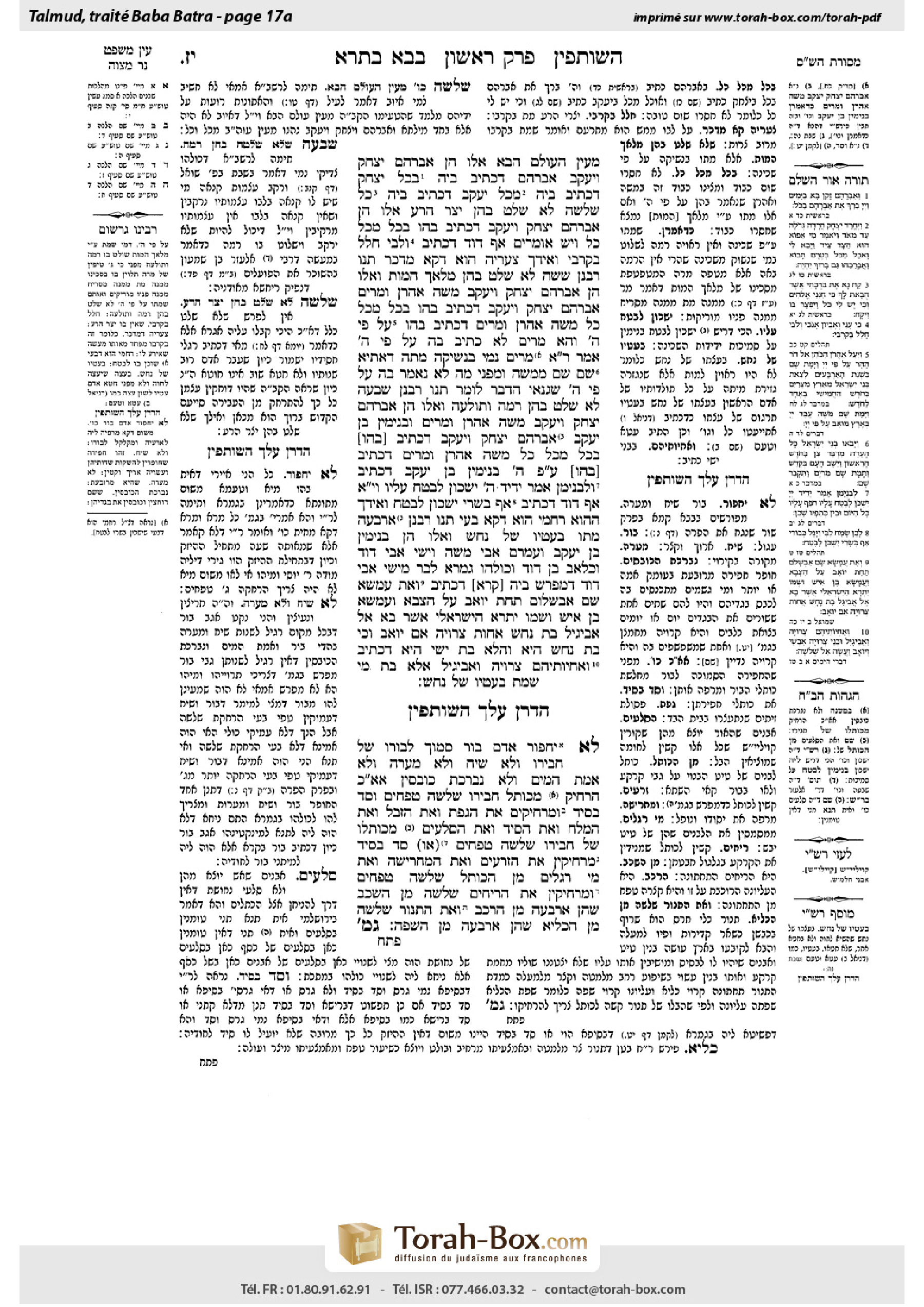
Bava Batra 17a: Talmud study for Daf Yomi
Study the Talmud for Daf Yomi with scanned pages, Hebrew text, English translations from Sefaria and AI-generated French translations.
Passage selection and English or AI-generated French translation are available where the scan has annotations. Daf Study is independent of Torah-Box and Sefaria.
Browse Bava Batra · בבא בתרא · All tractatesBava Batra 17a text and translations
This page of Bava Batra includes the Aramaic text, an English translation and an AI-generated French translation, alongside the scan above.
בבא בתרא י״ז א · Aramaic and Hebrew text
מֵעֵין הָעוֹלָם הַבָּא, אֵלּוּ הֵן: אַבְרָהָם, יִצְחָק וְיַעֲקֹב. אַבְרָהָם – דִּכְתִיב בֵּיהּ: ״בַּכֹּל״. יִצְחָק – דִּכְתִיב בֵּיהּ: ״מִכֹּל״. יַעֲקֹב – דִּכְתִיב בֵּיהּ: ״כֹּל״.
שְׁלֹשָׁה לֹא שָׁלַט בָּהֶן יֵצֶר הָרָע, אֵלּוּ הֵן: אַבְרָהָם, יִצְחָק וְיַעֲקֹב; דִּכְתִיב בְּהוּ: ״בַּכֹּל״, ״מִכֹּל״, ״כֹּל״. וְיֵשׁ אוֹמְרִים: אַף דָּוִד, דִּכְתִיב: ״וְלִבִּי חָלַל בְּקִרְבִּי״. וְאִידַּךְ – צַעֲרֵיהּ הוּא דְּקָא מַדְכַּר.
תָּנוּ רַבָּנַן: שִׁשָּׁה לֹא שָׁלַט בָּהֶן מַלְאַךְ הַמָּוֶת, וְאֵלּוּ הֵן: אַבְרָהָם, יִצְחָק וְיַעֲקֹב, מֹשֶׁה, אַהֲרֹן וּמִרְיָם. אַבְרָהָם, יִצְחָק וְיַעֲקֹב – דִּכְתִיב בְּהוּ: ״בַּכֹּל״, ״מִכֹּל״, ״כֹּל״; מֹשֶׁה, אַהֲרֹן וּמִרְיָם – דִּכְתִיב בְּהוּ: ״עַל פִּי ה׳״.
וְהָא מִרְיָם לָא כְּתִיב בָּהּ: ״עַל פִּי ה׳״! אָמַר רַבִּי אֶלְעָזָר: מִרְיָם נָמֵי בִּנְשִׁיקָה מֵתָה, דְּאָתְיָא ״שָׁם״–״שָׁם״ מִמֹּשֶׁה. וּמִפְּנֵי מָה לֹא נֶאֱמַר בָהּ ״עַל פִּי ה׳״ – שֶׁגְּנַאי הַדָּבָר לוֹמַר.
תָּנוּ רַבָּנַן: שִׁבְעָה לֹא שָׁלַט בָּהֶן רִמָּה וְתוֹלֵעָה, וְאֵלּוּ הֵן: אַבְרָהָם, יִצְחָק וְיַעֲקֹב, מֹשֶׁה, אַהֲרֹן וּמִרְיָם, וּבִנְיָמִין בֶּן יַעֲקֹב. אַבְרָהָם, יִצְחָק וְיַעֲקֹב – דִּכְתִיב [בְּהוּ]: ״בַּכֹּל״, ״מִכֹּל״, ״כֹּל״. מֹשֶׁה, אַהֲרֹן וּמִרְיָם – דִּכְתִיב [בְּהוּ]: ״עַל פִּי ה׳״. בִּנְיָמִין בֶּן יַעֲקֹב – דִּכְתִיב: ״וּלְבִנְיָמִין אָמַר: יְדִיד ה׳, יִשְׁכֹּן לָבֶטַח עָלָיו״. וְיֵשׁ אוֹמְרִים: אַף דָּוִד, דִּכְתִיב: ״אַף בְּשָׂרִי יִשְׁכֹּן לָבֶטַח״. וְאִידַּךְ – הָהוּא רַחֲמֵי הוּא דְּקָא בָּעֵי.
תָּנוּ רַבָּנַן: אַרְבָּעָה מֵתוּ בְּעֶטְיוֹ שֶׁל נָחָשׁ. וְאֵלּוּ הֵן: בִּנְיָמִין בֶּן יַעֲקֹב, וְעַמְרָם אֲבִי מֹשֶׁה, וְיִשַׁי אֲבִי דָּוִד, וְכִלְאָב בֶּן דָּוִד. וְכוּלְּהוּ גְּמָרָא, לְבַר מִיִּשַׁי אֲבִי דָוִד דִּמְפָרַשׁ בֵּיהּ [קְרָא], דִּכְתִיב: ״וְאֶת עֲמָשָׂא שָׂם אַבְשָׁלֹם תַּחַת יוֹאָב עַל הַצָּבָא, וַעֲמָשָׂא בֶן אִישׁ וּשְׁמוֹ יִתְרָא הַיִּשְׂרְאֵלִי, אֲשֶׁר בָּא אֶל אֲבִיגַיִל בַּת נָחָשׁ אֲחוֹת צְרוּיָה אֵם יוֹאָב״ – וְכִי בַּת נָחָשׁ הִיא? וַהֲלֹא בַּת יִשַׁי הִיא, דִּכְתִיב: ״וְאַחְיֹתֵיהֶם צְרוּיָה וַאֲבִיגַיִל״! אֶלָּא בַּת מִי שֶׁמֵּת בְּעֶטְיוֹ שֶׁל נָחָשׁ.
הַדְרָן עֲלָךְ הַשּׁוּתָּפִין
מַתְנִי׳ לֹא יַחְפּוֹר אָדָם בּוֹר סָמוּךְ לְבוֹרוֹ שֶׁל חֲבֵירו,ֹ וְלֹא שִׁיח, וְלֹא מְעָרָה, וְלֹא אַמַּת הַמַּיִם, וְלֹא נִבְרֶכֶת כּוֹבְסִין – אֶלָּא אִם כֵּן הִרְחִיק מִכּוֹתֶל חֲבֵירוֹ שְׁלֹשָׁה טְפָחִים, וְסָד בְּסִיד.
וּמַרְחִיקִים אֶת הַגֶּפֶת, וְאֶת הַזֶּבֶל, וְאֶת הַמֶּלַח, וְאֶת הַסִּיד, וְאֶת הַסְּלָעִים, מִכּוֹתְלוֹ שֶׁל חֲבֵירוֹ – שְׁלֹשָׁה טְפָחִים; אוֹ סָד בְּסִיד. מַרְחִיקִין אֶת הַזְּרָעִים, וְאֶת הַמַּחֲרֵישָׁה, וְאֶת מֵי רַגְלַיִם מִן הַכּוֹתֶל – שְׁלֹשָׁה טְפָחִים.
וּמַרְחִיקִין אֶת הָרֵיחַיִם שְׁלֹשָׁה מִן הַשֶּׁכֶב, שֶׁהֵן אַרְבָּעָה מִן הָרֶכֶב; וְאֶת הַתַּנּוּר – שְׁלֹשָׁה מִן הַכִּלְיָא, שֶׁהֵן אַרְבָּעָה מִן הַשָּׂפָה.
Bava Batra 17a · English translation
a taste of the World-to-Come. They are: Abraham, Isaac, and Jacob. Abraham, as it is written with regard to him: “And the Lord blessed Abraham with everything” (Genesis 24:1). Isaac, as it is written with regard to him: “And I have eaten from everything” (Genesis 27:33). Jacob, as it is written with regard to him: “Because I have everything” (Genesis 33:11). This teaches that already in their lifetimes they merited everything, i.e., perfection.
There were three people over whom the evil inclination had no sway. They are: Abraham, Isaac, and Jacob, as it is written with regard to them, respectively: “With everything,” “from everything,” “everything.” The completeness of their blessings means that they did not have to contend with their evil inclinations. And some say that even David was not subject to his evil inclination, as it is written: “And my heart has died within me” (Psalms 109:22), meaning that the evil inclination in his heart was nullified as if his heart had died. And how does the other authority, who does not include David in his list, explain this verse? He is mentioning his travails. David means to say that his heart died within him owing to all the suffering that he endured, but he says nothing about his evil inclination.
The Sages taught: There were six people over whom the Angel of Death had no sway in their demise, and they are: Abraham, Isaac, and Jacob, Moses, Aaron, and Miriam. Abraham, Isaac, and Jacob, as it is written with regard to them, respectively: “With everything,” “from everything,” “everything”; since they were blessed with everything they were certainly spared the anguish of the Angel of Death. Moses, Aaron, and Miriam, as it is written with regard to them that they died “by the mouth of the Lord” (Numbers 33:38; Deuteronomy 34:5), which indicates that they died with a kiss, and not at the hand of the Angel of Death.
The Gemara asks: But with regard to Miriam it is not written: “By the mouth of the Lord.” Rabbi Elazar says: Miriam also died with a kiss, as this is learned through a verbal analogy between the word “there” mentioned in regard to Miriam: “And Miriam died there” (Numbers 20:1), and the word “there” mentioned in regard to Moses: “And Moses died there” (Deuteronomy 34:5). And for what reason is “by the mouth of the Lord” not stated with regard to her? It is unseemly to mention death by a kiss with regard to a woman.
The Sages taught: There were seven people over whom the worm and the maggot had no sway, and they are: Abraham, Isaac, and Jacob, Moses, Aaron and Miriam, and Benjamin, son of Jacob. Abraham, Isaac, and Jacob, as it is written with regard to them, respectively: “With everything,” “from everything,” “everything.” Moses, Aaron, and Miriam, as it is written with regard to them: “By the mouth of the Lord”; Benjamin, son of Jacob, as it is written: “And to Benjamin he said: The beloved of the Lord, he shall dwell in safety by Him” (Deuteronomy 33:12). Even in death, he rests securely, unbothered by worms. And some say that even David is included, as it is written: “My flesh also dwells secure” (Psalms 16:9). The Gemara asks: And how does the other authority, who does not include David, explain this? The Gemara answers: He is asking for mercy, that his flesh should dwell secure and not be subject to worms and maggots, but his request was denied.
The Sages taught in a baraita: There were four people who died only because of the counsel of the primordial snake, in the wake of which all of humanity became mortal, and not on account of any personal sin. And they are: Benjamin, son of Jacob; Amram, father of Moses; Yishai, father of David; and Chileab, son of David. And all of these are known through tradition except for Yishai, father of David, with regard to whom it is written explicitly: “And Absalom placed Amasa over the army instead of Joab, and Amasa was the son of a man whose name was Ithra the Israelite, who engaged in intercourse with Abigail, daughter of Nahash, the sister of Zeruiah, mother of Joab” (II Samuel 17:25). But was Abigail the daughter of Nahash? Was she not the daughter of Yishai, as it is written: “And their sisters were Zeruiah and Abigail” (I Chronicles 2:16)? Rather, she was called “daughter of Nahash” to indicate that she was the daughter of one who died only because of the counsel of the snake.
MISHNA: A person may not dig a pit close to the pit of another, in order to avoid damaging the latter’s pit. And similarly, one may not dig a ditch, nor a cave, i.e., a covered pit, nor a water channel, nor a launderer’s pond, which is a pit used for washing clothes, unless he distanced all of these three handbreadths from the wall of another and he plasters lime on the place where there is water.
And one must distance the solid residue of produce that has been pressed free of its oil, e.g., the refuse of olives from which oil has been squeezed, and animal manure, and salt, and lime, and rocks three handbreadths from the wall of another, as all these items produce heat and can damage the wall. Or, alternatively, he may plaster the wall with lime to prevent damage. One must likewise distance seeds, i.e., one may not plant seeds, and one may not operate the plow, and one must eliminate urine, three handbreadths from the wall of another.
The mishna continues: And one must distance a mill from a neighbor’s wall by three handbreadths from the lower stone of the mill, which is four handbreadths from the smaller upper stone of the mill. And there must be a distance of three handbreadths from the protruding base [hakalya] of an oven until the wall, which is four handbreadths from the narrow upper rim [hassafa] of the oven.
Bava Batra 17a · Traduction française (IA)
Un goût du Monde à Venir. Ils sont : Abraham, Isaac et Jacob. Abraham, comme il est écrit à son sujet : « Et l'Éternel bénit Abraham avec tout » (Genèse 24:1). Isaac, comme il est écrit à son sujet : « Et j'ai mangé de tout » (Genèse 27:33). Jacob, comme il est écrit à son sujet : « Parce que j'ai tout » (Genèse 33:11). Cela enseigne que déjà dans leur vie ils méritaient tout, c'est-à-dire la perfection.
Il y avait trois personnes auxquels l'inclination mauvaise n'avait aucun pouvoir. Ce sont : Abraham, Isaac et Jacob, comme il est écrit à leur sujet respectivement : « Avec tout », « de tout », « tout ». La complétude de leurs bénédictions signifie qu'ils n'avaient pas à lutter contre leur inclination mauvaise. Et certains disent que même David n'était pas soumis à son inclination mauvaise, comme il est écrit : « Et mon cœur est mort en moi » (Psaumes 109:22), ce qui signifie que l'inclination mauvaise en son cœur était annulée comme si son cœur avait mouru. Et comment l'autre autorité, qui ne l'inclut pas dans sa liste, explique-t-il cette verset ? Il mentionne ses souffrances. David veut dire que son cœur était mort en lui à cause de toutes les souffrances qu'il avait endurées, mais il ne dit rien de son inclination mauvaise.
Les Sages enseignèrent : Il y avait six personnes auxquels l'Ange de la Mort n'avait aucun pouvoir sur leur mort, et ce sont : Abraham, Isaac et Jacob, Moïse, Aaron et Miriam. Abraham, Isaac et Jacob, comme il est écrit à leur sujet respectivement : « Avec tout », « de tout », « tout » ; puisqu'ils étaient bénis avec tout, ils étaient certainement épargnés de l'angoisse de l'Ange de la Mort. Moïse, Aaron et Miriam, comme il est écrit à leur sujet qu'ils sont morts « par la bouche de l'Éternel » (Nombres 33:38 ; Deutéronome 34:5), ce qui indique qu'ils sont morts avec un baiser, et non à la main de l'Ange de la Mort.
Le Guemara pose la question : Mais concernant Miriam, il n'est pas écrit : « Par la bouche de l'Éternel ». Rabbi Elazar dit : Miriam est également morte avec un baiser, comme cela est appris par analogie verbale entre le mot « là » mentionné à propos de Miriam : « Et Miriam mourut là » (Nombres 20:1), et le mot « là » mentionné à propos de Moïse : « Et Moïse mourut là » (Deutéronome 34:5). Et pourquoi « par la bouche de l'Éternel » n'est-il pas mentionné à son sujet ? C'est inapproprié de mentionner la mort par un baiser concernant une femme.
Les Sages enseignèrent : Il y avait sept personnes auxquelles la vermine et la mouche n'avaient aucun pouvoir, et ce sont : Abraham, Isaac et Jacob, Moïse, Aaron et Miriam, et Benjamin, fils de Jacob. Abraham, Isaac et Jacob, comme il est écrit à leur sujet respectivement : « Avec tout », « de tout », « tout ». Moïse, Aaron et Miriam, comme il est écrit à leur sujet : « Par la bouche de l'Éternel ». Benjamin, fils de Jacob, comme il est écrit : « Et à Benjamin il dit : L'aimé de l'Éternel, il habitera en sécurité auprès de Lui » (Deutéronome 33:12). Même en mort, il repose en sécurité, non importuné par les vers. Et certains disent que David est également inclus, comme il est écrit : « Mon corps aussi habite en sécurité » (Psaumes 16:9). Le Guemara pose la question : Et comment l'autre autorité, qui ne l'inclut pas, explique-t-il cela ? Le Guemara répond : Il demande la miséricorde, que son corps habite en sécurité et ne soit pas soumis à la vermine et à la mouche, mais sa demande a été refusée.
Les Sages enseignèrent dans une baraïta : Il y avait quatre personnes qui sont mortes uniquement à cause du conseil du serpent primordial, après quoi toute l'humanité est devenue mortelle, et non à cause d'un péché personnel. Et ce sont : Benjamin, fils de Jacob ; Amram, père de Moïse ; Yishai, père de David ; et Chileab, fils de David. Et toutes ces personnes sont connues par la tradition, sauf Yishai, père de David, à propos duquel il est écrit explicitement : « Et Absalom mit Amasa à la tête de l'armée à la place de Joab, et Amasa était le fils d'un homme dont le nom était Ithra l'Israélite, qui avait des relations avec Abigail, fille de Nahash, la sœur de Zeruiah, mère de Joab » (II Samuel 17:25). Mais Abigail était-elle la fille de Nahash ? N'était-elle pas la fille de Yishai, comme il est écrit : « Et leurs sœurs étaient Zeruiah et Abigail » (I Chroniques 2:16) ? Plutôt, elle était appelée « fille de Nahash » pour indiquer qu'elle était la fille d'une personne morte uniquement à cause du conseil du serpent.
MICHNA : Une personne ne doit pas creuser un puits proche du puits d'un autre, afin d'éviter de nuire au puits de l'autre. De même, on ne doit pas creuser un canal, ni une grotte, c'est-à-dire un puits couvert, ni un canal d'eau, ni un bassin de lavage, qui est un puits utilisé pour laver les vêtements, à moins qu'il ne distante de trois taches de main de la muraille d'un autre et qu'il plaque de la chaux sur la place où il y a de l'eau.
Et on doit distancer les résidus solides des produits pressés de leur huile, par exemple les déchets d'olives d'où l'huile a été extraite, et les déjections animales, et le sel, et la chaux, et les pierres de trois taches de main de la muraille d'un autre, car tous ces objets produisent de la chaleur et peuvent nuire à la muraille. Ou, de manière alternative, on peut plaquer la muraille avec de la chaux pour prévenir les dommages. On doit également distancer les semences, c'est-à-dire on ne doit pas planter des semences, et on ne doit pas utiliser la charrue, et on doit éliminer l'urine de trois taches de main de la muraille d'un autre.
La Michna continue : Et on doit distancer une meule d'une muraille d'un voisin de trois taches de main à partir de la pierre inférieure de la meule, qui est à quatre taches de main de la pierre supérieure plus petite de la meule. Et il doit y avoir une distance de trois taches de main de la base émergente [hakalya] d'un four jusqu'à la muraille, qui est à quatre taches de main de la bordure étroite [hassafa] supérieure du four.
Traduction française générée par IA à partir de l’édition anglaise de Sefaria. Vérifie toujours un passage avec le texte source.
Text from Sefaria: William Davidson Edition - Vocalized Aramaic (CC BY NC); William Davidson Edition - English (CC BY NC).