Bava Batra 170b: Talmud study for Daf Yomi
Study the Talmud for Daf Yomi with scanned pages, Hebrew text, English translations from Sefaria and AI-generated French translations.
Passage selection and English or AI-generated French translation are available where the scan has annotations. Daf Study is independent of Torah-Box and Sefaria.
Browse Bava Batra · בבא בתרא · All tractatesBava Batra 170b text and translations
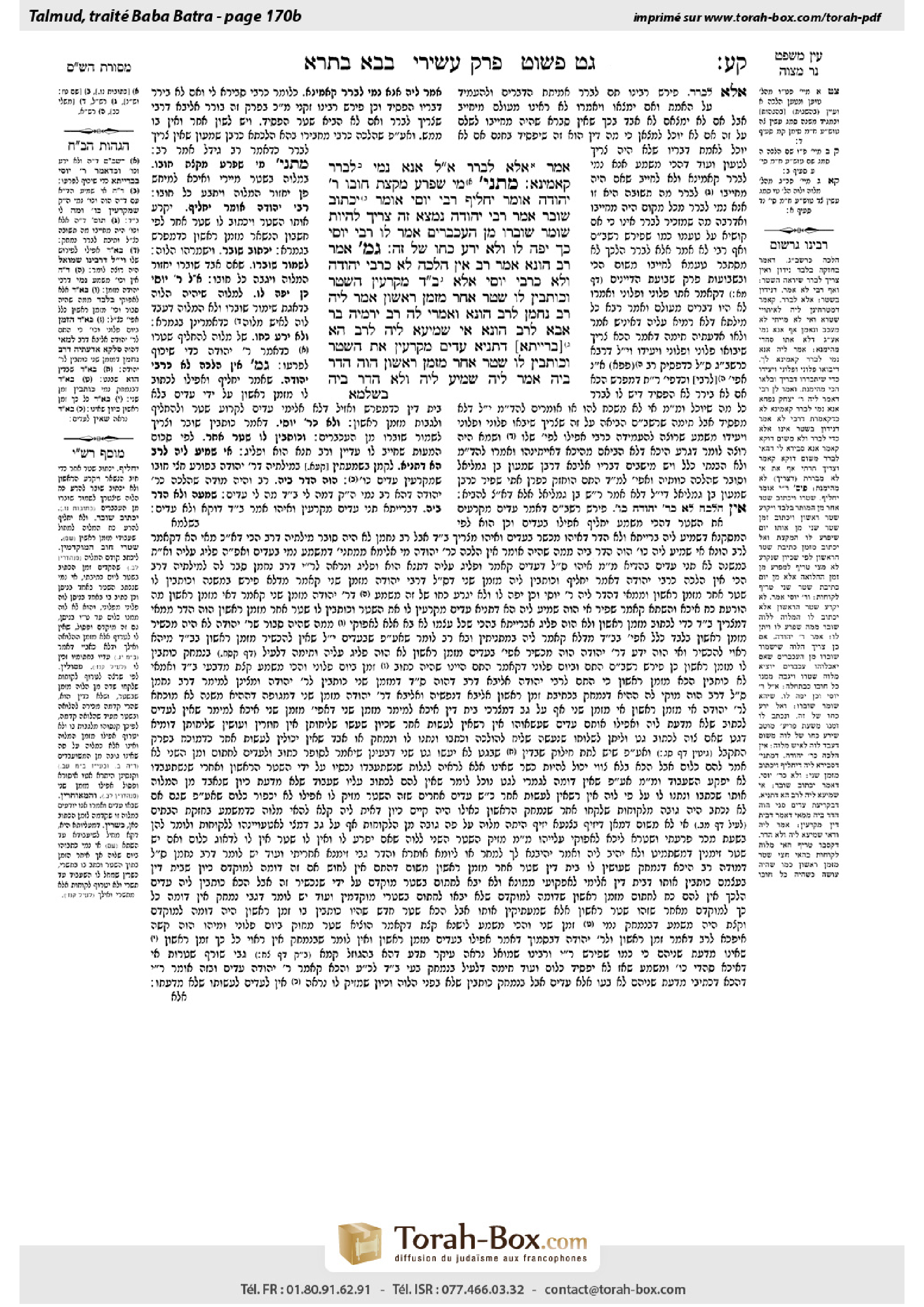
This page of Bava Batra includes the Aramaic text, an English translation and an AI-generated French translation, alongside the scan above.
בבא בתרא ק״ע ב · Aramaic and Hebrew text
אָמַר אֶלָּא לְבָרֵר! אֲמַר לֵיהּ: אֲנָא נָמֵי – לְבָרֵר קָאָמֵינָא.
מַתְנִי׳ מִי שֶׁפָּרַע מִקְצָת חוֹבוֹ, רַבִּי יְהוּדָה אוֹמֵר: יַחְלִיף, רַבִּי יוֹסֵי אוֹמֵר: יִכְתּוֹב שׁוֹבָר. אָמַר רַבִּי יְהוּדָה: נִמְצָא זֶה צָרִיךְ לִהְיוֹת שׁוֹמֵר שׁוֹבָרוֹ מִן הָעַכְבָּרִים! אָמַר לוֹ רַבִּי יוֹסֵי: כָּךְ יָפֶה לוֹ, וְלֹא יֵרַע כֹּחוֹ שֶׁל זֶה.
גְּמָ׳ אָמַר רַב הוּנָא אָמַר רַב: אֵין הֲלָכָה לֹא כְּרַבִּי יְהוּדָה וְלֹא כְּרַבִּי יוֹסֵי; אֶלָּא בֵּית דִּין מְקָרְעִין הַשְּׁטָר, וְכוֹתְבִין לוֹ שְׁטָר אַחֵר מִזְּמַן רִאשׁוֹן.
אֲמַר לֵיהּ רַב נַחְמָן לְרַב הוּנָא, וְאָמְרִי לַהּ רַב יִרְמְיָה בַּר אַבָּא לְרַב הוּנָא: אִי שְׁמִיעָא לֵיהּ לְרַב הָא [בָּרַיְיתָא] דְּתַנְיָא: עֵדִים מְקָרְעִין אֶת הַשְּׁטָר, וְכוֹתְבִין לוֹ שְׁטָר אַחֵר מִזְּמַן רִאשׁוֹן – הֲוָה הָדַר בֵּיהּ.
אֲמַר לֵיהּ: שְׁמִיעַ לֵיהּ, וְלָא הֲדַר בֵּיהּ.
Bava Batra 170b · English translation
say that the litigant loses the case if he cannot produce verification of his extraneous claims, but only that he is told to verify those claims if he can. Rabbi Yitzḥak Nappaḥa said to Rabbi Abba: I, too, am saying only that you are required to verify your claim if you can; if you cannot, you will not be required to pay.
MISHNA: In the case of a debtor who repaid part of his debt, Rabbi Yehuda says: The creditor should exchange the promissory note for a new one stating the current balance and tear up the first promissory note. Rabbi Yosei says: The creditor may keep the original promissory note, and he should write a receipt for the payment he has received and give it to the debtor as proof of his partial payment of the sum recorded in the old note. Rabbi Yehuda said with regard to this arrangement: It is found that this debtor must now guard his receipt against being destroyed by mice, as if he no longer has the receipt, he will have to pay the entire sum recorded in the promissory note. Rabbi Yosei said to him: This situation is fitting for him; it is better that this procedure be followed, and the strength of the claim of this creditor not be weakened.
GEMARA: Rav Huna says that Rav says: The halakha is not in accordance with the opinion of Rabbi Yehuda, nor is it in accordance with the opinion of Rabbi Yosei. Rather, the halakha is that the court tears up the original promissory note and writes a different promissory note for the creditor, listing the new sum owed, dated from the time of the first document.
Rav Naḥman said to Rav Huna, and some say it was Rav Yirmeya bar Abba who said this to Rav Huna: If Rav would have heard this following baraita, as it is taught in a baraita that according to Rabbi Yehuda the proper procedure is that the witnesses tear the original promissory note and write another promissory note for the creditor listing the new sum owed, dated from the time of the first document, he would have retracted his statement that the court tears the promissory note and writes a new one.
Rav Huna said to him: Rav heard the baraita, and nevertheless he did not retract his statement. While Rabbi Yehuda says in the baraita that the witnesses write a new promissory note, Rav maintains that this must be done specifically by a court. Why is this?
Bava Batra 170b · Traduction française (IA)
dire que le plaignant perd la cause s'il ne peut produire la vérification de ses allégations annexes, mais seulement que l'on lui demande de vérifier ces allégations s'il le peut. Rabbi Yitzḥak Nappaḥa a dit à Rabbi Abba : Je dis aussi que vous êtes tenu de vérifier votre allégation si vous le pouvez ; si vous ne pouvez pas, vous ne serez pas tenu de payer.
MICHNA : Dans le cas d'un débiteur qui a remboursé une partie de sa dette, Rabbi Yehuda dit : Le créancier devrait échanger le billet de change contre un nouveau indiquant le solde actuel et détruire le premier billet de change. Rabbi Yosei dit : Le créancier peut garder le billet de change original et il devrait écrire un reçu pour le paiement reçu et le donner au débiteur comme preuve de son paiement partiel de la somme indiquée dans l'ancien billet de change. Rabbi Yehuda a dit concernant cette disposition : On trouve que ce débiteur doit maintenant garder son reçu contre la destruction par les rats, comme s'il n'avait plus le reçu, il devrait payer la totalité de la somme indiquée dans le billet de change. Rabbi Yosei a dit à lui : Cette situation est appropriée pour lui ; il est préférable que cette procédure soit suivie, et la force du droit de ce créancier ne soit pas affaiblie.
GUEMARA : Rav Huna dit que Rav dit : La halakha n'est pas en conformité avec l'opinion de Rabbi Yehuda, ni avec celle de Rabbi Yosei. Plutôt, la halakha est que le tribunal détruit le billet de change original et écrit un nouveau billet de change pour le créancier, indiquant la nouvelle somme due, daté de la date du premier document.
Rav Naḥman a dit à Rav Huna, et on dit aussi que c'était Rav Yirmeya bar Abba qui a dit cela à Rav Huna : Si Rav avait entendu cette baraïta après, comme il est enseigné dans une baraïta que selon Rabbi Yehuda la procédure correcte est que les témoins détruisent le billet de change original et écrivent un nouveau billet de change pour le créancier indiquant la nouvelle somme due, daté de la date du premier document, il aurait rétracté son déclaration selon laquelle le tribunal détruit le billet de change et écrit un nouveau.
Rav Huna a dit à lui : Rav a entendu la baraïta, et pourtant il n'a pas rétracté son déclaration. Bien que Rabbi Yehuda dise dans la baraïta que les témoins écrivent un nouveau billet de change, Rav maintient que cela doit être fait spécifiquement par un tribunal. Pourquoi cela ?
Traduction française générée par IA à partir de l’édition anglaise de Sefaria. Vérifie toujours un passage avec le texte source.
Text from Sefaria: William Davidson Edition - Vocalized Aramaic (CC BY NC); William Davidson Edition - English (CC BY NC).