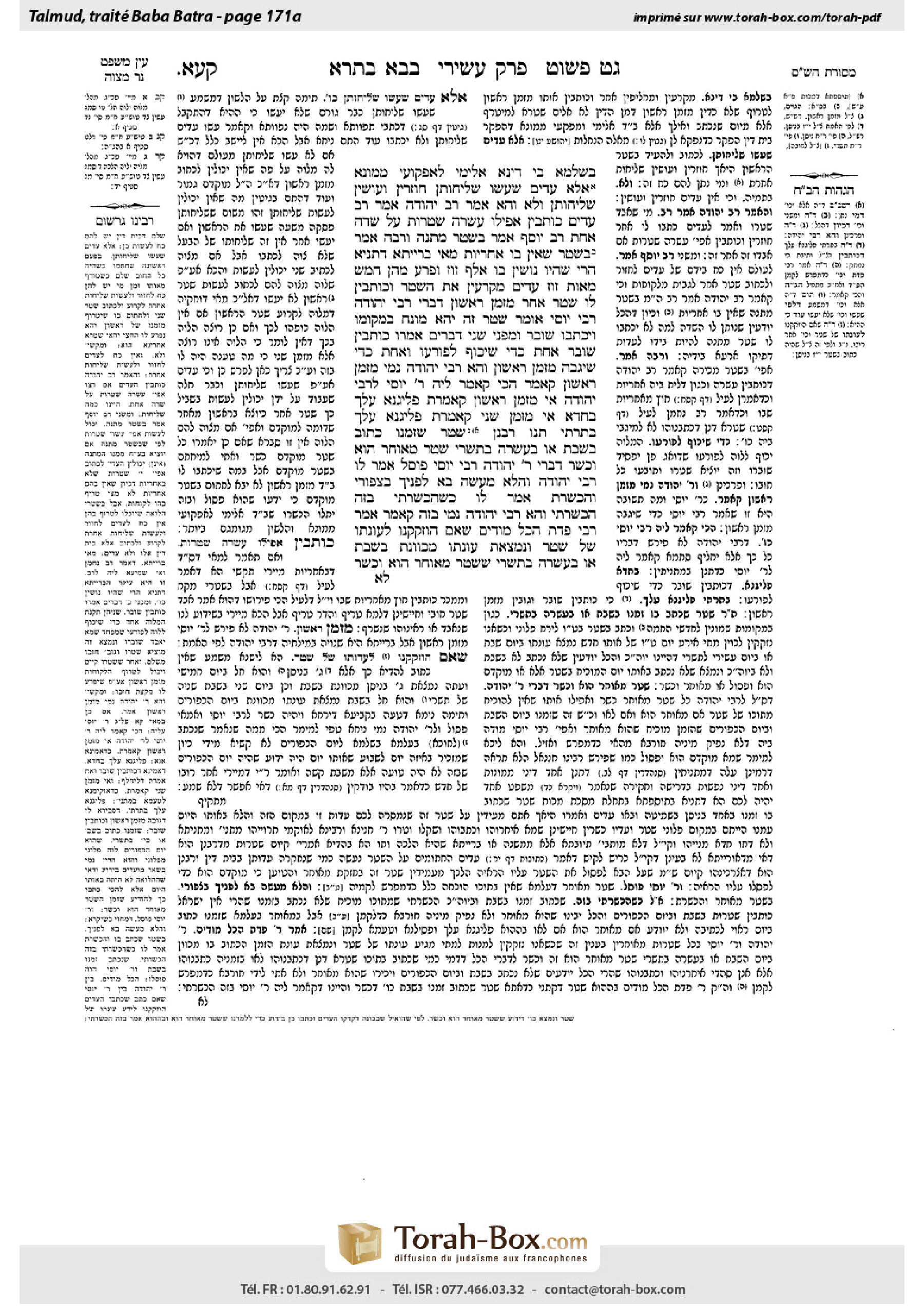
Bava Batra 171a: Talmud study for Daf Yomi
Study the Talmud for Daf Yomi with scanned pages, Hebrew text, English translations from Sefaria and AI-generated French translations.
Passage selection and English or AI-generated French translation are available where the scan has annotations. Daf Study is independent of Torah-Box and Sefaria.
Browse Bava Batra · בבא בתרא · All tractatesBava Batra 171a text and translations
This page of Bava Batra includes the Aramaic text, an English translation and an AI-generated French translation, alongside the scan above.
בבא בתרא קע״א א · Aramaic and Hebrew text
בִּשְׁלָמָא בֵּי דִינָא – אַלִּימֵי לְאַפְקוֹעֵי מָמוֹנָא. אֶלָּא עֵדִים שֶׁעָשׂוּ שְׁלִיחוּתָן – חוֹזְרִין וְעוֹשִׂין שְׁלִיחוּתָן?!
וְלָא?! וְהָא אָמַר רַב יְהוּדָה אָמַר רַב: עֵדִים כּוֹתְבִין אֲפִילּוּ עֲשָׂרָה שְׁטָרוֹת עַל שָׂדֶה אַחַת!
רַב יוֹסֵף אָמַר: בִּשְׁטַר מַתָּנָה,
וְרַבָּה אָמַר: בִּשְׁטָר שֶׁאֵין בּוֹ אַחְרָיוּת.
מַאי בָּרַיְיתָא? דְּתַנְיָא: הֲרֵי שֶׁהָיוּ נוֹשִׁין בּוֹ אֶלֶף זוּז, וּפָרַע מֵהֶן חֲמֵשׁ מֵאוֹת זוּז – עֵדִים מְקָרְעִין אֶת הַשְּׁטָר, וְכוֹתְבִין לוֹ שְׁטָר אַחֵר מִזְּמַן רִאשׁוֹן, דִּבְרֵי רַבִּי יְהוּדָה. רַבִּי יוֹסֵי אוֹמֵר: שְׁטָר זֶה יְהֵא מוּנָּח בִּמְקוֹמוֹ, וְיִכְתְּבוּ שׁוֹבָר.
וּמִפְּנֵי שְׁנֵי דְבָרִים אָמְרוּ כּוֹתְבִין שׁוֹבָר – אַחַת, כְּדֵי שֶׁיָּכוֹף לְפוֹרְעוֹ; וְאַחַת, כְּדֵי שֶׁיִּגְבֶּה מִזְּמַן רִאשׁוֹן.
וְהָא רַבִּי יְהוּדָה נָמֵי מִזְּמַן רִאשׁוֹן קָאָמַר! הָכִי קָאָמַר לֵיהּ רַבִּי יוֹסֵי לְרַבִּי יְהוּדָה: אִי מִזְּמַן רִאשׁוֹן קָאָמְרַתְּ – פְּלִיגְנָא עֲלָךְ בַּחֲדָא; אִי מִזְּמַן שֵׁנִי קָאָמְרַתְּ – פְּלִיגְנָא עֲלָךְ בְּתַרְתֵּי.
תָּנוּ רַבָּנַן: שְׁטַר שֶׁזְּמַנּוֹ כָּתוּב בְּשַׁבָּת אוֹ בַּעֲשָׂרָה בְּתִשְׁרִי – שְׁטָר מְאוּחָר הוּא, וְכָשֵׁר; דִּבְרֵי רַבִּי יְהוּדָה. רַבִּי יוֹסֵי פּוֹסֵל. אָמַר לוֹ רַבִּי יְהוּדָה: וַהֲלֹא מַעֲשֶׂה בָּא לְפָנֶיךָ בְּצִפּוֹרִי, וְהִכְשַׁרְתָּ! אָמַר לוֹ: כְּשֶׁהִכְשַׁרְתִּי – בָּזֶה הִכְשַׁרְתִּי.
וְהָא רַבִּי יְהוּדָה נָמֵי בָּזֶה קָאָמַר!
אָמַר רַבִּי פְּדָת: הַכֹּל מוֹדִים שֶׁאִם הוּזְקַקְנוּ לְעוֹנָתוֹ שֶׁל שְׁטָר, וְנִמְצֵאת עוֹנָתוֹ מְכֻוֶּונֶת בְּשַׁבָּת אוֹ בַּעֲשָׂרָה בְּתִשְׁרִי – שֶׁשְּׁטָר מְאוּחָר הוּא, וְכָשֵׁר;
Bava Batra 171a · English translation
Granted, a court can write a new document, because the court has the power to confiscate money. A creditor has the right to seize any property that the debtor had owned on the day the promissory note was written, even if that property was subsequently sold to others; the earlier the date on the note, the more properties it applies to. By dating the new document on the date of the original document the creditor is once again given the right to seize properties from those who had purchased land from the debtor in between the date of the original loan and the date the new promissory note is actually written. The court has such confiscatory power. But with regard to witnesses, who already performed their agency, i.e., fulfilled their assigned role, the first time they wrote the promissory note, can they return and perform their agency again by writing a second promissory note?
The Gemara asks: And is it so that witnesses are not empowered to do so? But doesn’t Rav Yehuda say that Rav says: Witnesses who were commissioned to write a deed for the transfer of property may write even ten deeds for one field? If the original deed is lost or destroyed, the witnesses may write a replacement deed for the purchaser, even if the deed is lost many times.
Rav Yosef says an answer to this question: Rav Yehuda’s statement was concerning a deed of gift, not a bill of sale. A gift of land has no guarantee; if it is repossessed from the recipient by the giver’s creditor to repay the giver’s debt, the recipient has no recourse and cannot collect any money from anyone. Therefore, in this case no one is jeopardized by the writing of many replacement deeds, which are intended only to serve as a proof that the recipient is actually entitled to the land.
And Rabba says: It is possible to say that Rav Yehuda’s statement applied even with regard to a bill of sale that does not have a guarantee in it. In that case as well, there is no potential loss to any purchasers of land. By contrast, in the case of a promissory note, which can be used to repossess property from those who have purchased land from the debtor, witnesses do not have the authority to predate a document and thereby subject more purchasers to possible land seizures due to the predating of the document.
The Gemara cited an excerpt from a baraita earlier. It now cites it in full: What is the full text of the baraita? As it is taught: If one thousand dinars are owed by a debtor, and the debt is recorded in a promissory note, and the debtor repaid five hundred dinars out of the total, the witnesses tear the original promissory note and write another promissory note for him, dated from the time of the first note. This is the statement of Rabbi Yehuda. Rabbi Yosei says: This original promissory note shall remain in its place, in the custody of the creditor, and witnesses write a receipt for the five hundred dinars that were repaid. This receipt is given to the debtor to protect himself against a possible attempt by the creditor to use the promissory note to collect the entire one thousand dinars.
Rabbi Yosei continues: And there are two reasons why the Sages said that they write a receipt, as opposed to writing a new promissory note: One reason is so that the creditor can coerce the debtor to repay him, i.e., the psychological pressure for the debtor of knowing that the creditor has a promissory note with a larger amount listed than what he owes him will induce the debtor to repay the remainder promptly. And the other one is so that he, the creditor, should be able to collect liened property from the first date, that of the original document.
The Gemara asks with regard to Rabbi Yosei’s second reason: But doesn’t Rabbi Yehuda also say that the new document must be dated from the time of the first document? The Gemara answers: Rabbi Yosei did not hear a full explanation of Rabbi Yehuda’s opinion; he heard only that Rabbi Yehuda prescribed writing a new promissory note recording the new balance. And this is what Rabbi Yosei is saying to Rabbi Yehuda: If you mean to say that the new promissory note is dated from the time of the first document, I disagree with you on one count, as I hold a receipt should be written to pressure the debtor. If you mean to say that the second promissory note is dated from the second date, i.e., from when the second promissory note was written, I disagree with you on two counts.
§ The Gemara discusses a related halakha. The Sages taught in a baraita (Tosefta, Makkot 1:3): If there is a promissory note whose date is written as a Shabbat or as the tenth of Tishrei, i.e., Yom Kippur, it is assumed to be a postdated promissory note, as writing is forbidden on Shabbat and Yom Kippur, and it is therefore valid. This is the statement of Rabbi Yehuda. Rabbi Yosei deems the promissory note invalid. Rabbi Yehuda said to Rabbi Yosei: But didn’t such an incident come before you in Tzippori, and you yourself deemed the promissory note valid? Rabbi Yosei said to him: When I deemed the promissory note valid, it was in a case like this, where the date was a Shabbat or Yom Kippur, that I deemed it valid.
The Gemara is puzzled by Rabbi Yosei’s response at the end of the baraita: But Rabbi Yehuda was also speaking in a case like this, where the date was a Shabbat or Yom Kippur, and yet Rabbi Yosei’s opinion was that the promissory note is invalid.
Rabbi Pedat says: All parties to this dispute agree that if we engaged in an investigation of the date of the document, and its date was found to be exactly on Shabbat or on the tenth of Tishrei, that it is self-evident that it is a postdated promissory note and is valid.
Bava Batra 171a · Traduction française (IA)
Il est vrai qu'un tribunal peut écrire un nouveau document, car le tribunal a le pouvoir de confisquer de l'argent. Un créancier a le droit de saisir toute propriété appartenant au débiteur à la date où le billet de change a été écrit, même si cette propriété a été ultérieurement vendue à d'autres ; plus la date du billet est ancienne, plus le nombre de propriétés concernées est élevé. En datant le nouveau document de la date du document original, le créancier est à nouveau autorisé à saisir des propriétés auprès de ceux qui ont acheté des terres au débiteur entre la date du prêt initial et la date réelle où le nouveau billet de change est rédigé. Le tribunal dispose de ce pouvoir confiscatoire. Mais concernant les témoins, qui ont déjà accompli leur tâche, c'est-à-dire rempli leur rôle assigné, lorsqu'ils ont rédigé le premier billet de change, peuvent-ils revenir et accomplir à nouveau leur tâche en rédigeant un second billet de change ?
La Guemara pose la question : Et est-ce que les témoins n'ont pas le pouvoir de le faire ? Mais ne dit-il pas Rav Yehuda que Rav dit : Les témoins qui ont été chargés de rédiger un acte de transfert de propriété peuvent rédiger même dix actes pour un seul champ ? Si l'acte original est perdu ou détruit, les témoins peuvent rédiger un acte de remplacement pour l'acheteur, même si l'acte est perdu plusieurs fois.
Rav Yosef répond à cette question : La déclaration de Rav Yehuda concernait un don, pas un acte de vente. Un don de terre n'a pas de garantie ; si la terre est réclamée par le créancier du donneur pour rembourser la dette du donneur, le receveur n'a aucun recours et ne peut récupérer aucune somme auprès de personne. Par conséquent, dans ce cas, personne n'est menacé par la rédaction de plusieurs actes de remplacement, qui sont uniquement destinés à servir de preuve que le receveur est effectivement propriétaire de la terre.
Et Rabba dit : Il est possible de dire que la déclaration de Rav Yehuda s'applique même concernant un contrat de vente qui n'a pas de garantie. Dans ce cas également, il n'y a pas de perte potentielle pour les acheteurs de terres. À l'inverse, dans le cas d'un billet de change, qui peut être utilisé pour saisir des propriétés auprès de ceux qui ont acheté des terres au débiteur, les témoins n'ont pas le pouvoir de proroger un document et de soumettre ainsi davantage d'acheteurs à une possible saisie de terres en raison de cette prorogation.
La Guemara cite un extrait d'une baraïta plus tôt. Elle cite maintenant le texte complet : Quel est le texte complet de la baraïta ? Il est enseigné ainsi : Si un débiteur doit mille dinars, et que la dette est inscrite dans un billet de change, et que le débiteur remet cinq cents dinars de la somme totale, les témoins déchirent le billet de change original et rédigent un nouveau billet de change pour lui, daté de la date du premier billet. C'est l'opinion de Rabbi Yehuda. Rabbi Yosei dit : Ce billet de change original doit rester en place, entre les mains du créancier, et les témoins rédigent un reçu pour les cinq cents dinars remis. Ce reçu est donné au débiteur afin de le protéger contre toute tentative du créancier d'utiliser le billet de change pour récupérer les mille dinars.
Rabbi Yosei continue : Et il y a deux raisons pour lesquelles les Sages ont dit qu'ils rédigent un reçu, au lieu de rédiger un nouveau billet de change : une raison est afin que le créancier puisse contraindre le débiteur à le rembourser, c'est-à-dire la pression psychologique exercée sur le débiteur en sachant que le créancier possède un billet de change indiquant une somme supérieure à ce qu'il doit, ce qui incitera le débiteur à rembourser le reste rapidement. Et la deuxième raison est afin que le créancier puisse récupérer une propriété liée dès la date initiale du document.
La Guemara pose une question concernant la deuxième raison de Rabbi Yosei : Mais ne dit-il pas Rabbi Yehuda également que le nouveau document doit être daté de la date du premier document ? La Guemara répond : Rabbi Yosei n’a pas entendu une explication complète de l’opinion de Rabbi Yehuda ; il a entendu seulement que Rabbi Yehuda prescrivait la rédaction d’un nouveau billet de change indiquant le nouveau solde. Et c’est ce que Rabbi Yosei dit à Rabbi Yehuda : Si tu veux dire que le nouveau billet de change est daté de la date du premier document, je ne suis pas d’accord avec toi sur un point, car je considère qu’un reçu devrait être rédigé pour presser le débiteur. Si tu veux dire que le second billet de change est daté de la date du second document, c’est-à-dire de la date où le second billet de change a été rédigé, je ne suis pas d’accord avec toi sur deux points.
§ La Guemara discute d’une halakha liée. Les Sages enseignent dans une baraïta (Tosefta, Makkot 1:3) : Si un billet de change a une date indiquant un sabbat ou le dixième de Tishrei, c’est-à-dire Yom Kippour, on suppose qu’il s’agit d’un billet de change postérieur, car l’écriture est interdite le sabbat et Yom Kippour, et il est donc valide. C’est l’opinion de Rabbi Yehuda. Rabbi Yosei considère que le billet de change est invalide. Rabbi Yehuda dit à Rabbi Yosei : Mais n’as-tu pas eu une telle situation devant toi à Tzippori, et tu as toi-même considéré le billet de change comme valide ? Rabbi Yosei répond à lui : Lorsque j’ai considéré le billet de change comme valide, c’était dans un cas similaire, où la date était un sabbat ou Yom Kippour, et c’est à ce moment-là que j’ai considéré le billet de change comme valide.
La Guemara est perplexe face à la réponse de Rabbi Yosei à la fin de la baraïta : Mais Rabbi Yehuda parlait également dans un cas similaire, où la date était un sabbat ou Yom Kippour, et pourtant l’opinion de Rabbi Yosei était que le billet de change était invalide.
Rabbi Pedat dit : Tous les parties à ce débat s'accordent sur le fait que si nous avions mené une enquête sur la date du document et que nous avions trouvé qu'elle était exactement un sabbat ou le dixième de Tishrei, il est évident qu'il s'agit d'un billet de change postérieur et qu'il est valide.
Traduction française générée par IA à partir de l’édition anglaise de Sefaria. Vérifie toujours un passage avec le texte source.
Text from Sefaria: William Davidson Edition - Vocalized Aramaic (CC BY NC); William Davidson Edition - English (CC BY NC).