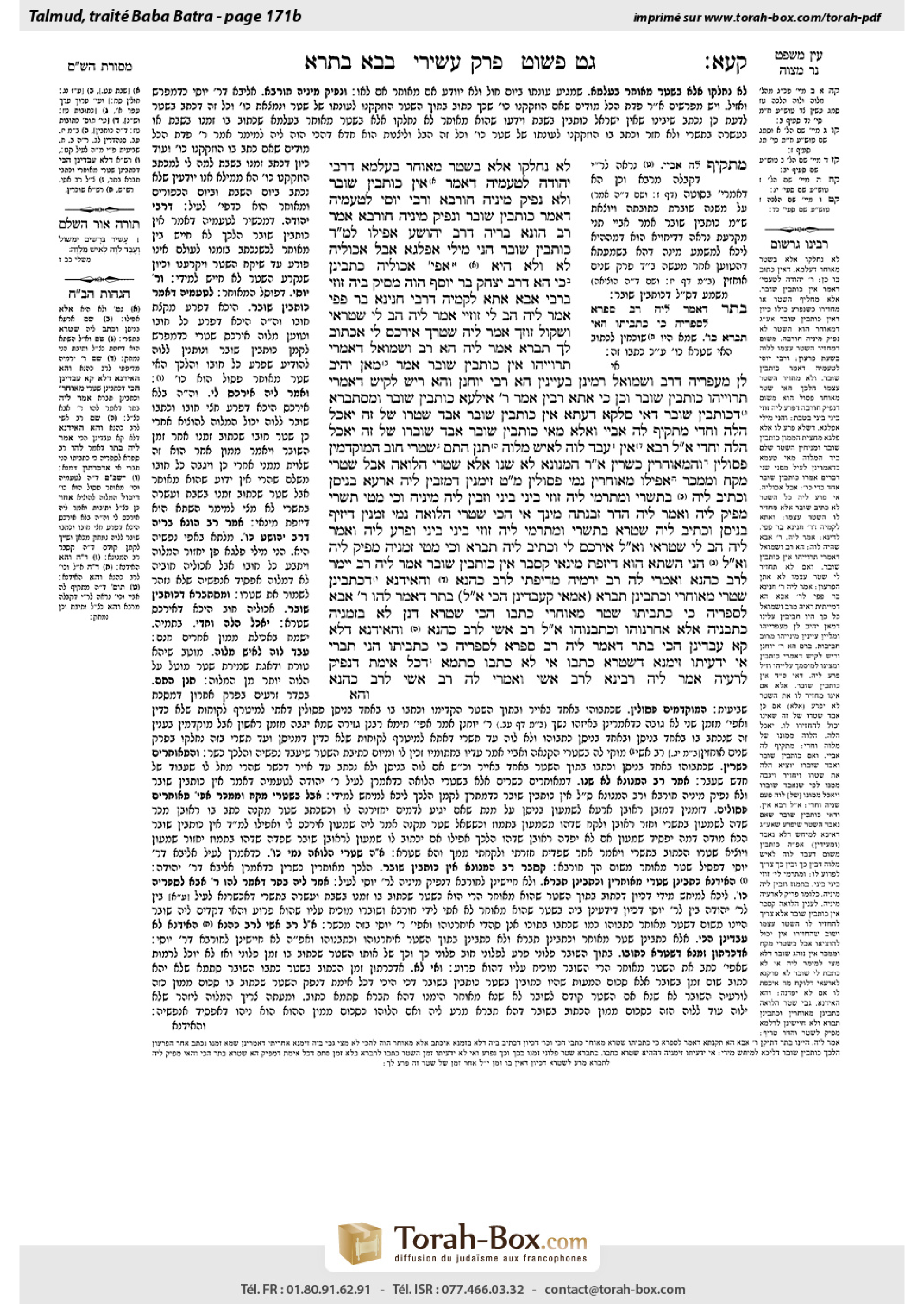
Bava Batra 171b: Talmud study for Daf Yomi
Study the Talmud for Daf Yomi with scanned pages, Hebrew text, English translations from Sefaria and AI-generated French translations.
Passage selection and English or AI-generated French translation are available where the scan has annotations. Daf Study is independent of Torah-Box and Sefaria.
Browse Bava Batra · בבא בתרא · All tractatesBava Batra 171b text and translations
This page of Bava Batra includes the Aramaic text, an English translation and an AI-generated French translation, alongside the scan above.
בבא בתרא קע״א ב · Aramaic and Hebrew text
לֹא נֶחְלְקוּ אֶלָּא בִּשְׁטָר מְאוּחָר בְּעָלְמָא –
דְּרַבִּי יְהוּדָה לְטַעְמֵיהּ, דְּאָמַר: אֵין כּוֹתְבִין שׁוֹבָר, וְלָא נָפֵיק מִינֵּיהּ חוּרְבָּא;
וְרַבִּי יוֹסֵי לְטַעְמֵיהּ, דְּאָמַר: כּוֹתְבִין שׁוֹבָר, וְנָפֵיק מִינֵּיהּ חוּרְבָּא.
אָמַר רַב הוּנָא בְּרֵיהּ דְּרַב יְהוֹשֻׁעַ: אֲפִילּוּ לְמַאן דְּאָמַר כּוֹתְבִין שׁוֹבָר, הָנֵי מִילֵּי אַפַּלְגָא, אֲבָל אַכּוּלֵּיהּ – לָא.
וְלָא הִיא, אֲפִילּוּ אַכּוּלֵּיהּ כָּתְבִינַן.
כִּי הָא דְּרַב יִצְחָק בַּר יוֹסֵף הֲוָה מַסֵּיק בֵּיהּ זוּזִי בְּרַבִּי אַבָּא. אֲתָא לְקַמֵּיהּ דְּרַבִּי חֲנִינָא בַּר פַּפֵּי, אֲמַר לֵיהּ: ״הַב לִי זוּזַיי״. אֲמַר לֵיהּ: ״הַב לִי שְׁטָרַאי, וּשְׁקוֹל זוּזָךְ״. אֲמַר לֵיהּ: ״שְׁטָרָךְ אִירְכַס לִי, אֶכְתּוֹב לָךְ תְּבָרָא״. אָמַר לֵיהּ: ״הָא רַב וּשְׁמוּאֵל דְּאָמְרִי תַּרְוַיְיהוּ: אֵין כּוֹתְבִין שׁוֹבָר!״
אֲמַר: ״מַאן יָהֵיב לַן מֵעַפְרֵיהּ דְּרַב וּשְׁמוּאֵל, רָמִינַן בְּעַיְינִין; הָא רַבִּי יוֹחָנָן וְהָא רֵישׁ לָקִישׁ דְּאָמְרִי תַּרְוַיְיהוּ: כּוֹתְבִין שׁוֹבָר״.
וְכֵן כִּי אֲתָא רָבִין אָמַר רַבִּי אִילְעָא: כּוֹתְבִין שׁוֹבָר.
וּמִסְתַּבְּרָא דְּכוֹתְבִין שׁוֹבָר; דְּאִי סָלְקָא דַּעְתָּא אֵין כּוֹתְבִין שׁוֹבָר, אָבַד שְׁטָרוֹ שֶׁל זֶה – יֹאכַל הַלָּה וְחָדֵי?!
מַתְקֵיף לַהּ אַבָּיֵי: וְאֶלָּא מַאי, כּוֹתְבִין שׁוֹבָר?! אָבַד שׁוֹבָרוֹ שֶׁל זֶה – יֹאכַל הַלָּה וְחָדֵי? אֲמַר לֵיהּ רָבָא: אִין, ״עֶבֶד לֹוֶה לְאִישׁ מַלְוֶה״.
תְּנַן הָתָם: שִׁטְרֵי חוֹב הַמּוּקְדָּמִין – פְּסוּלִין, וְהַמְאוּחָרִין – כְּשֵׁרִין.
אָמַר רַב הַמְנוּנָא: לֹא שָׁנוּ אֶלָּא שְׁטָרֵי הַלְוָאָה, אֲבָל שְׁטָרֵי מִקָּח וּמִמְכָּר – אֲפִילּוּ מְאוּחָרִין נָמֵי פְּסוּלִין. מַאי טַעְמָא? זִימְנִין דִּמְזַבֵּין לֵיהּ אַרְעָא בְּנִיסָן וְכָתֵיב לֵיהּ בְּתִשְׁרִי, וּמִתְרְמֵי לֵיהּ זוּזֵי בֵּינֵי בֵּינֵי וְזָבֵין לַיהּ מִינֵּיהּ, וְכִי מָטֵי תִּשְׁרִי – מַפֵּיק לֵיהּ, וְאָמַר לֵיהּ: הֲדַר זְבֵנְתַּהּ מִינָּךְ!
אִי הָכִי, שְׁטָרֵי הַלְוָאָה נָמֵי – זִמְנִין דְּיָזֵיף בְּנִיסָן וּכְתִיב לֵיהּ שְׁטָרָא בְּתִשְׁרִי; וּמִתְרְמֵי לֵיהּ זוּזֵי בֵּינֵי בֵּינֵי וּפָרַע לֵיהּ, וְאָמַר לֵיהּ: הַב לִי שְׁטָרַאי, וְאָמַר לֵיהּ: אִירְכַס לִי, וְכָתֵיב לֵיהּ תְּבָרָא; וְכִי מָטֵי זִמְנֵיהּ, מַפֵּיק לֵיהּ וַאֲמַר לֵיהּ: הָנֵי הַשְׁתָּא הוּא דִּיזַפְתְּ מִינַּאי!
קָסָבַר: אֵין כּוֹתְבִין שׁוֹבָר.
אֲמַר לֵיהּ רַב יֵימַר לְרַב כָּהֲנָא, וְאָמְרִי לַהּ רַב יִרְמְיָה מִדִּיפְתִּי לְרַב כָּהֲנָא: וְהָאִידָּנָא דְּכָתְבִינַן שְׁטָרֵי מְאוּחָרֵי וְכָתְבִינַן תְּבָרָא, אַמַּאי קָעָבְדִינַן הָכִי? אֲמַר לֵיהּ, בָּתַר דַּאֲמַר לְהוּ רַבִּי אַבָּא לְסָפְרֵיהּ: כִּי כָּתְבִיתוּ שְׁטָרֵ[י] מְאוּחָרֵי, כְּתֻבוּ הָכִי: ״שְׁטָרָא דְּנַן לָא בְּזִמְנֵיהּ כְּתַבְנֵיהּ, אֶלָּא אַחַרְנוֹהִי וּכְתַבְנוֹהִי״.
אֲמַר לֵיהּ רַב אָשֵׁי לְרַב כָּהֲנָא: וְהָאִידָּנָא – דְּלָא קָא עָבְדִינַן הָכִי? בָּתַר דַּאֲמַר לֵיהּ רַב סָפְרָא לְסָפְרֵיהּ: כִּי כָּתְבִיתוּ הָנֵי תְּבָרֵי; אִי יָדְעִיתוּ זִימְנָא דִשְׁטָרָא – כְּתֻבוּ, אִי לָא – כְּתֻבוּ סְתָמָא, דְּכׇל אֵימַת דְּנָפֵיק – לַרְעֵיהּ.
אֲמַר לֵיהּ רָבִינָא לְרַב אָשֵׁי, וְאָמְרִי לַהּ רַב אָשֵׁי לְרַב כָּהֲנָא:
Bava Batra 171b · English translation
The two Sages disagree only with regard to a case of a postdated promissory note in general, i.e., one in which the fact that it is postdated is not readily discernible from the dating of the document, as opposed to one dated on Shabbat or Yom Kippur.
As Rabbi Yehuda conforms to his line of reasoning, as he says: One does not write a receipt for a debtor when he pays his debt; rather, the original document is torn, and in the case of partial repayment a new document is written, attesting to the balance due. And consequently, no harm can emerge from a postdated document. There is no concern that the date on the postdated document may have been recorded after the writing of a receipt.
And Rabbi Yosei conforms to his line of reasoning, as he says: One writes a receipt for a debtor when he pays his debt, in lieu of tearing the promissory note. And consequently, harm can emerge from a postdated promissory note. Harm can occur in a case such as the following: The loan was given on the first of Nisan. The debt was paid on the following day and, rather than tearing the promissory note, a receipt was written and dated on the second of Nisan. If the original note had been postdated to the third of Nisan or thereafter, the creditor could use it to collect his debt a second time, arguing that the debtor’s receipt is irrelevant, as its date is prior to the date in the promissory note.
§ Rav Huna, son of Rav Yehoshua, says: Even according to the one who says that one writes a receipt for the debtor when he pays, in lieu of tearing the promissory note, this statement applies only with regard to a case where the debtor pays half, i.e., a portion, of the debt. But with regard to a case where the debtor comes to repay all of the debt and the creditor has lost the promissory note and cannot tear it, all agree that one does not write a receipt. Rather, the debtor will not be required to repay the loan unless the creditor can produce the promissory note.
The Gemara rejects this opinion: But it is not so; we write a receipt even in a case where the debtor pays all of the debt.
The Gemara proves its assertion: This is like that case where Rav Yitzḥak bar Yosef was owed money by Rabbi Abba. Rav Yitzḥak bar Yosef came before Rabbi Ḥanina bar Pappi, and said to Rabbi Abba: Give me my money. Rabbi Abba said to him: First give me my promissory note, and then take your money. Rav Yitzḥak bar Yosef said to him: I lost your promissory note; instead, I will write a receipt for you. Rabbi Abba said to him: Isn’t there the opinion of Rav and Shmuel, who both say that the halakha is that one does not write a receipt?
Rabbi Ḥanina bar Pappi, the judge, thereupon said: Who will give us some of the dust of Rav and Shmuel, and I will place it on my eyes, so highly do I regard them. Nevertheless, isn’t there the opinion of Rabbi Yoḥanan and Reish Lakish, who both say that one writes a receipt?
And similarly, when Ravin came from Eretz Yisrael to Babylonia, he said that Rabbi Ilai says: The halakha is that one writes a receipt.
The Gemara concludes: And it stands to reason that one writes a receipt. As, if it would enter your mind that one does not write a receipt, then if the promissory note of this creditor is lost, should this debtor eat and rejoice? Is it fair that he should keep money that he knows he owes the creditor?
Abaye objects to this line of reasoning: Rather, what should the halakha be, that one writes a receipt when the creditor cannot find the promissory note? If the receipt of the debtor is lost, should this creditor eat and rejoice? Once the debtor has lost his receipt, there is nothing to prevent the creditor from collecting the debt a second time. This, too, is unfair. In either case, whether a receipt is written or not, an injustice could result. Why should it be preferred that the potential of suffering an injustice should be borne by the debtor rather than the creditor? Rava said to Abaye: Yes, it is preferable, because, as it is written: “The borrower is a servant to the lender” (Proverbs 22:7). The debtor’s interests are subordinated to those of the creditor.
§ We learned in a mishna elsewhere (Shevi’it 10:5): Promissory notes that are antedated are not valid, but those that are postdated are valid.
Rav Hamnuna says: They taught this halakha only with regard to promissory notes, but with regard to deeds of buying and selling property, even postdated documents are not valid. What is the reason for this stringency in the case of bills of sale? If postdated documents were allowed, there could be times that the seller sells land to the purchaser in the month of Nisan of a particular year and writes a postdated deed for him stating that the sale took place in the following Tishrei, and some money happens to reach the seller between Nisan and Tishrei and he purchases the land back from the purchaser. And then, when Tishrei arrives, the purchaser takes out the original bill of sale and says to the seller: It is true that you purchased the field from me, but I then purchased it from you again now, in Tishrei, as stated in this document.
The Gemara asks: If so, a similar scenario could occur with promissory notes as well: There could be times that one borrows money in Nisan and writes a promissory note for the creditor stating that the loan took place in the following Tishrei, and some money happens to reach the debtor between Nisan and Tishrei and he repays his debt to the creditor early and says to him: Give me my promissory note. And the creditor says to him: I lost it, and he writes him a receipt instead. And then, when the time written in the note arrives, the creditor takes out the supposedly lost promissory note and says to the debtor: It is true that you repaid me previously, but it is now, after you repaid that loan, that you borrowed from me these dinars recorded in this document, which is dated in Tishrei.
The Gemara answers: Rav Hamnuna holds that one does not write a receipt, so that scenario cannot occur. Like Rabbi Yehuda, Rav Hamnuna maintains that if a creditor loses his promissory note the debtor does not have to repay the loan. Rabbi Yosei, who does allow the creditor to collect his debt in such a case and write a receipt for the debtor, is concerned about that scenario, and consequently he holds that postdated promissory notes are not valid.
Rav Yeimar said to Rav Kahana, and some say it was Rav Yirmeya of Difti who said this to Rav Kahana: And today, when we write postdated promissory notes, and we also write a receipt in cases where the creditor loses his promissory note, why do we do this? The combination of allowing postdated promissory notes and allowing the writing of a receipt instead of producing the promissory note would enable double collection of the loan to take place. Rav Kahana said to him: The problem was rectified after Rabbi Abba told his court scribe: When you write postdated promissory notes, write as follows: We did not write this document on its date, i.e., on the date written within the document; rather, we postdated it and wrote it. Since it is clear from the text of the document that it was postdated, double collection of the loan is avoided.
Rav Ashi said to Rav Kahana: But what about today, when we do not do this, i.e., we do not follow Rabbi Abba’s instructions? How do we avoid double collection of the loan? Rav Kahana replied: The problem was rectified after Rav Safra said to his court scribe: When you write these receipts for debtors who pay debts without the original promissory note being torn, if you know the date written in the missing promissory note, write it into the receipt. But if you do not know the date written in the promissory note, write the receipt without specification, i.e., do not write any date at all in the receipt, so that whenever the creditor produces the promissory note, the undated receipt can weaken it, i.e., exempt the debtor from payment.
Ravina said to Rav Ashi, and some say it was Rav Ashi who said to Rav Kahana:
Bava Batra 171b · Traduction française (IA)
Les deux Sages s'entendent seulement sur le cas d'une note de promesse postdatée en général, c'est-à-dire celle dont la postdation n'est pas facilement discernable à partir de la date du document, contrairement à celle datée le shabbat ou Yom Kippur.
Comme Rabbi Yehuda suit sa ligne de raisonnement, car il dit : On ne rédige pas un reçu pour un débiteur lorsqu'il paie sa dette ; plutôt, le document original est déchiré, et dans le cas d'un paiement partiel, un nouveau document est rédigé attestant de la somme restante due. Et par conséquent, aucun préjudice ne peut résulter d'un document postdaté. Il n'y a pas de crainte que la date du document postdaté puisse avoir été enregistrée après la rédaction d'un reçu.
Et Rabbi Yosei suit sa ligne de raisonnement, car il dit : On rédige un reçu pour un débiteur lorsqu'il paie sa dette, à la place de déchirer la note de promesse. Et par conséquent, un préjudice peut résulter d'une note de promesse postdatée. Un préjudice peut survenir dans un cas tel que le suivant : Le prêt a été donné le premier de Nisan. La dette a été payée le lendemain, et, au lieu de déchirer la note de promesse, un reçu a été rédigé et daté du deuxième de Nisan. Si la note originale avait été postdatée au troisième de Nisan ou plus tard, le créancier pourrait l'utiliser pour réclamer sa dette une deuxième fois, arguant que le reçu du débiteur est sans importance, car sa date est antérieure à celle de la note de promesse.
§ Rav Huna, fils de Rav Yehoshua, dit : Même selon celui qui dit qu'on rédige un reçu pour le débiteur lorsqu'il paie, cela s'applique seulement à un cas où le débiteur paie la moitié, c'est-à-dire une portion, de la dette. Mais concernant un cas où le débiteur vient rembourser toute la dette et que le créancier a perdu la note de promesse et ne peut la déchirer, tous s'accordent sur le fait qu'on ne rédige pas de reçu. Plutôt, le débiteur ne sera pas tenu de rembourser le prêt à moins que le créancier ne puisse produire la note de promesse.
La Guemara rejette cette opinion : Mais ce n'est pas ainsi ; on rédige un reçu même dans le cas où le débiteur paie toute la dette.
La Guemara prouve son affirmation : C'est comme le cas où Rav Yitzḥak bar Yosef était dû de l'argent par Rabbi Abba. Rav Yitzḥak bar Yosef est venu devant Rabbi Ḥanina bar Pappi et a dit à Rabbi Abba : Donnez-moi mon argent. Rabbi Abba lui a dit : D'abord donnez-moi votre note de promesse, et ensuite prenez votre argent. Rav Yitzḥak bar Yosef lui a dit : J'ai perdu votre note de promesse ; au lieu de cela, je vais rédiger un reçu pour vous. Rabbi Abba lui a dit : N'est-ce pas l'opinion de Rav et de Shmuel, qui disent tous les deux que la halakha est qu'on ne rédige pas de reçu ?
Rabbi Ḥanina bar Pappi, le juge, a dit alors : Qui nous donnera un peu de la poussière de Rav et de Shmuel, et je la mettrai sur mes yeux, car je les estime très haut. Cependant, n'est-ce pas l'opinion de Rabbi Yoḥanan et de Reish Lakish, qui disent tous les deux qu'on rédige un reçu ?
Et de même, lorsque Ravin est venu de la Terre d'Israël en Babylone, il a dit que Rabbi Ilai dit : La halakha est qu'on rédige un reçu.
La Guemara conclut : Et cela semble logique qu'on rédige un reçu. Car, si cela vous venait à l'esprit qu'on ne rédige pas de reçu, alors si la note de promesse de ce créancier est perdue, devrait-ce ce débiteur manger et se réjouir ? Est-ce juste qu'il conserve de l'argent qu'il sait devoir au créancier ?
Abaye s'oppose à cette ligne de raisonnement : Plutôt, quelle devrait être la halakha, qu'on rédige un reçu lorsque le créancier ne peut pas trouver la note de promesse ? Si le reçu du débiteur est perdu, devrait-ce ce créancier manger et se réjouir ? Une fois que le débiteur a perdu son reçu, il n'y a rien qui empêche le créancier de réclamer la dette une deuxième fois. Cela aussi est injuste. Dans les deux cas, qu'un reçu soit rédigé ou non, un injustice pourrait résulter. Pourquoi devrait-il être préféré que le potentiel de souffrir un injustice soit supporté par le débiteur plutôt que par le créancier ? Rava a dit à Abaye : Oui, c'est préférable, car, comme il est écrit : « Le prêteur est un serviteur du créancier » (Proverbes 22:7). Les intérêts du débiteur sont subordonnés à ceux du créancier.
§ Nous avons appris dans une mitsva ailleurs (Shevi’it 10:5) : Les notes de promesse antedatées ne sont pas valides, mais celles postdatées sont valides.
Rav Hamnuna dit : Ils ont enseigné cette halakha seulement concernant les notes de promesse, mais concernant les actes de vente de propriété, même les documents postdatés ne sont pas valides. Quelle est la raison de cette stricteur dans le cas des actes de vente ? Si les documents postdatés étaient autorisés, il pourrait y avoir des cas où le vendeur vend un terrain à l'acheteur en Nisan d'une année donnée et rédige un acte de vente postdaté pour lui indiquant que la vente a eu lieu dans le Tishrei suivant, et si une somme d'argent arrive au vendeur entre Nisan et Tishrei, il achète le terrain à nouveau à l'acheteur. Et ensuite, lorsque Tishrei arrive, l'acheteur sort l'acte de vente original et dit au vendeur : C'est vrai que vous avez acheté le champ de moi, mais je l'ai acheté à nouveau de vous maintenant, en Tishrei, comme indiqué dans ce document.
La Guemara pose la question : Si c'est ainsi, un scénario similaire pourrait survenir avec les notes de promesse également : Il pourrait y avoir des cas où l'on emprunte de l'argent en Nisan et rédige une note de promesse pour le créancier indiquant que le prêt a eu lieu dans le Tishrei suivant, et si une somme d'argent arrive au débiteur entre Nisan et Tishrei, il rembourse sa dette au créancier à l'avance et dit à celui-ci : Donnez-moi votre note de promesse. Et le créancier lui dit : J'ai perdu, et il rédige un reçu à la place. Et ensuite, lorsque la date indiquée dans la note arrive, le créancier sort la note de promesse prétendument perdue et dit au débiteur : C'est vrai que vous m'avez remboursé précédemment, mais maintenant, après que vous avez remboursé ce prêt, vous avez emprunté ces dinars indiqués dans ce document, daté de Tishrei.
La Guemara répond : Rav Hamnuna affirme que l'on ne doit pas écrire un reçu, afin que ce scénario ne puisse pas se produire. Comme Rabbi Yéhuda, Rav Hamnuna maintient que si un créancier perd son billet de change, le débiteur n'a pas à rembourser le prêt. Rabbi Yosei, qui permet au créancier de récupérer son créance dans ce cas et d'écrire un reçu au débiteur, s'inquiète de ce scénario et, par conséquent, affirme que les billets de change postdatés ne sont pas valides.
Rav Yeimar a dit à Rav Kahana, et certains disent que c'était Rav Yirméya de Difti qui a dit cela à Rav Kahana : Et aujourd'hui, lorsque nous écrivons des billets de change postdatés et que nous écrivons également un reçu dans les cas où le créancier perd son billet de change, pourquoi le faisons-nous ? La combinaison d'autoriser les billets de change postdatés et d'autoriser l'écriture d'un reçu à la place du billet de change permettrait la collecte double du prêt. Rav Kahana a répondu à lui : Le problème a été résolu après que Rabbi Abba ait dit à son scribe de cour : Lorsque vous écrivez des billets de change postdatés, écrivez comme suit : Nous n'avons pas écrit ce document à la date indiquée, c'est-à-dire à la date écrite dans le document ; plutôt, nous l'avons postdaté et écrit. Puisque cela est clair du texte du document qu'il s'agit d'un billet de change postdaté, la collecte double du prêt est évitée.
Rav Ashi dit à Rav Kahana : Mais que faire aujourd'hui, lorsque nous ne faisons pas cela, c'est-à-dire que nous ne suivons pas les instructions de Rabbi Abba ? Comment évitons-nous la collecte double du prêt ? Rav Kahana répondit : Le problème a été résolu après que Rav Safra eut dit à son scribe de cour : Lorsque vous écrivez ces reçus pour les débiteurs qui paient des dettes sans que le billet de change original ne soit déchiré, si vous connaissez la date écrite dans le billet de change manquant, écrivez-la dans le reçu. Mais si vous ne connaissez pas la date écrite dans le billet de change, écrivez le reçu sans précision, c'est-à-dire n'écrivez aucune date du tout dans le reçu, de sorte que chaque fois que le créancier produit le billet de change, le reçu non daté puisse affaiblir ce dernier, c'est-à-dire exempter le débiteur du paiement.
Ravina dit à Rav Ashi, et certains disent que c'était Rav Ashi qui dit à Rav Kahana :
Traduction française générée par IA à partir de l’édition anglaise de Sefaria. Vérifie toujours un passage avec le texte source.
Text from Sefaria: William Davidson Edition - Vocalized Aramaic (CC BY NC); William Davidson Edition - English (CC BY NC).