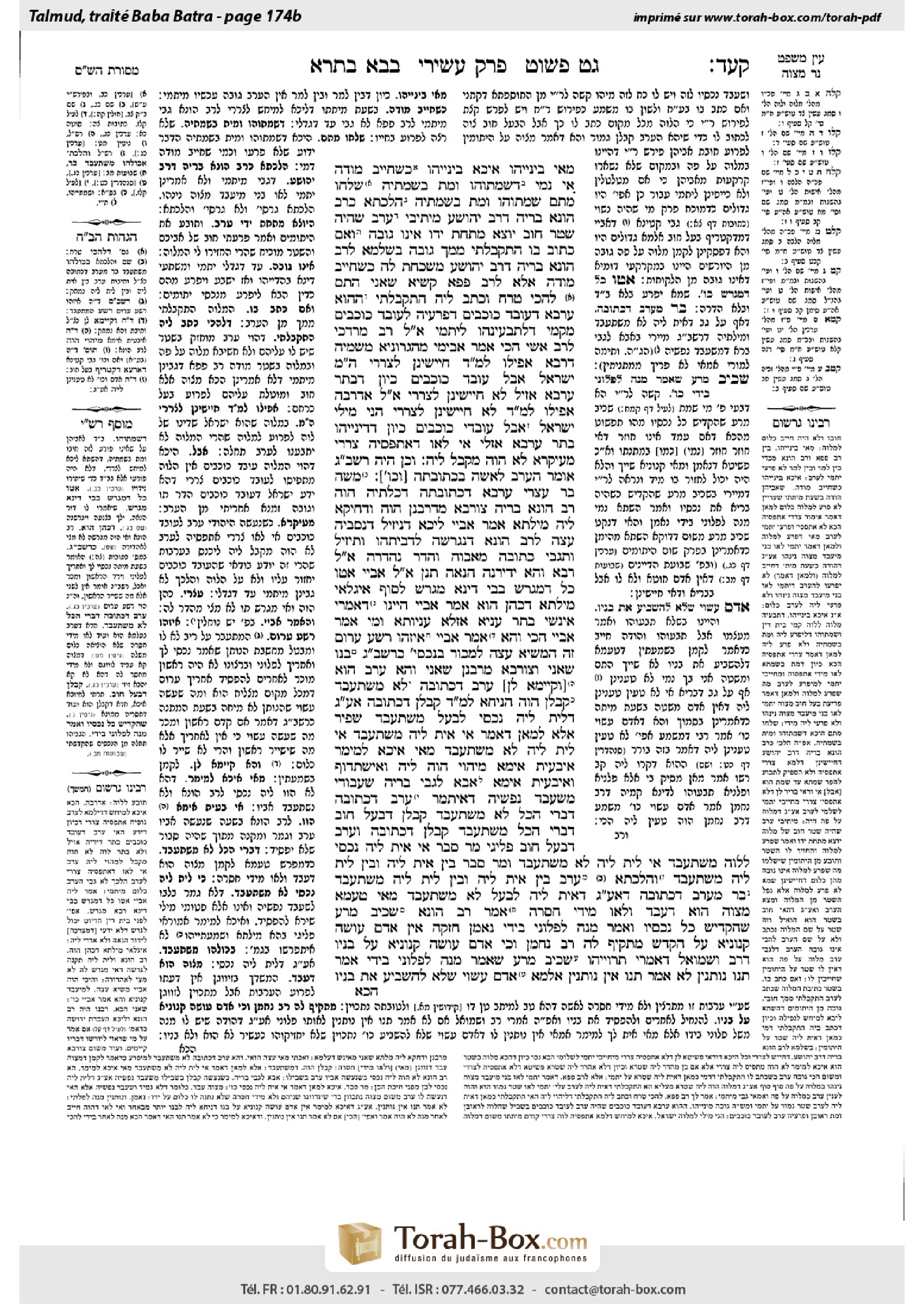
Bava Batra 174b: Talmud study for Daf Yomi
Study the Talmud for Daf Yomi with scanned pages, Hebrew text, English translations from Sefaria and AI-generated French translations.
Passage selection and English or AI-generated French translation are available where the scan has annotations. Daf Study is independent of Torah-Box and Sefaria.
Browse Bava Batra · בבא בתרא · All tractatesBava Batra 174b text and translations
This page of Bava Batra includes the Aramaic text, an English translation and an AI-generated French translation, alongside the scan above.
בבא בתרא קע״ד ב · Aramaic and Hebrew text
מַאי בֵּינַיְיהוּ?
אִיכָּא בֵּינַיְיהוּ כְּשֶׁחַיָּיב מוֹדֶה. אִי נָמֵי, דְּשַׁמְּתוּהוּ וּמִת בְּשַׁמְתֵּיהּ.
שְׁלַחוּ מִתָּם: שַׁמְּתוּהוּ וּמִת בְּשַׁמְתֵּיהּ, הִלְכְתָא כְּרַב הוּנָא בְּרֵיהּ דְּרַב יְהוֹשֻׁעַ.
מֵיתִיבִי: עָרֵב שֶׁהָיָה שְׁטַר חוֹב יוֹצֵא מִתַּחַת יָדוֹ – אֵינוֹ גּוֹבֶה. וְאִם כָּתוּב בּוֹ: ״הִתְקַבַּלְתִּי מִמְּךָ״ – גּוֹבֶה.
בִּשְׁלָמָא לְרַב הוּנָא בְּרֵיהּ דְּרַב יְהוֹשֻׁעַ – מַשְׁכַּחַתְּ לַהּ כְּשֶׁחַיָּיב מוֹדֶה, אֶלָּא לְרַב פָּפָּא – קַשְׁיָא!
שָׁאנֵי הָתָם, לְהָכִי טְרַח וּכְתַב לֵיהּ ״הִתְקַבַּלְתִּי״.
הָהוּא עָרְבָא דְּגוֹי דְּפַרְעֵיהּ לְגוֹי מִקַּמֵּי דְּלִתְבְּעִינְהוּ לְיַתְמֵי. אֲמַר לֵיהּ רַב מָרְדֳּכַי לְרַב אָשֵׁי, הָכִי אָמַר אֲבִימִי מֵהַגְרוֹנְיָא מִשְּׁמֵיהּ דְּרָבָא: אֲפִילּוּ לְמַאן דְּאָמַר חָיְישִׁינַן לִצְרָרֵי – הָנֵי מִילֵּי יִשְׂרָאֵל; אֲבָל גּוֹי, כֵּיוָן דְּבָתַר עָרְבָא אָזֵיל – לָא חָיְישִׁינַן לִצְרָרֵי.
אֲמַר לֵיהּ: אַדְּרַבָּה! אֲפִילּוּ לְמַאן דְּאָמַר לָא חָיְישִׁינַן לִצְרָרֵי – הָנֵי מִילֵּי יִשְׂרָאֵל; אֲבָל גּוֹיִם, כֵּיוָן דְּדִינַיְיהוּ בָּתַר עָרְבָא אָזְלִי, אִי לָאו דְּאַתְפְּסֵיהּ צְרָרֵי מֵעִיקָּרָא – לָא הֲוָה מְקַבֵּל לֵיהּ.
וְכֵן הָיָה רַבָּן שִׁמְעוֹן בֶּן גַּמְלִיאֵל אוֹמֵר: הֶעָרֵב לְאִשָּׁה בִּכְתוּבָּתָהּ [וְכוּ׳]. מֹשֶׁה בַּר עַצְרִי עָרְבָא דִּכְתוּבְּתַהּ דְּכַלָּתֵיהּ הֲוָה. רַב הוּנָא בְּרֵיהּ – צוּרְבָּא מִדְּרַבָּנַן הֲוָה, וּדְחִיקָא לֵיהּ מִילְּתָא. אָמַר אַבָּיֵי: לֵיכָּא דְּנֵיזִיל דְּנַסְּבֵיהּ עֵצָה לְרַב הוּנָא, דִּנְגָרְשַׁהּ לִדְבֵיתְהוּ וְתֵיזִיל וְתִגְבֵּי כְּתוּבָּה מֵאֲבוּהּ, וַהֲדַר נַהְדְּרַהּ?
אֲמַר לֵיהּ רָבָא: וְהָא ״יַדִּירֶנָּה הֲנָאָה״ תְּנַן! אֲמַר לֵיהּ אַבָּיֵי: אַטּוּ כֹּל דִּמְגָרֵשׁ – בְּבֵי דִינָא מְגָרֵשׁ?
לְסוֹף אִיגַּלַּאי מִילְּתָא דְּכֹהֵן הוּא. אָמַר אַבָּיֵי, הַיְינוּ דְאָמְרִי אִינָשֵׁי: בָּתַר עַנְיָא אָזְלָא עַנְיוּתָא.
וּמִי אָמַר אַבָּיֵי הָכִי? וְהָא אָמַר אַבָּיֵי: אֵיזֶהוּ ״רָשָׁע עָרוּם״? זֶה הַמַּשִּׂיא עֵצָה לִמְכּוֹר בִּנְכָסִים כְּרַבָּן שִׁמְעוֹן בֶּן גַּמְלִיאֵל!
בְּנוֹ שָׁאנֵי, וְצוּרְבָּא מֵרַבָּנַן שָׁאנֵי.
וְהָא עָרֵב הוּא, [וְקַיְימָא לַן] עָרֵב דִּכְתוּבָּה לֹא מִשְׁתַּעְבֵּד! קַבְּלָן הֲוָה.
הָנִיחָא לְמַאן דְּאָמַר: קַבְּלָן דִּכְתוּבָּה – אַף עַל גַּב דְּלֵית לֵיהּ נִכְסֵי לְבַעַל, מִשְׁתַּעְבַּד – שַׁפִּיר. אֶלָּא לְמַאן דְּאָמַר: אִי אִית לֵיהּ מִשְׁתַּעְבַּד, אִי לֵית לֵיהּ לָא מִשְׁתַּעְבַּד – מַאי אִיכָּא לְמֵימַר?
אִיבָּעֵית אֵימָא: מִיהְוֵי הֲוָה לֵיהּ, וְאִישְׁתְּדוּף. וְאִיבָּעֵית אֵימָא: אַבָּא לְגַבֵּי בְּרֵיהּ – שַׁעְבּוֹדֵי מְשַׁעְבַּד נַפְשֵׁיהּ.
דְּאִיתְּמַר: עָרֵב דִּכְתוּבָּה – דִּבְרֵי הַכֹּל לָא מִשְׁתַּעְבַּד. קַבְּלָן דְּבַעַל חוֹב – דִּבְרֵי הַכֹּל מִשְׁתַּעְבַּד. קַבְּלָן דִּכְתוּבָּה, וְעָרֵב דְּבַעַל חוֹב – פְּלִיגִי; מָר סָבַר: אִי אִית לֵיהּ נִכְסֵי לְלֹוֶה – מִשְׁתַּעְבַּד, אִי לֵית לֵיהּ – לָא מִשְׁתַּעְבַּד; וּמָר סָבַר: בֵּין אִית לֵיהּ וּבֵין לֵית לֵיהּ – מִשְׁתַּעְבַּד.
וְהִלְכְתָא: עָרֵב – בֵּין אִית לֵיהּ וּבֵין לֵית לֵיהּ, מִשְׁתַּעְבַּד; בַּר מֵעָרֵב דִּכְתוּבָּה – דְּאַף עַל גַּב דְּאִית לֵיהּ לְבַעַל, לָא מִשְׁתַּעְבַּד. מַאי טַעְמָא? מִצְוָה הוּא דַּעֲבַד, וְלָאו מִידֵּי חַסְּרֵהּ.
אָמַר רַב הוּנָא: שְׁכִיב מְרַע שֶׁהִקְדִּישׁ כׇּל נְכָסָיו, וְאָמַר ״מָנֶה לִפְלוֹנִי בְּיָדִי״ – נֶאֱמָן; חֲזָקָה אֵין אָדָם עוֹשֶׂה קְנוּנְיָא עַל הֶקְדֵּשׁ.
מַתְקֵיף לַהּ רַב נַחְמָן: וְכִי אָדָם עוֹשֶׂה קְנוּנְיָא עַל בָּנָיו?! דְּרַב וּשְׁמוּאֵל דְּאָמְרִי תַּרְוַיְיהוּ: שְׁכִיב מְרַע שֶׁאָמַר ״מָנֶה לִפְלוֹנִי בְּיָדִי״; אָמַר ״תְּנוּ״ – נוֹתְנִין. לֹא אָמַר ״תְּנוּ״ – אֵין נוֹתְנִין. אַלְמָא אָדָם עָשׂוּי שֶׁלֹּא לְהַשְׂבִּיעַ אֶת בָּנָיו;
Bava Batra 174b · English translation
The Gemara asks: What is the difference between the opinion of Rav Pappa and that of Rav Huna, son of Yehoshua, as both agree that the orphans are exempt from repaying the debt until they reach majority?
The Gemara answers: The difference between them is in a case where the one who owed the money, i.e., the deceased, admits explicitly just before his death that he did not yet repay any of his loan. Alternatively, there is a difference between them in a case where the court excommunicated the deceased for not cooperating with the court in repaying his debt, and he died while still in a state of excommunication, which demonstrates that the debt had not been repaid prior to his death. In both of these cases Rav Pappa would exempt the minor orphans from payment, as minors are not obligated to perform mitzvot, while Rav Huna, son of Yehoshua, would require them to repay the debt immediately, as there is no possibility that their father had repaid the debt.
The Sages of Eretz Yisrael sent a ruling from there to Babylonia: In a case where the court had excommunicated a debtor for not cooperating in repaying his debt, and the debtor died while still in a state of excommunication, the halakha is in accordance with the opinion of Rav Huna, son of Rav Yehoshua, and the orphans must repay the debt immediately.
The Gemara raises an objection from a baraita (Tosefta 11:15): A guarantor for a debt who has the promissory note for that debt in his possession, indicating that he has repaid the debt, and now seeks reimbursement from the debtor, cannot collect if the debtor has died and the obligation for the debt has fallen to his minor heirs. But if it is written by the creditor in the promissory note: I received repayment from you, the guarantor, then the guarantor can collect the debt from the minor heirs.
The Gemara explains the objection: Granted, according to the opinion of Rav Huna, son of Rav Yehoshua, you find a case where the minor heirs would be required to repay the debt, such as when the one who owed the money, i.e., the deceased, admits explicitly just before his death that he did not yet repay the loan. But according to the opinion of Rav Pappa, who maintains that minor heirs never have to repay their father’s debts, it is difficult. What is the case discussed in the baraita?
The Gemara answers: It is different there, as it is for this reason that the creditor troubled himself and wrote for the guarantor: I received repayment from you. Once the creditor writes this in the promissory note, it attains the status of a promissory note of the guarantor held directly against the debtor, and even Rav Pappa agrees that a debt that is recorded in a promissory note can be collected from the deceased’s property immediately, even from the minor heirs.
The Gemara relates: There was a certain guarantor who had guaranteed a loan given by a gentile, who repaid the gentile creditor before the gentile creditor claimed repayment from the orphans who survived the debtor. The guarantor now sought reimbursement from the orphans. Rav Mordekhai said to Rav Ashi: This is what Avimi of Hagronya said in the name of Rava: Even according to the one who says that we are concerned for the possibility that the deceased may have given bundles of money to the creditor before his death, this statement applies only in the case of a Jewish creditor. But in the case of a gentile creditor, since according to gentile law he is entitled to go directly to a guarantor, we are not concerned for the possibility that the deceased may have given bundles of money. The debtor would not repay the gentile before the loan is due, as the latter has the right to collect directly from the guarantor, and would thereby receive double payment.
Rav Ashi said to Rav Mordekhai: On the contrary, even according to the one who says that we are not concerned for the possibility that the deceased may have given bundles of money, this statement applies only in the case of a Jewish creditor. But in the case of a gentile creditor, since according to gentile law they are entitled to go directly to a guarantor, no guarantor would accept upon himself to guarantee such a loan if the debtor had not given bundles of money as collateral to the gentile creditor from the outset.
§ The mishna teaches: And so Rabban Shimon ben Gamliel would say: If there is a guarantor for a woman for her marriage contract, and her husband is divorcing her, the husband must take a vow prohibiting himself from deriving any benefit from her so that he can never remarry her. The Gemara relates an incident pertaining to this ruling: Someone named Moshe bar Atzari was a guarantor for the marriage contract of his daughter-in-law, guaranteeing the money promised by his son in the event of death or divorce. His son, named Rav Huna, was a young Torah scholar, and was in financial straits. Abaye said: Is there no one who will go advise Rav Huna that he should divorce his wife, and she will go and collect her marriage contract from Rav Huna’s father, and then Rav Huna should remarry her?
Rava said to Abaye: But didn’t we learn in the mishna that when a husband divorces his wife in such circumstances he must take a vow prohibiting himself from deriving any benefit from her, thereby precluding the possibility of remarriage? Abaye said to him: Is that to say that everyone who divorces his wife divorces her in a court? Rav Huna could be advised to divorce his wife outside the court, in which case he could do so without being forced to take the prescribed vow.
Ultimately, it was revealed that this Rav Huna was a priest, who may not marry a divorcée, even his own ex-wife. Abaye’s suggestion was therefore not an option for him. Upon hearing this, Abaye said: This is in accordance with the adage that people say: Poverty follows the poor.
The Gemara asks: But did Abaye really say this? Would he really encourage giving such advice? But doesn’t Abaye himself say: Who is a cunning, wicked person? This is one who provides advice to sell property in accordance with the ruling of Rabban Shimon ben Gamliel. As taught elsewhere (Ketubot 95b), if one says: My property is hereby bequeathed to you, and after you die it will pass to so-and-so, Rabban Shimon ben Gamliel rules that the first recipient can sell the property, which would thereby deprive the second recipient from receiving it. Abaye said that giving advice to someone to pursue such action, though it is legally sound, is considered wicked. Here as well, why would he give advice to Rav Huna to divorce his wife only in order to force his father to pay the marriage contract?
The Gemara answers: When dealing with one’s son it is different. It is not considered wickedness to force a father to give money to his own son. Moreover, when dealing with a Torah scholar it is different. It is not considered wickedness to procure money for a Torah scholar, because the money enables him to pursue his studies.
The Gemara asks another question with regard to this incident: But wasn’t Moshe bar Atzari a guarantor? And we maintain, as the Gemara will soon note, that a guarantor for a marriage contract does not become obligated to pay. The Gemara answers: He was an unconditional guarantor.
The Gemara objects: This works out well according to the one who says that an unconditional guarantor for a marriage contract becomes obligated to pay it even if the husband has no property of his own at the time of the marriage. According to this opinion all is well. But according to the one who says: If the husband has his own property the unconditional guarantor becomes obligated to pay, but if the husband does not have his own property he does not become obligated, what is there to say? Rav Huna obviously did not have any property of his own. Why, then, was his father held responsible for paying his marriage contract according to this latter opinion?
The Gemara answers: If you wish, say that Rav Huna had property when he got married, so that his father’s guarantee took effect, but it became blighted, i.e., it was ruined or lost in the interim. And if you wish, say instead: A father, vis-à-vis his son, sincerely obligates himself to guarantee his marriage contract, even when the son has no property of his own.
The Gemara elaborates on the issue under discussion. This is as it was stated: Everyone agrees that a standard guarantor for a marriage contract does not become obligated to pay the marriage contract, and everyone agrees that an unconditional guarantor for a creditor, i.e., for a loan, becomes obligated to repay the loan. With regard to an unconditional guarantor for a marriage contract and a standard guarantor for a creditor, the Sages disagree. One Sage holds that if the debtor or husband has his own property, these guarantors become obligated for the guarantees they have undertaken, but if he does not have his own property the guarantor does not become obligated. And one Sage holds that whether the debtor or husband has property or does not have property, the guarantor becomes obligated to pay it.
And the halakha is that a guarantor becomes obligated to pay, whether the debtor has his own property or does not have property. This is to the exclusion of a guarantor for a marriage contract, in which case even if the husband has his own property he does not become obligated to pay. What is the reason for this? The intention of the guarantor is to perform the mitzva of facilitating a marriage by encouraging the woman to consent to the marriage as a result of his involvement, but he does not truly intend to obligate himself. And furthermore, in contrast to a guarantor for a loan, where the creditor stands to suffer a loss if he is not repaid, the woman does not suffer any concrete loss, as the husband does not borrow money from the woman. Therefore, the level of commitment of the guarantor in this case is lower. Accordingly, the Sages instituted that the guarantor does not become responsible for payment of the marriage contract from his own property.
§ Rav Huna says that a person on his deathbed who consecrated all his property to the Temple treasury, and then says: So-and-so has one hundred dinars in my possession, i.e., I owe one hundred dinars to so-and-so, is deemed credible, and the money is to be repaid to that person. The reason for this is that there is a presumption that a person does not collude against the Temple treasury. He would not lie about owing money to someone, thereby causing a loss to the Temple treasury.
Rav Naḥman objects to this ruling: And does a person collude against his children? Of course not. Yet, as Rav and Shmuel both say that in the case of a person on his deathbed who says: So-and-so has one hundred dinars in my possession, only if he says explicitly: Give him the money, the children give it, but if he did not say explicitly: Give him the money, the children do not give it. The person on his deathbed is not assumed to be telling the truth about owing the money unless he explicitly instructs that the money be given. Apparently, then, it is assumed that a person is prone to make false statements so as not to make his sons appear sated, i.e., wealthy. A person on his deathbed may falsely claim that he is in debt in order to dispel the notion that his children are wealthy heirs.
Bava Batra 174b · Traduction française (IA)
La Guemara pose la question : Quelle est la différence entre l'opinion de Rav Pappa et celle de Rav Huna, fils de Yéhoshua, puisque les deux s'accordent sur le fait que les orphelins sont dispensés de rembourser la dette jusqu'à ce qu'ils atteignent l'âge de la majorité ?
La Guemara répond : La différence entre eux réside dans un cas où celui qui devait l'argent, c'est-à-dire le défunt, admet explicitement juste avant sa mort qu'il n'avait pas encore remboursé aucune partie de son prêt. Alternativement, il y a une différence entre eux dans un cas où le tribunal a excommunié le défunt pour son manque de coopération dans le remboursement de sa dette, et il est mort encore en état d'excommunication, ce qui montre que la dette n'avait pas été remboursée avant sa mort. Dans ces deux cas, Rav Pappa dispenserait les orphelins mineurs de payer, car les mineurs ne sont pas tenus d'accomplir des mitsvot, tandis que Rav Huna, fils de Yéhoshua, exigerait qu'ils remboursent la dette immédiatement, car il n'y a pas de possibilité que leur père ait remboursé la dette.
Les Sages d'Eretz Yisrael ont envoyé un avis depuis là-bas à Babylone : Dans un cas où le tribunal avait excommunié un débiteur pour son manque de coopération dans le remboursement de sa dette, et que le débiteur est mort encore en état d'excommunication, la halakha suit l'opinion de Rav Huna, fils de Rav Yéhoshua, et les orphelins doivent rembourser la dette immédiatement.
La Guemara soulève une objection tirée d'une baraïta (Tosefta 11:15) : Un cautionneur d'une dette qui possède le billet de change pour cette dette, indiquant qu'il a remboursé la dette, et qui cherche maintenant à récupérer auprès du débiteur, ne peut récupérer si le débiteur est mort et que l'obligation de la dette est tombée sur ses héritiers mineurs. Mais si le créancier a écrit sur le billet de change : J'ai reçu le remboursement de votre part, le cautionneur peut récupérer la dette auprès des héritiers mineurs.
La Guemara explique l'objection : C'est évident, selon l'opinion de Rav Huna, fils de Rav Yéhoshua, vous trouvez un cas où les héritiers mineurs seraient tenus de rembourser la dette, comme dans le cas où celui qui devait l'argent, c'est-à-dire le défunt, admet explicitement juste avant sa mort qu'il n'avait pas encore remboursé le prêt. Mais selon l'opinion de Rav Pappa, qui maintient que les héritiers mineurs n'ont jamais à rembourser les dettes de leur père, c'est difficile. Quel est le cas discuté dans la baraïta ?
La Guemara répond : C'est différent là-bas, car c'est pour cette raison que le créancier s'est donné la peine d'écrire pour le cautionneur : J'ai reçu le remboursement de votre part. Une fois que le créancier écrit cela sur le billet de change, cela acquiert le statut d'un billet de change du cautionneur directement contre le débiteur, et même Rav Pappa est d'accord sur le fait qu'une dette enregistrée dans un billet de change peut être récupérée immédiatement du patrimoine du défunt, même auprès des héritiers mineurs.
La Guemara rapporte : Il y avait un certain cautionneur qui avait cautionné un prêt donné par un non-Juif, qui a remboursé le créancier non-Juif avant que ce dernier ne demande le remboursement auprès des orphelins survivants du débiteur. Le cautionneur cherche maintenant à récupérer auprès des orphelins. Rav Mordekhai dit à Rav Ashi : C'est ce que Avimi de Hagronya a dit en nom de Rava : Même selon celui qui dit que nous nous inquiétons du fait que le défunt aurait pu donner des ballots de monnaie au créancier avant sa mort, cette déclaration s'applique uniquement dans le cas d'un créancier juif. Mais dans le cas d'un créancier non-Juif, puisque selon la loi non-Juive il a le droit de s'adresser directement au cautionneur, nous ne nous inquiétons pas du fait que le défunt aurait pu donner des ballots de monnaie. Le débiteur ne rembourserait pas le non-Juif avant l'échéance du prêt, car le dernier a le droit de récupérer directement auprès du cautionneur, et il recevrait ainsi un double paiement.
Rav Ashi dit à Rav Mordekhai : Au contraire, même selon celui qui dit que nous ne nous inquiétons pas du fait que le défunt aurait pu donner des ballots de monnaie, cette déclaration s'applique uniquement dans le cas d'un créancier juif. Mais dans le cas d'un créancier non-Juif, puisque selon la loi non-Juive ils ont le droit de s'adresser directement au cautionneur, aucun cautionneur ne s'engagerait à cautionner un tel prêt si le débiteur n'avait pas donné des ballots de monnaie comme caution à l'origine.
§ La mitsna enseigne : Et ainsi Rabban Shimon ben Gamliel disait : Si un garant garantit un mariage d'une femme, et son mari divorce d'elle, le mari doit prendre un serment interdisant à lui-même d'obtenir quelque bénéfice d'elle afin qu'il ne puisse jamais la remarié. La Guemara rapporte un incident lié à cette décision : Un certain Moshe bar Atzari était un garant pour le contrat de mariage de sa fille, garantissant l'argent promis par son fils en cas de décès ou de divorce. Son fils, nommé Rav Huna, était un jeune savant de la Torah, et était en difficulté financière. Abaye dit : N'y a-t-il pas quelqu'un qui pourra conseiller à Rav Huna de divorcer de sa femme, et elle ira récupérer son contrat de mariage auprès du père de Rav Huna, et ensuite Rav Huna pourrait la remarié ?
Rava dit à Abaye : N'avons-nous pas appris dans la mitsna que lorsqu'un mari divorce de sa femme dans de tels cas, il doit prendre un serment interdisant à lui-même d'obtenir quelque bénéfice d'elle, empêchant ainsi le remariage ? Abaye dit à lui : Est-ce pour dire que tout le monde qui divorce de sa femme divorce dans un tribunal ? Rav Huna pourrait être conseillé à divorcer de sa femme en dehors du tribunal, dans lequel cas il pourrait le faire sans être contraint de prendre le serment prescrit.
Finalement, il s'est révélé que ce Rav Huna était un prêtre, qui ne peut pas épouser une divorcée, même sa propre ex-femme. La suggestion d'Abaye n'était donc pas une option pour lui. En entendant cela, Abaye dit : C'est selon l'adage que les gens disent : La pauvreté suit le pauvre.
La Guemara pose la question : Mais Abaye a-t-il vraiment dit cela ? Est-ce qu'il encouragerait vraiment de donner un tel conseil ? Mais ne dit-il pas lui-même : Qui est un homme rusé et malveillant ? C'est celui qui conseille à quelqu'un de vendre sa propriété conformément à la décision de Rabban Shimon ben Gamliel. Comme enseigné ailleurs (Ketubot 95b), si l'on dit : Mon bien est désormais légué à toi, et après ta mort il passera à tel et tel, Rabban Shimon ben Gamliel décide que le premier bénéficiaire peut vendre la propriété, ce qui en empêcherait le second de la recevoir. Abaye disait que donner un tel conseil à quelqu'un, bien que légalement correct, est considéré comme malveillant. Ici aussi, pourquoi donnerait-il un conseil à Rav Huna de divorcer de sa femme uniquement pour forcer son père à payer le contrat de mariage ?
La Guemara répond : Lorsqu'on s'occupe de son fils, c'est différent. Il n'est pas considéré comme une malveillance de forcer un père à donner de l'argent à son propre fils. De plus, lorsqu'on s'occupe d'un savant de la Torah, c'est différent. Il n'est pas considéré comme une malveillance de procurer de l'argent à un savant de la Torah, car cet argent lui permet de poursuivre ses études.
La Guemara pose une autre question concernant cet incident : Mais Moshe bar Atzari n'était-il pas un garant ? Et nous maintenons, comme le notera bientôt la Guemara, qu'un garant d'un contrat de mariage ne devient pas obligé de payer. La Guemara répond : Il était un garant inconditionnel.
La Guemara s'oppose à cela : Cela fonctionne bien selon celui qui dit qu'un garant inconditionnel d'un contrat de mariage devient obligé de payer même si le mari n'a pas de propriété à l'époque du mariage. Selon cet avis, tout va bien. Mais selon celui qui dit : Si le mari a sa propre propriété, le garant inconditionnel devient obligé de payer, mais si le mari n'a pas sa propre propriété, il ne devient pas obligé, que dire alors ? Rav Huna n'avait manifestement pas de propriété personnelle. Pourquoi, alors, son père était-il tenu responsable de payer le contrat de mariage selon cet avis ultérieur ?
La Guemara répond : Si vous le souhaitez, dites que Rav Huna avait des biens lors de son mariage, de sorte que la garantie de son père a pris effet, mais qu'elle a été ruinée, c'est-à-dire qu'elle a été détruite ou perdue pendant l'intervalle. Et si vous le souhaitez, dites plutôt : Un père, vis-à-vis de son fils, s'oblige sincèrement à garantir son contrat de mariage, même lorsque le fils n'a pas de propriété personnelle.
La Guemara développe la question en discussion. C'est comme il a été dit : Tout le monde convient qu'un garant standard d'un contrat de mariage ne devient pas obligé de payer le contrat de mariage, et tout le monde convient qu'un garant inconditionnel d'un créancier, c'est-à-dire d'un prêt, devient obligé de rembourser le prêt. En ce qui concerne un garant inconditionnel d'un contrat de mariage et un garant standard d'un créancier, les Sages s'entendent à moitié. Un Sage affirme que si le débiteur ou le mari a sa propre propriété, ces garantisseurs deviennent obligés de payer les garanties qu'ils ont souscrits, mais si il n'a pas sa propre propriété, le garant ne devient pas obligé. Un autre Sage affirme que qu'importe si le débiteur ou le mari a de la propriété ou non, le garant devient obligé de payer.
Et la halakha est que le garant devient obligé de payer, qu'il ait ou non sa propre propriété. Cela exclut le garant d'un contrat de mariage, dans lequel cas même si le mari a sa propre propriété, il ne devient pas obligé de payer. Quelle est la raison de cela ? L'intention du garant est de remplir la mitsva de faciliter un mariage en encourageant la femme à consentir au mariage en raison de son implication, mais il ne souhaite pas véritablement s'obliger. De plus, contrairement à un garant d'un prêt, où le créancier subit une perte s'il n'est pas remboursé, la femme ne subit aucune perte concrète, car le mari ne prête pas d'argent à la femme. Par conséquent, le niveau de compromis du garant dans ce cas est plus faible. Ainsi, les Sages ont institué que le garant ne devient pas responsable du paiement du contrat de mariage à partir de ses propres biens.
§ Rav Huna dit qu'une personne sur son lit de mort qui a consacré toute sa propriété au trésor du Temple, et qui dit ensuite : Tel et tel a cent drachmes en mon possession, c'est-à-dire que je dois cent drachmes à tel et tel, est considérée comme crédible, et l'argent est à remettre à cette personne. La raison de cela est que l'on suppose qu'une personne ne collabore pas contre le trésor du Temple. Il ne mentrait pas sur l'argent qu'il doit à quelqu'un, ce qui causerait une perte au trésor du Temple.
Rav Naḥman s'oppose à cette décision : Et une personne collabore-t-elle contre ses enfants ? Bien sûr que non. Cependant, comme Rav et Shmuel disent tous les deux que dans le cas d'une personne sur son lit de mort qui dit : Tel et tel a cent drachmes en mon possession, seulement si elle dit explicitement : Donne-lui l'argent, les enfants donnent l'argent, mais si elle n'a pas dit explicitement : Donne-lui l'argent, les enfants ne donnent pas l'argent. La personne sur son lit de mort n'est pas supposée dire la vérité sur l'argent qu'elle doit à quelqu'un à moins qu'elle n'ait explicitement ordonné de donner l'argent. Apparemment, alors, on suppose qu'une personne est enclined à mentir afin de ne pas faire paraître ses enfants rassasiés, c'est-à-dire riches. Une personne sur son lit de mort peut mentir en affirmant qu'elle doit de l'argent à quelqu'un afin de dissiper l'idée que ses enfants sont des héritiers riches.
Traduction française générée par IA à partir de l’édition anglaise de Sefaria. Vérifie toujours un passage avec le texte source.
Text from Sefaria: William Davidson Edition - Vocalized Aramaic (CC BY NC); William Davidson Edition - English (CC BY NC).