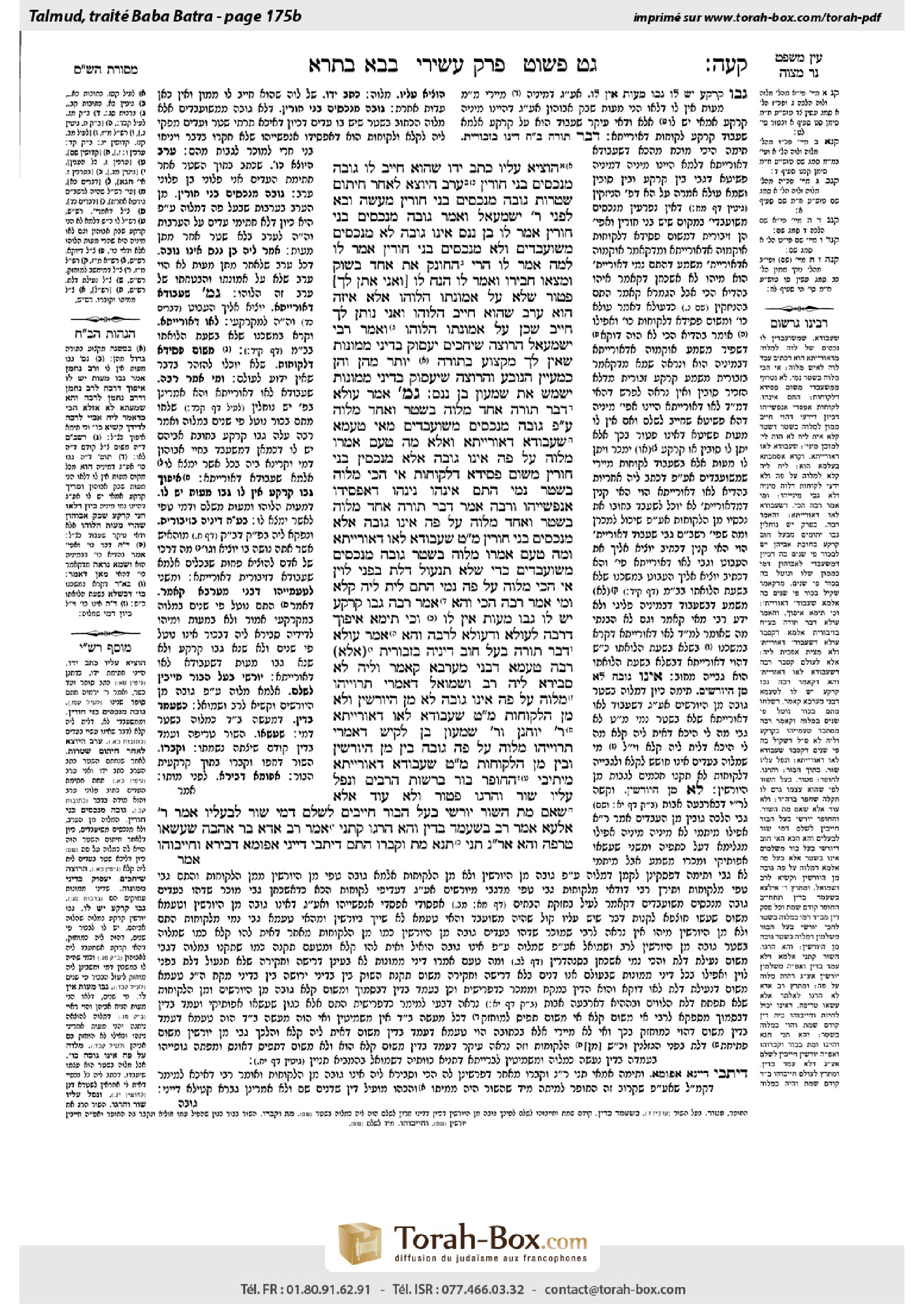
Bava Batra 175b: Talmud study for Daf Yomi
Study the Talmud for Daf Yomi with scanned pages, Hebrew text, English translations from Sefaria and AI-generated French translations.
Passage selection and English or AI-generated French translation are available where the scan has annotations. Daf Study is independent of Torah-Box and Sefaria.
Browse Bava Batra · בבא בתרא · All tractatesBava Batra 175b text and translations
This page of Bava Batra includes the Aramaic text, an English translation and an AI-generated French translation, alongside the scan above.
בבא בתרא קע״ה ב · Aramaic and Hebrew text
הוֹצִיא עָלָיו כְּתַב יָדוֹ שֶׁהוּא חַיָּיב לוֹ – גּוֹבֶה מִנְּכָסִים בְּנֵי חוֹרִין.
עָרֵב הַיּוֹצֵא לְאַחַר חִיתּוּם שְׁטָרוֹת – גּוֹבֶה מִנְּכָסִים בְּנֵי חוֹרִין.
מַעֲשֶׂה וּבָא לִפְנֵי רַבִּי יִשְׁמָעֵאל, וְאָמַר: גּוֹבֶה מִנְּכָסִים בְּנֵי חוֹרִין. אָמַר לוֹ בֶּן נַנָּס: אֵינוֹ גּוֹבֶה לֹא מִנְּכָסִים מְשׁוּעְבָּדִים וְלֹא מִנְּכָסִים בְּנֵי חוֹרִין.
אָמַר לוֹ: לָמָּה? אָמַר לוֹ: הֲרֵי הַחוֹנֵק אֶת אֶחָד בַּשּׁוּק, וּמְצָאוֹ חֲבֵירוֹ וְאָמַר לוֹ ״הַנַּח לוֹ [וַאֲנִי אֶתֵּן לָךְ]״ – פָּטוּר, שֶׁלֹּא עַל אֱמוּנָתוֹ הִלְוָהוּ. אֶלָּא אֵיזֶה הוּא עָרֵב שֶׁהוּא חַיָּיב? ״הַלְוֵהוּ, וַאֲנִי נוֹתֵן לָךְ״ – חַיָּיב, שֶׁכֵּן עַל אֱמוּנָתוֹ הִלְוָהוּ.
וְאָמַר רַבִּי יִשְׁמָעֵאל: הָרוֹצֶה שֶׁיַּחְכִּים – יַעֲסוֹק בְּדִינֵי מָמוֹנוֹת; שֶׁאֵין לָךְ מִקְצוֹעַ בַּתּוֹרָה יוֹתֵר מֵהֶן, וְהֵן כְּמַעְיָין הַנּוֹבֵעַ. וְהָרוֹצֶה שֶׁיַּעֲסוֹק בְּדִינֵי מָמוֹנוֹת – יְשַׁמֵּשׁ אֶת שִׁמְעוֹן בֶּן נַנָּס.
גְּמָ׳ אָמַר עוּלָּא: דְּבַר תּוֹרָה – אֶחָד מִלְוֶה בִּשְׁטָר, וְאֶחָד מִלְוֶה עַל פֶּה – גּוֹבֶה מִנְּכָסִים מְשׁוּעְבָּדִים. מַאי טַעְמָא? שִׁעְבּוּדָא דְּאוֹרָיְיתָא. וְאֶלָּא מַה טַּעַם אָמְרוּ מִלְוֶה עַל פֶּה אֵינוֹ גּוֹבֶה אֶלָּא מִנְּכָסִין בְּנֵי חוֹרִין? מִשּׁוּם פְּסֵידָא דְלָקוֹחוֹת.
אִי הָכִי, מִלְוֶה בִּשְׁטָר נָמֵי! הָתָם, אִינְהוּ נִינְהוּ דְּאַפְסִידוּ אַנַּפְשַׁיְיהוּ.
וְרַבָּה אָמַר: דְּבַר תּוֹרָה – אֶחָד מִלְוֶה בִּשְׁטָר וְאֶחָד מִלְוֶה עַל פֶּה – אֵינוֹ גּוֹבֶה אֶלָּא מִנְּכָסִים בְּנֵי חוֹרִין. מַאי טַעְמָא? שִׁעְבּוּדָא לָאו דְּאוֹרָיְיתָא. וּמַה טַּעַם אָמְרוּ מִלְוֶה בִּשְׁטָר גּוֹבֶה מִנְּכָסִים מְשׁוּעְבָּדִים? כְּדֵי שֶׁלֹּא תִּנְעוֹל דֶּלֶת בִּפְנֵי לֹוִין.
אִי הָכִי, מִלְוֶה עַל פֶּה נָמֵי! הָתָם לֵית לֵיהּ קָלָא.
וּמִי אָמַר רַבָּה הָכִי? וְהָא אָמַר רַבָּה: גָּבוּ קַרְקַע – יֵשׁ לוֹ. גָּבוּ מָעוֹת – אֵין לוֹ!
וְכִי תֵּימָא אֵיפוֹךְ דְּרַבָּה לְעוּלָּא וּדְעוּלָּא לְרַבָּה, וְהָא אָמַר עוּלָּא: דְּבַר תּוֹרָה, בַּעַל חוֹב דִּינֵיהּ בְּזִבּוּרִית!
אֶלָּא רַבָּה – טַעְמָא דִּבְנֵי מַעְרְבָא קָאָמַר, וְלֵיהּ לָא סְבִירָא לֵיהּ.
רַב וּשְׁמוּאֵל דְּאָמְרִי תַּרְוַיְיהוּ: מִלְוֶה עַל פֶּה – אֵינוֹ גּוֹבֶה לֹא מִן הַיּוֹרְשִׁין וְלֹא מִן הַלָּקוֹחוֹת. מַאי טַעְמָא? שִׁעְבּוּדָא לָאו דְּאוֹרָיְיתָא.
רַבִּי יוֹחָנָן וְרַבִּי שִׁמְעוֹן בֶּן לָקִישׁ דְּאָמְרִי תַּרְוַיְיהוּ: מִלְוֶה עַל פֶּה – גּוֹבֶה בֵּין מִן הַיּוֹרְשִׁין, וּבֵין מִן הַלָּקוֹחוֹת. מַאי טַעְמָא? שִׁעְבּוּדָא דְּאוֹרָיְיתָא.
מֵיתִיבִי: הַחוֹפֵר בּוֹר בִּרְשׁוּת הָרַבִּים, וְנָפַל עָלָיו שׁוֹר וַהֲרָגוֹ – פָּטוּר. וְלֹא עוֹד, אֶלָּא שֶׁאִם מֵת הַשּׁוֹר – יוֹרְשֵׁי בַּעַל הַבּוֹר חַיָּיבִים לְשַׁלֵּם דְּמֵי שׁוֹר לִבְעָלָיו!
אָמַר רַבִּי אִלְעָא אָמַר רַב: בְּשֶׁעָמַד בַּדִּין.
וְהָא ״הֲרָגוֹ״ קָתָנֵי! אָמַר רַב אַדָּא בַּר אַהֲבָה: שֶׁעֲשָׂאוֹ טְרֵפָה.
וְהָא אָמַר רַב נַחְמָן, תָּנֵי תַּנָּא: ״מֵת וּקְבָרוֹ״! הָתָם – דְּיָתְבִי דַּיָּינֵי אַפּוּמָּא דְבֵירָא, וְחַיְּיבוּהוּ.
Bava Batra 175b · English translation
If one presents to a debtor a document in the handwriting of the debtor stating that he owes money to him, but without witnesses signed on the document, the creditor can collect only from unsold property.
In the case of a guarantor whose commitment emerged after the signing of the promissory note, the creditor can collect the sum only from unsold property of the guarantor.
The mishna relates: An incident occurred where such a case came before Rabbi Yishmael, and he said: The creditor can collect the sum from unsold property of the guarantor, but not from liened property that he has sold to others. Ben Nannas said to Rabbi Yishmael: The creditor cannot collect the sum from the guarantor at all, not from liened property that has been sold, nor from unsold property.
Rabbi Yishmael said to him: Why not? Ben Nannas said to him: If one was strangling someone in the marketplace, demanding repayment of a loan, and another person found him doing so and said to the attacker: Leave him alone and I will give you the money he owes, the person who intervened is exempt from paying, as the creditor did not loan the money in the first place based on his trust of the one who intervened. Rather, who is a guarantor who is obligated to repay the loan he has guaranteed? One who tells the creditor before the loan takes place: Lend money to him, and I will give you the repayment, as in that case the creditor did loan the money based on his trust of the guarantor.
And Rabbi Yishmael thereupon said: One who wants to become wise should engage in the study of monetary law, as there is no greater discipline in the Torah, and it is like a flowing spring. And, he added, one who wants to engage in the study of monetary law should attend to, i.e., become a disciple of, Shimon ben Nannas.
GEMARA: Ulla says: By Torah law, a creditor, whether in the case of a loan with a promissory note or the case of a loan by oral contract, can collect the debt from liened property that has been sold by the debtor subsequent to his receiving the loan. What is the reason for this? The property of a debtor at the time of the loan, even an oral loan, is liened by Torah law. And what is the reason the Sages said that one who gives a loan by oral contract can collect the debt only from unsold property? Because of the loss that would be incurred by purchasers of land if the seller’s creditors could seize the land they have purchased.
The Gemara asks: If so, a loan with a promissory note should also not be collected from purchasers of property, as this would cause them a loss. The Gemara answers: There, in the case of a loan recorded in a promissory note, the purchasers, who neglected to investigate the financial status of the seller before purchasing land from him, brought the loss upon themselves. By contrast, loans by oral contract are often impossible to discover, even with a thorough investigation.
And Rabba says: By Torah law, a creditor, whether in the case of a loan with a promissory note or the case of a loan by oral contract, can collect the debt only from the debtor’s unsold property. What is the reason for this? The property of a debtor is not liened by Torah law. And what is the reason the Sages said that one who gives a loan with a promissory note can collect the debt from liened property that has been sold? So as not to lock the door in the face of potential borrowers. If one could not collect a debt by taking liened property that has been sold, people would be hesitant to put their money at risk by lending it.
The Gemara asks: If that is so, that there is a desire to encourage people to lend money by granting greater power of collection to creditors, a loan by oral contract should also be collectible from liened property that has been sold. The Gemara answers: There, in the case of a loan by oral contract, it has no publicity associated with it, so that purchasers often cannot find out about it, even after a thorough investigation, and it would be an unfair burden on them to have the property purchased by them seized in such cases.
The Gemara asks: And did Rabba really say this? But doesn’t Rabba say, in the case of a firstborn son, that if he and his brothers collected a debt from land, he has the right to receive a double portion of that payment, but if they collected a debt from money, he does not have the right to a double portion? A firstborn son is entitled to a double share of inheritance of any property that was owned by his father at the time of his death, but not to profits or income that accrue to the estate after his death. If a debt owed to the father is collected from land after his death, Rabba said that the firstborn is entitled to a double portion, indicating that the land was considered in the father’s possession even before he died, which indicates that Rabba holds that the property of a debtor is liened to a creditor by Torah law.
And if you would say: The opinions as they were cited earlier are attributed incorrectly, and it is necessary to reverse the two opinions, and exchange the opinion of Rabba for that of Ulla, and that of Ulla for that of Rabba, there is a difficulty: But doesn’t Ulla say elsewhere: By Torah law the halakha of a creditor is to collect his debt only from inferior-quality land?
The Gemara resolves the contradiction between Rabba’s two statements: Rather, Rabba was stating an explanation for the opinion of the people of the West, Eretz Yisrael, cited earlier (125a), but he himself does not hold accordingly, as he holds that a firstborn son is not entitled to a double portion of a debt collected from land.
The Gemara continues to discuss the issue of the extent of liens on a debtor’s property. Rav and Shmuel both say: In the case of a loan by oral contract, the creditor can collect the debt only from the one who took the loan, but not from the heirs of the debtor after his death, and not from purchasers of his property. What is the reason for this? They maintain that the property of a debtor is not liened by Torah law.
Rabbi Yoḥanan and Rabbi Shimon ben Lakish both say: In the case of a loan by oral contract, the creditor can collect the debt both from the heirs of the debtor after his death and from the purchasers of his property. What is the reason for this? They maintain that the property of a debtor is liened by Torah law.
The Gemara raises an objection to the opinion of Rav and Shmuel from a baraita (Tosefta, Bava Kamma 6:2): If one was digging a pit in the public domain, and an ox fell on him and killed him as he was in the pit, the owner of the ox is exempt from paying for the damage caused, as it is the one who dug the pit who is at fault. Moreover, if it occurred that the ox died as a result of the fall, the heirs of the owner of the pit are liable to pay the value of the ox to its owner. Compensation for damages is comparable to a loan by oral contract, and yet the baraita states that the heirs of the culpable party must pay it.
Rabbi Ela says that Rav says: The baraita is discussing a case in which the one who dug the pit stood trial for the damage before he died, and once judgment is rendered by a court, the resulting financial liability is comparable to a loan with a promissory note.
The Gemara objects: But it is taught in the baraita that the ox killed him by falling on him. How then can one say that he stood trial? Rav Adda bar Ahava says: The baraita does not mean that the ox killed him instantly, but that it rendered him one who has a wound that will cause him to die within twelve months [tereifa], and there was enough time before his death to try him and deem him liable to pay for damages.
The Gemara objects that there is a different version of the baraita according to which this interpretation is not possible: But doesn’t Rav Naḥman say that a certain tanna taught the baraita with a different formulation, stating that the one who dug the pit died from the impact of the ox and the ox in effect buried him in the ground at the bottom of the pit? In this scenario it would be impossible to take the one who dug the pit to court to stand trial. The Gemara answers: There, according to that second version, it is discussing a case where judges sat at the opening of the pit and deemed liable the one who dug the pit to pay for the damage before he died.
Bava Batra 175b · Traduction française (IA)
Si une personne présente à un débiteur un document rédigé à la main du débiteur indiquant qu'il lui doit de l'argent, sans que des témoins ne soient signataires de ce document, le créancier ne peut récupérer que sur les biens non vendus.
Dans le cas d'un caution dont la responsabilité a émergé après la signature de l'engagement, le créancier ne peut récupérer la somme que sur les biens non vendus du caution.
La mitsna rapporte : Un cas s'est produit où une telle situation a été soumise à Rabbi Yishmael, et il a dit : Le créancier peut récupérer la somme sur les biens non vendus du caution, mais pas sur les biens hypothéqués qu'il a vendus à d'autres. Ben Nannas a dit à Rabbi Yishmael : Le créancier ne peut récupérer la somme du caution du tout, ni sur les biens hypothéqués vendus, ni sur les biens non vendus.
Rabbi Yishmael a dit à lui : Pourquoi pas ? Ben Nannas a dit à lui : Si l'on étouffait quelqu'un dans la place publique, exigeant le remboursement d'un prêt, et une autre personne le découvre en train de le faire et lui dit : Laisse-le tranquille et je te donnerai l'argent qu'il doit, la personne qui s'est interposée est exemptée de payer, car le créancier n'avait pas prêté l'argent d'abord sur la confiance de la personne qui s'est interposée. Plutôt, qui est un caution qui est tenu de rembourser le prêt qu'il a garanti ? Celui qui dit au créancier avant que le prêt ne se produise : Prête-lui de l'argent, et je te donnerai le remboursement, car dans ce cas le créancier a prêté l'argent sur la confiance du caution.
Et Rabbi Yishmael a dit alors : Celui qui veut devenir sage devrait étudier la loi monétaire, car il n'y a pas de discipline plus grande dans la Torah, et c'est comme une source d'eau courante. Et il a ajouté : Celui qui veut étudier la loi monétaire devrait s'occuper, c'est-à-dire devenir disciple de Shimon ben Nannas.
GUEMARA : Ulla dit : Selon la loi divine, un créancier, qu'il s'agisse d'un prêt avec un engagement ou d'un prêt par contrat oral, peut récupérer la dette sur les biens hypothéqués vendus par le débiteur après qu'il ait reçu le prêt. Quelle est la raison de cela ? La propriété du débiteur au moment du prêt, même un prêt par contrat oral, est hypothéquée selon la loi divine. Et quelle est la raison pour laquelle les Sages ont dit que celui qui prête par contrat oral ne peut récupérer la dette que sur les biens non vendus ? Parce que cela causerait une perte aux acheteurs de terres si les créanciers pouvaient saisir les terres qu'ils avaient achetées.
La Guemara pose la question : Si c'est ainsi, un prêt avec un contrat ne devrait pas non plus être récupéré des acheteurs de biens, car cela causerait une perte. La Guemara répond : Là, dans le cas d'un prêt enregistré dans un contrat, les acheteurs, qui n'ont pas investigué l'état financier du vendeur avant d'acheter la terre, ont eux-mêmes causé la perte. En revanche, les prêts par contrat oral sont souvent impossibles à découvrir, même après une investigation approfondie.
Et Rabba dit : Selon la loi divine, un créancier, qu'il s'agisse d'un prêt avec un contrat ou d'un prêt par contrat oral, peut récupérer la dette uniquement sur les biens non vendus du débiteur. Quelle est la raison de cela ? La propriété du débiteur n'est pas hypothéquée selon la loi divine. Et quelle est la raison pour laquelle les Sages ont dit que celui qui prête avec un contrat peut récupérer la dette sur les biens hypothéqués vendus ? Pour ne pas bloquer la porte devant les emprunteurs potentiels. Si l'on ne pouvait pas récupérer une dette en saisissant les biens hypothéqués vendus, les gens hésiteraient à mettre leur argent en danger en prêtant.
La Guemara pose la question : Si c'est ainsi, c'est-à-dire s'il y a un désir d'encourager les gens à prêter de l'argent en donnant plus de pouvoir de récupération aux créanciers, un prêt par contrat oral devrait aussi être récupérable sur les biens hypothéqués vendus. La Guemara répond : Là, dans le cas d'un prêt par contrat oral, il n'y a pas de publicité associée, donc les acheteurs ne peuvent souvent pas découvrir cela, même après une investigation approfondie, et ce serait une charge injuste pour eux de voir leurs biens achetés saisis dans de tels cas.
La Guemara pose la question : Et Rabba a-t-il vraiment dit cela ? Mais ne dit-il pas, dans le cas d'un premier-né, que s'il et ses frères ont récupéré une dette de terre, il a le droit à une part double, mais s'ils ont récupéré une dette d'argent, il n'a pas le droit à une part double ? Un premier-né a le droit à une part double de l'héritage de toute propriété qui appartenait à son père au moment de sa mort, mais pas aux profits ou revenus qui s'accumulent à l'égard du patrimoine après sa mort. Si une dette due au père est récupérée de terre après sa mort, Rabba a dit que le premier-né a le droit à une part double, indiquant que la terre était considérée comme appartenant au père même avant sa mort, ce qui indique que Rabba considère que la propriété du débiteur est hypothéquée au créancier selon la loi divine.
Et si vous dites : Les opinions citées précédemment sont attribuées incorrectement, et il est nécessaire d'inverser les deux opinions, et d'échanger l'opinion de Rabba avec celle d'Ulla, et celle d'Ulla avec celle de Rabba, il y a une difficulté : Mais ne dit-il pas Ulla ailleurs : Selon la loi divine, la halakha du créancier est de récupérer sa dette uniquement sur des terres de qualité inférieure ?
La Guemara résout la contradiction entre les deux déclarations de Rabba : Plutôt, Rabba exprimait une explication pour l'opinion des gens de l'Ouest, Eretz Yisrael, citée précédemment (125a), mais il ne l'admet pas lui-même, car il considère que le premier-né n'a pas le droit à une part double d'une dette récupérée de terre.
La Guemara continue à discuter de l'étendue des garanties sur la propriété d'un débiteur. Rav et Shmuel disent tous les deux : Dans le cas d'un prêt par contrat oral, le créancier peut récupérer le prêt uniquement auprès de celui qui a emprunté, mais pas auprès des héritiers du débiteur après sa mort, ni auprès des acheteurs de sa propriété. Quelle est la raison de cela ? Ils affirment que la propriété d'un débiteur n'est pas liée par la loi divine.
Rabbi Yoḥanan et Rabbi Shimon ben Lakish disent tous les deux : Dans le cas d'un prêt par contrat oral, le créancier peut récupérer le prêt à la fois auprès des héritiers du débiteur après sa mort et auprès des acheteurs de sa propriété. Quelle est la raison de cela ? Ils affirment que la propriété d'un débiteur est liée par la loi divine.
La Guemara soulève une objection contre l'opinion de Rav et Shmuel, en se basant sur une baraïta (Tosefta, Bava Kamma 6:2) : Si l'on creusait un puits dans le domaine public, et un bœuf tombait sur lui et le tuait alors qu'il était dans le puits, l'propriétaire du bœuf est exempt de payer les dommages causés, car c'est celui qui a creusé le puits qui est fautif. De plus, si le bœuf est mort en raison de la chute, les héritiers de l'propriétaire du puits doivent payer la valeur du bœuf à son propriétaire. La compensation des dommages est comparable à un prêt par contrat oral, et pourtant la baraïta affirme que les héritiers du partie responsable doivent le payer.
Rabbi Ela dit que Rav dit : La baraïta discute d'un cas où celui qui avait creusé le puits a été jugé pour les dommages avant sa mort, et une fois que le tribunal rend un jugement, la responsabilité financière résultante est comparable à un prêt avec un billet de remboursement.
La Guemara s'oppose en disant : Mais il est enseigné dans la baraïta que le bœuf l'a tué en tombant sur lui. Comment alors peut-on dire qu'il a été jugé ? Rav Adda bar Ahava dit : La baraïta ne signifie pas que le bœuf l'a tué instantanément, mais qu'il l'avait blessé de manière à ce qu'il meure dans les douze mois [tereifa], et qu'il y avait suffisamment de temps avant sa mort pour le juger et le déclarer responsable de payer les dommages.
La Guemara s'oppose en disant que la baraïta a une autre version selon laquelle cette interprétation n'est pas possible : Mais n'est-ce pas ce que Rav Naḥman dit, qu'un tanna a enseigné la baraïta avec une formulation différente, affirmant que celui qui avait creusé le puits est mort de l'impact du bœuf et que le bœuf l'a en effet enterré dans le fond du puits ? Dans ce scénario, il serait impossible de conduire le creuseur du puits devant un tribunal pour un procès. La Guemara répond : Là, selon cette deuxième version, il s'agit d'un cas où des juges siégeaient à l'entrée du puits et ont déclaré responsable celui qui avait creusé le puits avant sa mort pour les dommages.
Traduction française générée par IA à partir de l’édition anglaise de Sefaria. Vérifie toujours un passage avec le texte source.
Text from Sefaria: William Davidson Edition - Vocalized Aramaic (CC BY NC); William Davidson Edition - English (CC BY NC).