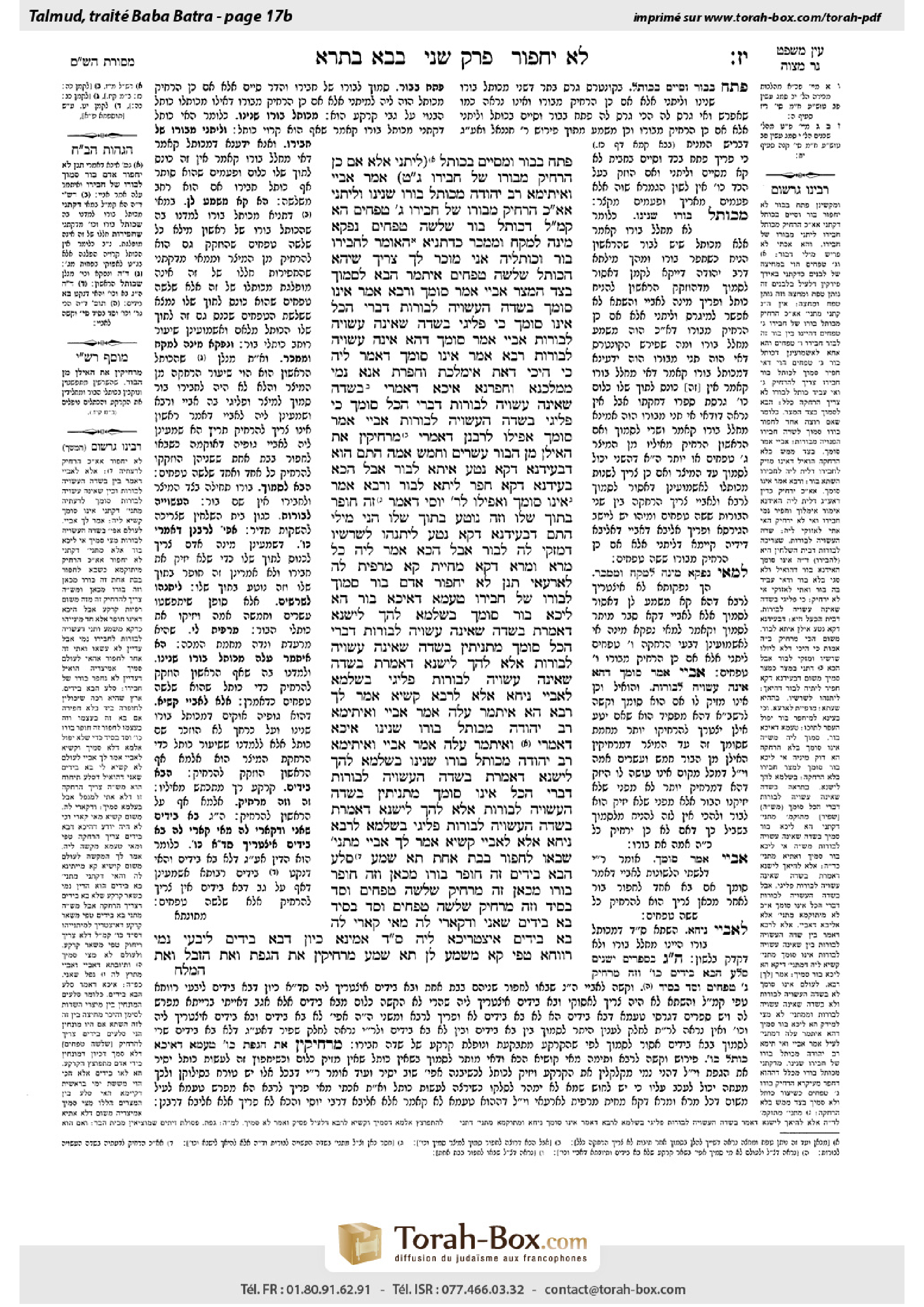
Bava Batra 17b: Talmud study for Daf Yomi
Study the Talmud for Daf Yomi with scanned pages, Hebrew text, English translations from Sefaria and AI-generated French translations.
Passage selection and English or AI-generated French translation are available where the scan has annotations. Daf Study is independent of Torah-Box and Sefaria.
Browse Bava Batra · בבא בתרא · All tractatesBava Batra 17b text and translations
This page of Bava Batra includes the Aramaic text, an English translation and an AI-generated French translation, alongside the scan above.
בבא בתרא י״ז ב · Aramaic and Hebrew text
גְּמָ׳ פָּתַח בְּבוֹר – וּמְסַיֵּים בְּכוֹתֶל; לִיתְנֵי: אֶלָּא אִם כֵּן הִרְחִיק מִבּוֹרוֹ שֶׁל חֲבֵירוֹ שְׁלֹשָׁה טְפָחִים!
אָמַר אַבָּיֵי, וְאִיתֵּימָא רַב יְהוּדָה: ״מִכּוֹתֶל בּוֹרוֹ״ שָׁנִינוּ.
וְלִיתְנֵי: אֶלָּא אִם כֵּן הִרְחִיק מִבּוֹרוֹ שֶׁל חֲבֵירוֹ שְׁלֹשָׁה טְפָחִים! הָא קָא מַשְׁמַע לַן – דְּכוֹתֶל בּוֹר שְׁלֹשָׁה טְפָחִים; נָפְקָא מִינַּהּ לְמִקָּח וּמִמְכָּר – כִּדְתַנְיָא: הָאוֹמֵר לַחֲבֵירוֹ: ״בּוֹר וְכוֹתְלֶיהָ אֲנִי מוֹכֵר לָךְ״ – צָרִיךְ שֶׁיְּהֵא הַכּוֹתֶל שְׁלֹשָׁה טְפָחִים.
אִיתְּמַר: הַבָּא לִסְמוֹךְ בְּצַד הַמֶּצֶר – אַבָּיֵי אָמַר: סוֹמֵךְ, וְרָבָא אָמַר: אֵינוֹ סוֹמֵךְ. בְּשָׂדֶה הָעֲשׂוּיָה לְבוֹרוֹת – דִּבְרֵי הַכֹּל אֵינוֹ סוֹמֵךְ, כִּי פְּלִיגִי – בְּשָׂדֶה שֶׁאֵינָהּ עֲשׂוּיָה לְבוֹרוֹת.
אַבָּיֵי אָמַר: סוֹמֵךְ – דְּהָא אֵינָהּ עֲשׂוּיָה לְבוֹרוֹת. רָבָא אָמַר: אֵינוֹ סוֹמֵךְ – דְּאָמַר לֵיהּ: כִּי הֵיכִי דְּאַתְּ אִימְּלַכְתְּ וַחֲפַרְתְּ, אֲנָא נָמֵי מִמְּלַכְנָא וְחָפַרְנָא.
אִיכָּא דְּאָמְרִי: בְּשָׂדֶה שֶׁאֵינָהּ עֲשׂוּיָה לְבוֹרוֹת – דִּבְרֵי הַכֹּל סוֹמֵךְ, כִּי פְּלִיגִי – בְּשָׂדֶה הָעֲשׂוּיָה לְבוֹרוֹת. אַבָּיֵי אָמַר: סוֹמֵךְ – אֲפִילּוּ לְרַבָּנַן, דְאָמְרִי: מַרְחִיקִין אֶת הָאִילָן מִן הַבּוֹר עֶשְׂרִים וְחָמֵשׁ אַמָּה – הָתָם הוּא דִּבְעִידָּנָא דְּקָא נָטַע, אִיתָא לְבוֹר; אֲבָל הָכָא, בְּעִידָּנָא דְּקָא חָפַר – לֵיתָא לְבוֹר.
וְרָבָא אָמַר: אֵינוֹ סוֹמֵךְ – וַאֲפִילּוּ לְרַבִּי יוֹסֵי דְּאָמַר: זֶה חוֹפֵר בְּתוֹךְ שֶׁלּוֹ וְזֶה נוֹטֵעַ בְּתוֹךְ שֶׁלּוֹ – הָנֵי מִילֵּי הָתָם, דִּבְעִידָּנָא דְּקָא נָטַע – לֵיתַנְהוּ לְשׇׁרָשָׁיו דְּמַזְּקִי לַהּ לְבוֹר; אֲבָל הָכָא – אָמַר לֵיהּ: כֹּל מָרָא וּמָרָא דְּקָא מָחֲיֵית, קָא מְרַפֵּית לַהּ לְאַרְעַאי.
תְּנַן: לֹא יַחְפּוֹר אָדָם בּוֹר סָמוּךְ לְבוֹרוֹ שֶׁל חֲבֵירוֹ. טַעְמָא דְּאִיכָּא בּוֹר, הָא לֵיכָּא בּוֹר – סוֹמֵךְ; בִּשְׁלָמָא לְהָךְ לִישָּׁנָא דְּאָמְרַתְּ: בְּשָׂדֶה שֶׁאֵינָהּ עֲשׂוּיָה לְבוֹרוֹת – דִּבְרֵי הַכֹּל סוֹמֵךְ, מַתְנִיתִין בְּשָׂדֶה שֶׁאֵינָהּ עֲשׂוּיָה לְבוֹרוֹת.
אֶלָּא לְהָךְ לִישָּׁנָא דְּאָמְרַתְּ: בְּשָׂדֶה שֶׁאֵינָהּ עֲשׂוּיָה לְבוֹרוֹת פְּלִיגִי – בִּשְׁלָמָא לְאַבָּיֵי נִיחָא, אֶלָּא לְרָבָא קַשְׁיָא!
אָמַר לָךְ רָבָא: הָא אִיתְּמַר עֲלַהּ, אָמַר אַבָּיֵי וְאִיתֵּימָא רַב יְהוּדָה: מִכּוֹתֶל בּוֹרוֹ שָׁנִינוּ.
אִיכָּא דְּאָמְרִי: וְאִיתְּמַר עֲלַהּ, אָמַר אַבָּיֵי וְאִיתֵּימָא רַב יְהוּדָה: מִכּוֹתֶל בּוֹרוֹ שָׁנִינוּ. בִּשְׁלָמָא לְהָךְ לִישָּׁנָא דְּאָמְרַתְּ: בְּשָׂדֶה הָעֲשׂוּיָה לְבוֹרוֹת – דִּבְרֵי הַכֹּל אֵינוֹ סוֹמֵךְ, מַתְנִיתִין בְּשָׂדֶה הָעֲשׂוּיָה לְבוֹרוֹת.
אֶלָּא לְהָךְ לִישָּׁנָא דְּאָמְרַתְּ: בְּשָׂדֶה הָעֲשׂוּיָה לְבוֹרוֹת פְּלִיגִי – בִּשְׁלָמָא לְרָבָא נִיחָא, אֶלָּא לְאַבָּיֵי קַשְׁיָא!
אָמַר לָךְ אַבָּיֵי: מַתְנִיתִין שֶׁבָּאוּ לַחְפּוֹר בְּבַת אַחַת.
תָּא שְׁמַע: סֶלַע הַבָּא בְּיָדַיִם – זֶה חוֹפֵר בּוֹרוֹ מִכָּאן, וְזֶה חוֹפֵר בּוֹרוֹ מִכָּאן; זֶה מַרְחִיק שְׁלֹשָׁה טְפָחִים וְסָד בְּסִיד, וָזֶה מַרְחִיק שְׁלֹשָׁה טְפָחִים וְסָד בְּסִיד! בָּא בְּיָדַיִם שָׁאנֵי.
וּדְקָאָרֵי לַהּ מַאי קָאָרֵי לַהּ? בָּא בְּיָדַיִם אִיצְטְרִיכָא לֵיהּ, סָלְקָא דַּעְתָּךְ אָמֵינָא: כֵּיוָן דְּבָא בְּיָדַיִם, לִיבְעֵי נָמֵי רַוְוחָא טְפֵי; קָא מַשְׁמַע לַן.
תָּא שְׁמַע: מַרְחִיקִין אֶת הַגֶּפֶת, וְאֶת הַזֶּבֶל, וְאֶת
Bava Batra 17b · English translation
GEMARA: The tanna of the mishna opens by speaking of a pit: A person may not dig a pit close to the pit of another, and yet he ends with a reference to a wall: Unless he distances it from the wall of another. Let the tanna teach: Unless he distanced his pit or ditch three handbreadths from the pit of another, just as he begins his statement by referring to a pit. Why does the mishna suddenly mention a wall here?
Abaye said, and some say it was Rav Yehuda who said: We learned that the mishna means: From the wall of his pit. In other words, one should read the mishna as follows: Unless he distanced his pit or ditch three handbreadths from the wall of another’s pit. The neighbor also built his pit close to the border between the two properties, and the mishna is teaching that the one digging a pit must distance it three handbreadths from the wall of the pit of the other.
The Gemara challenges: But even so, let it teach: Unless he distanced his excavations three handbreadths from the pit of another, and one would understand that the term pit is referring to the wall of the other’s pit. The Gemara responds: By using the phrase: From the wall of another, this teaches us incidentally that the wall of a pit must be at least three handbreadths thick, as the wall of the other’s pit occupied the full three handbreadths between the cavity of his pit and the property of his neighbor. The practical difference of this observation is with regard to buying and selling, as it is taught in a baraita: With regard to one who says to another: I am selling you a pit and its walls, the wall of the pit must be at least three handbreadths thick.
§ It was stated: With regard to one who comes to dig any of these excavations or place any of the items listed in the mishna close to the boundary of his field, where his neighbor currently has no pit, Abaye says: He may dig or place them close to the boundary; and Rava says: He may not dig or place them close to the boundary. The Gemara explains: All agree that he may not dig or place them close to a field of his neighbor if that field is designated for digging pits, as he will thereby restrict his neighbor from using his field in the manner it is expected to be used. When they disagree it is with regard to a field that is not designated for digging pits.
The Gemara elaborates: Abaye says: He may dig these excavations or place these items close to the boundary, as the neighbor’s field is not designated for pits, so he is not causing any damage by doing so. Rava says: He may not dig these excavations or place these items close to the boundary, as the neighbor can say to him: Just as you changed your mind and dug a pit, I too might change my mind and dig a pit, and I will no longer be able to dig near my border if you dig your pit close to the boundary.
There are those who say a different version of this discussion: All agree that one may dig these excavations or place these items close to the boundary of a field that is not designated for digging pits. When they disagree it is with regard to a field that is designated for digging pits. Abaye says: One may dig these excavations or place these items close to the boundary; and this is the halakha even according to the opinion of the Rabbis, who say in the mishna (25b): One must distance a tree twenty-five cubits from a cistern, lest the roots of the tree grow and damage a neighbor’s cistern in his field. The difference is that there it is prohibited, as when he plants the tree there is already a cistern. But here, at the time when he digs his cistern, there is as yet no cistern in his neighbor’s field.
And Rava says: One may not dig these excavations or place these items close to the boundary; and this is the halakha even according to the opinion of Rabbi Yosei, who says in that same mishna: This one may dig in his field and that one may plant in his field, i.e., one need not distance his tree for fear of damaging his neighbor’s field through expanding roots. The reason that Rava maintains that his ruling is correct even according to the opinion of Rabbi Yosei is that this matter applies only there, as when he plants the tree, its roots, which might damage the cistern, are not yet present. Consequently, when he plants he does not cause any damage. But here, the neighbor can say to him: Each and every strike of yours with the hoe loosens my earth, and therefore you are already causing damage as you dig your cistern.
The Gemara suggests a proof: We learned in the mishna that a person may not dig a pit close to the pit of another, unless he does so at a distance of three handbreadths from his neighbor’s wall. The Gemara analyzes this statement: Apparently, the reason he may not dig close to the boundary of his neighbor’s field is that there is a pit there, from which it may be inferred that if there is no pit he may dig his pit close to his neighbor’s wall. Granted, according to that second version of the dispute, in which you said: All agree that one may dig these excavations or place these items close to the boundary of a field that is not designated for digging pits, one can explain that the mishna is referring to a field that is not designated for digging pits.
But according to that first version of the dispute, in which you said that they disagree with regard to a field that is not designated for digging pits, there is a difficulty. Granted, this works out well according to the opinion of Abaye, who says that one may dig one’s pit near the boundary when the neighbor has no pit. But according to the opinion of Rava, who maintains that it is prohibited to dig a pit near the boundary under any circumstances, the ruling of this mishna is difficult.
The Gemara explains: Rava could have said to you: Wasn’t it stated with regard to that mishna that Abaye says, and some say it was Rav Yehuda who says: We learned that the mishna means: From the wall of his pit? This indicates that the neighbor must distance the edge of his pit from the boundary by the thickness of his wall, which is three handbreadths. Therefore, even according to the ruling of the mishna, one may not dig his pit directly adjacent to the boundary.
There are those who say this discussion in the form of a challenge to the opinion of Abaye. The mishna teaches that one must distance his pit from that of his neighbor, and it was stated with regard to that ruling that Abaye says, and some say it was Rav Yehuda who says: We learned that it means: From the wall of his pit. In other words, the edge of the neighbor’s pit must be three handbreadths away from the boundary. Granted, according to that first version of the dispute, in which you said: All agree that he may not dig or place them close to a field of his neighbor if that field is designated for digging pits, one can explain that the mishna is referring to a field that is designated for digging pits.
But according to that second version of the dispute, in which you said that they disagree with regard to a field that is designated for digging pits, there is a difficulty. Granted, this works out well according to the opinion of Rava, who says that it is prohibited to dig a pit near the boundary in this case. But according to the opinion of Abaye, the ruling of this mishna is difficult, as if the mishna is referring to the wall of the neighbor’s pit, this indicates that the first pit was dug close to the boundary.
The Gemara explains: Abaye could have said to you: The mishna is referring to the specific case where both neighbors came to dig their pits at the same time. Consequently, they must both distance their pits from one another. If there is no pit as yet next to the boundary, and the neighbor is not digging at that point, one may dig his pit alongside the boundary.
The Gemara suggests: Come and hear a proof from a baraita: In the case of rock that is so soft that it crumbles in one’s hands, and no tool is needed, this one may dig his pit from here, and that one may dig his pit from there. This one distances his pit three handbreadths and plasters with lime, and that one distances his pit three handbreadths and plasters with lime. This indicates that the first one who digs a pit must distance his pit even when the second one does not yet have a pit. The Gemara rejects this proof: Rock that crumbles in one’s hands is different. In this case, one must maintain a distance from the boundary due to the softness of the ground.
The Gemara is puzzled by this exchange: And he who asked it, why did he ask it? The baraita is explicitly referring to rock that crumbles in one’s hands, so this is clearly a unique case. The Gemara answers that the Sage who asked the question assumed that the halakha of the baraita includes all types of soil, and he thought that it was necessary for the tanna to mention the specific example of rock that crumbles in one’s hands, as it could enter your mind to say that since this substance crumbles in one’s hands he is required to keep his pit at an even greater distance. To counter this, the baraita teaches us that a distance of three handbreadths is sufficient.
The Gemara suggests: Come and hear a proof from the mishna: One must distance the solid residue of produce that has been pressed free of its oil, and animal manure, and
Bava Batra 17b · Traduction française (IA)
GUEMARA : Le tanna de la mishna commence par parler d’un puits : une personne ne doit pas creuser un puits près du puits de l’autre, et pourtant il termine par une référence à un mur : sauf s’il le distancie du mur de l’autre. Faisons apprendre : sauf s’il a distancié son puits ou sa fosse de trois paumes du puits de l’autre, tout comme il commence son propos en mentionnant un puits. Pourquoi la mishna mentionne-t-elle soudain un mur ici ?
Abaye a dit, et certains disent que c’est Rav Yehuda qui a dit : Nous avons appris que la mishna signifie : du mur de son puits. En d’autres termes, on devrait lire la mishna ainsi : sauf s’il distancie son puits ou sa fosse de trois paumes du mur du puits de l’autre. Le voisin a également construit son puits près de la limite entre les deux propriétés, et la mishna enseigne que celui qui creuse un puits doit le distancer de trois paumes du mur du puits de l’autre.
La Guemara soulève un défi : Mais même ainsi, apprenons : sauf s’il a distancié ses excavations de trois paumes du puits de l’autre, et on comprendrait alors que le terme puits fait référence au mur du puits de l’autre. La Guemara répond : En utilisant la formule : du mur de l’autre, cela nous apprend incidentellement que le mur d’un puits doit avoir au moins trois paumes d’épaisseur, car le mur du puits de l’autre occupait les trois paumes entre la cavité de son puits et la propriété de son voisin. La différence pratique de cette observation concerne l’achat et la vente, comme il est enseigné dans une baraïta : concernant celui qui dit à un autre : Je vends à toi un puits et ses murs, la muraille du puits doit avoir au moins trois paumes d’épaisseur.
§ Il a été dit : concernant celui qui vient creuser l’un de ces excavations ou placer l’un des objets mentionnés dans la mishna près de la limite de son champ, où son voisin n’a pas encore de puits, Abaye dit : il peut creuser ou placer ces choses près de la limite ; et Rava dit : il ne peut pas creuser ou placer ces choses près de la limite. La Guemara explique : tous s’accordent sur le fait qu’il ne peut pas creuser ou placer ces choses près du champ de son voisin si ce champ est désigné pour creuser des puits, car cela le restreint dans l’utilisation de son champ selon l’usage attendu. Lorsqu’ils divergent, c’est concernant un champ non désigné pour creuser des puits.
La Guemara développe : Abaye dit : il peut creuser ces excavations ou placer ces objets près de la limite, car le champ du voisin n’est pas désigné pour des puits, donc il ne cause pas de dommage en le faisant. Rava dit : il ne peut pas creuser ces excavations ou placer ces objets près de la limite, car le voisin peut lui dire : Comme tu as changé d’avis et creusé un puits, je pourrais aussi changer d’avis et creuser un puits, et je ne pourrais plus creuser près de ma limite si tu creuses ton puits près de la limite.
Certains affirment une version différente de cette discussion : tous s'accordent sur le fait qu'on peut creuser ces excavations ou placer ces objets près de la limite d'un champ non désigné pour creuser des puits. Lorsqu'ils divergent, c'est concernant un champ désigné pour creuser des puits. Abaye dit : on peut creuser ces excavations ou placer ces objets près de la limite ; et c'est la halakha même selon l'opinion des Rabbins, qui disent dans la mishna (25b) : on doit distancer un arbre de vingt-cinq coudées d'un cistern, de peur que les racines de l'arbre s'étendent et dégradent le cistern du voisin. La différence est que là, c'est interdit, car lorsqu'on plante l'arbre, il y a déjà un cistern. Mais ici, lorsqu'on creuse son cistern, il n'y a pas encore de cistern dans le champ du voisin.
Et Rava dit : on ne peut pas creuser ces excavations ou placer ces objets près de la limite ; et c'est la halakha même selon l'opinion de Rabbi Yosei, qui dit dans cette même mishna : celui-ci peut creuser dans son champ et celui-là peut planter dans son champ, c'est-à-dire qu'on n'a pas besoin de distancer son arbre de peur qu'il dégrade le champ du voisin par l'extension de ses racines. La raison pour laquelle Rava maintient que son jugement est correct même selon l'opinion de Rabbi Yosei est que cette affaire s'applique uniquement là, car lorsqu'on plante l'arbre, ses racines, qui pourraient dégrader le cistern, ne sont pas encore présentes. Ainsi, lorsqu'on plante, on ne cause pas de dommage. Mais ici, le voisin peut lui dire : chaque coup de houe que tu fais détache mon sol, et donc tu causes déjà un dommage en creusant ton cistern.
La Guemara suggère une preuve : Nous avons appris dans la mishna que personne ne doit creuser un puits près du puits de l’autre, sauf s’il le fait à une distance de trois paumes de son mur. La Guemara analyse cette déclaration : Apparemment, la raison pour laquelle on ne peut pas creuser près de la limite du champ du voisin est qu’il y a un puits là, d’où on peut en déduire que s’il n’y a pas de puits, on peut creuser son puits près du mur du voisin. Admettons que selon cette deuxième version du débat, où vous avez dit : tous s’accordent sur le fait qu’on peut creuser ces excavations ou placer ces objets près de la limite d’un champ non désigné pour creuser des puits, on peut expliquer que la mishna fait référence à un champ non désigné pour creuser des puits.
Mais selon cette première version du débat, où vous avez dit que le débat porte sur un champ non désigné pour creuser des puits, il y a un problème. Admettons que cela fonctionne bien selon l’opinion d’Abaye, qui dit qu’on peut creuser son puits près de la limite lorsque le voisin n’a pas de puits. Mais selon l’opinion de Rava, qui maintient qu’il est interdit de creuser un puits près de la limite sous quelque circonstance que ce soit, le jugement de cette mishna est difficile.
La Guemara explique : Rava aurait pu te dire : N’a-t-on pas dit concernant cette mishna que Abaye a dit, et certains disent que c’est Rav Yehuda qui a dit : Nous avons appris que la mishna signifie : du mur de son puits ? Cela indique que le voisin doit distancer l’extrémité de son puits de la limite par l’épaisseur de son mur, soit trois paumes. Ainsi, même selon le jugement de la mishna, on ne peut pas creuser son puits directement adjacent à la limite.
Il y a ceux qui disent que cette discussion est formulée comme un défi à l'opinion d'Abaye. La mitsva enseigne qu'on doit éloigner sa fosse de celle de son voisin, et il a été dit à propos de cette décision que Abaye dit, et certains disent que c'est Rav Yehuda qui dit : Nous avons appris que cela signifie : De la paroi de sa fosse. Autrement dit, le bord de la fosse du voisin doit être à trois paumes de distance de la limite. Admettons que, selon cette première version du débat, où vous avez dit : Tout le monde est d'accord sur le fait qu'on ne doit pas creuser ou placer des choses près du champ de son voisin si ce champ est destiné à la creuser, on peut expliquer que la mitsva fait référence à un champ destiné à la creuser.
Mais selon cette deuxième version du débat, où vous avez dit qu'ils s'opposent concernant un champ destiné à la creuser, il y a une difficulté. Admettons que cela fonctionne bien selon l'opinion de Rava, qui dit qu'il est interdit de creuser une fosse près de la limite dans ce cas. Mais selon l'opinion d'Abaye, la décision de cette mitsva est difficile, car si la mitsva fait référence à la paroi de la fosse du voisin, cela indique que la première fosse a été creusée près de la limite.
La Guemara explique : Abaye aurait pu dire à vous : La mitsva fait référence au cas spécifique où les deux voisins viennent creuser leurs fosses en même temps. Ainsi, ils doivent tous deux éloigner leurs fosses les unes des autres. Si aucune fosse n'est encore à côté de la limite et que le voisin ne creuse pas à ce moment, on peut creuser sa fosse à la limite.
La Guemara suggère : Venez écouter une preuve d'une baraïta : Dans le cas de roche si molle qu'elle s'effrite entre les mains, et qu'aucun outil n'est nécessaire, l'un peut creuser sa fosse d'ici, et l'autre peut creuser sa fosse là. L'un éloigne sa fosse de trois paumes et plaque avec de la chaux, et l'autre éloigne sa fosse de trois paumes et plaque avec de la chaux. Cela indique que celui qui creuse la première fosse doit éloigner sa fosse même si l'autre n'a pas encore creusé. La Guemara rejette cette preuve : La roche qui s'effrite entre les mains est différente. Dans ce cas, on doit maintenir une distance de la limite en raison de la mollesse du sol.
La Guemara est perplexe face à cet échange : Et celui qui a posé la question, pourquoi l'a-t-il posée ? La baraïta fait explicitement référence à une roche qui s'effrite entre les mains, donc c'est clairement un cas particulier. La Guemara répond que le Sage qui a posé la question supposait que la halakha de la baraïta inclut tous les types de sol, et il pensait qu'il était nécessaire pour le tanna de mentionner l'exemple spécifique de roche qui s'effrite entre les mains, car cela pourrait entrer en votre esprit de dire que puisque cette substance s'effrite entre les mains, il est nécessaire de maintenir une distance encore plus grande. Pour contre cela, la baraïta nous enseigne que la distance de trois paumes suffit.
La Guemara suggère : Venez écouter une preuve de la mitsna : On doit éloigner le résidu solide des produits dont l'huile a été pressée, et les déjections animales,
Traduction française générée par IA à partir de l’édition anglaise de Sefaria. Vérifie toujours un passage avec le texte source.
Text from Sefaria: William Davidson Edition - Vocalized Aramaic (CC BY NC); William Davidson Edition - English (CC BY NC).