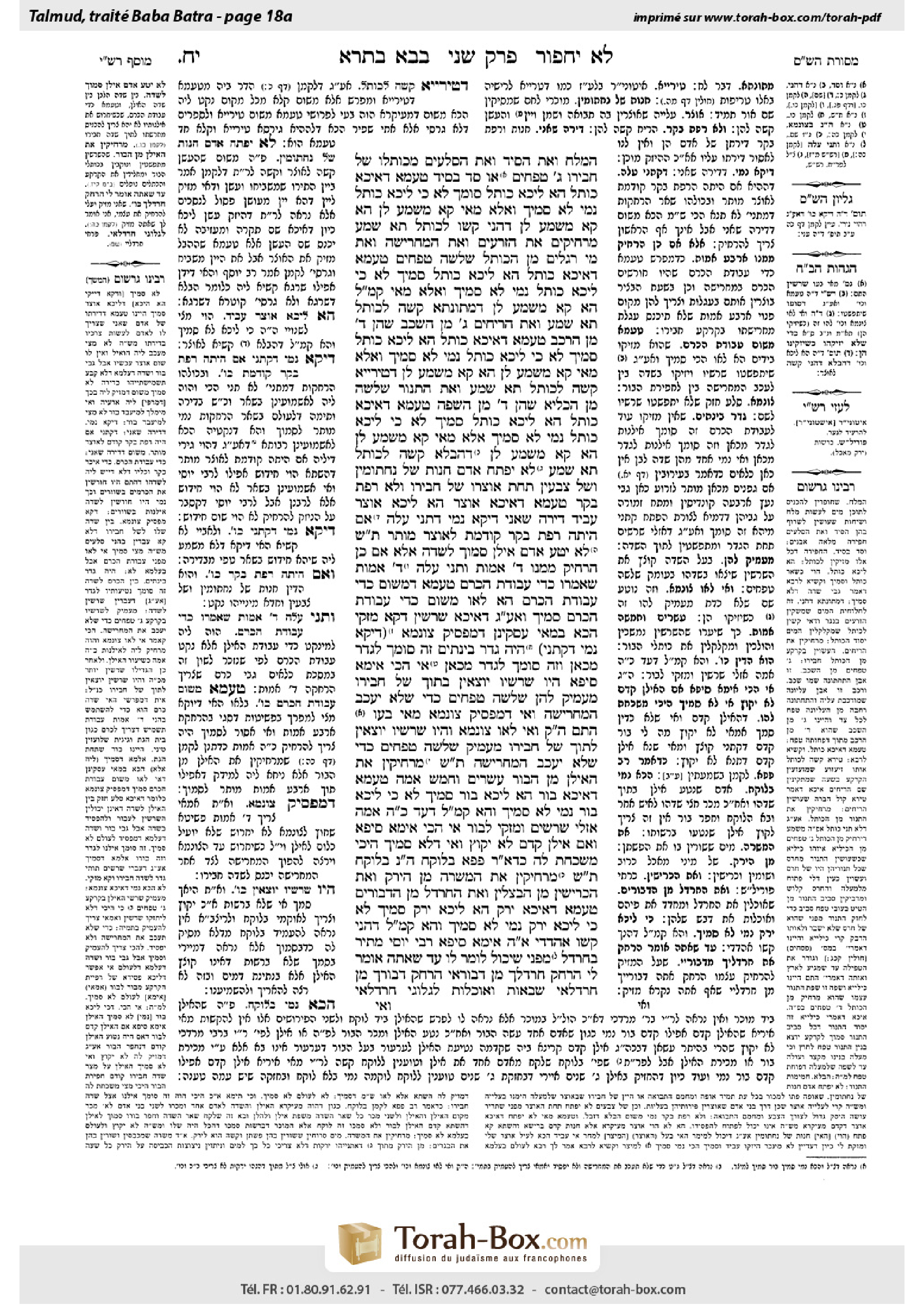
Bava Batra 18a: Talmud study for Daf Yomi
Study the Talmud for Daf Yomi with scanned pages, Hebrew text, English translations from Sefaria and AI-generated French translations.
Passage selection and English or AI-generated French translation are available where the scan has annotations. Daf Study is independent of Torah-Box and Sefaria.
Browse Bava Batra · בבא בתרא · All tractatesBava Batra 18a text and translations
This page of Bava Batra includes the Aramaic text, an English translation and an AI-generated French translation, alongside the scan above.
בבא בתרא י״ח א · Aramaic and Hebrew text
הַמֶּלַח, וְאֶת הַסִּיד, וְאֶת הַסְּלָעִים מִכּוֹתְלוֹ שֶׁל חֲבֵירוֹ שְׁלֹשָׁה טְפָחִים, אוֹ סָד בְּסִיד. טַעְמָא דְּאִיכָּא כּוֹתֶל, הָא לֵיכָּא כּוֹתֶל – סוֹמֵךְ!
לָא; כִּי לֵיכָּא כּוֹתֶל נָמֵי לָא סָמֵיךְ. וְאֶלָּא מַאי קָא מַשְׁמַע לַן? הָא קָא מַשְׁמַע לַן – דְּהָנֵי קָשׁוּ לְכוֹתֶל.
תָּא שְׁמַע: מַרְחִיקִים אֶת הַזְּרָעִים, וְאֶת הַמַּחֲרֵישָׁה, וְאֶת מֵי רַגְלַיִם מִן הַכּוֹתֶל שְׁלֹשָׁה טְפָחִים. טַעְמָא דְּאִיכָּא כּוֹתֶל, הָא לֵיכָּא כּוֹתֶל – סָמֵיךְ! לָא; כִּי לֵיכָּא כּוֹתֶל נָמֵי לָא סָמֵיךְ. וְאֶלָּא מַאי קָא מַשְׁמַע לַן? הָא קָא מַשְׁמַע לַן – דִּמְתוּנְתָּא קָשֶׁה לַכּוֹתֶל.
תָּא שְׁמַע: וְאֶת הָרֵיחַיִם – שְׁלֹשָׁה מִן הַשֶּׁכֶב שֶׁהֵן אַרְבָּעָה מִן הָרֶכֶב. טַעְמָא דְּאִיכָּא כּוֹתֶל, הָא לֵיכָּא כּוֹתֶל – סָמֵיךְ! לָא; כִּי לֵיכָּא כּוֹתֶל נָמֵי לָא סָמֵיךְ. וְאֶלָּא מַאי קָא מַשְׁמַע לַן? הָא קָא מַשְׁמַע לַן – דְּטִירְיָיא קָשֶׁה לַכּוֹתֶל.
תָּא שְׁמַע: וְאֶת הַתַּנּוּר – שְׁלֹשָׁה מִן הַכִּלְיָא שֶׁהֵן אַרְבָּעָה מִן הַשָּׂפָה. טַעְמָא דְּאִיכָּא כּוֹתֶל, הָא לֵיכָּא כּוֹתֶל – סָמֵיךְ! לָא; כִּי לֵיכָּא כּוֹתֶל נָמֵי לָא סָמֵיךְ. אֶלָּא מַאי קָא מַשְׁמַע לַן? הָא קָא מַשְׁמַע לַן – דְּהַבְלָא קָשֶׁה לַכּוֹתֶל.
תָּא שְׁמַע: לֹא יִפְתַּח אָדָם חֲנוּת שֶׁל נַחְתּוֹמִין וְשֶׁל צַבָּעִין תַּחַת אוֹצָרוֹ שֶׁל חֲבֵירוֹ, וְלֹא רֶפֶת בָּקָר. טַעְמָא דְּאִיכָּא אוֹצָר, הָא לֵיכָּא אוֹצָר – עָבֵיד!
דִּירָה שָׁאנֵי. דַּיְקָא נָמֵי, דְּתָנֵי עֲלַהּ: אִם הָיְתָה רֶפֶת בָּקָר קוֹדֶמֶת לָאוֹצָר – מוּתָּר.
תָּא שְׁמַע: לֹא יִטַּע אָדָם אִילָן סָמוּךְ לַשָּׂדֶה, אֶלָּא אִם כֵּן הִרְחִיק מִמֶּנּוּ אַרְבַּע אַמּוֹת. וְתָנֵי עֲלַהּ: אַרְבַּע אַמּוֹת שֶׁאָמְרוּ – כְּדֵי עֲבוֹדַת הַכֶּרֶם.
טַעְמָא דְּמִשּׁוּם כְּדֵי עֲבוֹדַת הַכֶּרֶם, הָא לָאו מִשּׁוּם כְּדֵי עֲבוֹדַת הַכֶּרֶם – סָמֵיךְ, וְאַף עַל גַּב דְּאִיכָּא שׇׁרָשִׁין דְּקָא מַזְּקִי! הָכָא בְּמַאי עָסְקִינַן – דְּמַפְסֵיק צוּנְמָא.
דַּיְקָא נָמֵי, דְּקָתָנֵי: הָיָה גָּדֵר בֵּינָתַיִם – זֶה סוֹמֵךְ לַגָּדֵר מִכָּאן, וְזֶה סוֹמֵךְ לַגָּדֵר מִכָּאן.
אִי הָכִי, אֵימָא סֵיפָא: הָיוּ שׇׁרָשָׁיו יוֹצְאִין בְּתוֹךְ שֶׁל חֲבֵירוֹ – מַעֲמִיק לָהֶן שְׁלֹשָׁה טְפָחִים, כְּדֵי שֶׁלֹּא יְעַכֵּב הַמַּחֲרֵישָׁה. וְאִי דְּמַפְסֵיק צוּנְמָא, מַאי בָּעוּ הָתָם? הָכִי קָאָמַר: וְאִי לָאו צוּנְמָא, וְהָיוּ שׇׁרָשָׁיו יוֹצְאִין לְתוֹךְ שֶׁל חֲבֵירוֹ – מַעֲמִיק שְׁלֹשָׁה טְפָחִים, כְּדֵי שֶׁלֹּא יְעַכֵּב הַמַּחֲרֵישָׁה.
תָּא שְׁמַע: מַרְחִיקִין אֶת הָאִילָן מִן הַבּוֹר עֶשְׂרִים וְחָמֵשׁ אַמָּה. טַעְמָא דְּאִיכָּא בּוֹר, הָא לֵיכָּא בּוֹר – סָמֵיךְ! לָא; כִּי לֵיכָּא בּוֹר נָמֵי לָא סָמֵיךְ, וְהָא קָמַשְׁמַע לַן – דְּעַד עֶשְׂרִים וְחָמֵשׁ אַמָּה, אָזְלִי שׇׁרָשִׁים וּמַזְּקִי לְבוֹר.
אִי הָכִי, אֵימָא סֵיפָא: וְאִם אִילָן קָדַם – לֹא יָקוֹץ. וְאִי דְּלָא סָמֵיךְ, הֵיכִי מַשְׁכַּחַתְּ לַהּ? כִּדְאָמַר רַב פָּפָּא: בְּלוֹקֵחַ; הָכִי נָמֵי בְּלוֹקֵחַ.
תָּא שְׁמַע: מַרְחִיקִין אֶת הַמִּשְׁרָה מִן הַיָּרָק, וְאֶת הַכְּרֵישִׁין מִן הַבְּצָלִין, וְאֶת הַחַרְדָּל מִן הַדְּבוֹרִים. טַעְמָא דְּאִיכָּא יָרָק, הָא לֵיכָּא יָרָק – סָמֵיךְ! לָא; כִּי לֵיכָּא יָרָק נָמֵי לָא סָמֵיךְ; וְהָא קָא מַשְׁמַע לַן – דְּהָנֵי קָשׁוּ אַהֲדָדֵי.
אִי הָכִי, אֵימָא סֵיפָא: רַבִּי יוֹסֵי מַתִּיר בְּחַרְדָּל, מִפְּנֵי שֶׁיָּכוֹל לוֹמַר לוֹ: עַד שֶׁאַתָּה אוֹמֵר לִי הַרְחֵק חַרְדָּלֶךָ מִן דְּבוֹרַאי, הַרְחֵק דְּבוֹרֶךָ מִן חַרְדָּלַאי – שֶׁבָּאוֹת וְאוֹכְלוֹת לִגְלוּגַי חַרְדָּלַאי.
Bava Batra 18a · English translation
salt, and lime, and rocks three handbreadths from the wall of another, or he can plaster the wall with lime. The Gemara analyzes this statement: The reason for this ruling is that there is a wall there belonging to his neighbor, from which it may be inferred that if there is no wall there, one may place these substances close to the boundary of his neighbor’s courtyard. This presents a difficulty for the opinion of Rava according to the first version of the dispute, which states that one may not place these substances close to a boundary even in the case of a field that is not designated for pits.
The Gemara rejects this proof: No, even if there is no wall one may also not place these substances close to the boundary. The Gemara asks: Rather, what does mentioning a wall here teach us? The Gemara answers: This teaches us that all these substances are damaging to a wall.
The Gemara suggests: Come and hear another proof from the mishna: One must distance seeds, and the plow, and urine three handbreadths from the wall of another. The Gemara analyzes this ruling: The reason for this ruling is that there is a wall, from which it may be inferred that if there is no wall, one may place these substances close to the boundary of the field. The Gemara rejects this proof as well: No, even if there is no wall, one may also not place these substances close by the boundary. The Gemara asks: But rather, what does this teach us? The Gemara answers: This teaches us that dampness [dimtunta] is damaging to a wall.
The Gemara suggests: Come and hear another proof from the mishna: And one must distance a mill from a wall by three handbreadths from the lower stone of the mill, which is four handbreadths from the upper stone. The Gemara analyzes this statement: The reason for this ruling is that there is a wall, from which it may be inferred that if there is no wall, one may place a mill close by the boundary. The Gemara rejects this proof: No, even if there is no wall, one may also not place his mill close by the boundary. The Gemara asks: But rather, what does this teach us? The Gemara answers: This teaches us that vibrations are damaging to a wall.
The Gemara suggests: Come and hear another proof from the mishna: And the oven must be distanced three handbreadths from the base, which is four handbreadths from the upper rim of the oven. The Gemara analyzes this statement: The reason for this ruling is that there is a wall, from which it may be inferred that if there is no wall, one may place an oven close by the boundary. The Gemara rejects this proof as well: No, even if there is no wall, one may also not place his oven close by the boundary. The Gemara asks: Rather, what does this teach us? The Gemara answers: This teaches us that heat is damaging to a wall.
The Gemara suggests: Come and hear a proof from the mishna (20b): A person may not open a bakery or a dye shop beneath the wine storeroom of another, nor may one open a cattle barn there. The Gemara analyzes this mishna: The reason for this ruling is that there is a storeroom already in place, from which it may be inferred that if there is no storeroom one may do so. If this is the case, then with regard to a pit as well, one may dig next to a boundary if there is as yet no pit.
The Gemara answers: The case of a residence is different, as in general one can use his domicile in any manner of his choosing unless he directly causes damage to another or his property. The Gemara adds: The language of the mishna is also precise, as an explicit baraita is taught with regard to that mishna: If the construction of the cattle barn preceded the storeroom, it is permitted. Nothing can be inferred from the case of the baraita with regard to the halakha of the mishna, which does not concern living quarters.
The Gemara suggests: Come and hear a proof from a mishna (26a): A person may not plant a tree close to another’s field unless he distances it four cubits from his neighbor. And it is taught with regard to this mishna: The four cubits of which the Sages spoke are to enable the work of the vineyard, i.e., a small space next to the trees is necessary to enable animals to plow between them.
The Gemara analyzes this ruling: The reason this distance is required is due to the work of the vineyard, from which it may be inferred that if not for the problem due to the work of the vineyard, it would be permitted for one to plant his tree close to the boundary, and apparently, this is the halakha even though there are roots of the tree that damage his neighbor’s field. The Gemara answers: With what are we dealing here? We are dealing with a case where a hard rock [tzunema] interrupts between the two fields, preventing the roots from passing through to the other field.
The Gemara continues: The language of the mishna is also precise with regard to this point, as it teaches further on: If there was a fence between them, this one places, i.e., plants a tree, close to the fence from here, and that one places, i.e., plants a tree, close to the fence from here. If the baraita were referring to a case where the roots could travel across, how could it be permitted for both neighbors to plant their trees alongside each other? Consequently, it must be referring to a situation where a rock separates between the two fields below, and therefore the neighbors may plant their trees near the fence.
The Gemara responds: If so, say the last clause of that mishna: If the roots of the tree extended into the field of another, the neighbor may cut them off to a depth of three handbreadths, so that they do not impede the plow. The Gemara asks: But if a rock interrupts between the two fields and forms a barrier, what are these roots doing there, i.e., how did they get there? The Gemara answers: This is what the tanna of the mishna is saying: And if there is no rock, and the roots of the tree extended into the field of another, the neighbor may cut them off to a depth of three handbreadths so that they do not impede the plow.
The Gemara suggests: Come and hear a proof from a mishna (25b): One must distance a tree twenty-five cubits from a cistern. The Gemara analyzes this halakha: The reason for this ruling is that there is a cistern, from which it may be inferred that if there is no cistern, one may place, i.e., plant, his tree close to the neighbor’s field. The Gemara answers: No, even when there is no cistern one may also not place it close to the neighbor’s field. And by mentioning a cistern, the tanna of the mishna teaches us this: That the roots of a tree extend and damage the cistern up to a distance of twenty-five cubits away.
The Gemara asks: If so, say the last clause of that mishna: And if the tree preceded the cistern, one is not required to cut down the tree. But if one may not place the tree close to the boundary even if there is no cistern, how can you find a case where the tree preceded the cistern? Why would its owner not be required to cut it down? The Gemara answers: This is as Rav Pappa says with regard to a similar matter, that it is referring to a buyer who purchases part of a field. So too here, it is referring to a buyer. In other words, a field contained a cistern and tree alongside each other, and the owner sold the part of the field containing the cistern.
The Gemara cites yet another source: Come and hear a proof from a mishna (25a): One must distance the water in which flax is steeped from vegetables growing in a neighbor’s field, and one must distance leeks from onions growing in a neighbor’s field, and one must likewise distance mustard from bees that are in a neighbor’s field. The Gemara analyzes this statement: The reason is that there are vegetables present, from which it may be inferred that if there are no vegetables, one may place the water close to the neighbor’s field. The Gemara rejects this opinion: No, even if there are no vegetables one may also not place the water close to the neighbor’s field. And the tanna teaches us that these items mentioned in that mishna are harmful to each other.
The Gemara responds: If so, say the last clause of that mishna: Rabbi Yosei renders it permitted to plant near the neighbor’s bees in the case of mustard. As explained in a baraita, this is because he can say to the owner of the bees: Just as you say to me: Keep your mustard away from my bees, I can say to you: Keep your bees away from my mustard, as they come and eat my mustard plants. In other words, you are damaging my property as well.
Bava Batra 18a · Traduction française (IA)
du sel, de la chaux et des pierres à trois tefachim de la muraille d’un autre, ou il peut enduire la muraille avec de la chaux. La Guemara analyse cette déclaration : La raison de cette décision est qu’il y a une muraille appartenant à son voisin, d’où l’on peut déduire que si elle n’y est pas, on peut placer ces substances près de la limite du jardin de son voisin. Cela présente une difficulté pour l’opinion de Rava selon la première version du débat, qui affirme qu’on ne peut pas placer ces substances près d’une limite même dans le cas d’un champ non désigné pour des puits.
La Guemara rejette cette preuve : Non, même s’il n’y a pas de muraille, on ne peut pas non plus placer ces substances près de la limite. La Guemara demande : Mais alors, à quoi sert la mention de la muraille ici ? La Guemara répond : Cela nous apprend que toutes ces substances sont nuisibles à une muraille.
La Guemara suggère : Viens écouter une autre preuve à partir de la mitsva : On doit distancer les semences, la charrue et l’urine à trois tefachim de la muraille d’un autre. La Guemara analyse cette décision : La raison de cette décision est qu’il y a une muraille, d’où l’on peut déduire que si elle n’y est pas, on peut placer ces substances près de la limite du champ. La Guemara rejette cette preuve également : Non, même s’il n’y a pas de muraille, on ne peut pas non plus placer ces substances près de la limite. La Guemara demande : Mais alors, à quoi cela nous apprend-il ? La Guemara répond : Cela nous apprend que l’humidité [dimtunta] est nuisible à une muraille.
La Guemara suggère : Viens écouter une autre preuve à partir de la mitsna : Et on doit distancer une meule de trois tefachim du bas de la meule, qui est à quatre tefachim du haut de la meule. La Guemara analyse cette déclaration : La raison de cette décision est qu’il y a une muraille, d’où l’on peut déduire que si elle n’y est pas, on peut placer une meule près de la limite. La Guemara rejette cette preuve : Non, même s’il n’y a pas de muraille, on ne peut pas non plus placer sa meule près de la limite. La Guemara demande : Mais alors, à quoi cela nous apprend-il ? La Guemara répond : Cela nous apprend que les vibrations sont nuisibles à une muraille.
La Guemara suggère : Viens écouter une autre preuve à partir de la mitsna : Et l’four doit être distancé de trois tefachim de la base, qui est à quatre tefachim du bord supérieur de l’four. La Guemara analyse cette déclaration : La raison de cette décision est qu’il y a une muraille, d’où l’on peut déduire que si elle n’y est pas, on peut placer un four près de la limite. La Guemara rejette cette preuve également : Non, même s’il n’y a pas de muraille, on ne peut pas non plus placer son four près de la limite. La Guemara demande : Mais alors, à quoi cela nous apprend-il ? La Guemara répond : Cela nous apprend que la chaleur est nuisible à une muraille.
La Guemara suggère : Viens écouter une preuve à partir de la mitsna (20b) : Une personne ne peut pas ouvrir une boulangerie ou une teurie sous la cave de vin d’un autre, ni ne peut-on ouvrir un écurie là. La Guemara analyse cette mitsna : La raison de cette décision est qu’il y a déjà une cave, d’où l’on peut déduire que si elle n’y est pas, on peut le faire. Si c’est le cas, alors concernant un puits également, on peut creuser à côté d’une limite si elle n’existe pas encore.
La Guemara répond : Le cas d’une résidence est différent, car en général, on peut utiliser son domicile de toute manière qu’il le souhaite, à moins qu’il ne cause directement un préjudice à un autre ou à sa propriété. La Guemara ajoute : La formulation de la Michna est aussi précise, car une baraïta explicite est enseignée concernant cette Michna : Si la construction de l’écurie a précédé la cave, elle est permise. Rien ne peut être déduit du cas de la baraïta concernant la halakha de la Michna, qui ne concerne pas les logements.
La Guemara suggère : Viens écouter une preuve tirée d’une Michna (26a) : Une personne ne peut pas planter un arbre près du champ d’un autre à moins qu’il ne le distante de quatre cubits de son voisin. Et il est enseigné concernant cette Michna : Les quatre cubits dont les Sages parlaient permettent le travail du vignoble, c’est-à-dire un petit espace à côté des arbres est nécessaire pour permettre aux bêtes de labourer entre eux.
La Guemara analyse cette décision : La raison de cette distance est liée au travail du vignoble, d’où l’on peut déduire que si ce n’était pas pour le problème lié au travail du vignoble, on pourrait permettre à une personne de planter son arbre près de la limite, et apparemment, c’est la halakha même si les racines de l’arbre nuisent au champ de son voisin. La Guemara répond : Avec quoi sommes-nous en train de parler ? Nous sommes en train de parler d’un cas où un rocher dur [tzunema] intervient entre les deux champs, empêchant les racines de passer à l’autre champ.
La Guemara continue : La formulation de la Michna est aussi précise concernant ce point, car elle enseigne plus loin : Si un mur était entre eux, celui-ci plante, c’est-à-dire plante un arbre, près du mur d’ici, et celui-là plante, c’est-à-dire plante un arbre, près du mur d’ici. Si la baraïta faisait référence à un cas où les racines pouvaient traverser, comment pouvait-il être permis aux deux voisins de planter leurs arbres côte à côte ? Par conséquent, il doit faire référence à un cas où un rocher sépare les deux champs en dessous, et donc les voisins peuvent planter leurs arbres près du mur.
La Guemara répond : Si c’est le cas, disons la dernière clause de cette Michna : Si les racines de l’arbre s’étendaient dans le champ de l’autre, le voisin peut les couper à une profondeur de trois tefachim, afin qu’elles ne gênent pas la charrue. La Guemara demande : Mais si un rocher intervient entre les deux champs et forme un obstacle, à quoi ces racines font-elles ? C’est-à-dire, comment sont-elles arrivées là ? La Guemara répond : C’est ce que dit le tanna de la Michna : Et si il n’y a pas de rocher, et que les racines de l’arbre s’étendaient dans le champ de l’autre, le voisin peut les couper à une profondeur de trois tefachim afin qu’elles ne gênent pas la charrue.
La Guemara suggère : Viens écouter une preuve tirée d’une mitsva (25b) : On doit éloigner un arbre de vingt-cinq coudées d’un puits. La Guemara analyse cette halakha : La raison de cette décision est qu’il y a un puits, duquel on peut déduire que si l’on n’a pas de puits, on ne peut pas non plus placer son arbre près du champ du voisin. La Guemara répond : Non, même s’il n’y a pas de puits, on ne peut pas non plus placer l’arbre près du champ du voisin. Et en mentionnant un puits, le tanna de la mitsva nous enseigne cela : Que les racines d’un arbre s’étendent et nuisent au puits à une distance de vingt-cinq coudées.
La Guemara pose une question : Si c’est ainsi, disons la dernière clause de cette mitsva : Et si l’arbre a été planté avant le puits, on n’est pas tenu de couper l’arbre. Mais si l’on ne peut pas placer l’arbre près de la limite même s’il n’y a pas de puits, comment peut-on trouver un cas où l’arbre a été planté avant le puits ? Pourquoi l’propriétaire ne serait-il pas tenu de le couper ? La Guemara répond : C’est comme Rav Pappa le dit concernant une affaire similaire, à savoir qu’il s’agit d’un acheteur qui achète une partie d’un champ. De même ici, il s’agit d’un acheteur. En d’autres termes, un champ contenait un puits et un arbre côte à côte, et l’propriétaire a vendu la partie du champ contenant le puits.
La Guemara cite une autre source : Viens écouter une preuve tirée d’une mitsva (25a) : On doit éloigner l’eau dans laquelle on immerge le lin des légumes cultivés dans le champ du voisin, et on doit éloigner les ciboules des oignons cultivés dans le champ du voisin, et on doit de même éloigner le moutarde des abeilles présentes dans le champ du voisin. La Guemara analyse cette déclaration : La raison est qu’il y a des légumes présents, d’où on peut déduire que si l’on n’a pas de légumes, on peut placer l’eau près du champ du voisin. La Guemara rejette cette opinion : Non, même s’il n’y a pas de légumes, on ne peut pas non plus placer l’eau près du champ du voisin. Et le tanna nous enseigne que ces objets mentionnés dans cette mitsva sont nuisibles les uns aux autres.
La Guemara répond : Si c’est ainsi, disons la dernière clause de cette mitsva : Rabbi Yosei permet de planter près des abeilles du voisin dans le cas du moutarde. Comme expliqué dans une baraïta, c’est parce qu’il peut dire à l’propriétaire des abeilles : Comme tu dis à moi : Garde ton moutarde loin de mes abeilles, je peux dire à toi : Garde tes abeilles loin de mon moutarde, car elles viennent et mangent mes plantes de moutarde. En d’autres termes, tu nuis à ma propriété également.
Traduction française générée par IA à partir de l’édition anglaise de Sefaria. Vérifie toujours un passage avec le texte source.
Text from Sefaria: William Davidson Edition - Vocalized Aramaic (CC BY NC); William Davidson Edition - English (CC BY NC).