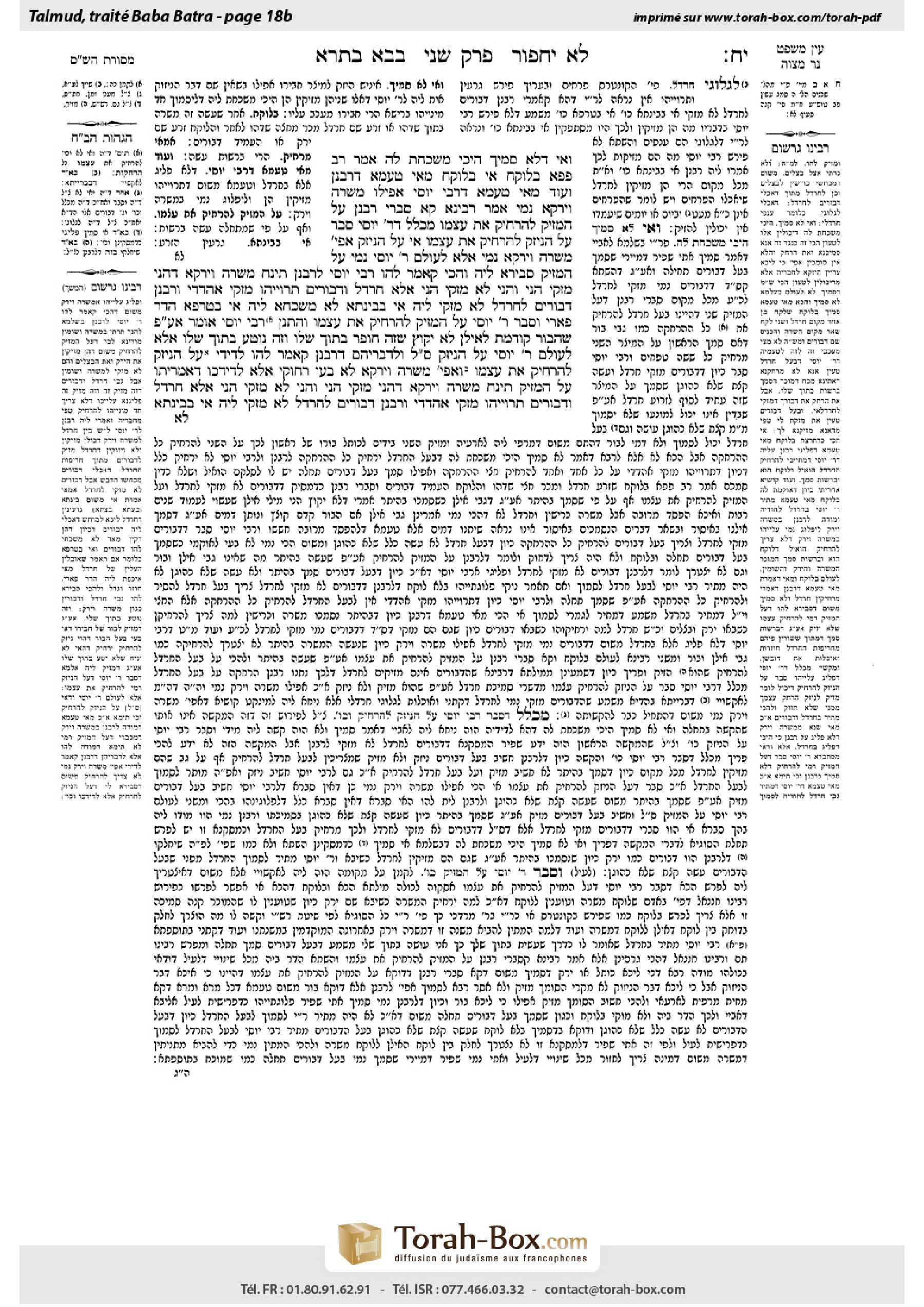
Bava Batra 18b: Talmud study for Daf Yomi
Study the Talmud for Daf Yomi with scanned pages, Hebrew text, English translations from Sefaria and AI-generated French translations.
Passage selection and English or AI-generated French translation are available where the scan has annotations. Daf Study is independent of Torah-Box and Sefaria.
Browse Bava Batra · בבא בתרא · All tractatesBava Batra 18b text and translations
This page of Bava Batra includes the Aramaic text, an English translation and an AI-generated French translation, alongside the scan above.
בבא בתרא י״ח ב · Aramaic and Hebrew text
וְאִי דְּלָא סָמֵיךְ, הֵיכִי מַשְׁכַּחַתְּ לַהּ? אָמַר רַב פָּפָּא: בְּלוֹקֵחַ.
אִי בְּלוֹקֵחַ, מַאי טַעְמָא דְּרַבָּנַן? וְעוֹד, מַאי טַעְמָא דְּרַבִּי יוֹסֵי? אֲפִילּוּ מִשְׁרָה וְיַרְקָא נָמֵי!
אָמַר רָבִינָא: קָא סָבְרִי רַבָּנַן: עַל הַמַּזִּיק לְהַרְחִיק אֶת עַצְמוֹ.
מִכְּלָל דְּרַבִּי יוֹסֵי סָבַר: עַל הַנִּיזָּק לְהַרְחִיק אֶת עַצְמוֹ?! אִי עַל הַנִּיזָּק, אֲפִילּוּ מִשְׁרָה וְיַרְקָא נָמֵי!
אֶלָּא לְעוֹלָם רַבִּי יוֹסֵי נָמֵי עַל הַמַּזִּיק סְבִירָא לֵיהּ, וְהָכִי קָאָמַר לְהוּ רַבִּי יוֹסֵי לְרַבָּנַן: תִּינַח מִשְׁרָה וְיַרְקָא – דְּהָנֵי מַזְּקִי הָנֵי, וְהָנֵי לָא מַזְּקִי הָנֵי, אֶלָּא חַרְדָּל וּדְבוֹרִים – תַּרְוַיְיהוּ מַזְּקִי אַהֲדָדֵי!
וְרַבָּנַן – דְּבוֹרִים לְחַרְדָּל לָא מַזְּקִי לֵיהּ; אִי בְּבִינְתָא – לָא מַשְׁכְּחָא לֵיהּ, אִי בְּטַרְפָּא – הָדַר פָּארֵי.
וְסָבַר רַבִּי יוֹסֵי עַל הַמַּזִּיק לְהַרְחִיק אֶת עַצְמוֹ?! וְהָתְנַן, רַבִּי יוֹסֵי אוֹמֵר: אַף עַל פִּי שֶׁהַבּוֹר קוֹדֶמֶת לְאִילָן – לֹא יָקוֹץ, שֶׁזֶּה חוֹפֵר בְּתוֹךְ שֶׁלּוֹ, וְזֶה נוֹטֵעַ בְּתוֹךְ שֶׁלּוֹ! אֶלָּא לְעוֹלָם רַבִּי יוֹסֵי – עַל הַנִּיזָּק סְבִירָא לֵיהּ, וּלְדִבְרֵיהֶם דְּרַבָּנַן קָאָמַר לְהוּ:
לְדִידִי, עַל הַנִּיזָּק לְהַרְחִיק אֶת עַצְמוֹ, וַאֲפִילּוּ מִשְׁרָה וְיַרְקָא לָא בָּעֵי רַחוֹקֵי; אֶלָּא לְדִידְכוּ, דְּאָמְרִיתוּ עַל הַמַּזִּיק; תִּינַח מִשְׁרָה וְיַרְקָא – דְּהָנֵי מַזְּקִי הָנֵי, וְהָנֵי לָא מַזְּקִי הָנֵי, אֶלָּא חַרְדָּל וּדְבוֹרִים – תַּרְוַיְיהוּ מַזְּקִי אַהֲדָדֵי!
וְרַבָּנַן – דְּבוֹרִים לְחַרְדָּל לָא מַזְּקִי לֵיהּ; אִי בְּבִינְתָא –
Bava Batra 18b · English translation
And if one may not place an item that might cause damage close to his neighbor’s boundary, how can you find a case where each neighbor is damaging the property of the other? Rav Pappa says: This is referring to a buyer who purchased part of his neighbor’s field, and it contains a substance or items that might cause damage, e.g., the water in which flax is steeped or mustard. In the other section of the field the neighbor retained an item or substance that could be damaged. In this manner, it is possible for the item that causes damage to be found near the boundary of the neighbor without one having violated the ruling of the mishna.
The Gemara asks: If this is referring to a buyer, what is the reason of the Rabbis, who say that the neighbor can demand that the buyer distance that which causes damage? After all, he has not acted improperly. And furthermore, what is the reason of Rabbi Yosei for disagreeing only in the case of the mustard and the bees? Even the case of water in which flax is steeped and vegetables is also subject to the same reasoning: Why should he have to distance his water, considering that he did not act improperly?
Ravina said that the explanation is as follows: The Rabbis hold that the responsibility falls on the one who causes damage to distance himself. The one who has the potential to cause damage must act to prevent the damage from occurring. This is the halakha even if his initial placement was done in accordance with halakha, as in the case where one bought part of a field.
The Gemara asks: Does this prove by inference that Rabbi Yosei, who disagrees with the ruling of the Rabbis, holds that the responsibility falls on the one whose property was damaged to distance himself; i.e., to avoid being damaged? But if the responsibility to distance oneself falls on the one whose property was damaged, even in the case of water in which flax is steeped and vegetables the owner should also not have to distance himself. Why does Rabbi Yosei distinguish between that situation and the case of bees and mustard?
Rather, actually Rabbi Yosei also holds that the responsibility to distance oneself falls on the one who causes damage, even if he did not act improperly. And this is what Rabbi Yosei is saying to the Rabbis: Your explanation works out well with regard to water in which flax is steeped and vegetables, where the one who causes damage must distance himself, as these damage those, but those do not damage these, i.e., the water in which flax is steeped damages the vegetables, but the vegetables do not damage the water. But in the case of mustard and bees, they both damage one another. In light of this factor, and since the initial planting of the mustard was permitted, the owner of the bees should distance them from the mustard.
And as for the Rabbis, how do they respond to this claim? They maintain that bees do not damage mustard. Their reasoning is that if it is referring to a seed, the bees will not find it. If it is referring to a leaf, it will grow back, and therefore no damage has been caused.
The Gemara asks: And does Rabbi Yosei hold that the responsibility falls on the one who causes damage to distance himself? But didn’t we learn in a mishna (25b) that Rabbi Yosei says: Even though the cistern preceded the tree, the owner need not cut down the tree, as this one digs a cistern in his property, and that one plants the tree in his property? Rather, actually Rabbi Yosei holds that the responsibility falls on the one whose property was damaged to distance himself. And Rabbi Yosei spoke to the Rabbis in accordance with their statement.
The Gemara elaborates: Rabbi Yosei was saying to the Rabbis: In my opinion, the responsibility falls on the one whose property was damaged to distance himself, and therefore even in the case of water in which flax is steeped and vegetables, the owner of the water need not distance himself. But according to your opinion, that the responsibility falls on the one who causes damage to distance himself, this works out well with regard to water in which flax is steeped and vegetables, as these damage those and those do not damage these. But mustard and bees both damage one another, and if the mustard owner acted properly, the owner of the bees should be required to move his bees.
The Gemara continues: And how do the Rabbis respond to this claim? They hold that bees do not damage mustard: If this is referring to a seed,
Bava Batra 18b · Traduction française (IA)
Et si l'on ne peut pas placer un objet qui pourrait causer un préjudice près de la limite de son voisin, comment peut-on trouver un cas où chaque voisin endommage la propriété de l'autre ? Rav Pappa dit : Il s'agit d'un acheteur qui a acheté une partie du champ de son voisin, et qui contient une substance ou des objets qui pourraient causer un préjudice, par exemple, l'eau dans laquelle on immerge le lin ou la moutarde. Dans l'autre partie du champ, le voisin a conservé un objet ou une substance qui pourrait être endommagé. Ainsi, il est possible de trouver l'objet qui cause un préjudice près de la limite du voisin sans que l'un ne viole la décision de la mitsna.
La Guemara pose la question : Si cela concerne un acheteur, quelle est la raison des Rabbins, qui disent que le voisin peut exiger que l'acheteur éloigne ce qui cause un préjudice ? Après tout, il n'a pas agi de manière incorrecte. Et de plus, quelle est la raison de Rabbi Yosei pour ne pas s'accorder avec les Rabbins dans le cas de la moutarde et des abeilles ? Même le cas de l'eau dans laquelle on immerge le lin et les légumes est soumis à la même logique : pourquoi devrait-il éloigner son eau, en considérant qu'il n'a pas agi de manière incorrecte ?
Ravina dit que l'explication est la suivante : Les Rabbins considèrent que la responsabilité incombe à celui qui cause un préjudice pour s'éloigner. Celui qui a le potentiel de causer un préjudice doit agir pour empêcher ce préjudice. C'est la halakha même si son placement initial a été effectué conformément à la halakha, comme dans le cas où l'on achète une partie d'un champ.
La Guemara pose la question : Ce fait prouve-t-il par déduction que Rabbi Yosei, qui s'oppose à la décision des Rabbins, considère que la responsabilité incombe à celui dont la propriété a été endommagée pour s'éloigner, c'est-à-dire pour éviter d'être endommagé ? Mais si la responsabilité de s'éloigner incombe à celui dont la propriété a été endommagée, même dans le cas de l'eau dans laquelle on immerge le lin et les légumes, l'propriétaire ne devrait pas non plus avoir à s'éloigner. Pourquoi Rabbi Yosei distingue-t-il ce cas de celui des abeilles et de la moutarde ?
En réalité, Rabbi Yosei considère également que la responsabilité de s'éloigner incombe à celui qui cause un préjudice, même s'il n'a pas agi de manière incorrecte. Et c'est ce que Rabbi Yosei dit aux Rabbins : Votre explication s'applique bien au cas de l'eau dans laquelle on immerge le lin et les légumes, où celui qui cause le préjudice doit s'éloigner, car ces derniers endommagent les premiers, mais les premiers ne détruisent pas les seconds, c'est-à-dire que l'eau dans laquelle on immerge le lin endommage les légumes, mais les légumes ne détruisent pas l'eau. Mais dans le cas de la moutarde et des abeilles, ils s'endommagent mutuellement. En raison de ce facteur, et puisque la plantation de la moutarde était permise, l'propriétaire des abeilles devrait s'éloigner de la moutarde.
Et concernant les Rabbins, comment répondent-ils à cette affirmation ? Ils maintiennent que les abeilles n'endommagent pas la moutarde. Leur raisonnement est le suivant : si cela concerne une graine, les abeilles ne la trouveront pas. Si cela concerne une feuille, elle repoussera, et donc aucun préjudice n'a été causé.
La Guemara pose la question : Et Rabbi Yosei considère-t-il que la responsabilité incombe à celui qui cause le préjudice pour s'éloigner ? Mais n'avons-nous pas appris dans une mitsna (25b) que Rabbi Yosei dit : Même si le cisternes a précédé l'arbre, l'propriétaire n'a pas besoin de couper l'arbre, car celui-ci creuse un cisternes dans sa propriété, et celui-là plante un arbre dans la sienne ? En réalité, Rabbi Yosei considère que la responsabilité incombe à celui dont la propriété a été endommagée pour s'éloigner. Et Rabbi Yosei s'exprime conformément à leur déclaration.
La Guemara développe : Rabbi Yosei disait aux Rabbins : Selon mon avis, la responsabilité incombe à celui dont la propriété a été endommagée pour s'éloigner, et donc même dans le cas de l'eau dans laquelle on immerge le lin et les légumes, l'propriétaire de l'eau n'a pas besoin de s'éloigner. Mais selon votre avis, que la responsabilité incombe à celui qui cause le préjudice pour s'éloigner, cela s'applique bien au cas de l'eau dans laquelle on immerge le lin et les légumes, car ces derniers endommagent les premiers et les premiers ne détruisent pas les seconds. Mais la moutarde et les abeilles s'endommagent mutuellement, et si l'propriétaire de la moutarde a agi correctement, l'propriétaire des abeilles devrait être tenu de déplacer ses abeilles.
La Guemara continue : Et comment les Rabbins répondent-ils à cette affirmation ? Ils considèrent que les abeilles n'endommagent pas la moutarde : Si cela concerne une graine,
Traduction française générée par IA à partir de l’édition anglaise de Sefaria. Vérifie toujours un passage avec le texte source.
Text from Sefaria: William Davidson Edition - Vocalized Aramaic (CC BY NC); William Davidson Edition - English (CC BY NC).