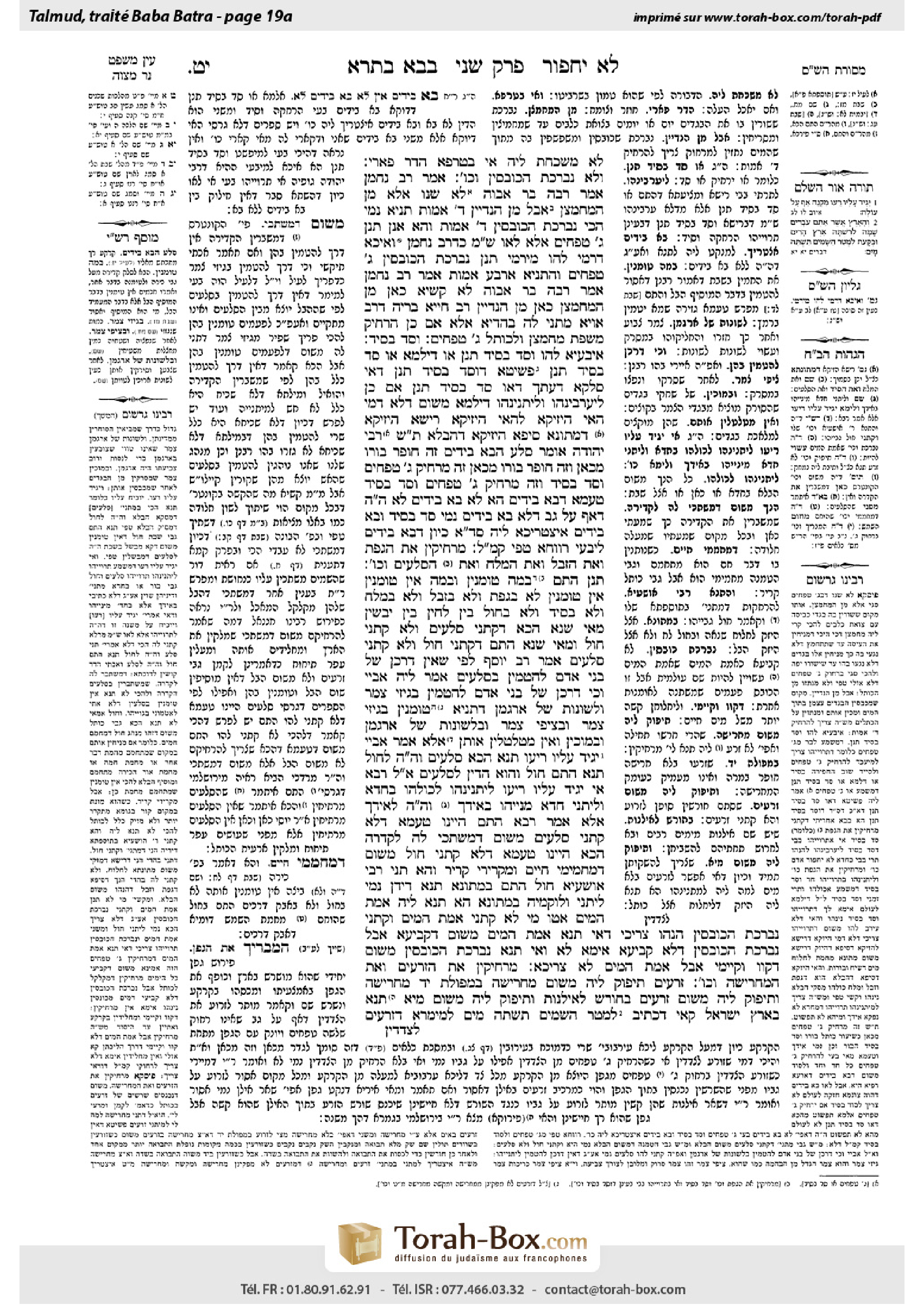
Bava Batra 19a: Talmud study for Daf Yomi
Study the Talmud for Daf Yomi with scanned pages, Hebrew text, English translations from Sefaria and AI-generated French translations.
Passage selection and English or AI-generated French translation are available where the scan has annotations. Daf Study is independent of Torah-Box and Sefaria.
Browse Bava Batra · בבא בתרא · All tractatesBava Batra 19a text and translations
This page of Bava Batra includes the Aramaic text, an English translation and an AI-generated French translation, alongside the scan above.
בבא בתרא י״ט א · Aramaic and Hebrew text
לָא מַשְׁכַּחַתְּ לֵיהּ, אִי בְּטַרְפָּא – הָדַר פָּארֵי.
וְלֹא נִבְרֶכֶת הַכּוֹבְסִין וְכוּ׳. אָמַר רַב נַחְמָן אָמַר רַבָּה בַּר אֲבוּהּ: לֹא שָׁנוּ אֶלָּא מִן הַמַּחְמְצָן, אֲבָל מִן הַנַּדְיָין – אַרְבַּע אַמּוֹת. תַּנְיָא נָמֵי הָכִי: נִבְרֶכֶת הַכּוֹבְסִין – אַרְבַּע אַמּוֹת. וְהָא אֲנַן תְּנַן שְׁלֹשָׁה טְפָחִים! אֶלָּא לָאו – שְׁמַע מִינַּהּ כִּדְרַב נַחְמָן.
וְאִיכָּא דְּרָמֵי לְהוּ מִירְמֵי, תְּנַן: נִבְרֶכֶת הַכּוֹבְסִין שְׁלֹשָׁה טְפָחִים. וְהָתַנְיָא אַרְבַּע אַמּוֹת! אָמַר רַב נַחְמָן אָמַר רַבָּה בַּר אֲבוּהּ, לָא קַשְׁיָא: כָּאן מִן הַמַּחְמְצָן, כָּאן מִן הַנַּדְיָין. רַב חִיָּיא בְּרֵיהּ דְּרַב אַוְיָא מַתְנֵי לַהּ בְּהֶדְיָא: אֶלָּא אִם כֵּן הִרְחִיק מִשְּׂפַת מַחְמְצָן וְלַכּוֹתֶל שְׁלֹשָׁה טְפָחִים.
וְסָד בְּסִיד. אִיבַּעְיָא לְהוּ: ״וְסָד בְּסִיד״ תְּנַן, אוֹ דִילְמָא ״אוֹ סָד בְּסִיד״ תְּנַן?
פְּשִׁיטָא דִּ״וְסָד בְּסִיד״ תְּנַן, דְּאִי סָלְקָא דַעְתָּךְ דְּ״אוֹ סָד בְּסִיד״ תְּנַן, אִם כֵּן לִיעָרְבִינְהוּ וְלִיתְנִינְהוּ!
דִּילְמָא מִשּׁוּם דְּלָא דָּמֵי הַאי הֶיזֵּיקָא לְהַאי הֶיזֵּיקָא – רֵישָׁא הֶיזֵּיקָא דִמְתוּנָא, סֵיפָא הֶיזֵּיקָא דְהַבְלָא.
תָּא שְׁמַע, רַבִּי יְהוּדָה אוֹמֵר: סֶלַע הַבָּא בְּיָדַיִם – זֶה חוֹפֵר בּוֹרוֹ מִכָּאן, וְזֶה חוֹפֵר בּוֹרוֹ מִכָּאן; זֶה מַרְחִיק שְׁלֹשָׁה טְפָחִים וְסָד בְּסִיד, וָזֶה מַרְחִיק שְׁלֹשָׁה טְפָחִים וְסָד בְּסִיד. טַעְמָא דְּבָא בְּיָדַיִם, הָא לֹא בָּא בְּיָדַיִם – לֹא!
הוּא הַדִּין דְּאַף עַל גַּב דְּלֹא בָּא בְּיָדַיִם נָמֵי סָד בְּסִיד, וּבָא בְּיָדַיִם אִיצְטְרִיכָא לֵיהּ – סָלְקָא דַּעְתָּךְ אָמֵינָא: כֵּיוָן דְּבָא בְּיָדַיִם, לִיבְעֵי רַוְוחָא טְפֵי; קָא מַשְׁמַע לַן:.
מַרְחִיקִין אֶת הַגֶּפֶת וְאֶת הַזֶּבֶל וְאֶת הַמֶּלַח וְאֶת הַסְּלָעִים וְכוּ׳. תְּנַן הָתָם: בַּמֶּה טוֹמְנִין וּבַמָּה אֵין טוֹמְנִין?
אֵין טוֹמְנִין לֹא בַּגֶּפֶת, וְלֹא בַּזֶּבֶל, וְלֹא בַּמֶּלַח, וְלֹא בַּסִּיד, וְלֹא בַּחוֹל – בֵּין לַחִין בֵּין יְבֵשִׁין. מַאי שְׁנָא הָכָא דְּקָתָנֵי סְלָעִים וְלָא קָתָנֵי חוֹל, וּמַאי שְׁנָא הָתָם דְּקָתָנֵי חוֹל וְלָא קָתָנֵי סְלָעִים?
אָמַר רַב יוֹסֵף: לְפִי שֶׁאֵין דַּרְכָּן שֶׁל בְּנֵי אָדָם לְהַטְמִין בִּסְלָעִים. אֲמַר לֵיהּ אַבָּיֵי: וְכִי דַּרְכָּן שֶׁל בְּנֵי אָדָם לְהַטְמִין בְּגִיזֵּי צֶמֶר וּלְשׁוֹנוֹת שֶׁל אַרְגָּמָן?! דְּתַנְיָא: טוֹמְנִין בְּגִיזֵּי צֶמֶר, וּבְצִיפֵּי צֶמֶר, וּבִלְשׁוֹנוֹת שֶׁל אַרְגָּמָן, וּבְמוֹכִין, וְאֵין מְטַלְטְלִין אוֹתָן!
אֶלָּא אָמַר אַבָּיֵי: ״יַגִּיד עָלָיו רֵעוֹ״; תְּנָא הָכָא סְלָעִים – וְהוּא הַדִּין לְחוֹל, תְּנָא הָתָם חוֹל – וְהוּא הַדִּין לִסְלָעִים. אֲמַר לֵיהּ רָבָא: אִי ״יַגִּיד עָלָיו רֵעוֹ״, לִיתְנִינְהוּ לְכוּלְּהוּ בַּחֲדָא, וְלִיתְנֵי חֲדָא מִנַּיְיהוּ בְּאִידַּךְ – וְהוּא הַדִּין לְאִידַּךְ!
אֶלָּא אָמַר רָבָא: הָתָם הַיְינוּ טַעְמָא דְּלָא קָתָנֵי סְלָעִים – מִשּׁוּם דִּמְשַׁתְּכִי לַהּ לִקְדֵרָה; הָכָא הַיְינוּ טַעְמָא דְּלָא קָתָנֵי חוֹל – מִשּׁוּם דְּמֵחַמִּימֵי חָיֵים וּמִקָּרִירֵי קָרֵיר.
וְהָא תָּנֵי רַבִּי אוֹשַׁעְיָא: חוֹל! הָתָם בִּמְתוּנָא. תַּנָּא דִּידַן נָמֵי לִיתְנֵי, וְלוֹקְמֵיהּ בִּמְתוּנָא! הָא תְּנָא לֵיהּ אַמַּת הַמַּיִם.
אַטּוּ מִי לָא קָתָנֵי אַמַּת הַמַּיִם – וְקָתָנֵי נִבְרֶכֶת הַכּוֹבְסִין?
הָנְהוּ צְרִיכִי; דְּאִי תְּנָא אַמַּת הַמַּיִם – מִשּׁוּם דִּקְבִיעָא, אֲבָל נִבְרֶכֶת הַכּוֹבְסִין, דְּלָא קְבִיעָא – אֵימָא לָא. וְאִי תְּנָא נִבְרֶכֶת הַכּוֹבְסִין – מִשּׁוּם דִּקְווּ וְקָיְימִי, אֲבָל אַמַּת הַמַּיִם – לָא; צְרִיכָא.
מַרְחִיקִין אֶת הַזְּרָעִים וְאֶת הַמַּחֲרֵישָׁה וְכוּ׳. זְרָעִים – תִּיפּוֹק לֵיהּ מִשּׁוּם מַחֲרֵישָׁה! בְּמַפּוֹלֶת יָד.
מַחֲרֵישָׁה – וְתִיפּוֹק לֵיהּ מִשּׁוּם זְרָעִים! בְּחוֹרֵשׁ לְאִילָנוֹת. וְתִיפּוֹק לֵיהּ מִשּׁוּם מַיָּא! תַּנָּא בְּאֶרֶץ יִשְׂרָאֵל קָאֵי, דִּכְתִיב: ״לִמְטַר הַשָּׁמַיִם תִּשְׁתֶּה מָּיִם״.
לְמֵימְרָא דִּזְרָעִים
Bava Batra 19a · English translation
the bees will not find it; if it is referring to a leaf, it will grow back.
§ The mishna teaches: Nor may one set up a launderer’s pond near his neighbor’s wall unless he distances it three handbreadths from the wall. Rav Naḥman says that Rabba bar Avuh says: They taught this only with regard to a soaking pond, in which soiled clothes are left to soak for several days. But in the case of a washing pond [hanadyan], where clothes are actively cleaned, four cubits are required. That opinion is also taught in a baraita: A launderer’s pond must be kept four cubits from one’s neighbor’s wall. But didn’t we learn in the mishna that one must keep a distance of only three handbreadths? Rather, must one not conclude from the baraita that the statement of Rav Naḥman is correct?
And some raise this as a contradiction, and present the mishna and baraita as apparently conflicting sources. We learned in the mishna that a launderer’s pond must be kept three handbreadths from his neighbor’s property. But isn’t it taught in a baraita that four cubits are required? Rav Naḥman says that Rabba bar Avuh says: This is not difficult. Here, the mishna is referring to a soaking pond, which requires three handbreadths; there, the baraita is referring to a washing pond, in which case four cubits are necessary. Rav Ḥiyya, son of Rav Avya, teaches the mishna explicitly as reading: Unless he distanced three handbreadths from the rim of the soaking pond and the wall.
§ The mishna teaches that one who digs a pit must distance it three handbreadths from another’s property and plaster it with lime. A dilemma was raised before the Sages: What is the precise wording of the mishna? Did we learn: And plasters with lime, meaning that the walls must be plastered with lime in addition to distancing the pit three handbreadths, or perhaps we learned: Or plasters with lime, i.e., one may plaster the walls with lime instead of digging the pit at a distance of three handbreadths.
The Gemara answers: It is obvious that we learned: And plasters with lime, as, if it enters your mind that we learned: Or plasters with lime, which is the same as what is stated in the clause of the mishna discussing olive refuse, if so, let the tanna combine them and teach them together. If the same halakha applied in all circumstances, all of the mishna’s cases could be taught together.
The Gemara answers: This is not proof, as perhaps these cases are taught separately because this type of damage is not similar to that type of damage. The first clause of the mishna addresses the issue of damage due to moisture, whereas the last clause addresses the issue of damage due to heat.
The Gemara suggests: Come and hear a proof from a baraita. Rabbi Yehuda says: With regard to rock that is so soft it crumbles in one’s hands, this one digs his pit from here, on his property, and that one digs his pit from there. This one distances his pit three handbreadths and plasters with lime, and that one distances his pit three handbreadths and plasters with lime. The Gemara analyzes this ruling: The specific reason one must also plaster with lime is that he is using rock that crumbles in one’s hands, from which it may be inferred that if it is rock that does not crumble in one’s hands, one would not be required to plaster with lime as well.
The Gemara answers: One could say that the same is true, i.e., that even though he is using rock that does not crumble in one’s hands, he must also plaster with lime. And it was necessary for the tanna to mention the case of rock that crumbles in one’s hands, as it might enter your mind to say that since it crumbles in one’s hands, let us require a greater distance. Therefore, the tanna teaches us that this is not the case.
§ The mishna teaches that one must distance the solid residue of produce that has been pressed free of its oil, and animal manure, and salt, and lime, and rocks three handbreadths from the wall of another, or plaster its receptacle with lime. The Gemara comments: We learned in a mishna there (Shabbat 47b): With what substances may one insulate a pot of cooked food on Shabbat eve, and with what substances may one not insulate it?
One may insulate the pot neither with the solid residue of produce that has been pressed free of its oil, nor with manure, nor with salt, nor with lime, nor with sand, whether those materials are moist or whether they are dry. All of these materials spontaneously generate heat when piled up for an extended period of time. Therefore, they add heat to the pot they insulate. The Gemara asks: What is different here that the mishna teaches the halakha in the case of rocks and it does not teach the halakha in the case of sand, and what is different there that it teaches the halakha in the case of sand and it does not teach the halakha in the case of rocks?
Rav Yosef says: There is a practical reason for this difference. Rocks are not mentioned there because it is not customary for people to insulate food with rocks. Abaye said to him: And is it customary for people to insulate food with wool fleece and tabs of purple wool? As it is taught in a baraita: One may insulate food with wool fleece; with combed wool clumps, which are unwoven; with tabs of purple wool; and with swatches of soft material; but one may not move them on Shabbat because they are set-aside [muktze].
Rather, Abaye said that the tanna follows the biblical aphorism in the verse that states: “Its neighbor tells about him” (Job 36:33), i.e., one example is mentioned and the same applies to the other case. He taught the halakha in the case of rocks here and the same is true of sand; he taught the halakha in the case of sand there and the same is true of rocks. Rava said to Abaye: If this is correct, that “its neighbor tells about him,” let him teach the halakha of all of these examples in one case, and let him teach the halakha of just one in the other case, and it can be said that the same is true with regard to the others.
Rather, Rava said: There, this is the reason that the tanna does not teach the halakha in the case of rocks: Because they break, i.e., scratch, the pot, and consequently people do not use them for insulating food at all. Here, this is the reason that the tanna does not teach the halakha in the case of sand: Because it heats hot items and cools cold items, and therefore it does not cause any damage to the wall.
The Gemara asks: But Rabbi Oshaya taught in a baraita that one must distance sand from his neighbor’s wall. The Gemara answers: There, it is referring to damp sand, which must be kept at a distance due to its moisture. The Gemara challenges: Let the tanna of our mishna also teach the halakha in the case of sand and we will interpret it as referring to damp sand. The Gemara answers: This tanna already taught the case of a water channel, which is a source of dampness, and therefore there was no need to mention damp sand as well.
The Gemara rejects this answer: That is incorrect, as is that to say that the mishna includes only one example of a source of dampness? Doesn’t the mishna teach the case of a water channel? And yet it also teaches the example of a launderer’s pond. This demonstrates that the mishna teaches many cases, despite the similarity between them, and therefore it should have mentioned the halakha in the case of sand as well.
The Gemara answers: Both of those particular examples are necessary, as, had the tanna taught only the case of a water channel, one would have claimed that a distance must be kept because it is fixed, i.e., water constantly passes through it. But with regard to a launderer’s pond, which is not fixed, as it sometimes holds water and sometimes does not, one might say that one need not distance it from his neighbor’s property. And conversely, had the tanna taught only the case of a launderer’s pond, one might have said that this must be distanced because its water is fixed and standing in one location and therefore leaks out. But with regard to a water channel, one might say distancing it is not required. Consequently, it is necessary to state both examples. By contrast, including the halakha in the case of sand would not add any novel understanding.
§ The mishna teaches: One must distance seeds, i.e., one may not plant seeds, and one may not operate the plow, and one must eliminate urine, three handbreadths from the wall of another. The Gemara asks: Why is it necessary to mention seeds? Let him derive this requirement to distance the seeds due to the requirement to distance a plow, as in any event the ground must be plowed before it can be sown? The Gemara answers: This is referring to planting with a single hand motion, which is performed without plowing.
The Gemara further challenges: The mishna teaches that one must distance a plow; but let him derive this requirement to distance a plow due to the requirement to distance the seeds, as plowing is preparation for planting. The Gemara answers: This is referring to one who plows to prepare the ground for trees. The Gemara challenges: But if so, let him derive this requirement to distance a plow due to the requirement to distance the water. If there are trees, there must be a water channel to irrigate them, and arranging one’s field in such a manner should be prohibited for that reason. The Gemara answers: The tanna is referring to Eretz Yisrael, concerning which it is written: “And drinks water as the rain of heaven comes down” (Deuteronomy 11:11). In Eretz Yisrael, water channels were not needed.
The Gemara asks: Is this to say that seeds
Bava Batra 19a · Traduction française (IA)
les abeilles ne trouveront pas ; si cela concerne une feuille, elle repoussera.
§ La Michna enseigne : On ne peut pas non plus établir un bassin de lavage près du mur de son voisin à moins qu'il ne le distante de trois tefachim du mur. Rav Naḥman dit que Rabba bar Avuh dit : Ils ont enseigné cela uniquement concernant un bassin de trempage, dans lequel les vêtements souillés sont laissés tremper plusieurs jours. Mais dans le cas d'un bassin de lavage [hanadyan], où les vêtements sont activement nettoyés, quatre cubits sont requis. Cette opinion est également enseignée dans une baraïta : Un bassin de lavage doit être tenu à quatre cubits de la muraille de son voisin. Mais n'avons-nous pas appris dans la Michna que l'on doit maintenir une distance de seulement trois tefachim ? Plutôt, ne devons-nous pas conclure à partir de la baraïta que l'opinion de Rav Naḥman est correcte ?
Et certains soulevent cela comme une contradiction, et présentent la Michna et la baraïta comme des sources apparemment contradictoires. Nous avons appris dans la Michna que le bassin de lavage doit être tenu à trois tefachim de la propriété de son voisin. Mais n'est-il pas enseigné dans une baraïta que quatre cubits sont requis ? Rav Naḥman dit que Rabba bar Avuh dit : Ce n'est pas difficile. Ici, la Michna fait référence à un bassin de trempage, qui exige trois tefachim ; là, la baraïta fait référence à un bassin de lavage, dans lequel cas quatre cubits sont nécessaires. Rav Ḥiyya, fils de Rav Avya, enseigne la Michna explicitement en disant : À moins qu'il ne distante trois tefachim du bord du bassin de trempage et du mur.
§ La Michna enseigne que celui qui creuse un puits doit le distancer de trois tefachim de la propriété d'autrui et le recouvrir de chaux. Un dilemme a été soulevé devant les Sages : Quelle est la formulation exacte de la Michna ? A-t-on appris : Et recouvre avec de la chaux, c'est-à-dire que les murs doivent être recouverts de chaux en plus de distancer le puits de trois tefachim, ou peut-être a-t-on appris : Ou recouvre avec de la chaux, c'est-à-dire qu'on peut recouvrir les murs de chaux à la place de creuser le puits à une distance de trois tefachim.
La Guemara répond : Il est évident que nous avons appris : Et recouvre avec de la chaux, car, si cela entre dans votre esprit que nous avons appris : Ou recouvre avec de la chaux, ce qui est le même que ce qui est dit dans la clause de la Michna concernant les détritus d'olive, si tel est le cas, laissez le tanna les combiner et les enseigner ensemble. Si la même halakha s'appliquait dans tous les cas, toutes les situations de la Michna pouvaient être enseignées ensemble.
La Guemara répond : Ce n'est pas une preuve, car peut-être ces cas sont enseignés séparément car ce type de dommage n'est pas semblable à ce type de dommage. La première clause de la Michna traite du dommage causé par l'humidité, tandis que la dernière clause traite du dommage causé par la chaleur.
La Guemara suggère : Viens écouter une preuve à partir d'une baraïta. Rabbi Yehuda dit : Concernant un rocher si mou qu'il se désintègre entre les mains, celui-ci creuse son puits d'ici, sur sa propriété, et celui-là creuse son puits là. Celui-ci distante son puits de trois tefachim et recouvre avec de la chaux, et celui-là distante son puits de trois tefachim et recouvre avec de la chaux. La Guemara analyse cette décision : La raison spécifique pour laquelle on doit également recouvrir avec de la chaux est qu'on utilise un rocher qui se désintègre entre les mains, d'où il peut être inféré que si c'est un rocher qui ne se désintègre pas entre les mains, on ne serait pas tenu de recouvrir avec de la chaux également.
La Guemara répond : On pourrait dire que c'est pareil, c'est-à-dire que même s'il utilise un rocher qui ne se désintègre pas entre les mains, il doit également recouvrir avec de la chaux. Et il était nécessaire que le tanna mentionne le cas du rocher qui se désintègre entre les mains, car cela pourrait entrer dans votre esprit de dire que puisqu'il se désintègre entre les mains, laissons-nous exiger une distance plus grande. Par conséquent, le tanna nous enseigne que cela n'est pas le cas.
§ La Michna enseigne que l'on doit distancer les résidus solides des produits dont l'huile a été pressée, et les déjections animales, et le sel, et la chaux, et les rochers de trois tefachim du mur d'autrui, ou recouvrir leur récipient de chaux. La Guemara commente : Nous avons appris dans une Michna là (Shabbat 47b) : Avec quels matériaux peut-on isoler un récipient de nourriture cuite le soir du sabbat, et avec quels matériaux ne peut-on pas l'isoler ?
On ne peut pas isoler le récipient ni avec les résidus solides des produits dont l'huile a été pressée, ni avec les déjections animales, ni avec le sel, ni avec la chaux, ni avec le sable, que ce soit si ces matériaux sont humides ou secs. Tous ces matériaux génèrent spontanément de la chaleur lorsqu'ils sont empilés pendant une longue période. Par conséquent, ils ajoutent de la chaleur au récipient qu'ils isolent. La Guemara pose la question : Qu'est-ce qui diffère ici que la Michna enseigne la halakha dans le cas des rochers et ne l'enseigne pas dans le cas du sable, et qu'est-ce qui diffère là que la Michna enseigne la halakha dans le cas du sable et ne l'enseigne pas dans le cas des rochers ?
Rav Yosef dit : Il y a une raison pratique pour cette différence. Les rochers ne sont pas mentionnés là car il n'est pas coutumier de faire isoler la nourriture avec des rochers. Abaye dit à lui : Et est-ce coutumier de faire isoler la nourriture avec des touffes de laine et des morceaux de laine violette ? Comme il est enseigné dans une baraïta : On peut isoler la nourriture avec des touffes de laine ; avec des boulettes de laine tondue, qui ne sont pas tissées ; avec des morceaux de laine violette ; et avec des morceaux de tissu doux ; mais on ne peut pas les déplacer le sabbat car ils sont mis de côté [muktze].
Plutôt, Abaye dit que le tanna suit l'aphorisme biblique dans le verset qui dit : « Son voisin parle à son sujet » (Job 36:33), c'est-à-dire qu'un exemple est mentionné et la même chose s'applique à l'autre cas. Il a enseigné la halakha dans le cas des rochers ici et la même chose s'applique au sable ; il a enseigné la halakha dans le cas du sable là et la même chose s'applique aux rochers. Rava a dit à Abaye : Si cela est correct, que « son voisin parle à son sujet », laissez-le enseigner la halakha de tous ces exemples dans un seul cas, et laissez-le enseigner la halakha de seulement un dans l'autre cas, et on peut dire que la même chose s'applique aux autres.
En réalité, Rava a dit : Là, c'est la raison pour laquelle le tanna ne transmet pas la halakha dans le cas des roches : parce qu'elles rayent la marmite, et par conséquent, les gens n'utilisent pas du tout ces roches pour isoler les aliments. Ici, c'est la raison pour laquelle le tanna ne transmet pas la halakha dans le cas du sable : parce qu'il réchauffe les objets chauds et refroidit les objets froids, et par conséquent, il ne cause aucun dommage au mur.
Le Guemara pose la question : Mais Rabbi Oshaya a enseigné dans une baraïta qu'il faut éloigner le sable de la muraille de son voisin. Le Guemara répond : Là, il s'agit du sable humide, qui doit être maintenu à distance en raison de sa moiteur. Le Guemara conteste : Faisons en sorte que le tanna de notre mishna enseigne également la halakha dans le cas du sable, et nous interpréterons cela comme faisant référence au sable humide. Le Guemara répond : Ce tanna a déjà enseigné le cas d'un canal d'eau, qui est une source de moiteur, et par conséquent, il n'était pas nécessaire de mentionner le sable humide.
Le Guemara rejette cette réponse : Cela est incorrect, comme dire que la mishna inclut seulement un exemple d'une source de moiteur ? N'enseigne-t-elle pas le cas d'un canal d'eau ? Et pourtant, elle enseigne également l'exemple d'un bassin de lavage. Cela démontre que la mishna enseigne plusieurs cas, malgré la similitude entre eux, et par conséquent, elle aurait dû mentionner la halakha dans le cas du sable.
Le Guemara répond : Ces deux exemples particuliers sont nécessaires, car, si le tanna avait enseigné seulement le cas d'un canal d'eau, on aurait pu affirmer qu'il faut maintenir une distance en raison de sa permanence, c'est-à-dire que l'eau y circule constamment. Mais concernant un bassin de lavage, qui n'est pas fixe, car il contient parfois de l'eau et parfois pas, on pourrait dire qu'il n'est pas nécessaire de l'éloigner de la propriété de son voisin. Et inversement, si le tanna avait enseigné seulement le cas du bassin de lavage, on aurait pu dire que cela doit être éloigné en raison de l'eau fixe et stationnaire qui s'écoule. Mais concernant un canal d'eau, on pourrait dire que l'éloignement n'est pas requis. Par conséquent, il est nécessaire d'énoncer les deux exemples. À l'inverse, l'inclusion de la halakha dans le cas du sable ne serait pas utile.
§ La mishna enseigne : Il faut éloigner les semences, c'est-à-dire qu'on ne doit pas planter de semences, et qu'on ne doit pas utiliser la charrue, et qu'on doit éliminer l'urine, à trois paumes de la muraille d'autrui. Le Guemara pose la question : Pourquoi est-il nécessaire de mentionner les semences ? Faisons en sorte que cette exigence d'éloigner les semences soit dérivée de l'exigence d'éloigner la charrue, car, en tout cas, le sol doit être labouré avant d'être semé. Le Guemara répond : Il s'agit de la plantation avec une seule main, qui est effectuée sans labourage.
Le Guemara conteste davantage : La mishna enseigne qu'il faut éloigner la charrue ; mais on devrait déduire cette exigence d'éloigner la charrue de l'exigence d'éloigner les semences, car le labourage est la préparation à la plantation. Le Guemara répond : Il s'agit de celui qui laboure pour préparer le sol aux arbres. Le Guemara conteste : Mais si c'est ainsi, on devrait déduire cette exigence d'éloigner la charrue de l'exigence d'éloigner l'eau. Si des arbres existent, il faut un canal d'eau pour les arroser, et l'organisation du champ devrait être interdite pour cette raison. Le Guemara répond : Le tanna fait référence à Eretz Yisrael, concernant lequel il est écrit : « Et il boit de l'eau comme la pluie du ciel descend » (Deutéronome 11:11). En Eretz Yisrael, les canaux d'eau n'étaient pas nécessaires.
Le Guemara pose la question : Est-ce que cela signifie que les semences
Traduction française générée par IA à partir de l’édition anglaise de Sefaria. Vérifie toujours un passage avec le texte source.
Text from Sefaria: William Davidson Edition - Vocalized Aramaic (CC BY NC); William Davidson Edition - English (CC BY NC).