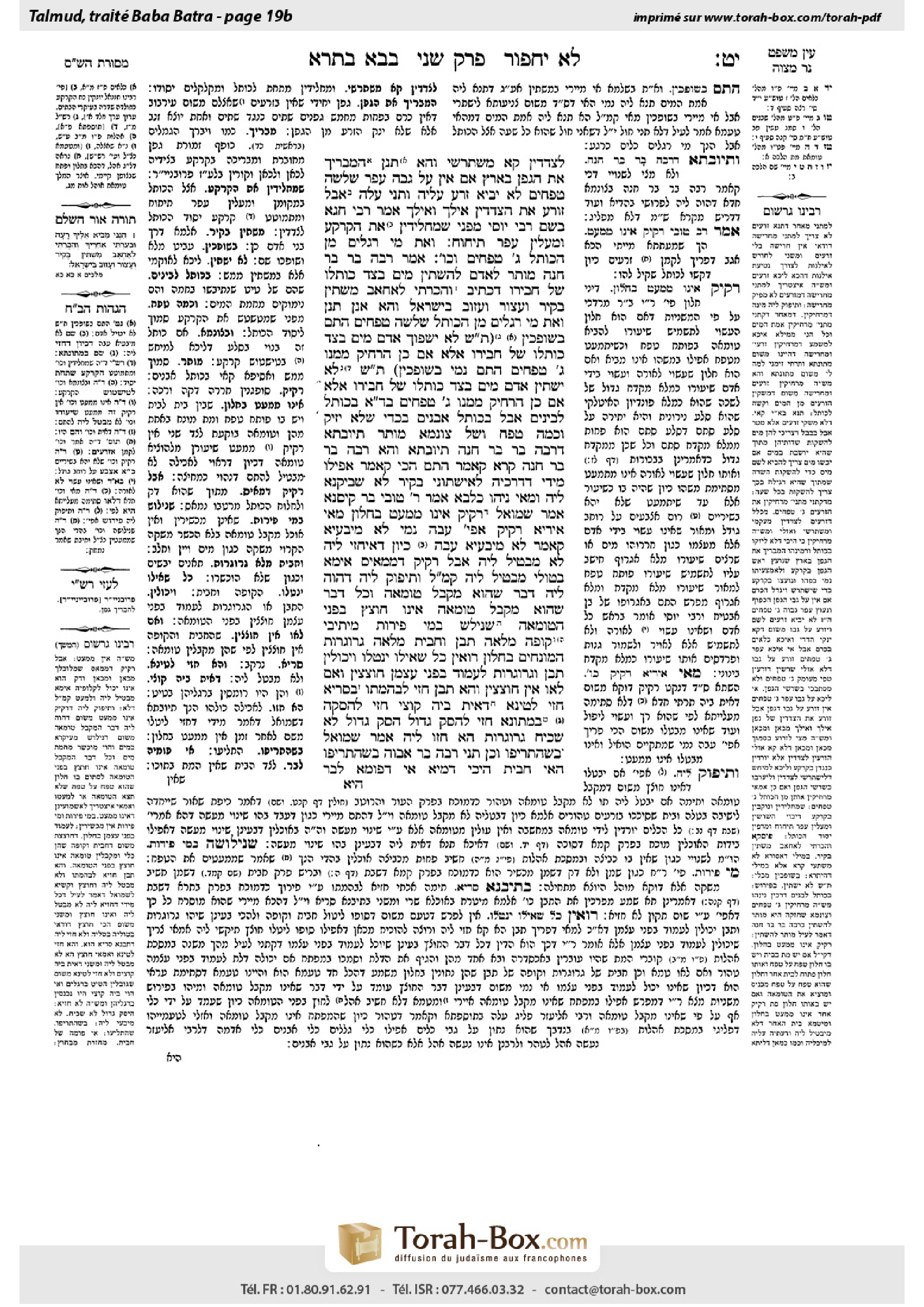
Bava Batra 19b: Talmud study for Daf Yomi
Study the Talmud for Daf Yomi with scanned pages, Hebrew text, English translations from Sefaria and AI-generated French translations.
Passage selection and English or AI-generated French translation are available where the scan has annotations. Daf Study is independent of Torah-Box and Sefaria.
Browse Bava Batra · בבא בתרא · All tractatesBava Batra 19b text and translations
This page of Bava Batra includes the Aramaic text, an English translation and an AI-generated French translation, alongside the scan above.
בבא בתרא י״ט ב · Aramaic and Hebrew text
לִצְדָדִין קָא מִשְׁתָּרְשִׁי?! וְהָא תְּנַן: הַמַּבְרִיךְ אֶת הַגֶּפֶן בָּאָרֶץ, אִם אֵין עַל גַּבָּהּ עָפָר שְׁלֹשָׁה טְפָחִים – לֹא יָבִיא זֶרַע עָלֶיהָ;
וְתָנֵי עֲלַהּ: אֲבָל זוֹרֵעַ אֶת הַצְּדָדִין אֵילָךְ וְאֵילָךְ. אָמַר רַבִּי חַגָּא בְּשֵׁם רַבִּי יוֹסֵי: מִפְּנֵי שֶׁמַּחֲלִידִין אֶת הַקַּרְקַע וּמַעֲלִין עָפָר תִּיחוּחַ.
וְאֶת מֵי רַגְלַיִם מִן הַכּוֹתֶל – שְׁלֹשָׁה טְפָחִים וְכוּ׳. אָמַר רַבָּה בַּר בַּר חָנָה: מוּתָּר לָאָדָם לְהַשְׁתִּין מַיִם בְּצַד כּוֹתְלוֹ שֶׁל חֲבֵירוֹ, דִּכְתִיב: ״וְהִכְרַתִּי לְאַחְאָב מַשְׁתִּין בְּקִיר, וְעָצוּר וְעָזוּב בְּיִשְׂרָאֵל״. וְהָא אֲנַן תְּנַן: וְאֶת מֵי רַגְלַיִם מִן הַכּוֹתֶל – שְׁלֹשָׁה טְפָחִים! הָתָם בְּשׁוֹפְכִין.
תָּא שְׁמַע: לֹא יִשְׁפּוֹךְ אָדָם מַיִם בְּצַד כּוֹתְלוֹ שֶׁל חֲבֵירוֹ – אֶלָּא אִם כֵּן הִרְחִיק מִמֶּנּוּ שְׁלֹשָׁה טְפָחִים! הָתָם נָמֵי בְּשׁוֹפְכִין.
תָּא שְׁמַע: לֹא יַשְׁתִּין אָדָם מַיִם בְּצַד כּוֹתְלוֹ שֶׁל חֲבֵירוֹ – אֶלָּא אִם כֵּן הִרְחִיק מִמֶּנּוּ שְׁלֹשָׁה טְפָחִים. בַּמֶּה דְּבָרִים אֲמוּרִים – בְּכוֹתֶל לְבֵינִים, אֲבָל בְּכוֹתֶל אֲבָנִים – בִּכְדֵי שֶׁלֹּא יַזִּיק. וְכַמָּה? טֶפַח. וְשֶׁל צוּנְמָא – מוּתָּר. תְּיוּבְתָּא דְּרַבָּה בַּר בַּר חָנָה, תְּיוּבְתָּא.
וְהָא רַבָּה בַּר בַּר חָנָה – קְרָא קָאָמַר! הָתָם הָכִי קָאָמַר: אֲפִילּוּ מִידֵּי דְּדַרְכֵּיהּ לְאַישְׁתּוֹנֵי בְּקִיר לָא שָׁבֵיקְנָא לֵיהּ, וּמַאי נִיהוּ? כַּלְבָּא.
אָמַר רַבִּי טוֹבִי בַּר קִיסְנָא אָמַר שְׁמוּאֵל: רָקִיק אֵינוֹ מְמַעֵט בַּחַלּוֹן. מַאי אִירְיָא רָקִיק? אֲפִילּוּ עָבֶה נָמֵי!
לָא מִיבַּעְיָא קָאָמַר: לָא מִיבַּעְיָא עָבֶה – כֵּיוָן דְּאִיחֲזִי לֵיהּ, לָא מְבַטֵּיל לֵיהּ; אֲבָל רָקִיק, דְּמִמְּאִיס – אֵימָא בַּטּוֹלֵי מְבַטֵּיל לֵיהּ; קָא מַשְׁמַע לַן.
וְתִיפּוֹק לֵיהּ דְּהָוֵה לֵיהּ דָּבָר שֶׁהוּא מְקַבֵּל טוּמְאָה, וְכׇל דָּבָר שֶׁהוּא מְקַבֵּל טוּמְאָה – אֵינוֹ חוֹצֵץ בִּפְנֵי הַטּוּמְאָה! שֶׁנִּילֹשׁ בְּמֵי פֵירוֹת.
מֵיתִיבִי: קוּפָּה מְלֵאָה תֶּבֶן, וְחָבִית מְלֵאָה גְּרוֹגְרוֹת, הַמּוּנָּחִים בַּחַלּוֹן – רוֹאִין, כֹּל שֶׁאִילּוּ יִנָּטְלוּ וִיכוֹלִין תֶּבֶן וּגְרוֹגְרוֹת לַעֲמוֹד בִּפְנֵי עַצְמָן – חוֹצְצִין, וְאִם לָאו – אֵין חוֹצְצִין. וְהָא תֶּבֶן חֲזֵי לִבְהֶמְתּוֹ!
בְּסַרְיָא. חֲזֵי לְטִינָא! דְּאִית בֵּיהּ קוֹצֵי. חֲזֵי לְהַסָּקָה! בִּמְתוּנָא. חֲזֵי לְהֶסֵּק גָּדוֹל! הֶסֵּק גָּדוֹל לָא שְׁכִיחַ.
גְּרוֹגְרוֹת – הָא חֲזוּ לֵיהּ! אָמַר שְׁמוּאֵל: בְּשֶׁהִתְרִיפוּ. וְכֵן תָּנֵי רַבָּה בַּר אֲבוּהּ: בְּשֶׁהִתְרִיפוּ.
הַאי חָבִית, הֵיכִי דָּמְיָא? אִי דְּפוּמָּא לְבַר –
Bava Batra 19b · English translation
take root to the sides, i.e., the growing roots spread sideways and cause damage to walls? But didn’t we learn in a mishna (Kilayim 7:1): With regard to one who bends a branch of a grapevine into the ground so that it strikes roots and produces a new vine, if it does not have three handbreadths of earth over it he may not plant a seed above it, as he would thereby transgress the prohibition of diverse kinds?
And it is taught with regard to this mishna: But one may plant on either side of that bent branch. This indicates that there is no concern that the roots of the seeds will spread out sideways. Rabbi Ḥagga says in the name of Rabbi Yosei: The issue here is not that the roots will spread out sideways and reach the wall. Rather, it is prohibited to plant seeds near one’s neighbor’s property because they break up the ground and cause loose soil to rise up, which damages the foundation of the wall.
§ The mishna teaches: And urine must be kept at a distance of three handbreadths from the wall of one’s neighbor. Rabba bar bar Ḥana says: It is permitted for a person to urinate alongside the wall of another, as it is written: “And I will cut off from Ahab those who urinate against the wall, and him that is shut up and him that is left at large in Israel” (I Kings 21:21). As the verse employs the term “those who urinate against the wall” to mean males, it seems that urinating against a wall was a common practice. The Gemara asks: But didn’t we learn in the mishna that urine must be kept a distance of three handbreadths from the wall? The Gemara answers: There, the mishna is referring to urine that is poured from a chamber pot, as opposed to urine that is passed from the body.
The Gemara suggests: Come and hear a baraita: A person may not pour water at the side of the wall of another unless he distances the water three handbreadths from it. If pouring water is prohibited, then all the more so should urination be prohibited. The Gemara explains: There too, it is referring to urine that is poured from a chamber pot.
The Gemara suggests: Come and hear another proof from a baraita: A person may not urinate alongside the wall of another unless he distances himself three handbreadths from it. In what case is this statement said? It is said in the case of a brick wall. But in the case of a stone wall, one must distance himself enough so that it does not cause damage. And how far must he distance himself? One handbreadth. And if there is hard rock present, it is permitted to urinate there. The Gemara comments: The refutation of the opinion of Rabba bar bar Ḥana is a conclusive refutation, and his ruling is rejected.
The Gemara asks: But Rabba bar bar Ḥana stated a verse in support of his opinion; how can the baraita rule counter to what is written in a verse? The Gemara answers: This is what it is saying there, i.e., this is the meaning of that verse: I will not even leave Ahab something whose manner is to urinate against a wall. And what is that? A dog. According to this interpretation, the verse is not referring to people at all.
§ Rabbi Tovi bar Kisna says that Shmuel says: A wafer does not reduce the dimensions of a window. When a corpse, or a significant part thereof, is in one room, its impurity can spread to a room adjacent to it if there is a window of a certain size between the rooms. Shmuel states that when one puts a wafer in a window, the wafer is not considered an obstruction, so the size of the opening as relevant to this halakha remains the same. The Gemara asks: Why discuss specifically this case? Why does Shmuel teach this halakha with regard to a wafer? Even a thick chunk of bread also does not reduce the dimensions of a window.
The Gemara answers: Shmuel is speaking utilizing the style of: It is not necessary, as follows: It is not necessary to state this halakha with regard to thick bread. Since it is fit for him to consume, he does not nullify it, i.e., he does not plan to leave it in the window for an extended amount of time. But in the case of a wafer, which becomes disgusting when placed in a window, I might say that he does nullify it and it becomes part of the house, thereby reducing the size of the window. To counter this, Shmuel teaches us that even a wafer is not nullified, as it can be used to feed animals, as one is not particular about their food. Therefore, the wafer does not become part of the window in which it is placed.
The Gemara challenges: And let him derive this halakha from the fact that a wafer is an item that is susceptible to ritual impurity, and any item that is susceptible to impurity does not serve as a barrier against the spread of impurity. The Gemara explains: This is referring to a wafer that was kneaded in fruit juice, which is not one of the liquids that renders food susceptible to ritual impurity, and therefore the wafer is not susceptible to ritual impurity. Consequently, one might have thought that it serves as a barrier before ritual impurity and reduces the dimensions of the window.
The Gemara raises an objection to Shmuel’s opinion from a mishna (Oholot 6:2): With regard to a basket that is full of straw, or an earthenware barrel full of dried figs, which are placed in a window, one considers: If the straw or dried figs would stand on their own were the basket or barrel removed, then they would serve as a barrier against the spread of impurity. But if they would not stand on their own they would not serve as a barrier. The Gemara explains the objection: But why should the straw or dried figs serve as a barrier? Even straw that can stand on its own is fit for feeding to one’s animal and will likely be removed from the opening, which means it should not be considered part of the window.
The Gemara answers: The ruling of the mishna is stated with regard to rotted straw, which is unfit for animal consumption. The Gemara asks: But it is fit for use in the making of clay for bricks. The Gemara answers: This is referring to straw that has thorns in it and therefore is not fit for making bricks. The Gemara challenges: Even so, it is fit for kindling a fire. The Gemara answers that this is referring to wet straw. The Gemara responds: Nevertheless, it is fit for kindling a large fire. If one builds a large fire, wet straw will dry and become ignitable. The Gemara answers: A large fire is not common, and therefore, in all likelihood, the straw will remain in the window.
The Gemara further asks: But dried figs are fit for him to consume, and he will certainly remove them. Consequently, they should not be considered fixed in their place. Shmuel says: This is referring to a case where the figs became worm infested [beshehitrifu]. And so Rabba bar Avuh teaches: This is referring to a case where the figs became worm infested.
The Gemara clarifies: What are the exact circumstances of this barrel that held the dried figs? If this is referring to a case where its opening faced outward, i.e., not toward the source of the ritual impurity,
Bava Batra 19b · Traduction française (IA)
Les racines s'étendent latéralement, c'est-à-dire que les racines en croissance s'étendent vers les côtés et causent des dommages aux murs ? Mais n'avons-nous pas appris dans une mitsva (Kilayim 7:1) : Concernant celui qui plie une branche de vigne dans le sol de sorte qu'elle prenne des racines et produise une nouvelle vigne, s'il n'y a pas trois tefachim de terre au-dessus d'elle, il ne doit pas planter une graine au-dessus d'elle, car il commettrait ainsi l'interdiction de mélanger des espèces ?
Et cela est enseigné concernant cette mitsva : Mais on peut planter des graines des deux côtés de cette branche pliée. Cela indique qu'il n'y a pas de crainte que les racines des graines s'étendent latéralement. Rabbi Ḥagga, en nom de Rabbi Yosei, dit : L'objet ici n'est pas que les racines s'étendent latéralement et atteignent le mur. Plutôt, il est interdit de planter des graines près de la propriété de son voisin, car elles détériorent le sol et provoquent que des terres érodées montent, ce qui endommage la fondation du mur.
§ La mitsva enseigne : Et l'urine doit être tenue à une distance de trois tefachim du mur de son voisin. Rabba bar bar Ḥana dit : Il est permis à une personne d'uriner contre le mur d'un autre, car il est écrit : « Et je ferai disparaître de Ahab ceux qui urinent contre le mur, et celui qui est enfermé et celui qui est laissé libre en Israël » (I Rois 21:21). Comme la verset utilise le terme « ceux qui urinent contre le mur » pour désigner les hommes, cela semble indiquer que l'uriner contre un mur était une pratique courante. La Guemara demande : Mais n'avons-nous pas appris dans la mitsva que l'urine doit être tenue à une distance de trois tefachim du mur ? La Guemara répond : Là, la mitsva fait référence à l'urine versée d'un pot, contrairement à l'urine qui est passée du corps.
La Guemara suggère : Viens entendre une baraïta : Une personne ne doit pas verser de l'eau au côté du mur d'un autre, à moins qu'il ne maintienne l'eau à trois tefachim de distance. Si verser de l'eau est interdit, alors encore davantage l'urination devrait être interdite. La Guemara explique : Là aussi, il s'agit de l'urine versée d'un pot.
La Guemara suggère : Viens entendre une autre preuve d'une baraïta : Une personne ne doit pas uriner contre le mur d'un autre, à moins qu'il ne se maintienne à trois tefachim de distance. Dans quel cas cette déclaration est-elle dite ? Elle est dite dans le cas d'un mur en briques. Mais dans le cas d'un mur en pierre, on doit maintenir une distance suffisante pour qu'il ne cause pas de dommage. Et à quelle distance doit-on maintenir cette distance ? Un tefach. Et si la pierre est dure, il est permis d'uriner là. La Guemara commente : La réfutation de l'opinion de Rabba bar bar Ḥana est une réfutation décisive, et son jugement est rejeté.
La Guemara demande : Mais Rabba bar bar Ḥana a énoncé un verset en soutien de son opinion ; comment la baraïta peut-elle être contraire à ce qui est écrit dans un verset ? La Guemara répond : C'est ce que cela signifie là, c'est-à-dire la signification de ce verset : Je ne laisserai même pas à Ahab quelque chose dont la manière est d'uriner contre un mur. Et que cela signifie-t-il ? Un chien. Selon cette interprétation, le verset ne fait pas référence aux personnes du tout.
§ Rabbi Tovi bar Kisna dit que Shmuel dit : Une galette ne réduit pas les dimensions d'une fenêtre. Lorsqu'un cadavre, ou une partie importante de celui-ci, est dans une pièce, sa impureté peut se propager à une pièce adjacente si il y a une fenêtre de certaines dimensions entre les pièces. Shmuel affirme que lorsqu'on met une galette dans une fenêtre, la galette n'est pas considérée comme un obstacle, donc la taille de l'ouverture concernant cette halakha reste la même. La Guemara demande : Pourquoi discuter spécifiquement ce cas ? Pourquoi Shmuel enseigne cette halakha concernant une galette ? Même un morceau épais de pain ne réduit pas les dimensions d'une fenêtre.
La Guemara répond : Shmuel parle en utilisant le style suivant : Il n'est pas nécessaire, comme suit : Il n'est pas nécessaire d'énoncer cette halakha concernant un pain épais. Comme il est adapté à la consommation, il ne le nullifie pas, c'est-à-dire qu'il ne prévoit pas de le laisser dans la fenêtre pendant une longue période. Mais dans le cas d'une galette, qui devient dégoûtante lorsqu'elle est placée dans une fenêtre, je pourrais dire qu'il la nullifie et qu'elle devient partie de la maison, réduisant ainsi les dimensions de la fenêtre. Pour contrecarrer cela, Shmuel nous enseigne que même une galette n'est pas nullifiée, car elle peut être utilisée pour nourrir les animaux, car on n'est pas exigeant concernant leur nourriture. Ainsi, la galette ne devient pas partie de la fenêtre dans laquelle elle est placée.
La Guemara conteste : Et qu'il dérive cette halakha du fait que la galette est un objet susceptible d'impureté, et tout objet susceptible d'impureté ne sert pas de barrière contre la propagation de l'impureté. La Guemara explique : Cela fait référence à une galette pétrie dans du jus de fruit, qui n'est pas l'un des liquides qui rendent les aliments susceptibles d'impureté, et donc la galette n'est pas susceptible d'impureté. Ainsi, on pourrait penser qu'elle sert de barrière avant l'impureté rituelle et réduit les dimensions de la fenêtre.
La Guemara soulève une objection contre l'opinion de Shmuel, tirée d'une mitsva (Oholot 6:2) : Concernant un panier plein de paille, ou un tonneau en terre plein de figues sèches, placés dans une fenêtre, on considère : Si la paille ou les figues sèches pourraient se tenir debout seules si le panier ou le tonneau était retiré, alors elles pourraient servir de barrière contre la propagation de l'impureté. Mais si elles ne pourraient pas se tenir debout seules, elles ne serviraient pas de barrière. La Guemara explique l'objection : Mais pourquoi les pailles ou les figues sèches devraient-elles servir de barrière ? Même la paille qui peut se tenir debout est adaptée à l'alimentation de son animal et sera probablement retirée de l'ouverture, ce qui signifie qu'elle ne devrait pas être considérée comme partie de la fenêtre.
La Guemara répond : La décision de la Michna est formulée en référence à des fagots de paille pourrie, qui sont inadaptés à la consommation animale. La Guemara demande : Mais ils sont adaptés à l'usage dans la fabrication de la terre pour des briques. La Guemara répond : Cela fait référence à de la paille qui contient des épines et donc n'est pas adaptée à la fabrication de briques. La Guemara conteste : Même ainsi, elle est adaptée à l'allumage d'un feu. La Guemara répond que cela fait référence à de la paille humide. La Guemara répond : Cependant, elle est adaptée à l'allumage d'un grand feu. Si l'on allume un grand feu, la paille humide sèchera et deviendra inflammable. La Guemara répond : Un grand feu n'est pas commun, et donc, dans la plupart des cas, la paille restera dans la fenêtre.
La Guemara demande de plus : Mais les figues sèches sont adaptées à sa consommation, et il enlèvera certainement celles-ci. Ainsi, elles ne devraient pas être considérées comme fixées dans leur lieu. Shmuel dit : Cela fait référence à un cas où les figues sont infestées de vers [beshehitrifu]. Et ainsi Rabba bar Avuh enseigne : Cela fait référence à un cas où les figues sont infestées de vers.
La Guemara précise : Quels sont les circonstances exactes de ce tonneau qui contenait les figues sèches ? Si cela fait référence à un cas où son ouverture faisait face à l'extérieur, c'est-à-dire pas vers la source de l'impureté rituelle,
Traduction française générée par IA à partir de l’édition anglaise de Sefaria. Vérifie toujours un passage avec le texte source.
Text from Sefaria: William Davidson Edition - Vocalized Aramaic (CC BY NC); William Davidson Edition - English (CC BY NC).