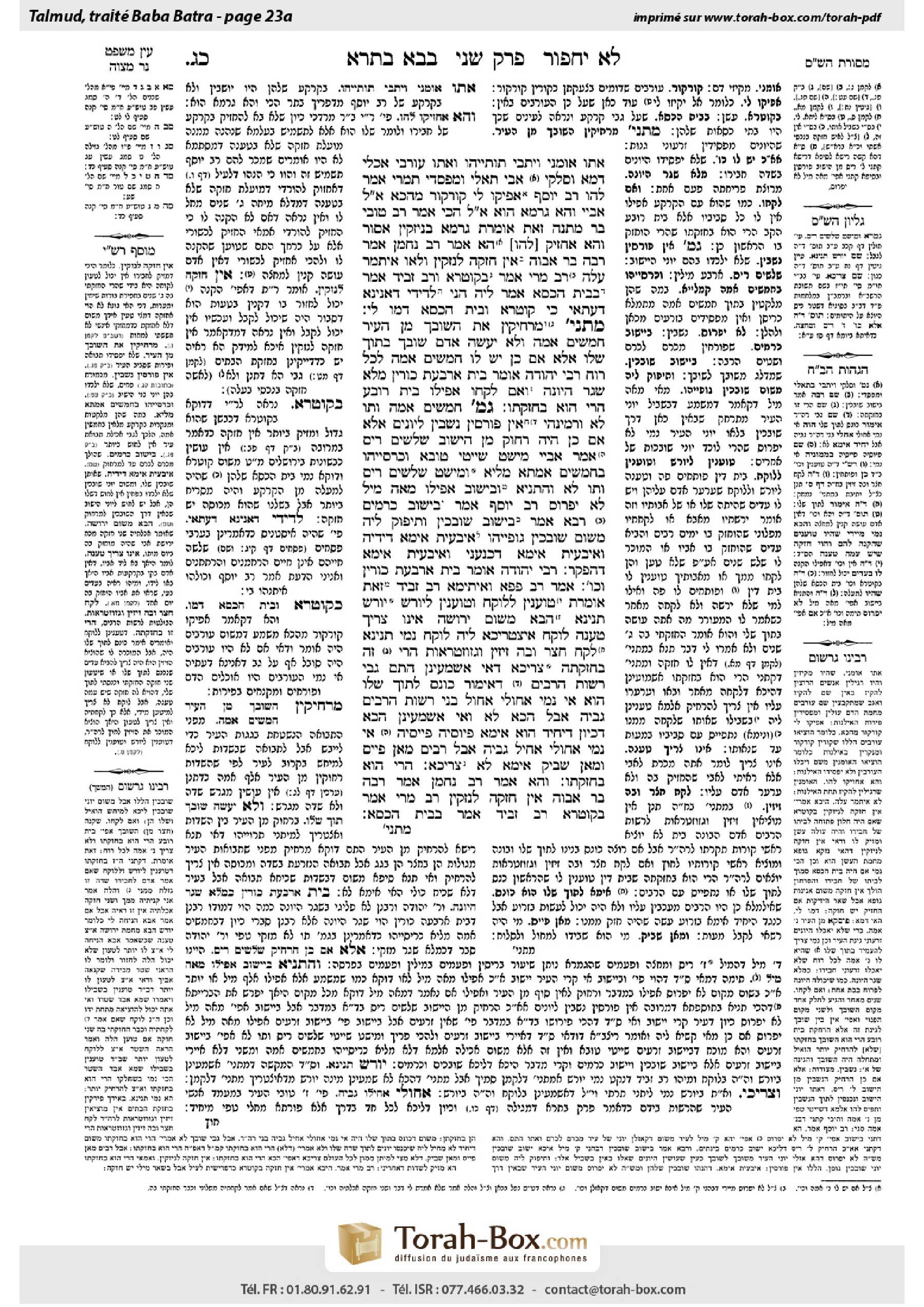
Bava Batra 23a: Talmud study for Daf Yomi
Study the Talmud for Daf Yomi with scanned pages, Hebrew text, English translations from Sefaria and AI-generated French translations.
Passage selection and English or AI-generated French translation are available where the scan has annotations. Daf Study is independent of Torah-Box and Sefaria.
Browse Bava Batra · בבא בתרא · All tractatesBava Batra 23a text and translations
This page of Bava Batra includes the Aramaic text, an English translation and an AI-generated French translation, alongside the scan above.
בבא בתרא כ״ג א · Aramaic and Hebrew text
אָתוּ אוּמָּנֵי וְיָתְבִי תּוּתַיְיהוּ, וְאָתוּ עוֹרְבֵי אָכְלִי דְּמָא, וְסָלְקִי אַבֵּי תָאלֵי וּמַפְסְדִי תַּמְרֵי. אֲמַר לְהוּ רַב יוֹסֵף: אַפִּיקוּ לִי קוּרְקוּר מֵהָכָא. אֲמַר לֵיהּ אַבָּיֵי: וְהָא גְּרָמָא הוּא! אֲמַר לֵיהּ: הָכִי אָמַר רַב טוֹבִי בַּר מַתְנָה, זֹאת אוֹמֶרֶת: גְּרָמָא בְּנִיזָּקִין אָסוּר.
וְהָא אַחְזֵיק [לְהוּ]! הָא אָמַר רַב נַחְמָן אָמַר רַבָּה בַּר אֲבוּהּ: אֵין חֲזָקָה לִנְזָקִין. וְלָאו אִיתְּמַר עֲלַהּ – רַב מָרִי אָמַר: בְּקוּטְרָא, וְרַב זְבִיד אָמַר: בְּבֵית הַכִּסֵּא?! אֲמַר לֵיהּ: הָנֵי, לְדִידִי – דַּאֲנִינָא דַּעְתַּאי, כִּי קוּטְרָא וּבֵית הַכִּסֵּא דָּמוּ לִי.
מַתְנִי׳ מַרְחִיקִין אֶת הַשּׁוֹבָךְ מִן הָעִיר חֲמִשִּׁים אַמָּה. וְלֹא יַעֲשֶׂה אָדָם שׁוֹבָךְ בְּתוֹךְ שֶׁלּוֹ, אֶלָּא אִם כֵּן יֵשׁ לוֹ חֲמִשִּׁים אַמָּה לְכׇל רוּחַ. רַבִּי יְהוּדָה אוֹמֵר: בֵּית אַרְבַּעַת כּוֹרִין – מְלֹא שֶׁגֶר הַיּוֹנֶה. וְאִם לְקָחוֹ – אֲפִילּוּ בֵּית רוֹבַע, הֲרֵי הוּא בְּחֶזְקָתוֹ.
גְּמָ׳ חֲמִשִּׁים אַמָּה – וְתוּ לָא? וּרְמִינְהִי: אֵין פּוֹרְסִין נִשְׁבִּין לְיוֹנִים, אֶלָּא אִם כֵּן הָיָה רָחוֹק מִן הַיִּשּׁוּב שְׁלֹשִׁים רִיס!
אָמַר אַבָּיֵי: מֵישָׁט שָׁיְיטִי טוּבָא, וּכְרֵסַיְיהוּ בַּחֲמִשִּׁים אַמְּתָא מַלְיָא. וּמֵישָׁט – שְׁלֹשִׁים רִיס וְתוּ לָא? וְהָתַנְיָא: וּבַיִּשּׁוּב – אֲפִילּוּ מֵאָה מִיל לֹא יִפְרוֹס! רַב יוֹסֵף אָמַר: בְּיִשּׁוּב כְּרָמִים.
רָבָא אָמַר: בְּיִשּׁוּב שׁוֹבָכִין. וְתִיפּוֹק לֵיהּ מִשּׁוּם שׁוֹבָכִין גּוּפַיְיהוּ! אִיבָּעֵית אֵימָא: דִּידֵיהּ, וְאִיבָּעֵית אֵימָא: דְּגוֹי, וְאִיבָּעֵית אֵימָא: דְּהֶפְקֵר.
רַבִּי יְהוּדָה אוֹמֵר: בֵּית אַרְבַּעַת כּוֹרִין וְכוּ׳. אָמַר רַב פָּפָּא, וְאִיתֵּימָא רַב זְבִיד: זֹאת אוֹמֶרֶת, טוֹעֲנִין לְלוֹקֵחַ וְטוֹעֲנִין לְיוֹרֵשׁ.
יוֹרֵשׁ – תְּנֵינָא: הַבָּא מִשּׁוּם יְרוּשָּׁה – אֵינוֹ צָרִיךְ טַעֲנָה! לוֹקֵחַ אִיצְטְרִיכָא לֵיהּ. לוֹקֵחַ נָמֵי תְּנֵינָא: לָקַח חָצֵר וּבָהּ זִיזִין וּגְזוּזְטְרָאוֹת – הֲרֵי זֶה בְּחֶזְקָתָהּ!
צְרִיכָא; דְּאִי אַשְׁמְעִינַן הָתָם גַּבֵּי רְשׁוּת הָרַבִּים – דְּאֵימוֹר כּוֹנֵס לְתוֹךְ שֶׁלּוֹ הוּא, אִי נָמֵי אַחוֹלֵי אַחוּל בְּנֵי רְשׁוּת הָרַבִּים גַּבֵּיהּ; אֲבָל הָכָא – לָא;
וְאִי אַשְׁמְעִינַן הָכָא, דְּכֵיוָן דְּיָחִיד הוּא – אֵימָא: פַּיּוֹסֵי פַּיְּיסֵיהּ, אִי נָמֵי אַחוֹלֵי אַחֵיל גַּבֵּיהּ; אֲבָל רַבִּים, מַאן פַּיֵּיס וּמַאן שָׁבֵיק – אֵימָא לָא; צְרִיכָא.
הֲרֵי הוּא בְּחֶזְקָתוֹ. וְהָא אָמַר רַב נַחְמָן אָמַר רַבָּה בַּר אֲבוּהּ: אֵין חֲזָקָה לִנְזָקִין! רַב מָרִי אָמַר: בְּקוּטְרָא, רַב זְבִיד אָמַר: בְּבֵית הַכִּסֵּא.
Bava Batra 23a · English translation
bloodletters would come and sit beneath them and perform their work there, and crows would come, eat the blood, and fly up to the palm trees and damage the dates. Rav Yosef said to the bloodletters: Remove these crowing birds from here, i.e., leave in order to avoid further damage. Abaye said to him: But it is an indirect action, as the bloodletters themselves are not damaging the dates. Rav Yosef said to him that Rav Tovi bar Mattana said as follows: That is to say that it is prohibited to cause even indirect damage.
Abaye said to Rav Yosef: But they have established an acquired privilege to use that particular spot for their work. Rav Yosef replied: Doesn’t Rav Naḥman say that Rabba bar Avuh says: There is no acquired privilege of use in cases of damage, i.e., an established situation may not be allowed to continue in the event that damage results. Abaye inquired further: But wasn’t it stated with regard to that statement of Rav Naḥman that Rav Mari said it is referring specifically to smoke, and Rav Zevid said it is referring to a bathroom? In other words, this principle was stated specifically in the context of damage caused by these substances. Rav Yosef said to him: For me, as I am sensitive, these are like smoke and a bathroom to me, which is why I have the right to demand that the bloodletters leave.
MISHNA: One must distance a dovecote fifty cubits from the city to prevent doves from eating seeds in the town. And a person should not establish a dovecote within his own property unless he has fifty cubits in each direction between the dovecote and the edge of his property. Rabbi Yehuda says that one must have surrounding the dovecote the area required for sowing four kor of seed on each side, which generally extends as far as a dove flies in a single flight. And if one bought the dovecote with the land, he has the acquired privilege of its use even if it has surrounding it only the area required for sowing a quarter-kav of seed [beit rova] around it, and he need not remove it from there.
GEMARA: The Gemara asks: Must one distance a dovecote only fifty cubits from the city and no more? Is that as far as one can expect a dove to fly? And the Gemara raises a contradiction from a mishna (Bava Kamma 79b): One may spread out traps [neshavin] for doves only if this was performed at a distance of at least thirty ris, or four mil, which is eight thousand cubits, from any settled area, to avoid catching birds that belong to another. Apparently, doves fly a distance of thirty ris, whereas the mishna here states fifty cubits.
Abaye said: Doves do fly great distances, which is why one must avoid catching others’ birds by keeping traps thirty ris away from settled areas. But as they eat along their way, their stomachs are filled after a distance of fifty cubits, at which point they will do no more damage to seeds. The Gemara asks: And do they fly only thirty ris and no more? But isn’t it taught in a baraita: And in a settled area, one may not spread out a trap even if the area under his control extends as far as one hundred mil in each direction? Rav Yosef says: That baraita is referring to a settled area of vineyards, i.e., a contiguous region of vineyards and gardens. In that case the doves pass from place to place even over a great distance.
Rava said: The baraita is referring to a settled area of dovecotes, i.e., where many dovecotes are distributed. The Gemara asks: And according to Rava, let the tanna derive that one may not establish a new dovecote there due to the other dovecotes themselves, as he will trap doves belonging to others. The Gemara answers: If you wish, say that this is referring to his own dovecotes. And if you wish, say it is referring to the dovecotes of a gentile, whose property one is not obligated to protect from harm. And if you wish, say it is referring to ownerless dovecotes.
§ Rabbi Yehuda says that one must have surrounding the dovecote the area required for sowing four kor of seed on each side, which is as far as a dove flies in a single flight. And if one bought the dovecote with the land, he has the acquired privilege of its use. Rav Pappa said, and some say it was Rav Zevid: That is to say that a court issues a claim on behalf of a buyer, and issues a claim on behalf of an heir. This is referring to the halakha of taking possession. If one has been physically in possession of an item for a period of time, generally three years, this serves as proof that he is in fact the legal owner. This possession must be accompanied by a claim of how one acquired the item; he cannot simply state that no one protested his possessing the item for three years. Rav Pappa is saying that the court will lodge a claim on behalf of a buyer or heir that they acquired the item from someone who was the owner, just as here the court assumes that the previous owner of the dovecote came to an agreement with his neighbors that he may use it.
The Gemara asks: Why is it necessary for Rav Pappa to state this halakha? We already learn this with regard to an heir (41a): In the case of land that comes as an inheritance, one is not required to make a claim as to how the land came into his benefactor’s possession when one’s ownership of the land is challenged. The Gemara answers: It was necessary for him to state this halakha with regard to a buyer. The Gemara asks: With regard to a buyer as well, we learn this in a mishna (60a): If one bought a courtyard in which there are projections and balconies [ugzuztraot] extending into the public domain, this courtyard retains its presumptive status, i.e., the owner has the acquired privilege of their use, and the court does not demand their removal.
The Gemara answers: It was necessary for the tanna of the mishna to state this halakha in both cases, as, if he had taught us this only there, in that mishna, one might have said that it applies specifically with regard to a protrusion or a balcony that extends into the public domain, as one can say that perhaps it is a case where the seller had drawn back into his own land before adding the projections and balconies, and they in fact do not extend into the public thoroughfare. Alternatively, perhaps the public waived their right to him and allowed him to place them over the common area, as otherwise they would have protested. But here, where he causes damage to private individuals, one might have thought that the buyer does not have a privilege of use, and therefore the mishna teaches us otherwise.
And if he had taught this only in the mishna here, one might say that since the party potentially suffering damage is an individual, the owner of the dovecote appeased his neighbor by paying him to permit him to construct it. Alternatively, the neighbor might have waived his right to him. But in a case where damage is caused to the public, one might argue: Whom did he appease, and who yielded to him? Consequently, one might say that the purchaser does not retain the privilege of use. Therefore, it is necessary for the tanna to state the halakha in this case as well.
§ The mishna teaches that if one bought the dovecote with the land, he has the acquired privilege of use. The Gemara asks: But doesn’t Rav Naḥman say that Rabba bar Avuh says: There is no acquired privilege of use for cases of damage? Why should he retain his acquired privilege of use when his doves cause damage? Rav Mari said: Rav Naḥman’s statement is referring specifically to smoke, which causes serious damage, and that is why it overrides an acquired privilege. Rav Zevid said: It is referring to a bathroom, whose odor is particularly strong.
Bava Batra 23a · Traduction française (IA)
Les bouchers viendraient s'installer sous leur abri et effectuaient leur travail là, et des corbeaux viendraient manger le sang et voleraient jusqu'aux palmiers, endommageant ainsi les figues. Rav Yosef dit aux bouchers : Éloignez ces oiseaux de ce lieu, c'est-à-dire, quittez le pour éviter un dommage supplémentaire. Abaye lui répondit : Mais c'est une action indirecte, car les bouchers eux-mêmes ne nuisent pas aux figues. Rav Yosef dit à Abaye que Rav Tovi bar Mattana avait dit ceci : Cela signifie que causer même un dommage indirect est interdit.
Abaye dit à Rav Yosef : Mais ils ont acquis le droit d'utiliser ce lieu pour leur travail. Rav Yosef répondit : N'est-ce pas ce que Rav Naḥman dit, que Rabba bar Avuh dit : Il n'y a pas de droit acquis d'utilisation dans les cas de dommage, c'est-à-dire qu'une situation établie ne peut pas être autorisée à continuer si cela entraîne un dommage. Abaye demanda ensuite : N'était-ce pas précisé dans cette déclaration de Rav Naḥman que Rav Mari dit qu'il s'agit spécifiquement de la fumée, et Rav Zevid dit qu'il s'agit spécifiquement d'une toilette ? Autrement dit, ce principe a été énoncé spécifiquement dans le contexte de dommages causés par ces substances. Rav Yosef dit à Abaye : Pour moi, étant sensible, ces choses sont pour moi comme de la fumée et une toilette, ce qui me donne le droit de demander aux bouchers de partir.
MICHNA : On doit éloigner un colombier de cinquante coudées de la ville afin d'éviter que les colombes ne mangent les graines dans la ville. Et une personne ne doit pas établir un colombier sur sa propriété à moins qu'il n'ait cinquante coudées dans chaque direction entre le colombier et la limite de sa propriété. Rabbi Yehuda dit qu'il faut entourer le colombier d'une surface suffisante pour semer quatre kor de grain de chaque côté, ce qui s'étend généralement jusqu'à la distance que vole une colombe en un seul vol. Et si l'on a acheté le colombier avec la terre, il a le droit acquis d'en utiliser même s'il n'y a autour qu'une surface suffisante pour semer un quart de kav de grain [beit rova], et il n'a pas besoin de le retirer de là.
GUEMARA : La Guemara demande : Faut-il éloigner un colombier seulement de cinquante coudées de la ville et pas plus ? Est-ce la distance maximale qu'on peut attendre que vole une colombe ? Et la Guemara soulève une contradiction avec une mishna (Bava Kamma 79b) : On peut installer des pièges [neshavin] pour des colombes uniquement si cela a été fait à une distance d'au moins trente ris, ou quatre mil, ce qui équivaut à huit mille coudées, d'aucun lieu habité, afin d'éviter de capturer des oiseaux appartenant à quelqu'un d'autre. Apparemment, les colombes volent une distance de trente ris, alors que la mishna ici indique cinquante coudées.
Abaye a dit : Les moineaux volent sur de grandes distances, c'est pourquoi on doit éviter de capturer les oiseaux d'autrui en maintenant des pièges à trente rachats à l'écart des zones habitées. Cependant, comme ils mangent sur leur chemin, leur estomac est rempli après une distance de cinquante coudées, au point où ils ne causent plus de dommages aux graines. La Guemara demande : Et volent-ils seulement trente rachats et pas plus ? Mais n'est-il pas enseigné dans une baraïta : Et dans une zone habité, on ne peut pas étendre un piège même si la zone sous son contrôle s'étend jusqu'à cent mil dans chaque direction ? Rav Yosef dit : Cette baraïta fait référence à une zone habité de vignobles, c'est-à-dire une région contiguë de vignobles et de jardins. Dans ce cas, les moineaux passent d'un endroit à un autre même sur une grande distance.
Rava a dit : Cette baraïta fait référence à une zone habité de colombières, c'est-à-dire un lieu où de nombreuses colombières sont réparties. La Guemara demande : Et selon Rava, laissaient le tanna déduire que l'on ne peut pas établir une nouvelle colombière là, en raison des autres colombières elles-mêmes, car il capturerait des moineaux appartenant à autrui. La Guemara répond : Si tu veux, dis que cela fait référence à ses propres colombières. Et si tu veux, dis que cela fait référence aux colombières d'un non-Juif, dont la propriété on n'est pas tenu de la protéger. Et si tu veux, dis que cela fait référence aux colombières sans propriétaire.
§ Rabbi Yéhuda dit qu'il faut entourer la colombière une zone suffisante pour semer quatre kor de grain de chaque côté, ce qui correspond à la distance que vole un moineau en un seul vol. Et si l'on a acheté la colombière avec la terre, il a acquis le privilège d'en user. Rav Pappa a dit, et certains disent que c'était Rav Zévid : Cela signifie que la cour émet une réclamation au nom d'un acheteur et au nom d'un héritier. Cela fait référence à la halakha de l'occupation. Si l'on a physiquement occupé un objet pendant une période donnée, généralement trois ans, cela sert de preuve qu'on est effectivement le propriétaire légal. Cette occupation doit être accompagnée d'une réclamation sur la manière dont l'objet a été acquis ; on ne peut pas simplement affirmer que personne n'a protesté son occupation pendant trois ans. Rav Pappa dit que la cour émettra une réclamation au nom d'un acheteur ou d'un héritier qu'ils ont acquis l'objet auprès de quelqu'un qui était le propriétaire, tout comme ici la cour suppose que le propriétaire précédent de la colombière a convenu avec ses voisins qu'il pouvait l'utiliser.
La Guemara demande : Pourquoi est-il nécessaire que Rav Pappa énonce cette halakha ? Nous apprenons déjà cela concernant un héritier (41a) : Dans le cas d'une terre qui vient comme héritage, on n'est pas tenu de faire une réclamation sur la manière dont la terre est entrée en possession de son bénéficiaire lorsque la propriété de la terre est contestée. La Guemara répond : Il était nécessaire qu'il énonce cette halakha concernant un acheteur. La Guemara demande : Concernant un acheteur également, nous apprenons cela dans une mitsva (60a) : Si l'on a acheté un jardin dans lequel il y a des projections et balcons [ugzuztraot] s'étendant dans le domaine public, ce jardin conserve son statut présomptif, c'est-à-dire que le propriétaire a acquis le privilège d'en user, et la cour ne demande pas leur retrait.
La Guemara répond : Il était nécessaire que le tanna de la michna ait énoncé cette halakha dans les deux cas, car, si elle avait été enseignée uniquement là, dans cette michna, on aurait pu penser qu’elle s’applique spécifiquement à un éperon ou à un balcon s’étendant dans le domaine public, car on pourrait dire que peut-être le vendeur avait reculé dans son propre terrain avant d’ajouter les éperons et les balcons, et qu’ils n’étendent pas effectivement dans la voie publique. Ou bien, peut-être le public a renoncé à son droit envers lui et lui a permis de les placer sur la zone commune, autrement ils auraient protesté. Mais ici, où il cause un préjudice à des particuliers, on aurait pu penser que l’acheteur n’a pas le privilège d’usage, et c’est pourquoi la michna nous l’enseigne ainsi.
Et si elle avait été enseignée uniquement ici, dans cette michna, on aurait pu dire que puisque la partie potentiellement victime est un individu, le propriétaire du colombier a rassuré son voisin en lui payant pour lui permettre de le construire. Ou bien, le voisin aurait pu renoncer à son droit envers lui. Mais dans le cas où un préjudice est causé au public, on pourrait argumenter : à qui a-t-il rassuré, et qui a cédé à lui ? Ainsi, on pourrait dire que l’acheteur ne conserve pas le privilège d’usage. Par conséquent, il était nécessaire que le tanna énonce cette halakha dans ce cas également.
§ La michna enseigne que si l’on achète le colombier avec la terre, on acquiert le privilège d’usage. La Guemara demande : Mais ne dit pas Rav Naḥman que Rabba bar Avuh dit : Il n’y a pas de privilège d’usage acquis dans les cas de préjudice ? Pourquoi devrait-il conserver son privilège d’usage quand ses moineaux causent un préjudice ? Rav Mari dit : La déclaration de Rav Naḥman fait référence spécifiquement à la fumée, qui cause un préjudice grave, et c’est pourquoi elle annule un privilège acquis. Rav Zevid dit : Il s’agit d’une salle de bain, dont l’odeur est particulièrement forte.
Traduction française générée par IA à partir de l’édition anglaise de Sefaria. Vérifie toujours un passage avec le texte source.
Text from Sefaria: William Davidson Edition - Vocalized Aramaic (CC BY NC); William Davidson Edition - English (CC BY NC).