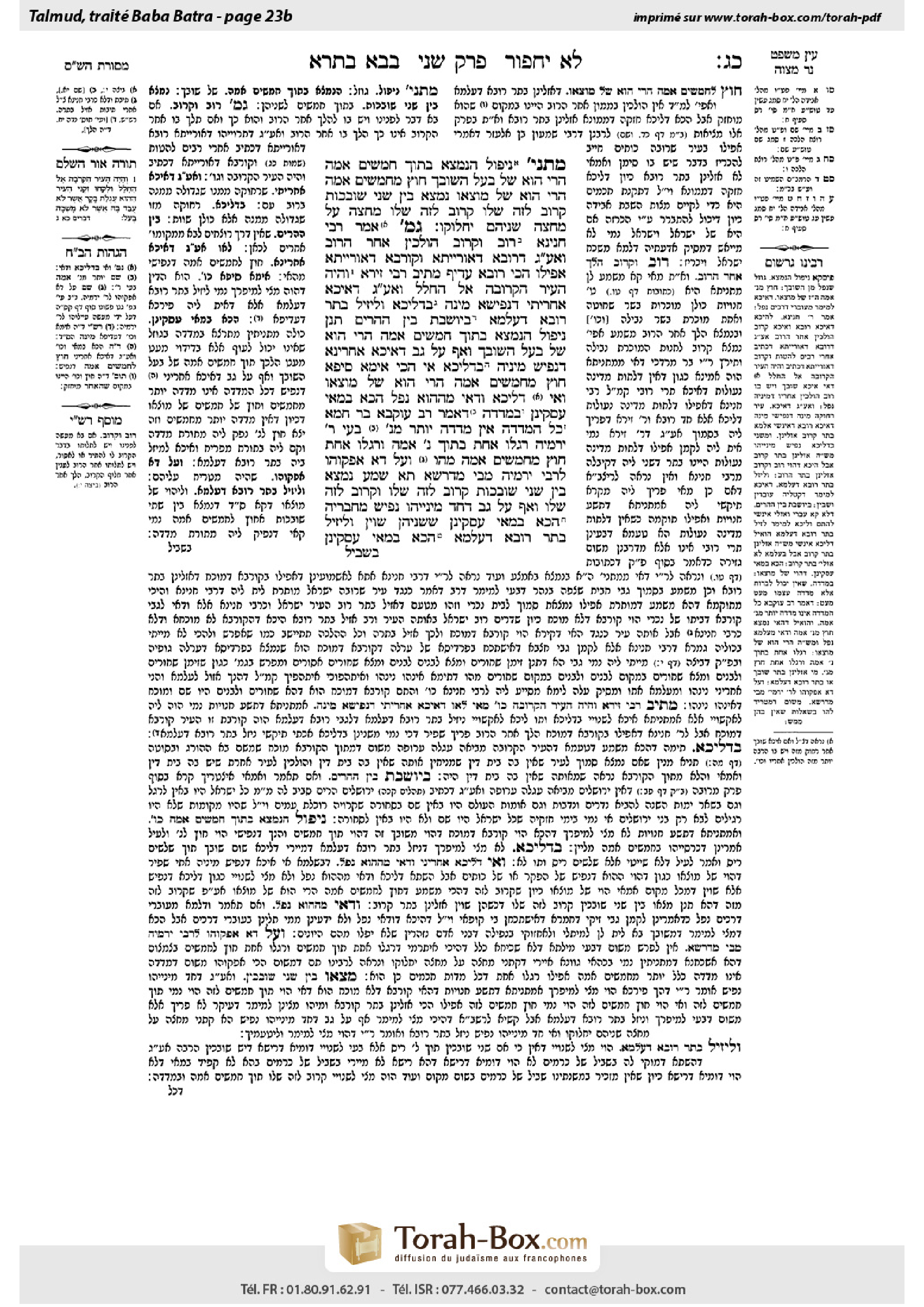
Bava Batra 23b: Talmud study for Daf Yomi
Study the Talmud for Daf Yomi with scanned pages, Hebrew text, English translations from Sefaria and AI-generated French translations.
Passage selection and English or AI-generated French translation are available where the scan has annotations. Daf Study is independent of Torah-Box and Sefaria.
Browse Bava Batra · בבא בתרא · All tractatesBava Batra 23b text and translations
This page of Bava Batra includes the Aramaic text, an English translation and an AI-generated French translation, alongside the scan above.
בבא בתרא כ״ג ב · Aramaic and Hebrew text
מַתְנִי׳ נִיפּוּל הַנִּמְצָא בְּתוֹךְ חֲמִשִּׁים אַמָּה – הֲרֵי הוּא שֶׁל בַּעַל הַשּׁוֹבָךְ. חוּץ מֵחֲמִשִּׁים אַמָּה – הֲרֵי הוּא שֶׁל מוֹצְאוֹ. נִמְצָא בֵּין שְׁנֵי שׁוֹבָכוֹת; קָרוֹב לָזֶה – שֶׁלּוֹ. קָרוֹב לָזֶה – שֶׁלּוֹ. מֶחֱצָה עַל מֶחֱצָה – שְׁנֵיהֶם יַחְלוֹקוּ.
גְּמָ׳ אָמַר רַבִּי חֲנִינָא: רוֹב וְקָרוֹב – הוֹלְכִין אַחַר הָרוֹב; וְאַף עַל גַּב דְּרוּבָּא דְּאוֹרָיְיתָא וְקוּרְבָא דְּאוֹרָיְיתָא – אֲפִילּוּ הָכִי, רוּבָּא עֲדִיף.
מֵתִיב רַבִּי זֵירָא: ״וְהָיָה הָעִיר הַקְּרֹבָה אֶל הֶחָלָל״ – וְאַף עַל גַּב דְּאִיכָּא אַחֲרִיתִי דִּנְפִישָׁא מִינַּהּ!
בִּדְלֵיכָּא. וְלֵיזִיל בָּתַר רוּבָּא דְעָלְמָא! בְּיוֹשֶׁבֶת בֵּין הֶהָרִים.
תְּנַן: נִיפּוּל הַנִּמְצָא בְּתוֹךְ חֲמִשִּׁים אַמָּה – הֲרֵי הוּא שֶׁל בַּעַל הַשּׁוֹבָךְ; וְאַף עַל גַּב דְּאִיכָּא אַחֲרִינָא דִּנְפִישׁ מִינֵּיהּ! בִּדְלֵיכָּא.
אִי הָכִי, אֵימָא סֵיפָא: חוּץ מֵחֲמִשִּׁים אַמָּה – הֲרֵי הוּא שֶׁל מוֹצְאוֹ. וְאִי דְּלֵיכָּא, וַדַּאי מֵהָהוּא נְפַל! הָכָא בְּמַאי עָסְקִינַן – בִּמְדַדֶּה, דְּאָמַר רַב עוּקְבָא בַּר חָמָא: כׇּל הַמְדַדֶּה – אֵין מְדַדֶּה יוֹתֵר מֵחֲמִשִּׁים.
בָּעֵי רַבִּי יִרְמְיָה: רַגְלוֹ אַחַת בְּתוֹךְ חֲמִשִּׁים אַמָּה, וְרַגְלוֹ אַחַת חוּץ מֵחֲמִשִּׁים אַמָּה – מַהוּ? וְעַל דָּא אַפְּקוּהוּ לְרַבִּי יִרְמְיָה מִבֵּי מִדְרְשָׁא.
תָּא שְׁמַע: נִמְצָא בֵּין שְׁנֵי שׁוֹבָכוֹת; קָרוֹב לָזֶה – שֶׁלּוֹ, וְקָרוֹב לָזֶה – שֶׁלּוֹ; וְאַף עַל גַּב דְּחַד מִינַּיְיהוּ נְפִישׁ מֵחַבְרֵיהּ! הָכָא בְּמַאי עָסְקִינַן – שֶׁשְּׁנֵיהֶן שָׁוִין. וְלֵיזִיל בָּתַר רוּבָּא דְעָלְמָא! הָכָא בְּמַאי עָסְקִינַן –
Bava Batra 23b · English translation
MISHNA: With regard to a dove chick [nippul] that was found within fifty cubits of a dovecote, it belongs to the owner of the dovecote. If it was found beyond fifty cubits from a dovecote, it belongs to its finder. In a case where it was found between two dovecotes, if it was close to this one, it belongs to the owner of this dovecote; if it was close to that one, it belongs to the owner of that dovecote. If it was half and half, i.e., equidistant from the two dovecotes, the two owners divide the value of the chick.
GEMARA: Rabbi Ḥanina says: When resolving an uncertainty with regard to the halakhic status of an item, e.g., a found item, if the status of the majority of like items indicates that it has one status but the item in question is proximate to a source that indicates otherwise, one follows the majority. And even though the halakha of majority applies by Torah law and the halakha of proximity also applies by Torah law, even so the majority is preferable.
Rabbi Zeira raises an objection from the Torah’s statement with regard to a murder victim where the identity of the murderer is unknown. In a case of this kind, the court measures the distances between the corpse and the nearby towns, in order to determine which town is closest and must consequently perform the rite of the heifer whose neck is broken. The verse states: “And it shall be, that the city that is nearest to the slain man, the Elders of that city shall take a heifer of the herd…and shall break the heifer’s neck” (Deuteronomy 21:3–4). And this town is chosen even though there might be another town that is larger in population than it. According to Rabbi Ḥanina, in a case of this kind one should follow the majority.
The Gemara answers: This verse is referring to a situation where there is no other town that is larger than that one. The Gemara asks: And still, if one follows the majority, why should the court follow the closest city? Let us follow the majority of the world, as most people are found elsewhere. The Gemara answers: This is referring to a case where the city sits in isolation between mountains, and therefore it is unlikely that the murderer arrived from elsewhere.
The Gemara continues to discuss the issue of majority as opposed to proximity. We learned in the mishna: With regard to a dove chick that was found within fifty cubits of a dovecote, it belongs to the owner of the dovecote. And as the mishna does not make a distinction between different cases, it indicates that this is the halakha even though there is another dovecote that is larger than the proximate one in terms of number of birds. This shows that closeness, not majority, is the determining factor. The Gemara answers: This is referring to a case where there is no other dovecote in the area.
The Gemara asks: If so, say the latter clause of the mishna: If it was found beyond fifty cubits from a dovecote, it belongs to its finder. And if there is no other dovecote in the area, it certainly fell from that dovecote. How, then, can it be given to the finder? The Gemara answers: With what are we dealing here? We are dealing with a chick that hops from place to place but does not yet fly. As Rav Ukva bar Ḥama says: With regard to any creature that hops, it does not hop more than fifty cubits. Consequently, any bird found within fifty cubits of a dovecote is assumed to have come from there. If it is farther away than that, it likely came from elsewhere or was dropped by travelers.
Rabbi Yirmeya raises a dilemma: If one leg of the chick was within fifty cubits of the dovecote, and one leg was beyond fifty cubits, what is the halakha? The Gemara comments: And it was for his question about this far-fetched scenario that they removed Rabbi Yirmeya from the study hall, as he was apparently wasting the Sages’ time.
The Gemara further suggests: Come and hear the mishna: In a case where it was found between two dovecotes, if it was close to this one, it belongs to the owner of this dovecote; if it was close to that one, it belongs to the owner of that dovecote. The Gemara comments: And this is the halakha even though one of them is greater in number of birds than the other one. Apparently, one rules based on proximity, not majority. The Gemara explains: With what are we dealing here? We are dealing with a situation where the two dovecotes are equal in size. The Gemara asks: But even so, why should one follow the closer dovecote? Let us follow the majority of the world, as there are many other dovecotes besides these, and the number of doves they contain is greater. The Gemara responds: With what are we dealing here?
Bava Batra 23b · Traduction française (IA)
MICHNA : Concernant un petit pigeon [nippul] trouvé à moins de cinquante coudées d’un colombier, il appartient à l’propriétaire du colombier. Si l’on le trouve à plus de cinquante coudées du colombier, il appartient à celui qui l’a trouvé. Dans le cas où il est trouvé entre deux colombiers, si l’on est proche de l’un d’eux, il appartient à l’propriétaire de ce colombier ; si l’on est proche de l’autre, il appartient à l’propriétaire de l’autre. Si l’on est à égale distance des deux, les deux propriétaires partagent la valeur du petit pigeon.
GUEMARA : Rabbi Ḥanina dit : Lorsqu’on résout une incertitude concernant le statut halakhique d’un objet, par exemple un objet trouvé, si le statut de la majorité des objets semblables indique qu’il a un certain statut, mais que l’objet en question est proche d’une source indiquant le contraire, on suit la majorité. Et même si la halakha de la majorité s’applique selon la Torah et la halakha de la proximité s’applique également selon la Torah, la majorité est préférable.
Rabbi Zeira émet une objection à partir de la parole de la Torah concernant une victime de meurtre dont l’identité du meurtrier est inconnue. Dans un cas de ce genre, la cour mesure les distances entre le corps et les villes proches afin de déterminer quelle ville est la plus proche et doit donc effectuer le rite de la bête dont le cou est brisé. La parole de la Torah dit : « Et il arrivera que la ville la plus proche du meurtre, les anciens de cette ville prendront une bête de la troupe et briseront le cou de la bête » (Deutéronome 21 : 3-4). Et cette ville est choisie même s’il pourrait y avoir une autre ville plus peuplée qu’elle. Selon Rabbi Ḥanina, dans un cas de ce genre, on devrait suivre la majorité.
La Guemara répond : Cette parole fait référence à un cas où il n’y a pas d’autre ville plus grande que celle-ci. La Guemara demande : Et pourtant, si l’on suit la majorité, pourquoi la cour devrait-elle suivre la ville la plus proche ? Faisons suivre la majorité du monde, car la plupart des gens sont trouvés ailleurs. La Guemara répond : Cela fait référence à un cas où la ville est isolée entre des montagnes, et donc il est peu probable que le meurtrier soit arrivé d’ailleurs.
La Guemara continue à discuter du problème entre la majorité et la proximité. Nous avons appris dans la mishna : Concernant un petit pigeon trouvé à moins de cinquante coudées d’un colombier, il appartient à l’propriétaire du colombier. Et comme la mishna ne fait pas de distinction entre les cas différents, cela indique que c’est la halakha même s’il y a un autre colombier plus grand en termes de nombre d’oiseaux. Cela montre que la proximité, et non la majorité, est le facteur déterminant. La Guemara répond : Cela fait référence à un cas où il n’y a pas d’autre colombier dans la région.
La Guemara demande : Si c’est ainsi, disons la dernière partie de la mishna : Si l’on le trouve à plus de cinquante coudées d’un colombier, il appartient à celui qui l’a trouvé. Et si il n’y a pas d’autre colombier dans la région, il est certainement tombé de ce colombier. Comment alors peut-il être donné à l’individu qui l’a trouvé ? La Guemara répond : Avec quoi sommes-nous en train de parler ? Nous parlons d’un petit pigeon qui saute d’un endroit à un autre mais ne vole pas encore. Comme Rav Ukva bar Ḥama dit : Concernant toute créature qui saute, elle ne saute pas plus de cinquante coudées. Par conséquent, tout oiseau trouvé à moins de cinquante coudées d’un colombier est considéré comme provenant de là. Si l’on le trouve à plus de cinquante coudées, il est probable qu’il provienne d’ailleurs ou qu’il ait été jeté par des voyageurs.
Rabbi Yirmeya pose un dilemme : Si une seule patte du petit pigeon était à moins de cinquante coudées du colombier et l’autre patte à plus de cinquante coudées, quelle est la halakha ? La Guemara commente : Et c’est à cause de cette question absurde qu’ils ont expulsé Rabbi Yirmeya de la salle de study, car il semblait gaspiller le temps des Sages.
La Guemara suggère davantage : Viens écouter la mishna : Dans le cas où il est trouvé entre deux colombiers, si l’on est proche de l’un d’eux, il appartient à l’propriétaire de ce colombier ; si l’on est proche de l’autre, il appartient à l’propriétaire de l’autre. La Guemara commente : Et c’est la halakha même si l’un d’eux est plus grand en termes de nombre d’oiseaux que l’autre. Apparemment, on décide en fonction de la proximité, et non de la majorité. La Guemara explique : Avec quoi sommes-nous en train de parler ? Nous parlons d’un cas où les deux colombiers sont égaux en taille. La Guemara demande : Et même ainsi, pourquoi devrait-on suivre le colombier le plus proche ? Faisons suivre la majorité du monde, car il y a beaucoup d’autres colombiers en dehors de ceux-ci, et le nombre d’oiseaux qu’ils contiennent est plus grand. La Guemara répond : Avec quoi sommes-nous en train de parler ?
Traduction française générée par IA à partir de l’édition anglaise de Sefaria. Vérifie toujours un passage avec le texte source.
Text from Sefaria: William Davidson Edition - Vocalized Aramaic (CC BY NC); William Davidson Edition - English (CC BY NC).