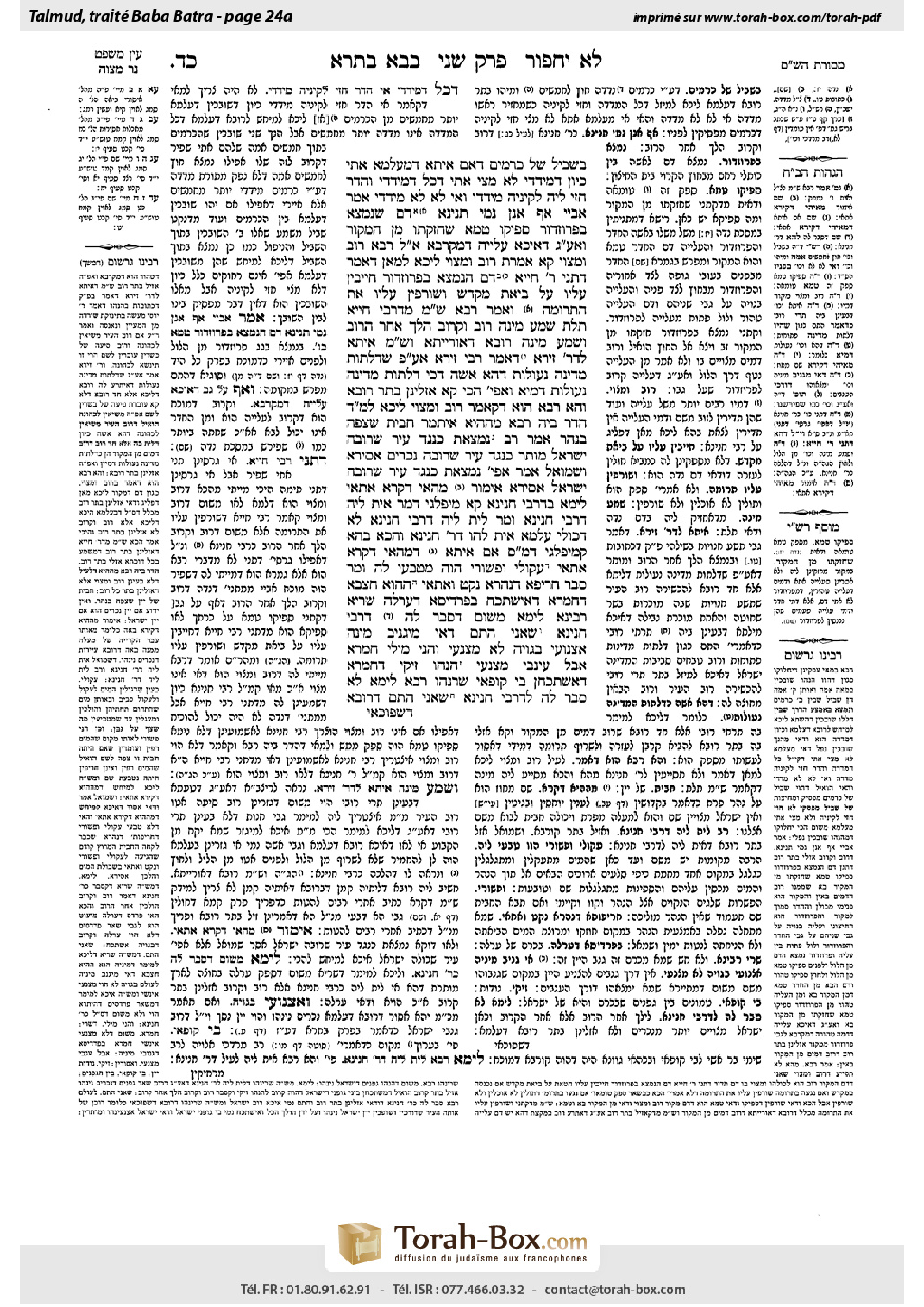
Bava Batra 24a: Talmud study for Daf Yomi
Study the Talmud for Daf Yomi with scanned pages, Hebrew text, English translations from Sefaria and AI-generated French translations.
Passage selection and English or AI-generated French translation are available where the scan has annotations. Daf Study is independent of Torah-Box and Sefaria.
Browse Bava Batra · בבא בתרא · All tractatesBava Batra 24a text and translations
This page of Bava Batra includes the Aramaic text, an English translation and an AI-generated French translation, alongside the scan above.
בבא בתרא כ״ד א · Aramaic and Hebrew text
בִּשְׁבִיל שֶׁל כְּרָמִים; דְּאִם אִיתָא דְּמֵעָלְמָא אָתֵי, כֵּיוָן דְּמִידַּדֵּי – לָא מָצֵי אָתֵי; דְּכׇל דְּמִידַּדֵּי וַהֲדַר חָזֵי לֵיהּ לְקִינֵּיהּ – מִידַּדֵּי, וְאִי לָא – לָא מִידַּדֵּי.
אָמַר אַבָּיֵי, אַף אֲנַן נָמֵי תְּנֵינָא: דָּם שֶׁנִּמְצָא בַּפְּרוֹזְדוֹר – סְפֵיקוֹ טָמֵא, שֶׁחֶזְקָתוֹ מִן הַמָּקוֹר. וְאַף עַל גַּב דְּאִיכָּא עֲלִיָּיה, דִּמְקָרְבָא!
אֲמַר לֵיהּ רָבָא: רוֹב וּמָצוּי קָא אָמְרַתְּ? רוֹב וּמָצוּי לֵיכָּא לְמַאן דְּאָמַר.
דְּתָנֵי רַבִּי חִיָּיא: דָּם הַנִּמְצָא בַּפְּרוֹזְדוֹר, חַיָּיבִין עָלָיו עַל בִּיאַת מִקְדָּשׁ, וְשׂוֹרְפִין עָלָיו אֶת הַתְּרוּמָה.
וְאָמַר רָבָא, שְׁמַע מִינַּהּ מִדְּרַבִּי חִיָּיא – תְּלָת: שְׁמַע מִינַּהּ רוֹב וְקָרוֹב הַלֵּךְ אַחַר הָרוֹב, וּשְׁמַע מִינַּהּ רוּבָּא דְּאוֹרָיְיתָא, וּשְׁמַע מִינַּהּ אִיתָא לִדְרַבִּי זֵירָא –
דְּאָמַר רַבִּי זֵירָא: אַף עַל פִּי שֶׁדַּלְתוֹת מְדִינָה נְעוּלוֹת.
דְּהָא אִשָּׁה – דְּכִי דַּלְתוֹת מְדִינָה נְעוּלוֹת דָּמְיָא, וַאֲפִילּוּ הָכִי קָא אָזְלִינַן בָּתַר רוּבָּא.
וְהָא רָבָא הוּא דְּקָאָמַר: רוֹב וּמָצוּי לֵיכָּא לְמַאן דְּאָמַר! הֲדַר בֵּיהּ רָבָא מֵהַהִיא.
אִיתְּמַר: חָבִית שֶׁצָּפָה בַּנָּהָר, אָמַר רַב: נִמְצֵאת כְּנֶגֶד עִיר שֶׁרוּבָּהּ יִשְׂרָאֵל – מוּתָּר, כְּנֶגֶד עִיר שֶׁרוּבָּהּ נׇכְרִים – אֲסִירָא. וּשְׁמוּאֵל אָמַר: אֲפִילּוּ נִמְצֵאת כְּנֶגֶד עִיר שֶׁרוּבָּהּ יִשְׂרָאֵל – אֲסִירָא; אֵימוֹר מֵהַאי דְּקִרָא אֲתַאי.
לֵימָא בִּדְרַבִּי חֲנִינָא קָא מִיפַּלְגִי, דְּמָר אִית לֵיהּ דְּרַבִּי חֲנִינָא, וּמָר לֵית לֵיהּ דְּרַבִּי חֲנִינָא?
לָא; דְּכוּלֵּי עָלְמָא אִית לְהוּ דְּרַבִּי חֲנִינָא, וְהָכָא בְּהָא קָמִיפַּלְגִי – דְּמָר סָבַר: אִם אִיתָא דְּמֵהַאי דְּקִרָא אֲתַאי, עִקּוּלֵי וּפָשׁוֹרֵי הֲוָה מַטְבְּעִי לַהּ. וּמָר סָבַר: חֲרִיפָא דְּנַהֲרָא נְקַט וַאֲתַאי.
הָהוּא חַצְבָּא דְחַמְרָא דְּאִישְׁתְּכַח בְּפַרְדֵּיסָא דְעׇרְלָה, שַׁרְיֵא רָבִינָא. לֵימָא מִשּׁוּם דְּסָבַר לַהּ דְּרַבִּי חֲנִינָא?
שָׁאנֵי הָתָם, דְּאִי מִיגְּנִיב מִינֵּהּ – אַצְנוֹעֵי בְּגַוֵּיהּ לָא מַצְנְעִי. וְהָנֵי מִילֵּי חַמְרָא, אֲבָל עִינְבֵי – מַצְנְעִי.
הָנְהוּ זִיקֵי דְחַמְרָא דְּאִשְׁתְּכַחוּ בֵּי קוּפָאֵי, שְׁרַנְהוּ רָבָא. לֵימָא לָא סָבַר לַהּ לִדְרַבִּי חֲנִינָא? שָׁאנֵי הָתָם, דְּרוּבָּא
Bava Batra 24a · English translation
We are dealing with a path that passes between vineyards, and these two dovecotes are situated there. As, if it is so that you claim the chick came from anywhere else in the world, since it only hops, it could not have come there. The reason is that any bird that hops and turns and sees its nest will continue to hop; but if it does not see its nest because it has gone too far, it will not hop farther. Consequently, this found chick that hops must have come from one of these two dovecotes.
Abaye said: We learn in a mishna (Nidda 17b) as well that one follows the majority rather than proximity: With regard to blood that is found in the corridor [baperozdor], i.e., the cervical canal, and it is uncertain whether or not it is menstrual blood, it is ritually impure as menstrual blood, as there is a presumption that it came from the uterus, which is the source of menstrual blood. And this is the halakha even though there is an upper chamber, which empties into the canal, which is closer.
Rava said to Abaye, in response to this claim: You state a proof from a case where the factors of majority and frequency are both present. When there is majority and frequency, there is no one who says that one ignores the majority and follows proximity. Here, not only is the blood from the uterus greater in quantity, it also passes through the canal more frequently, as blood generally does not come from the upper chamber.
Rava cites a proof for his statement. As Rabbi Ḥiyya teaches: Blood that is found in the corridor is considered definite menstrual blood, and therefore if she engages in sexual intercourse, both she and her partner would be liable as a result of it to receive karet for entering the Temple intentionally when ritually impure or to bring an offering for entering unwittingly. And one burns teruma due to it, if the woman touches such produce. Evidently, the status of this blood is not considered uncertain.
And Rava says: Learn from that which Rabbi Ḥiyya said three conclusions: Learn from his statement that when the relevant factors are majority and proximity, follow the majority; and learn from his statement that the halakha that one follows the majority applies by Torah law, as teruma is burned in this case on account of the blood and she is liable to receive karet if she enters the Temple in this state; and learn from his statement that there is a source for that which Rabbi Zeira said.
This statement of Rabbi Zeira was issued in reference to a case discussed in tractate Ketubot (15a). If there are ten stores in a city, nine of which sell kosher meat and one of which sells non-kosher meat, and one found meat outside the stores and he does not know from which store it came, one follows the majority. The Gemara there suggests that perhaps one follows the majority only in a case where the gates of the city are unlocked, when the meat could have come to the city from the majority of kosher meat outside in a circumstance where the majority of the meat sold in the surrounding area was kosher. In this case there are two majorities, the majority of kosher meat stores inside the city, and the majority from outside. The Gemara there explains that Rabbi Zeira says that even if the city gates are locked one follows the majority, and the meat is kosher, as there is a no need for a double majority.
The Gemara elaborates: The two cases are analogous, as the woman here is considered like the locked gates of the city, i.e., there is only a single majority, and even so we follow the majority.
The Gemara asks: But Rava is the one who says with regard to the case of the blood that when there is majority and frequency, there is no one who says that one ignores the majority and follows the proximity. In other words, Rava rejected this case as proof of the principle that one follows the majority even when it is not frequent. Here, by contrast, Rava claims that one can learn from the ruling of Rabbi Ḥiyya that one follows the majority by Torah law. The Gemara answers: Rava retracted that claim in favor of the opinion that one follows the majority in all cases.
§ It was stated: In the case of a barrel of wine that was found floating in a river, and the status of the wine was unknown, Rav says: If it was found opposite a town of which the majority of residents are Jews, the wine is permitted, as it can be assumed that the wine belongs to a Jew. If it was found opposite a town of which the majority are gentiles, it is forbidden, as it presumably belongs to a gentile. And Shmuel says: It is forbidden even if it was found opposite a town of which the majority are Jews. Why? Regardless of where it was found, one can say that it came from that place called Dekira, where the majority of people are gentiles. In other words, there is a distinct possibility that a floating barrel came from far away.
The Gemara suggests: Shall we say that Rav and Shmuel disagree with regard to the statement of Rabbi Ḥanina, in that one Sage, Shmuel, is of the opinion that the ruling is in accordance with the opinion of Rabbi Ḥanina, and he rules based on the majority, which in this case includes even distant locales, and one Sage, Rav, is of the opinion that the ruling is not in accordance with the opinion of Rabbi Ḥanina, which is why he rules based on proximity.
The Gemara rejects this suggestion: No; everyone agrees with the opinion of Rabbi Ḥanina, and here they disagree about this: As one Sage, Rav, holds that if it is so, that the barrel came from that place called Dekira, this cannot be, as the currents and bays of the river, where the river flow is weak, would have sunk it. Therefore, it is logical that the barrel came from a nearby town. And one Sage, Shmuel, holds that perhaps the force of the river caught the barrel and brought it, as it is evident that the flow of a river can bring items from far away.
The Gemara relates that Ravina deemed permitted a certain barrel of wine that was found hidden in a vineyard where there were orla grapes, and he was not concerned that the wine might be from the grapes of that vineyard. The Gemara asks: Shall we say that this is because he holds in accordance with the opinion of Rabbi Ḥanina that one follows the majority of vineyards, which are not orla, rather than proximity?
The Gemara answers: It is different there, as, if thieves had stolen the barrel from that very vineyard they would not have hidden it there. Since the barrel was hidden there, it is reasonable to assume that it was stolen from somewhere else. The Gemara comments: And this matter, that thieves would not hide a stolen barrel in the same vineyard from which they stole it, applies only to wine; but they would hide grapes there, as grapes are not readily identifiable by the owner. Consequently, there is a concern that grapes found hidden there might be from that same vineyard.
The Gemara further relates that there were these jugs of wine that were found between vines [bei kofa’ei] of a Jew. Rava deemed the contents permitted and was unconcerned that they might be wine owned by a gentile. The Gemara asks: Shall we say that Rava does not hold in accordance with the opinion of Rabbi Ḥanina, who says that one follows the majority, in this case gentiles? The Gemara answers: There it is different, as the majority
Bava Batra 24a · Traduction française (IA)
Nous discutons d'un chemin qui traverse des vignobles, et ces deux colombiers sont situés là. En effet, si l'on affirme que le petit oiseau est venu d'ailleurs dans le monde, puisque c'est un oiseau qui saute, il ne pourrait pas avoir été là. La raison est que tout oiseau qui saute et se retourne pour voir son nid continuera à sauter ; mais s'il ne voit pas son nid parce qu'il est trop loin, il ne sautera plus. Ainsi, ce petit oiseau trouvé qui saute doit avoir été issu de l'un de ces deux colombiers.
Abaye dit : Nous apprenons également dans une mitsva (Nidda 17b) que l'on suit la majorité plutôt que la proximité : concernant le sang trouvé dans le couloir [baperozdor], c'est-à-dire le canal cervical, et si on ne sait pas s'il s'agit de sang menstruel, il est considéré comme impur rituellement, comme du sang menstruel, car on suppose qu'il provient de l'utérus, qui est la source du sang menstruel. Et c'est ainsi que la halakha est même s'il existe une chambre supérieure, qui se vide dans le canal, qui est plus proche.
Rava répondit à Abaye en ce qui concerne cette affirmation : Tu tires une preuve d'un cas où les facteurs de majorité et de fréquence sont tous deux présents. Lorsqu'il y a majorité et fréquence, personne ne dit qu'on néglige la majorité pour suivre la proximité. Ici, non seulement le sang de l'utérus est plus abondant, il traverse également plus fréquemment le canal, car le sang ne provient généralement pas de la chambre supérieure.
Rava cite une preuve pour son affirmation. Rabbi Ḥiyya enseigne : Le sang trouvé dans le couloir est considéré comme du sang menstruel, et par conséquent, si elle a des relations sexuelles, à la fois elle et son partenaire seront tenus responsables de cela, et recevront la peine de karet pour entrer intentionnellement dans le Temple dans un état d'impureté rituelle, ou devront présenter un sacrifice pour entrer sans le savoir. Et on brûle la terouma à cause de cela, si la femme touche de tels produits. Évidemment, le statut de ce sang n'est pas considéré comme incertain.
Et Rava dit : Apprends de ce que Rabbi Ḥiyya a dit trois conclusions : apprends de son affirmation que lorsqu'il y a majorité et proximité, on suit la majorité ; et apprends de son affirmation que la halakha qui stipule qu'on suit la majorité s'applique selon la loi divine, car la terouma est brûlée dans ce cas à cause du sang, et elle est tenue responsable de karet si elle entre dans le Temple dans cet état ; et apprends de son affirmation que c'est une source pour ce que Rabbi Zeira a dit.
Cette déclaration de Rabbi Zeira a été faite en référence à un cas discuté dans le traité Ketubot (15a). Si il y a dix boutiques dans une ville, neuf vendent de la viande kasher et une seule vend de la viande non kasher, et si l'on trouve de la viande en dehors des boutiques et qu'on ne sait pas d'où elle vient, on suit la majorité. La Guemara y suggère que peut-être on suit la majorité uniquement dans un cas où les portes de la ville sont ouvertes, lorsque la viande pourrait avoir été amenée dans la ville depuis la majorité de la viande kasher en dehors, dans un contexte où la majorité de la viande vendue dans la région environnante était kasher. Dans ce cas, il y a deux majorités, la majorité des boutiques kasher à l'intérieur de la ville, et la majorité en dehors. La Guemara y explique que Rabbi Zeira dit que même si les portes de la ville sont verrouillées, on suit la majorité, et la viande est kasher, car il n'y a pas besoin d'une majorité double.
La Guemara développe : Les deux cas sont analogues, car la femme ici est considérée comme les portes verrouillées de la ville, c'est-à-dire qu'il n'y a qu'une seule majorité, et même ainsi, on suit la majorité.
La Guemara pose la question : Mais Rava est celui qui dit concernant le cas du sang que lorsqu'il y a majorité et fréquence, personne ne dit qu'on néglige la majorité pour suivre la proximité. En d'autres termes, Rava a rejeté ce cas comme preuve du principe qu'on suit la majorité même si elle n'est pas fréquente. Ici, en revanche, Rava affirme qu'on peut apprendre de la décision de Rabbi Ḥiyya qu'on suit la majorité selon la loi divine. La Guemara répond : Rava a renoncé à cette affirmation en faveur de l'opinion qu'on suit la majorité dans tous les cas.
§ Il a été dit : Dans le cas d'une barrique de vin trouvée flottant dans un fleuve, et dont le statut était inconnu, Rav dit : Si elle a été trouvée en face d'une ville dont la majorité des habitants sont des Juifs, le vin est permis, car on peut supposer qu'il appartient à un Juif. Si elle a été trouvée en face d'une ville dont la majorité sont des non-Juifs, elle est interdite, car on peut supposer qu'elle appartient à un non-Juif. Et Shmuel dit : Elle est interdite même si elle a été trouvée en face d'une ville dont la majorité sont des Juifs. Pourquoi ? Quoi qu'il en soit, on peut dire qu'elle est venue de ce lieu appelé Dekira, où la majorité des gens sont des non-Juifs. En d'autres termes, il y a une possibilité distincte qu'une barrique flottante soit venue d'un endroit éloigné.
La Guemara suggère : Devons-nous dire que Rav et Shmuel s'opposent concernant la déclaration de Rabbi Ḥanina, en ce sens qu'un Sage, Shmuel, est d'avis que la décision suit l'opinion de Rabbi Ḥanina, et il décide en fonction de la majorité, qui dans ce cas inclut même des lieux éloignés, et un Sage, Rav, est d'avis que la décision ne suit pas l'opinion de Rabbi Ḥanina, ce qui est pourquoi il décide en fonction de la proximité.
La Guemara rejette cette suggestion : Non ; tout le monde est d'accord avec l'opinion de Rabbi Ḥanina, et ici ils s'opposent sur ce point : un Sage, Rav, considère que si c'est ainsi, que la barrique est venue de ce lieu appelé Dekira, cela ne peut pas être, car les courants et les baies du fleuve, où le courant est faible, l'auraient fait couler. Par conséquent, il est logique que la barrique soit venue d'une ville proche. Et un Sage, Shmuel, considère que peut-être la force du fleuve a attrapé la barrique et l'a amenée, car il est évident que le courant d'un fleuve peut amener des objets d'endroits éloignés.
La Guemara rapporte que Ravina considérait permis un certain tonneau de vin trouvé caché dans un domaine où des raisins d'orla étaient cultivés, et il ne s'inquiétait pas que le vin puisse provenir des raisins de ce domaine. La Guemara demande : devons-nous dire que c'est parce qu'il suit l'opinion de Rabbi Ḥanina, qui affirme qu'on suit la majorité des domaines, qui ne sont pas orla, plutôt que la proximité ?
La Guemara répond : C'est différent dans ce cas, car si des voleurs avaient volé le tonneau de ce domaine précis, ils ne l'auraient pas caché là. Puisque le tonneau était caché là, il est raisonnable d'en supposer qu'il provenait d'ailleurs. La Guemara commente : et cette affaire, selon laquelle les voleurs ne cacheraient pas un tonneau volé dans le même domaine d'où ils l'avaient volé, s'applique uniquement au vin ; mais ils cacheraient des raisins là, car les raisins ne sont pas facilement identifiables par le propriétaire. Ainsi, il y a une préoccupation que des raisins trouvés cachés là puissent provenir de ce même domaine.
La Guemara rapporte également que des jarres de vin avaient été trouvées entre les vignes [bei kofa’ei] d'un Juif. Rava considérait leur contenu comme permis et ne s'inquiétait pas qu'elles puissent être le vin d'un non-Juif. La Guemara demande : devons-nous dire que Rava ne suit pas l'opinion de Rabbi Ḥanina, qui dit qu'on suit la majorité, dans ce cas les non-Juifs ? La Guemara répond : C'est différent là, car la majorité des gens est juive, et donc on suit la majorité des gens, qui sont juifs.
Traduction française générée par IA à partir de l’édition anglaise de Sefaria. Vérifie toujours un passage avec le texte source.
Text from Sefaria: William Davidson Edition - Vocalized Aramaic (CC BY NC); William Davidson Edition - English (CC BY NC).