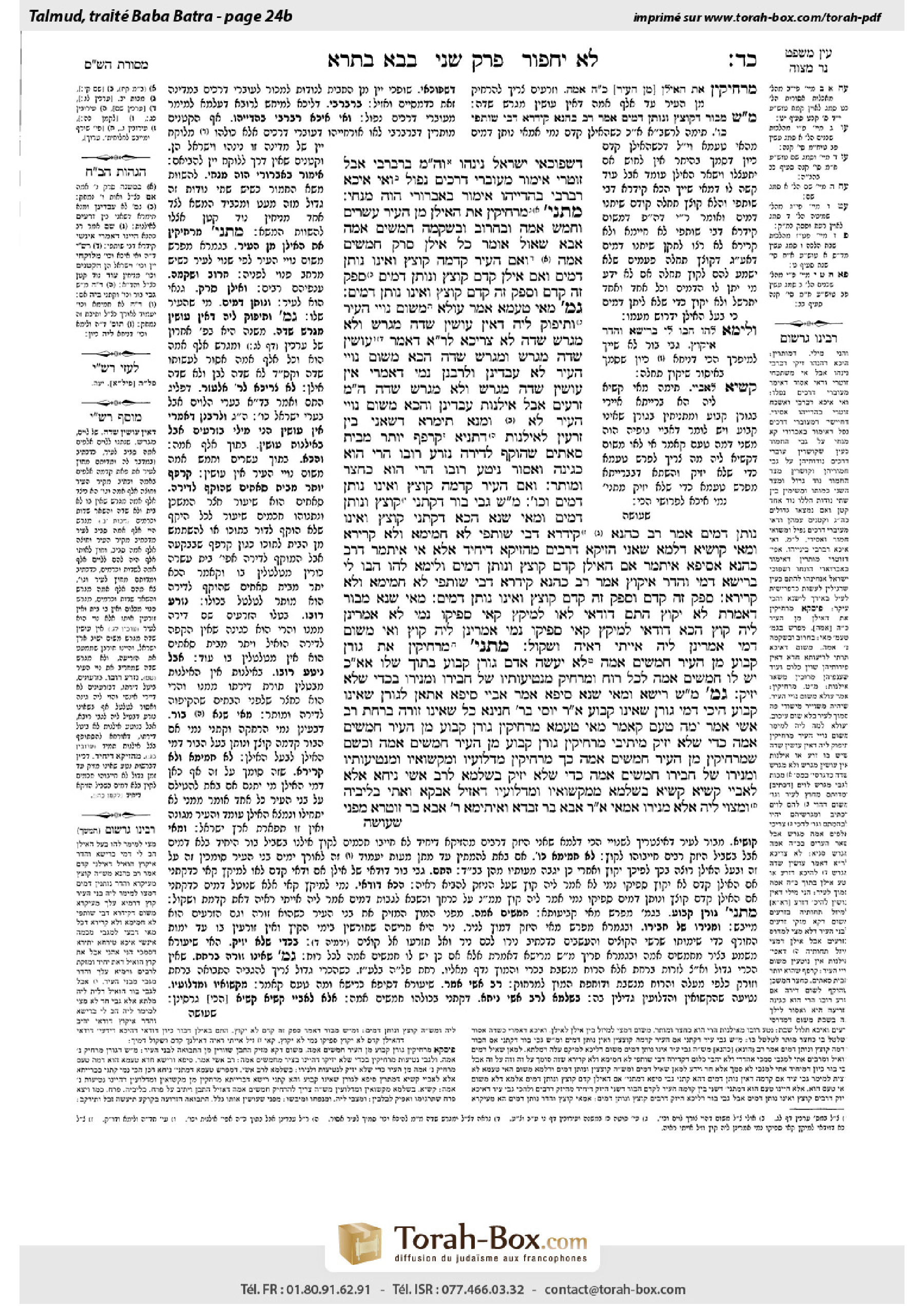
Bava Batra 24b: Talmud study for Daf Yomi
Study the Talmud for Daf Yomi with scanned pages, Hebrew text, English translations from Sefaria and AI-generated French translations.
Passage selection and English or AI-generated French translation are available where the scan has annotations. Daf Study is independent of Torah-Box and Sefaria.
Browse Bava Batra · בבא בתרא · All tractatesBava Batra 24b text and translations
This page of Bava Batra includes the Aramaic text, an English translation and an AI-generated French translation, alongside the scan above.
בבא בתרא כ״ד ב · Aramaic and Hebrew text
דְּשָׁפוֹכָאֵי – יִשְׂרָאֵל נִינְהוּ. וְהָנֵי מִילֵּי בְּרַבְרְבֵי, אֲבָל זוּטְרֵי – אֵימוֹר מֵעוֹבְרֵי דְרָכִים נְפוּל. וְאִי אִיכָּא רַבְרְבֵי בַּהֲדַיְיהוּ – אֵימוֹר בַּאֲבַרְוָרֵי הֲוָה מַנְּחִי.
מַתְנִי׳ מַרְחִיקִין אֶת הָאִילָן מִן הָעִיר עֶשְׂרִים וְחָמֵשׁ אַמָּה, וּבֶחָרוּב וּבַשִּׁקְמָה – חֲמִשִּׁים אַמָּה. אַבָּא שָׁאוּל אוֹמֵר: כׇּל אִילַן סְרָק חֲמִשִּׁים אַמָּה. וְאִם הָעִיר קָדְמָה – קוֹצֵץ, וְאֵינוֹ נוֹתֵן דָּמִים; וְאִם אִילָן קָדַם – קוֹצֵץ, וְנוֹתֵן דָּמִים; סָפֵק זֶה קָדַם וְסָפֵק זֶה קָדַם – קוֹצֵץ, וְאֵינוֹ נוֹתֵן דָּמִים.
גְּמָ׳ מַאי טַעְמָא? אָמַר עוּלָּא: מִשּׁוּם נוֹיֵי הָעִיר. וְתִיפּוֹק לֵיהּ דְּאֵין עוֹשִׂין שָׂדֶה מִגְרָשׁ, וְלֹא מִגְרָשׁ שָׂדֶה!
לָא צְרִיכָא – לְרַבִּי אֶלְעָזָר דְּאָמַר: עוֹשִׂין שָׂדֶה מִגְרָשׁ וּמִגְרָשׁ שָׂדֶה, הָכָא מִשּׁוּם נוֹיֵי הָעִיר לָא עָבְדִינַן.
וּלְרַבָּנַן נָמֵי, דְּאָמְרִי: אֵין עוֹשִׂין שָׂדֶה מִגְרָשׁ וְלֹא מִגְרָשׁ שָׂדֶה – הָנֵי מִילֵּי זְרָעִים, אֲבָל אִילָנוֹת עָבְדִינַן; וְהָכָא מִשּׁוּם נוֹיֵי הָעִיר – לָא.
וּמְנָא תֵּימְרָא דְּשָׁאנֵי בֵּין זְרָעִין לְאִילָנוֹת? דְּתַנְיָא: קַרְפֵּף יוֹתֵר מִבֵּית סָאתַיִם שֶׁהוּקַּף לְדִירָה;
נִזְרַע רוּבּוֹ – הֲרֵי הוּא כְּגִינָּה, וְאָסוּר; נִיטַּע רוּבּוֹ – הֲרֵי הוּא כְּחָצֵר, וּמוּתָּר.
וְאִם הָעִיר קָדְמָה – קוֹצֵץ וְאֵינוֹ נוֹתֵן דָּמִים וְכוּ׳. מַאי שְׁנָא גַּבֵּי בּוֹר, דְּקָתָנֵי – קוֹצֵץ וְנוֹתֵן דָּמִים; וּמַאי שְׁנָא הָכָא, דְּקָתָנֵי: קוֹצֵץ וְאֵינוֹ נוֹתֵן דָּמִים?
אָמַר רַב כָּהֲנָא: קִידְרָא דְּבֵי שׁוּתָּפֵי – לָא חַמִּימָא וְלָא קָרִירָא.
וּמַאי קוּשְׁיָא? דִּלְמָא שָׁאנֵי הֶזֵּיקָא דְּרַבִּים מֵהֶזֵּיקָא דְּיָחִיד!
אֶלָּא אִי אִיתְּמַר דְּרַב כָּהֲנָא, אַסֵּיפָא אִיתְּמַר – אִם הָאִילָן קָדַם, קוֹצֵץ וְנוֹתֵן דָּמִים. וְלֵימָא לְהוּ: הַבוּ לִי בְּרֵישָׁא דְּמֵי, וַהֲדַר אִיקּוֹץ! אָמַר רַב כָּהֲנָא: קִידְרָא דְּבֵי שׁוּתָּפֵי – לָא חַמִּימָא וְלָא קָרִירָא.
סָפֵק זֶה קָדַם וְסָפֵק זֶה קָדַם – קוֹצֵץ וְאֵינוֹ נוֹתֵן דָּמִים. מַאי שְׁנָא מִבּוֹר, דְּאָמְרַתְּ: לֹא יָקוֹץ?
הָתָם – דְּוַדַּאי לָאו לְמִיקַּץ קָאֵי, סְפֵיקוֹ נָמֵי לָא אָמְרִינַן לֵיהּ ״קוֹץ״; הָכָא – דְּוַדַּאי לְמִיקַּץ קָאֵי, סְפֵיקוֹ נָמֵי אָמְרִינַן לֵיהּ ״קוֹץ״. וְאִי מִשּׁוּם דְּמֵי – אָמְרִינַן לֵיהּ: אַיְיתִי רְאָיָה וּשְׁקוֹל.
מַתְנִי׳ מַרְחִיקִין אֶת גּוֹרֶן קָבוּעַ מִן הָעִיר חֲמִשִּׁים אַמָּה. לֹא יַעֲשֶׂה אָדָם גּוֹרֶן קָבוּעַ בְּתוֹךְ שֶׁלּוֹ, אֶלָּא אִם כֵּן יֵשׁ לוֹ חֲמִשִּׁים אַמָּה לְכׇל רוּחַ; וּמַרְחִיק מִנְּטִיעוֹתָיו שֶׁל חֲבֵירוֹ וּמִנִּירוֹ, בִּכְדֵי שֶׁלֹּא יַזִּיק.
גְּמָ׳ מַאי שְׁנָא רֵישָׁא, וּמַאי שְׁנָא סֵיפָא? אָמַר אַבָּיֵי: סֵיפָא אֲתָאן לְגוֹרֶן שֶׁאֵינוֹ קָבוּעַ.
הֵיכִי דָּמֵי גּוֹרֶן שֶׁאֵינוֹ קָבוּעַ? אָמַר רַבִּי יוֹסֵי בְּרַבִּי חֲנִינָא: כׇּל שֶׁאֵינוֹ זוֹרֶה בְּרַחַת.
רַב אָשֵׁי אָמַר: מַה טַּעַם קָאָמַר – מַאי טַעְמָא מַרְחִיקִין גּוֹרֶן קָבוּעַ מִן הָעִיר חֲמִשִּׁים אַמָּה? כְּדֵי שֶׁלֹּא יַזִּיק.
מֵיתִיבִי: מַרְחִיקִין גּוֹרֶן קָבוּעַ מִן הָעִיר, חֲמִשִּׁים אַמָּה. וּכְשֵׁם שֶׁמַּרְחִיקִין מִן הָעִיר חֲמִשִּׁים אַמָּה, כָּךְ מַרְחִיקִין מִדִּלּוּעָיו, וּמִקִּשּׁוּאָיו, וּמִנְּטִיעוֹתָיו, וּמִנִּירוֹ שֶׁל חֲבֵירוֹ – חֲמִשִּׁים אַמָּה, כְּדֵי שֶׁלֹּא יַזִּיק. בִּשְׁלָמָא לְרַב אָשֵׁי – נִיחָא, אֶלָּא לְאַבָּיֵי קַשְׁיָא! קַשְׁיָא.
בִּשְׁלָמָא מִמִּקְשׁוֹאָיו וּמִדְּלוֹעָיו – דְּאָזֵיל אַבְקָא וְאָתֵי בְּלִיבֵּיהּ, וּמְצַוֵּי לֵיהּ; אֶלָּא מִנִּירוֹ – אַמַּאי? אָמַר רַבִּי אַבָּא בַּר זַבְדָּא, וְאִיתֵּימָא רַבִּי אַבָּא בַּר זוּטְרָא: מִפְּנֵי
Bava Batra 24b · English translation
of those who pour wine from barrels into jugs are Jews, and therefore it is reasonable that the wine belongs to a Jew. The Gemara comments: And this matter applies only to large jugs. But if they were small jugs, one can say that they were dropped by travelers, most of whom are gentiles, and therefore the jugs of wine are forbidden. And if there are large jugs among the found jugs, say that they all belong to Jews, as travelers do not usually carry large jugs; it can be assumed that the small ones were placed to balance the donkey’s load, and the jugs all fell together.
MISHNA: One must distance a tree twenty-five cubits from the city, and in the cases of a carob tree and of a sycamore tree, which have a great many branches, they must be distanced fifty cubits. Abba Shaul says: Every barren tree must be distanced fifty cubits. And if the city preceded the tree, as one later planted the tree alongside the city, he cuts down the tree, and the city does not give money to the tree’s owner in compensation. And if the tree preceded the city, which expanded after one planted the tree until it reached the tree, he cuts down the tree and the city gives money to its owner. If it is uncertain whether this one was first or that one was first, he cuts down the tree and the city does not give money.
GEMARA: The Gemara asks: What is the reason that one must distance a tree from a city? Ulla says: It is due to the beauty of the city, as it is unattractive for a city’s walls to be obscured by tree branches. The Gemara suggests: And let him derive this halakha from the statement in tractate Arakhin (33b) that one may neither convert a field of a city into an open area surrounding the city, nor may one convert an open area into a field, as these have fixed places and measurements (see Numbers 35:1–8). If one plants trees in a city’s open area, he thereby turns the open area into a field.
The Gemara answers: No, it is necessary to supply the reason given by Ulla according to the opinion of Rabbi Elazar, who says: One may convert a field into an open area, and an open area into a field. Here, we do not plant trees, due to the beauty of the city.
And according to the opinion of the Rabbis as well, who say that one may not convert a field into an open area, nor convert an open area into a field, one can say that this matter applies only to seeds, i.e., one may not plant seeds in a city’s open area and thereby turn it into a field. But with regard to trees, we do plant them in an open area. But here we do not plant trees, due to the beauty of the city.
And from where do you say, i.e., on what basis do you maintain, that there is a difference between seeds and trees? As it is taught in a baraita that discusses the halakhot of Shabbat: With regard to an enclosure [karpef ] whose area is greater than two beit se’a but that was enclosed from the outset for the purpose of residence, it is permitted to carry within it on Shabbat regardless of its size, as it is considered a private domain.
If subsequently the greater part of it was sown with seed crops, it is considered like a garden, which is not a place of residence, and it is prohibited to carry anything within it on Shabbat. If the greater part of it was planted with trees, it is considered like a courtyard, which is a place of dwelling, and it is permitted to carry there on Shabbat. This shows that planting trees in an enclosure does not transform the area into a field, as is the case when seeds are planted.
§ The mishna teaches: And if the city preceded the tree he cuts down the tree, and the city does not give money. The Gemara asks: What is different with regard to a cistern, that the tanna of another mishna (25b) teaches that if one plants a tree next to a neighbor’s existing cistern, the owner of the tree cuts down the tree and the owner of the cistern gives money; and what is different here that the mishna teaches that the owner of the tree cuts down the tree and the city does not give money?
Rav Kahana said, citing a popular aphorism: A pot belonging to partners is neither hot nor cold, i.e., no one takes responsibility for an item that belongs to several people, as opposed to a single individual. Here too, there is no specific person who will pay for the tree.
The Gemara asks: And what is the difficulty to begin with? Perhaps damage caused to public property is different from damage caused to the property of an individual. Consequently, when one’s tree causes damage to the public he is not compensated for having to cut it down, whereas he does receive payment when his tree damages a private cistern.
Rather, if Rav Kahana’s comment was stated in this context, it was stated about the latter clause: If the tree preceded the city, he cuts down the tree and the city gives money to its owner. Concerning this halakha one could ask: And let the tree owner say to the city residents: Give me money first and then I will cut down the tree. In this context, Rav Kahana said: A pot belonging to partners is neither hot nor cold. If the owner of the tree is entitled to wait until he had first collects money, a good deal of time would pass before the tree would be cut down. Therefore, a community need not collect money and pay immediately, unlike an individual.
§ The mishna teaches that if it is uncertain whether this one was first or that one was first, he cuts down the tree and the city does not give money. The Gemara asks: In what way is this case different from that of a tree alongside a cistern, concerning which you said in the mishna (25b) that in a case of uncertainty the owner of the tree need not cut down the tree?
The Gemara answers: There, if it were a case of certainty the tree would not be subject to being cut down; therefore, in a case of uncertainty too, we do not say to the owner of the tree: Cut it down. In that case, if the tree preceded the cistern, the owner of the tree would not be required to cut it down. Here, if it were a case of certainty, the tree would be subject to being cut down even if it preceded the city, and the only uncertainty is whether or not the owner of the tree would need to be compensated. Consequently, in a case of uncertainty too, we say to the owner of the tree: Cut it down. And if the owner of the tree lodges a claim due to the value of the tree, as he wants compensation for it, we say to him: Bring proof that your tree came first, and take your money. Since he has no proof, he does not receive any money.
MISHNA: One must distance a permanent threshing floor fifty cubits from the city, so that the chaff will not harm the city’s residents. Furthermore, a person should not establish a permanent threshing floor even on his own property unless he has fifty cubits of open space in every direction. And one must distance a threshing floor from the plantings of another and from another’s plowed field far enough that it does not cause damage.
GEMARA: The Gemara asks: What is different in the first clause of the mishna, which states a fixed measurement for the distance of a threshing floor from a city, and what is different in the latter clause, which does not provide a measurement but simply states in general terms: Enough that it does not cause damage? Abaye said: In the latter clause we arrive at the case of a threshing floor that is not permanent. This threshing floor must be far enough from a neighbor that it does not cause damage to his property.
The Gemara asks: What are the circumstances of a threshing floor that is not permanent? Rabbi Yosei, son of Rabbi Ḥanina, says: It refers to any threshing floor where one processes such a small quantity of grain that he does not winnow with a winnowing shovel, but employs some other method that does not scatter the chaff as far. This is one resolution of the contradiction.
Rav Ashi said that the phrase: Enough that it does not cause damage, is not referring to a distance but provides an explanation. In other words, the tanna is saying: What is the reason for the ruling of the first clause, as follows: What is the reason that one must distance a permanent threshing floor fifty cubits from the city? It must be far enough away that it does not cause damage.
The Gemara raises an objection against the opinion of Abaye from a baraita: One must distance a permanent threshing floor fifty cubits from the city; and just as one distances it fifty cubits from the city, so too does one distance it fifty cubits from the gourds, cucumbers, plantings, and plowed field of another, enough that it does not cause damage. Granted, this works out well according to the opinion of Rav Ashi, as he claims that in both clauses the same distance is required: One must move a threshing floor fifty cubits from a plowed field and from those plantings. But according to the explanation of Abaye, it is difficult. The Gemara comments: Indeed, it is difficult.
The Gemara asks with regard to the baraita: Granted, one must distance his threshing floor from his neighbor’s cucumbers and gourds, as the chaff from the threshing floor goes and penetrates into the heart of the flower and dries it out. But why must one distance the threshing floor from another’s plowed field? Rabbi Abba bar Zavda said, and some say it was Rabbi Abba bar Zutra: It is because
Bava Batra 24b · Traduction française (IA)
De ceux qui versent du vin provenant de barriques dans des jarres, ce sont des Juifs, et donc il est raisonnable que le vin appartienne à un Juif. La Guemara commente : Cette affaire s'applique uniquement aux grandes jarres. Mais si ce sont des petites jarres, on peut dire qu'elles ont été laissées par des voyageurs, la plupart étant des non-Juifs, et donc les jarres de vin sont interdites. Et si parmi les jarres trouvées il y a des grandes jarres, on dit qu'elles appartiennent toutes aux Juifs, car les voyageurs ne transportent généralement pas de grandes jarres ; on peut supposer que les petites jarres étaient placées pour équilibrer la charge de l'âne, et que toutes les jarres sont tombées ensemble.
MICHNA : On doit éloigner un arbre à vingt-cinq coudées de la ville, et dans le cas des arbres de caroubier et de sycamore, qui ont beaucoup de branches, on doit les éloigner à cinquante coudées. Abba Shaul dit : Tout arbre sans feuilles doit être éloigné à cinquante coudées. Et si la ville a précédé l'arbre, c'est-à-dire qu'on a planté plus tard l'arbre à côté de la ville, on coupe l'arbre, et la ville ne paie pas à son propriétaire. Et si l'arbre a précédé la ville, qui s'est étendue après que l'arbre ait été planté jusqu'à ce qu'il atteigne l'arbre, on coupe l'arbre et la ville paie à son propriétaire. Si on ne sait pas qui a été le premier, on coupe l'arbre et la ville ne paie pas.
GUEMARA : La Guemara pose la question : Quelle est la raison d'éloigner un arbre de la ville ? Ulla dit : C'est à cause de la beauté de la ville, car il est peu attrayant que les murs de la ville soient obscurcis par les branches des arbres. La Guemara suggère : Et puisqu'on peut déduire cette halakha de la déclaration dans le traité Arakhin (33b) qui dit qu'on ne peut ni convertir un champ de la ville en un espace ouvert autour de la ville, ni convertir un espace ouvert en un champ, car ces espaces ont des lieux et des mesures fixes (voir Nombres 35:1–8). Si on plante des arbres dans un espace ouvert de la ville, on transforme ainsi l'espace ouvert en un champ.
La Guemara répond : Non, il est nécessaire de fournir la raison donnée par Ulla selon l'opinion de Rabbi Elazar, qui dit : On peut convertir un champ en un espace ouvert, et un espace ouvert en un champ. Ici, on ne plante pas d'arbres, à cause de la beauté de la ville.
Et selon l'opinion des Rabbins également, qui disent qu'on ne peut pas convertir un champ en un espace ouvert, ni un espace ouvert en un champ, on peut dire que cette affaire s'applique uniquement aux semences, c'est-à-dire qu'on ne peut pas planter des semences dans un espace ouvert de la ville et ainsi le transformer en un champ. Mais concernant les arbres, on les plante dans un espace ouvert. Mais ici on ne plante pas d'arbres, à cause de la beauté de la ville.
Et d'où dis-tu, c'est-à-dire sur quelle base maintiens-tu que la différence existe entre les semences et les arbres ? Comme il est enseigné dans une baraïta qui discute des halakhot du sabbat : Concernant un enclos [karpef] dont la surface est supérieure à deux beit se'a, mais qui a été enclos dès le départ pour l'habitation, il est permis de porter dedans le sabbat, indépendamment de sa taille, car il est considéré comme un domaine privé.
Si ensuite la plus grande partie a été semée avec des cultures, cela est considéré comme un jardin, qui n'est pas un lieu d'habitation, et il est interdit de porter quelque chose dedans le sabbat. Si la plus grande partie a été plantée d'arbres, cela est considéré comme un cour, qui est un lieu d'habitation, et il est permis de porter dedans le sabbat. Cela montre que planter des arbres dans un enclos ne transforme pas l'aire en un champ, comme c'est le cas lorsqu'on plante des semences.
§ La Michna enseigne : Et si la ville a précédé l'arbre, on coupe l'arbre, et la ville ne paie pas. La Guemara pose la question : Qu'est-ce qui est différent concernant un puits, que la tanna d'une autre Michna (25b) enseigne que si l'on plante un arbre à côté d'un puits existant d'un voisin, le propriétaire de l'arbre coupe l'arbre et le propriétaire du puits paie ; et qu'est-ce qui est différent ici que la Michna enseigne que le propriétaire de l'arbre coupe l'arbre et la ville ne paie pas ?
Rav Kahana a dit, en citant une aphorisme populaire : Une marmite appartenant à des partenaires n'est ni chaude ni froide, c'est-à-dire qu'aucun ne prend la responsabilité d'un objet appartenant à plusieurs personnes, contrairement à un individu unique. Ici aussi, il n'y a pas de personne spécifique qui paiera pour l'arbre.
La Guemara pose la question : Et quelle est la difficulté à commencer ? Peut-être que le dommage causé à la propriété publique est différent du dommage causé à la propriété d'un individu. Ainsi, lorsque l'arbre d'une personne cause un dommage à la propriété publique, il n'est pas indemnisé pour avoir à le couper, tandis qu'il reçoit une compensation lorsqu'il cause un dommage à un puits privé.
Plutôt, si la remarque de Rav Kahana a été faite dans ce contexte, elle a été faite concernant la clause suivante : Si l'arbre a précédé la ville, on coupe l'arbre et la ville paie à son propriétaire. Concernant cette halakha, on pourrait poser la question : Et le propriétaire de l'arbre pourrait dire aux habitants de la ville : Payez-moi d'abord, puis je couperai l'arbre. Dans ce contexte, Rav Kahana a dit : Une marmite appartenant à des partenaires n'est ni chaude ni froide. Si le propriétaire de l'arbre a le droit d'attendre qu'il ait d'abord reçu de l'argent, beaucoup de temps passerait avant que l'arbre ne soit coupé. Par conséquent, une communauté n'a pas besoin de collecter de l'argent et de le payer immédiatement, contrairement à un individu.
§ La mishna enseigne que si on ne sait pas qui a été le premier, on coupe l'arbre et la ville ne paie pas. La Guemara pose la question : De quelle manière ce cas est-il différent de celui d'un arbre à côté d'un puits, concernant lequel vous avez dit dans la mishna (25b) que dans un cas d'incertitude, le propriétaire de l'arbre n'a pas besoin de couper l'arbre ?
La Guemara répond : Là, si c'était un cas de certitude, l'arbre ne serait pas soumis à être abattu ; donc, dans un cas d'incertitude également, nous ne disons pas à l'propriétaire de l'arbre : Découpe-le. Dans ce cas, si l'arbre avait précédé le puits, l'propriétaire de l'arbre ne serait pas tenu de le couper. Ici, si c'était un cas de certitude, l'arbre serait soumis à être abattu même s'il avait précédé la ville, et l'incertitude unique est celle de savoir si l'propriétaire de l'arbre devrait être indemnisé. Par conséquent, dans un cas d'incertitude également, nous disons à l'propriétaire de l'arbre : Découpe-le. Et si l'propriétaire de l'arbre fait une réclamation en raison de la valeur de l'arbre, comme il veut une compensation, nous disons à lui : Apporte une preuve que ton arbre était le premier, et prends ton argent. Puisqu'il n'a pas de preuve, il ne reçoit aucun argent.
MICHNA : On doit distancer un moulin à céréales permanent de cinquante coudées de la ville, afin que la paille ne nuise pas aux habitants de la ville. De plus, une personne ne doit pas établir un moulin à céréales permanent même sur sa propre propriété, sauf s'il possède cinquante coudées d'espace ouvert dans toutes les directions. Et on doit distancer un moulin à céréales des plantations d'autrui et des champs labourés d'autrui suffisamment pour qu'il ne cause pas de dommage.
GUEMARA : La Guemara pose la question : Qu'est-ce qui diffère dans la première clause de la mishna, qui indique une mesure fixe pour la distance d'un moulin à céréales de la ville, et qu'est-ce qui diffère dans la dernière clause, qui ne fournit pas de mesure mais indique simplement de manière générale : Suffisamment pour ne pas causer de dommage ? Abaye dit : Dans la dernière clause, nous arrivons au cas d'un moulin à céréales qui n'est pas permanent. Ce moulin à céréales doit être suffisamment éloigné d'un voisin pour ne pas causer de dommage à sa propriété.
La Guemara pose la question : Quelles sont les circonstances d'un terrain de battage qui n'est pas permanent ? Rabbi Yosei, fils de Rabbi Ḥanina, dit : Il s'agit de tout terrain de battage où l'on traite une quantité si petite de céréales qu'on ne sépare pas la paille avec une pelle à paille, mais on utilise une autre méthode qui ne projette pas la paille aussi loin. C'est une résolution de la contradiction.
Rav Ashi dit que la phrase : Suffisamment pour ne pas causer de dommage, ne fait pas référence à une distance mais fournit une explication. En d'autres termes, le tanna dit : Quel est le motif de la décision de la première clause, comme suit : Quel est le motif de ce que l'on doit distancer un terrain de battage permanent de cinquante coudées de la ville ? Il doit être suffisamment éloigné pour ne pas causer de dommage.
La Guemara soulève un objection contre l'opinion d'Abaye, à partir d'une baraïta : On doit distancer un terrain de battage permanent de cinquante coudées de la ville ; et comme on distancie de cinquante coudées de la ville, ainsi aussi on distancie de cinquante coudées des melons, des concombres, des plantations et des champs labourés d'autrui, suffisamment pour ne pas causer de dommage. Cela s'adapte bien selon l'opinion de Rav Ashi, car il affirme que dans les deux clauses la même distance est requise : On doit déplacer un terrain de battage de cinquante coudées d'un champ labouré et des plantations d'autrui. Mais selon l'explication d'Abaye, cela est difficile. La Guemara commente : En effet, cela est difficile.
La Guemara pose la question concernant la baraïta : Cela est admis, on doit distancer son moulin à céréales de ceux des melons et concombres d'autrui, car la paille du moulin à céréales va et pénètre dans le cœur de la fleur et le dessèche. Mais pourquoi doit-on distancer le moulin à céréales d'un autre champ labouré ? Rabbi Abba bar Zavda a dit, et certains disent que c'était Rabbi Abba bar Zutra : C'est parce que
Traduction française générée par IA à partir de l’édition anglaise de Sefaria. Vérifie toujours un passage avec le texte source.
Text from Sefaria: William Davidson Edition - Vocalized Aramaic (CC BY NC); William Davidson Edition - English (CC BY NC).